Mining residue a threat to foothills town

By Edward Ortiz, Sacramento Bee

In the Gold Rush-era foothills community of Jackson, the worst-case scenario painted by the Environmental Protection Agency last year about a 100-year-old dam there held a chilling warning.

In a scant two minutes, a breach at the Eastwood Multiple Arch Dam would send a 15-foot-deep mudflow with high levels of arsenic and other toxic chemicals downhill into the center of the historic community. On the way down, the mudflow would pass the entrance to Jackson Junior High School and nearby residences.

The weathered 100-year-old concrete dam is built on the former Argonaut mine roughly a mile north of the town and is so unstable that a big storm or an earthquake could lead to a breach, according to the EPA and the Army Corps of Engineers. The result: millions of dollars of property damage and loss of life, with Jackson Creek and the city’s sewage system contaminated.


The agency has also put the Argonaut mine on a shortlist of eight sites across the U.S. for possible listing as a Superfund project.

Read the whole story


Colo. tourists may be able to buy as much pot as residents

By Associated Press

Colorado’s tourists would be able to buy as much marijuana as residents if a bill moving through the Legislature passes.

The measure repeals Colorado’s unique-in-the-nation tiered purchasing system for marijuana. All adults over 21 are allowed to possess an ounce of marijuana — but retail pot shops can’t sell more than a quarter-ounce in one day to people without Colorado identification.

The purchasing limits were established in 2013 to prevent marijuana diversion out of state.

Colorado pot regulators now say that tourists carrying small amounts of pot home aren’t the state’s main marijuana-diversion problem.

Instead, state regulators and local law enforcement point to underground pot growers as the most likely source of sending pot to states where the drug isn’t legal.

Colorado’s Marijuana Enforcement Division, which oversees pot shops, has never cited a retailer for selling a tourist more than a quarter-ounce of pot.

But the industry fears that new possession limits on concentrated and edible pot due to take effect this fall would make it harder for retailers to keep track. That’s because the new rules don’t consider leafy pot amounts to be the same as, say, pot brownies or hash oil or a skin lotion infused with marijuana’s active ingredient.

“We’d have to hire math professors to work in the dispensaries” to keep track of purchasing limits, said Mark Slaugh, head of the Colorado Cannabis Business Alliance.

Removal of the tiered purchase limits is part of a routine renewal of Colorado’s pot regulations. That renewal has passed the state House and is awaiting approval in the state Senate, where an initial committee approved the change Wednesday.


Could you come up with $400 if disaster struck?

By NPR

If a financial emergency struck — say, a health problem or a car that needed repair — would you be able to come up with $400? According to the Federal Reserve Board, 47 percent of Americans would have trouble paying it — they would have to sell something, borrow money or simply couldn’t pay.

And this is true even for people who consider themselves middle class. Neal Gabler is one of them. He’s a successful writer with five books under his belt, and he’s a visiting professor at the State University of New York, Stony Brook. But in a new article in he Atlantic, he admits to having “financial impotence”:

“I know what it is like to have to juggle creditors to make it through a week. I know what it is like to have to swallow my pride and constantly dun people to pay me so that I can pay others. I know what it is like to have liens slapped on me and to have my bank account levied by creditors. I know what it is like to be down to my last $5 — literally — while I wait for a paycheck to arrive, and I know what it is like to subsist for days on a diet of eggs. And I know what it is like to have to borrow money from my adult daughters because my wife and I ran out of heating oil,” Gabler said.

Read the whole story


UNR, UNLV differ on punishment for cheaters

By Sally Ho, AP

Leaders at the two major universities in Nevada don’t seem to agree on how to dish out punishment equally and consistently among cheating students.

Patricia Ellison, a biochemistry professor at UNR who is chair of the Faculty Senate’s academic standards committee, said the school lacks consistency in handling cases with such gray areas.

Ellison is among the elected leaders representing the UNR faculty who have now proposed a plan to create a “sliding scale” of consequences that would be in line with the severity of the offense. She said there also needs to be a uniform reporting process and the Reno professors are urging for an online system to make it easier to report cases.

Not all professors report possible cheats because the current letter-writing system can be cumbersome, Ellison said. Sanctions within the classroom — ranging from a do-over on an assignment to failing the entire course — are typically determined by the individual instructors without full guidance to ensure the punishment is even-handed and evenly applied.

“What we really want is consistent penalties,” Ellison said. “We can’t possibly catch every case. We catch as many as we can and should be consistent with what we do about it.”

UNR, which has 21,000 students and 5,200 faculty staff members, said it had 122 confirmed cases of academic misconduct out of the 135 reports filed in the 2014-2015 school year.

In the same time frame, UNLV, which has 28,600 students and about 950 instructors, had 287 cases of confirmed academic misconduct among the over 300 cases reported. UNLV already has an online reporting process.

Officials said plagiarism is a common mistake students can make. They may simply lack the skills to properly cite a source of information. They may also misunderstand the parameters of an assignment and error by working in groups with classmates.

And when it comes to the most severe cases of cheating involving not just mistakes but intentional dishonesty, both UNR and UNLV say it’s extremely rare that a student cheats repeatedly or egregiously. Beyond the classroom, the universities can also impose disciplinary action as severe as suspension or expulsion, though UNR said it’s never expelled anyone over academic misconduct.

Phil Burns, director of the office of student conduct at the Southern Nevada school, said UNLV has had to expel students but it’s uncommon, with fewer than 10 cases in recent memory.

UNLV also doesn’t have full guidelines dictating how a student should be sanctioned within the classroom for each particular offense. Burns said he doesn’t believe in a “cookie-cutter” approach because each student and set of circumstances should be weighed individually.

“We’re all human. We all make mistakes,” Burns said. “If this job was about punishment, I wouldn’t do it.”


Samba TV expanding to Incline Village

By Jason Hidalgo, Reno Gazette-Journal

A technology company backed by Dallas Mavericks owner and Shark Tank regular Mark Cuban is expanding to Lake Tahoe.

San Francisco-based Samba TV announced Thursday that it is opening a facility in Incline Village, bringing 30 jobs to the greater Reno-Tahoe area.

Samba TV is part of the Smart TV movement, specializing in real-time TV analytics and providing consumers with an interactive television viewing experience. In addition to Cuban, investors of the company include Rackspace founder Richard Yoo and entrepreneur Tom McInerney.

Read the whole story


Drug prices keep rising despite criticism

By Katie Thomas, New York Times

From the campaign trail to the halls of Congress, drug makers have spent much of the last year enduring withering criticism over the rising cost of drugs.

It doesn’t seem to be working.

In April alone, Johnson & Johnson raised its prices on several top-selling products, including the leukemia drug Imbruvica, the diabetes treatment Invokana, and Xarelto, an anti-clotting drug, according to a research note published last week by an analyst for Leerink, an investment bank. Other major companies that have raised prices this year include Amgen, Gilead and Celgene, the analyst reported.

Makers have raised prices on brand-name drugs by double-digit percentages since the start of the year, according to interviews with executives at Express Scripts and CVS Caremark, two major drug-benefit managers. And a report last week by the research firm IMS Health found that in 2015, list prices for drugs increased more than 12 percent, in line with the trend over the five previous years.

Read the whole story


Couple wins dispute to build in Angora area

Ray Burns and Teresa Avila-Burns will be able to build in the Angora burn area. Photo/Provided

Ray Burns and Teresa Avila-Burns will be able to build in the Angora burn area. Photo/Provided

By Kathryn Reed

A Bay Area couple learned the hard way that buying a vacant lot in Lake Tahoe does not automatically mean one gets to build on it.

Although, in the disclosure forms of the sale it was noted that the property was partially in a stream environmental zone.

“Prior to their purchase, a house on the property burned down in the Angora Fire, and the prior owner did not rebank his/her right to rebuild the home in time, so the automatic right to rebuild on this property was lost,” Tom Lotshaw with the Tahoe Regional Planning Agency told Lake Tahoe News. “After their purchase, this couple had an option to get a buildable IPES score for the property, but for some reason, we don’t know why, they chose to get a zero – nonbuildable — score, and then sue TRPA.”

IPES stands for individual parcel evaluation system. This is something the bi-state regulatory agency came up with to decide how much of a lot could be covered and which parts of it could be developed.

Teresa Avila-Burns and Ray Burns bought the foreclosed lot in the Angora burn area for $5,000. In December, they filed the lawsuit. The couple enlisted the Pacific Legal Foundation to fight in court for their right to build on the El Dorado County parcel.

The settlement reached this month allows for about 3,100 square feet to be eligible for development. One area is off-limits because of the SEZ.

TRPA said if the couple asked for an IPES score at the get-go, there would have been no need for a lawsuit.

The couple’s lawyer said it wasn’t quite that simple.

“Before turning to PLF for help, Ray and Teresa had wrangled with the regulators for years,” Christopher Kieser attorney for PLF, said in a statement. “Now, faced with being hauled before a court, TRPA is finally recognizing this couple’s fundamental rights, so they can finally move ahead with their dream to build a Lake Tahoe home for their elderly mothers.”


Placer County selling 3 Kings Beach parcels

Placer County is offering three development opportunities in Kings Beach on parcels that used to be owned by the Redevelopment Agency.

The three properties are being offered separately, though it is possible for a developer to combine them into a single related or compatible project.

The 1.3 acre Eastern Gateway property is located on North Lake Boulevard (Highway 28) at the southwest corner intersection of North Lake Boulevard and Chipmunk Street. The property consists of 10 contiguous parcels.

The Kings Beach Center property is located on North Lake Boulevard across the street from the Kings Beach State Recreation Area. The property is approximately 3.5 acres consisting of 16 parcels.

The Town Center South property is also located on North Lake Boulevard. The property is approximately 0.9 acres, four contiguous parcels.

Interested parties have until June 29 to submit letters. Details are online.


Tahoe Keys struggles to manage invasive weeds

Milfoil was first discovered in the Tahoe Keys in the 1980s and curly pondweed in 2003. Photo/LTN

Milfoil was first discovered in the Tahoe Keys in the 1980s and curlyleaf pondweed in 2003. Photo/LTN

By Kathryn Reed

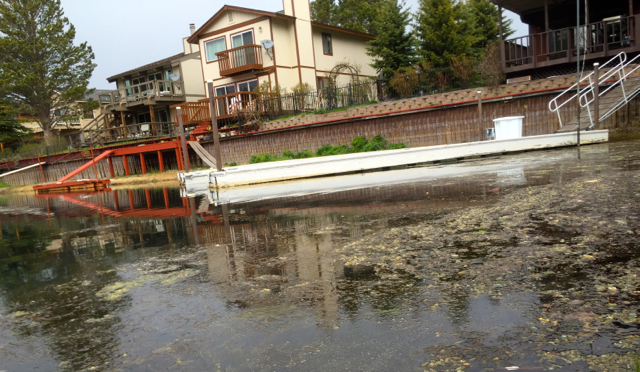
STATELINE – In less than a year, the Tahoe Keys Property Owners Association has started to backpedal when it comes to being adamant herbicides are the only way to rid the South Lake Tahoe canals of invasive weeds.

At the Tahoe Regional Planning Agency Governing Board meeting this week representatives of the housing development shared that field demonstrations will be conducted this summer with the goal of having a long-term solution in place for 2017. The TKPOA board two weeks ago allocated $250,000 for this summer’s work.

The Keys is the No. 1 source for invasive weeds, with Eurasian milfoil, curlyleaf pondweed and coontail being the most predominant. The weeds affect 90 percent of the lagoons.

At a meeting last August the solution was herbicides.

What has slowed down that potential reality is the number of comments to the draft Integrated Management Plan for Aquatic Invasive Weeds. Many people want other alternatives to be investigated. And while killing the weeds with ultraviolet light was pooh-poohed by authorities at last summer’s meeting, that is no longer the case.

John J. Paoluccio, president of Inventive Resources Inc., was in town last fall to demonstrate how UV light works. People were impressed. So much so that either the Keys or Lakeside Marina is likely to be a testing ground this year.

The Keys also plans to use herbicides in a test situation in isolated tanks on land. This will show how the plants respond to different chemicals.

Before any herbicide could be used in the lake the Lahontan Regional Water Quality Control Board would need to sign off on it. That board has already said the idea of limited use of herbicides on a case-by-case basis would be taken under consideration.

There are 10-deadend lagoons. Those would likely be the first to receive herbicide.

Dye is going to be put into the mouth of the Keys’ two entrance points to see where the current takes it and how fast. This relates to what would happen if an herbicide were used. Dye was used farther back in the canals last year as a test, with the colored water not moving far.

One Governing Board member asked if native species would be harmed. The answer – they shouldn’t be.

While harvesting the weeds is considered a nuisance in some ways because particles are spread and it never solves the problem, tweaking the process may have different results. A fragment capture boat will be deployed to scoop up the remnants. GPS tracking and paying better attention to the wind are other changes.

A water circulation mechanism was installed when the Keys was built in the late 1960s. It has not been used for a couple decades. TKPOA is going to see what it would take to get it operational again.

Another board member asked about the possibility of closing off the two main channels to be able to isolate the Keys in order to deal with the weed problem. While tidal gates exist, a big problem is there is boat traffic year-round. A bigger problem is that the three owners involved with the waterways in the Keys are not all on the same page.

TKPOA and Beach and Harbor Association are in agreement about things that need to be done. The owners of the marina are not cooperating, according to TKPOA and TRPA officials. Because the marina has a different type of permit than the homeowners, there is only so much pressure that can be applied.




Sanchez: Relaxing species law ‘on the table’ to help state

By Christopher Cadelago, Sacramento Bee

Loretta Sanchez

Loretta Sanchez

Democratic Rep. Loretta Sanchez, campaigning for U.S. Senate, said Tuesday that she would consider amending the federal law governing endangered species to help improve the water supply across the parched state of California.

To help address the drought, Sanchez said she wants to take a broader approach that calls for continued conservation measures, increased storage sites and the construction of Gov. Jerry Brown’s twin Delta tunnels project to move water south. Asked whether the Endangered Species Act should be looked at, Sanchez said yes.

“Everything needs to be on the table when we go in to find a solution,” Sanchez told the editorial boards of McClatchy Newspapers at a meeting in Fresno.

Read the whole story