Threat of fire ignites concern in Tahoe basin

Wildfire Awareness Week runs from May 26 to June 3. Photo/Susan Wood

Wildfire Awareness Week in the basin runs from May 26 to June 3. Photo/Susan Wood

By Susan Wood

The Lake Tahoe Basin Management Unit expects to get the Super Scooper fire-specific aircraft staged here again for good reason – California and Nevada are not out of the woods when it comes to experiencing another bad fire season.

That’s the word from a number of fire agencies that protect the basin and Sierra Nevada Mountain Range every year. Just because Mother Nature provided a better, closer-to-normal winter, the moisture windfall fails to make up for four years of drought.

The shrubs, brush and small trees known in fire circles as ladder fuel to the tall pine trees do not have enough moisture in them to keep from going up in flames from a carelessly-discarded cigarette butt or neglected campfire or lightning.

The other concern is just as devastating. The trees are getting eaten alive by bark beetles. Clumps of trees in groves all around the lake are dead, have snapped limbs and in many cases fallen to the ground. These dead and dying trees are brittle-bone dry, making them susceptible to erupting with any type of combustible.

Then, there’s the double dilemma. The plants and trees are either dry from drought or the rain and snow have created more of them, hence providing additional fuel on the ground.

“We can’t win with nature on that one,” LTBMU acting Fire Management Officer Steve Burns told Lake Tahoe News.

With this multiple threat, the U.S. Forest Service isn’t messing around with beefing up its resources – given the federal agency consumed half its budget last year fighting fires.

The Tahoe arm of the agency plans to be fully staffed with four engines, one hot shots 20-person crew, two 20-person hand crews on call and four prevention officers.

“We’ll be at a maximum efficiency level,” Burns said.

About the only saving grace in Burns’ eyes lies in the water level of the reservoirs in case of fire breaking out.

“It’s hard to predict what the season could bring. It’s warm and dry,” Burns said. “The one thing in California is trees are dying at an unprecedented rate. That has got CalFire and us and other groups looking at that.”

Tree mortality in the basin adds to fire concerns. Photo/Susan Wood

Tree mortality in the basin adds to fire concerns. Photo/Susan Wood

Being smarter

The Forest Service will begin aerial surveys to look at the tree mortality – now standing at a record high of 27.6 million trees. Aerial Survey Program Manager Jeffrey Moore discovered about 10 times more dead trees than previously recorded.

Patricia Maloney, U.C. Davis Department of Plant Pathology and Tahoe Environmental Research Center forest ecologist and conservation biologist, is talking at Sierra Nevada College on May 10 about her studies in tree species disturbances. It’s slated for 6pm.

Even private business has brought assistance. PG&E has awarded $2 million to California Fire Safe Councils to reduce the increased risk given the massive tree mortality.

Historically, wind has sparked the worst fires consuming forest and homes such as the arson-sparked King Fire near Pollock Pines.

“The rain has been great, but no amount will bring back the trees that have died to the drought and bark beetle,” said Brice Bennett, CalFire spokesman for the Amador El Dorado Unit.

Stationed in Cameron Park, Bennett knows all too well what fire can do – especially in high-wind situations.

Last year alone churned out the worst wildfire season in history for the West from Alaska to Lake County.

Tahoe has endured its fair share as well. Take the devastating Angora Fire in 2007, which burned 254 houses.

What worries many fire officials is the threat of more wind with climate change. Most climatologists predict more storms, meaning wind and lightning strikes may become more prevalent.

Fire agency officials insist they need help more than ever before. With that, CalFire has $3 million in grant funding for a variety of fire prevention projects aimed at reducing the elevated threat due to ongoing drought and significant tree mortality.

“This grant funding will help communities prepare for what is likely to be another challenging fire season,” said Chief Ken Pimlott, CalFire director and state forester.

And with that, fire agencies are becoming more organized, more methodical and more scientific than ever before. Some have turned to the study of science. Some have thrown more types of resources into the firefighting mix. Many have turned to each other – hence the formation of the Tahoe Fire and Fuels Team, a collaboration of 17 member agencies sharing notes at monthly meetings in fire season.

There’s even the “Firepit,” a public information team.

It’s a war, and these soldiers with water and retardant are determined to win it.

But many agencies on both sides of the state line are urging homeowners to help.
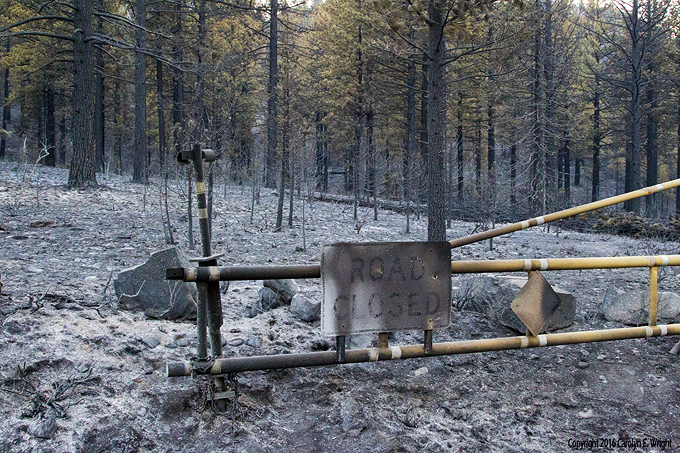
The lightning-induced Washington Fire that threatened Markleeville was the closest fire to the basin in 2015. Photo Copyright 2016 Carolyn E. Wright

The lightning-induced 2015 Washington Fire threatend to burn Markleeville. Photo Copyright 2016 Carolyn E. Wright

Not the time for awareness to smolder

Tahoe Douglas Fire Protection District officials are concerned there’s complacency among homeowners regarding the work necessary to keep their houses and loved ones protected.

For instance, the phones rang off the hook at the district after the Angora Fire to use the chipper to grind up wood debris, thus coaxing residents to clean up their yards. Now the phone barely rings.

It’s advised to provide a 100-foot buffer around structures. In some cases – namely Kingsbury Grade for example, Tahoe Douglas Fire experts expand the defensible space directive to 300 feet.

The cheat grass brought on by ample precipitation is expected to be a prominent threat to Nevada residents because of an ample amount of precipitation. Like manzanita, firefighters consider cheat grass primary fuel for fast-spreading wildfires. It blankets Spooner Summit and Kingsbury Grade.

The sun dries the Grade in the morning and cooks in the afternoon. So the district has been out thinning the area.

“Every day could be dangerous,” Tahoe Douglas Fire Marshal Eric Guevin said while scoping out the fire hazard on the Grade with district Forester John Pickett.

They stood in awe as the sun was setting feet from a house at the end of Bonnie Court at the notion of a major wildfire happening there. There’s a level of respect for the arch enemy, and Pickett talks about it with a lot of energy.

Despite all the work the homeowner did to the property, the topography is a bit of a challenge.

“We have our red flag days, and we’re definitely concerned. We can’t change the topography and the weather, but we can change the conditions,” Guevin told Lake Tahoe News.

“If anything starts at Van Sickle, it will be here in an hour,” Pickett said, motioning with his arm in the path of a chimney leading up to the cul-de-sac. The prevailing winds on a western facing slope are “by far the most dangerous.”

The air draft would pull the fire up like it’s ascending a chimney.

And worse yet, the fire doesn’t have to reach a neighborhood to consume it. The wind often pitches ahead embers that often land on roofs. During the Angora Fire, embers were reported to have landed as far away as Lake Tahoe Community College.
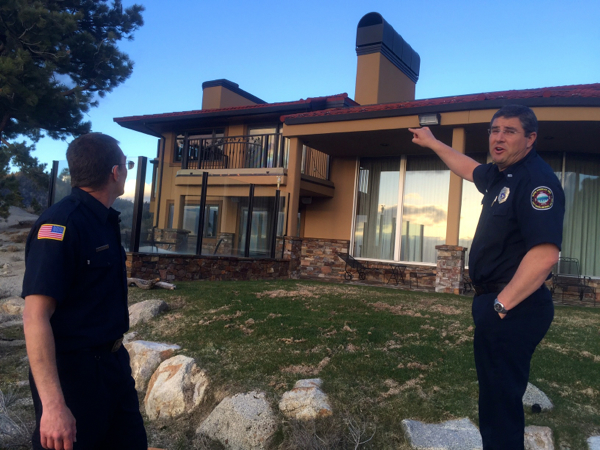
John Pickett and Eric Guevin with Tahoe Douglas Fire point out a home on Kingsbury Grade with good defensible space. Photo/Susan Wood

John Pickett and Eric Guevin with Tahoe Douglas Fire point out a home on Kingsbury Grade with good defensible space. Photo/Susan Wood

It takes a village

Sometimes homeowners can do all they can but have neighbors who are negligent.

“We can defend this house,” Pickett said, while roaming around a home at 100 Granite Crest Drive. The duo even noticed the homeowner had sealed the chimney and commended the resident.

“This is defendable, but in a dangerous neighborhood,” Pickett said.

Farther down, the forester pointed out a house with a shake roof, pine needles everywhere and tree limbs touching the house.

This is why Guevin and Pickett stressed the importance of all in a neighborhood to participate. There are even community work days sponsored by Tahoe Douglas in which clearing brush and limbing trees is done for free.

Guevin reported the district sits at 70 percent compliance in fire prevention and wants to see that number go up.

Pickett commended residents for being diligent about calling at every puff of smoke. Although signs have to be put out telling people not to call during control burns, Pickett welcomes the activism.

“People are doing a great job of being vigilant because the consequences are too high,” he said.

The bark beetle and drought are raising havoc with the trees, and he’s counting on residents to be just as diligent about ridding the beetle infestation if they can.

Homeowners may call pest control to inject the tree if they see color shift in the needles to a yellow-grey, but this is expensive and not always effective. If branches die at mid-crown, that’s also a sign of the bark beetle consuming a tree.

“It’s not if, it’s when, and we have got to be ready for it. That’s our responsibility of living in this great environment,” Guevin said, as if rallying troops before the next fire.
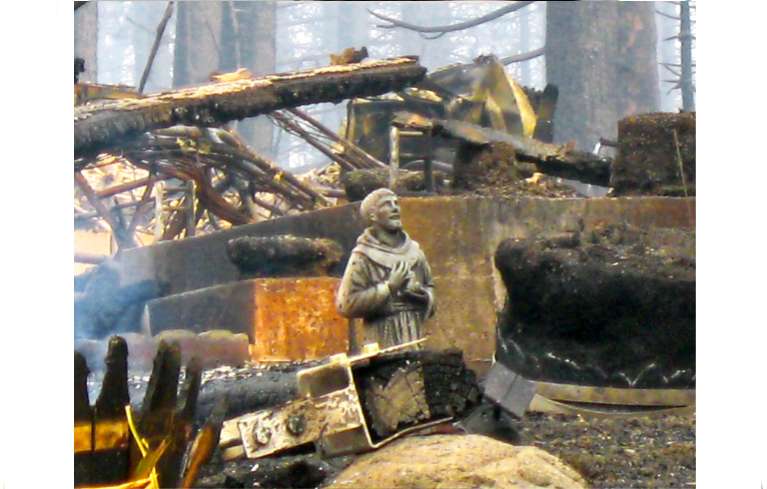
In 2007, 254 houses burned and bout 3,100 acres -- mostly USFS land -- on the South Shore of Lake Tahoe. Photo/Lake Valley Fire

In 2007, 254 houses were destroyed and about 3,100 acres — mostly USFS land — burned on the South Shore of Lake Tahoe. Photo/Lake Valley Fire

Fire knows no boundaries

Lake Valley Fire Protection District has its own areas of concern. Its focus in thinning projects revolves around the Meyers community off Pioneer Trail, with a close inspection of the heavily wooded Apache and Mandan pockets of the neighborhood.

The concern has become so serious the district is considering a new level of enforcement beyond inspections and warnings to negligent violators. But for now, education is a nice way of saying we’re all in this together.

The individual private vacant lots have prompted an extra level of concern given the property owners may be miles away and not present to see the fire threat every day.

“One good winter won’t erase … years of drought,” Martin Goldberg of Lake Valley Fire told Lake Tahoe News.

And the heightened awareness and anxiety isn’t limited to the more  sparsely populated areas – especially since there’s an increase in property owners building out in the forests.

“Some people are building homes in fire prone spots. It changes the way we fight fires, when we’re having to send more resources in to protect these homes,” said Mike Taormina, South Lake Tahoe fire wildland operations coordinator.

A good example would be South Lake Tahoe’s Needle Peak-Saddle Road neighborhood, whose residents watched in horror when a discarded cigarette from a Heavenly gondola car sparked a wildfire and gave chills to city residents in 2002. It roared up the east ridge from what’s now the Van Sickle Bi-State Park. Before it did, though, this reporter witnessed the wind swirl the fire toward the town.

That was as much a reality check as the Angora Fire’s back blaze that hopped over Highway 89.

“It all comes down to having a plan with pro-active thinning. We’re coming to a time when the fire season is getting longer. In Southern California, it’s year round. Obviously, we’re worried about it even though we got precipitation. But we’ve been in a sustained drought. It’s going to take time for the fuels to recover and for the fuels moisture to come back up,” Taormina warned. “Especially where we live, it’s not something to take lightly.”



Global obesity is on the rise

By John Tozzi and Jeremy Scott Diamond, Bloomberg

Humanity is putting on weight. Across the globe, in wealthy countries and developing nations, among children and adults, an increasing number of people are overweight or obese.

Today, nearly 40 percent of the world’s adults fall into one of those categories, according to estimates by a global network of researchers called the NCD Risk Factor Collaboration.

Economic forces are conspiring to cause the great global weight gain. Countries grow wealthier and increase consumption. People move from rural areas to cities, where they have ready access to inexpensive, processed foods. Machines do work that humans once did, decreasing the amount of energy people use.

And global trade means the reach of junk food has never been greater. Up against these trends, no country has figured out how to reverse the rise of obesity.

Read the whole story


Delta resumes nonstop Reno-Atlanta flights

By Jason Hidalgo, Reno Gazette-Journal

It’s baaaaack.

Reno-Tahoe International Airport announced on Friday that Delta Air Lines is bringing back nonstop service between the Biggest Little City and Atlanta.

The airport definitely had Georgia in its mind as the announcement was made amid a backdrop of sweet tea, peaches and musicians playing Dixieland music. Andy Wirth, chairman of the Airport Board of Trustees, called the return of non-stop flights to the world’s busiest airport a big deal, adding that Atlanta is the gateway to the South.

Read the whole story


Calif. to give counties extra cash for election costs

By Jim Miller, Sacramento Bee

Gov. Jerry Brown signed legislation Friday that directs $16.29 million to counties to help pay for expected high turnout in the June 7 presidential primary and to process a coming deluge of petitions from groups seeking to qualify November ballot measures, including one championed by the Democratic governor.

Assembly Bill 120’s signing comes a few weeks after Secretary of State Alex Padilla alerted Brown to a “surge” of voter interest in the June election because of the high-profile Republican presidential primary.

As they plan for that, county election officials face the prospect of trying to verifying as many as 9.4 million petition signatures, Padilla wrote the governor.

Read the whole story


4 people accused of selling alcohol to minors

Four workers in South Lake Tahoe were cited Friday for allegedly selling alcohol to minors. The minor decoy operation on April 29 was under the direct supervision of officers. The youths attempted to purchase alcohol from 10 retail licensees in the city.

Cited were Nathaniel Asavedo at Safeway Gas, Transito Martinez at Chevron Gas, Shearon Cullins at Whiskey Dicks and Ricardo Espino at Chevy’s restaurant.

They face a minimum fine of $250, and/or 24 to 32 hours of community service for a first violation. In addition, ABC could take administrative action against the alcoholic beverage license of the business. That may include a fine, a suspension of the license, or the permanent revocation of the license.

— Lake Tahoe News staff report


Amodei says group miscast him among anti-parks gang

By Benjamin Spillman, Reno Gazette-Journal

A Congressman whose district covers huge swaths of public land in Northern Nevada says he doesn’t deserve to be lumped in with 19 other lawmakers accused of driving an anti-parks agenda.

Rep. Mark Amodei, R-Carson City, was one of two federal lawmakers from the Silver State the Center for American Progress, a progressive group, identified as Congress’ “Anti-parks caucus.”

Rep. Cresent Hardy, R-Mesquite, was the other Nevadan on the list. Hardy spokesman Jacob Fullmer said Hardy also objected to being labeled anti-public land.

The report, titled “The Rise to Power of the Congressional Anti-parks Caucus,” seeks to tie votes and statements from 20 Republican members of the House of Representatives and Senate to actions by Nevada rancher Cliven Bundy and his sons, Ryan and Ammon Bundy.

Read the whole story


Commerce tax repeal before Nevada Supreme Court

By Michelle Rindels, AP

A high-stakes battle over a new business tax passed last year by the Nevada Legislature is heading to the Nevada Supreme Court today.

Justices will consider the fate of a proposed ballot measure to repeal the commerce tax, which applies to businesses that make more than $4 million each year in Nevada revenue. A Carson City judge ruled a few months ago that the petition language passes legal muster, clearing the way for supporters to gather the more than 55,000 signatures they’ll need to qualify it for the November ballot.

“I think we’ll pass with flying colors,” said Nevada state Controller Ron Knecht, a Republican who’s leading the charge against the tax.

But while he’s bullish on the petition’s chances of surviving the court appeal, an all-volunteer signature-gathering effort is another story. With a June 21 deadline approaching, Knecht said, the “RIP Commerce Tax” petition had about 20,000 signatures, and not all signatures are expected to pass a verification stage.

While the effort has traction in rural counties, Knecht said it’s having more trouble in the urban areas. That could be fatal for the petition because more than 13,000 signatures must be gathered from each of the four congressional districts — two of which are entirely contained within urban Clark County.

“We’ve done just awesomely well in the other 15 counties,” Knecht said. “We’ve had some organization in Washoe and Clark. We’re focusing on turning that into a juggernaut in the next few weeks.”

Knecht argues that the Republican-led Legislature went against the will of the voters when it approved a $1.4 billion tax package last spring, less than a year after Nevadans overwhelmingly rejected a ballot measure imposing a margins tax. But Gov. Brian Sandoval and casino executives who opposed the tax on the ballot lined up in favor of the commerce tax during the legislative session, saying it’s more nuanced and much smaller than the margins tax.

Sandoval presented the tax package as a way to fund targeted improvements to the state’s dismally ranked public school system. Economic development officials testified that businesses that were otherwise attracted to Nevada wouldn’t relocate to the state because of its schools.

“There is no doubt that what happens in our schools today will determine the future of Nevada,” Sandoval said. “That is why a supermajority of the Legislature and I made a generational investment in the children of Nevada.”

The commerce tax brings in about $60 million a year when offsets are counted. It’s the smallest part of the three-pronged tax package, which included more lucrative moves such as raising a payroll tax rate and permanently extending temporary taxes.

Knecht said the state will hardly miss the money if the tax goes away. Sandoval said schools are already counting on the money and axing it could defund new initiatives including autism therapy, an all-day kindergarten expansion and career training programs.

“It’s about time the Controller looked a child or parent in the eyes and justify the devastating cuts to Nevada’s schools he seeks to implement through his petition,” the governor said.

The effort to preserve the tax has more financial firepower, reporting more than $242,000 at the end of last year. Funders include major casinos, who are subject to the commerce tax but see it as a more palatable tax than other alternatives.

RIP Commerce Tax reported raising about $13,000 last year, including donations from individuals, $5,000 from Boulder City-based “Domain.com” and a $5,000 loan from conservative Las Vegas City Councilman Bob Beers. Knecht estimated that fundraising was now in the “high five figures,” but it still hasn’t been enough to hire signature gatherers who could potentially speed up the process.

Groups that have opposed the repeal effort include the Elko Area Chamber, while the Las Vegas Metro Chamber of Commerce is endorsing incumbent Republican lawmakers who supported the tax and are now facing tough primaries from anti-tax candidates.

The nonpartisan Nevada Taxpayers Association is also opposing the proposed ballot measure, even though they haven’t taken a position on the merits of the commerce tax itself. The group is concerned about the measure making it to the ballot because if voters say they don’t want to repeal the tax, it will be locked into the statute as-is, inaccessible to legislators and with no changes possible without another statewide ballot question.

“Generally, lawmaking by referendum is a bad idea,” said Anna Thornley, president of the association. “There are people whose job it is to advocate for sound, reasonable policies.”


South Shore residents on quest to bring change

Matt Palacio writes ideas about how to improve housing on the South Shore. Photo/LTN

Matt Palacio writes ideas about how to improve housing on the South Shore. Photo/LTN

By Kathryn Reed

Redevelopment, housing, mental health, environment and recreation are the five main concerns of a grass roots group that wants to bring change to the South Shore.

About 20 people met last week at the American Legion in South Lake Tahoe to discuss what they believe could be done to make the area better.

“We can only have progress if we collaborate,” Jenna Palacio, who facilitated the April 26 meeting, said.

The discussion was to help the group develop a platform. This month – a meeting date has yet to be set – the goal will be to create a strategy in order to realize objectives. A smaller steering committee was created that night to bring more structure to the group that is known as Tahoe for Progress.

This was the second gathering, with the initial one in March generating a turnout of about 80 people. The dwindling attendance could be timing, people wanting a different focus, or the realization change takes work.

It was suggested that surveys be created to generate input from people who cannot attend the meetings. A Facebook page and website may be created to bring the message to more people.

When it came to specifics, those gathered expressed the following ideas-concerns:

·      Redevelopment: repurpose old motels, put in the loop road, learn from Park City, public-private partnerships, walkable town center, marinas are being ignored, seek federal grants.

·      Mental health: increase El Dorado County’s budget, get people outside, education, reduce the stigma, address drug use.

·      Recreation: contiguous bike trails, vote to raise taxes to get a new rec center, more events, build high-end athletic facility, allow more uses on federal land, water park, address shoulder season slow down.

·      Environment: build green-LEED buildings, treat runoff, more renewable energy.

·      Housing: lack of affordable rentals, vacation rental and second homes are taking over, change regulations, housing for Lake Tahoe Community College students, second homeowner tax, convert hotels, increase wages, have businesses provide housing.


Bill would necessitate women register for draft

By Richard Lardner, AP

Women would be required to register for the military draft under a House committee’s bill that comes just months after the Defense Department lifted all gender-based restrictions on front-line combat units.

A divided Armed Services Committee backed the provision in a sweeping defense policy bill that the full House will consider this month, touching off a provocative debate about the role of women in the military. The panel also turned aside a measure backed by Democrats to punish the Citadel military college in South Carolina for flying the Confederate flag.

The United States has not had a military draft since 1973 in the Vietnam War era, but all men must register with the Selective Service Systems within 30 days of turning 18. Military leaders maintain that the all-volunteer force is working and the nation is not returning to the draft.

The 32-30 vote Wednesday night came with a twist: The proposal’s author didn’t back it.

Rep. Duncan Hunter, a former Marine who served three combat tours in Iraq and Afghanistan, does not support drafting women into combat and opposes opening infantry and special operations positions to women. Hunter, R-Calif., said he offered the measure during the committee’s consideration of the policy bill to prompt a discussion about how the Pentagon’s decision in December to rescind gender restrictions on military service failed to consider whether the exclusion on drafting women also should be lifted.

That’s a call for Congress, not the executive branch, Hunter said. “I think we should make this decision,” he said. “It’s the families that we represent who are affected by this.”

At times, Hunter evoked graphic images of combat in an apparent attempt to convince colleagues that drafting women would lead to them being sent directly into harm’s way.

“A draft is there to put bodies on the front lines to take the hill,” Hunter said. “The draft is there to get more people to rip the enemies’ throats out and kill them.”

But if Hunter was trying to sway people against his amendment, his plan did not work.

Rep. Jackie Speier, D-Calif., said she supported Hunter’s measure. “I actually think if we want equality in this country, if we want women to be treated precisely like men are treated and that they should not be discriminated against, we should be willing to support a universal conscription,” she said.

Rep. Martha McSally, R-Ariz. and a retired Air Force fighter pilot, said draftees aren’t exclusively sent to the front lines. There are plenty of other useful, noncombat positions for them to fill, she said.

Reporters pressed White House spokesman Josh Earnest on whether President Obama would hesitate to sign legislation expanding the draft because it would mean his daughters would be required to register. Earnest declined to comment, citing lawsuits that have been filed against the Selective Service System over the exclusion.

If an 18-year-old man does not register with the Selective Service, he could lose his eligibility for student financial aid, job training and government jobs. Immigrant men could lose their eligibility for U.S. citizenship. According to the latest annual report, 73 percent of 18-year-olds registered on time during the 2015 fiscal year ending last Sept. 30. And the registration rate for all men aged 20-25 was 94 percent.

Hunter’s amendment was part of a defense policy bill that authorizes defense spending for the budget year that begins Oct. 1. The committee passed the legislation by a 60-2 vote early Thursday.

The overall bill cuts $18 billion from the wartime operations account to pay for weapons and troops the Pentagon didn’t request, a money-shifting strategy Defense Secretary Ash Carter condemned on Wednesday as a “road to nowhere” that undermines U.S. troops and emboldens America’s enemies.

Rep. Mac Thornberry, R-Texas, the committee’s chairman, defended the plan and said the billions of dollars shifted out of the wartime fund would be restored in a supplemental budget submitted to Congress early next year by Obama’s successor. He’s argued the committee’s approach is essential to halting an erosion of combat readiness that has grown worse on Obama’s watch.

On another thorny policy issue, Rep. Adam Smith of Washington, the committee’s senior Democrat, offered an amendment that would have barred the Defense Department from financially supporting the ROTC program at any institution that flies the Confederate battle flag.

The Citadel is the only school that fits the profile. The college is in South Carolina Rep. John Clyburn’s district. He’s not on the committee, but he backed Smith’s measure in a statement, calling the Confederate flag a symbol of hate, racial oppression, and resistance to the rule of law.

Republicans said the college’s Board of Visitors has voted to remove the flag, but South Carolina state law prohibits the Citadel from doing so.

“This failure to take down the Confederate battle flag is an extremely disappointing statement of principles,” Smith said. “They should have voted to take it down instead of dodging the issue.”

The overall bill authorizes $602 billion in defense spending for the fiscal year that begins Oct. 1.


South Lake Tahoe grapples with aging fleet

By Kathryn Reed

South Lake Tahoe’s snowplow fleet was breaking down so much this winter that it eventually resembled scrap metal more than it did working machines.

“Catastrophic” is how staff described the situation. Four pieces of equipment are no longer operable.

“By not replacing them, you lower the level of snow removal next year,” Jim Marino, deputy public works director, warned the City Council.

The newest equipment  — three graders and a blower – were purchased in 2007.

To get by this winter the city rented equipment.

At a council meeting last month staff also explained how other departments need new vehicles – like the fire department and airport.

At the same meeting the council agreed to continue the $20 a year assessment on property owners for snow removal equipment purchases. This policy has been renewed every year since its inception in 1989. It generates about $200,000 a year.

The problem is that’s not enough money to keep up with needs and escalating costs. A single machine can run $400,000 new.

That is why the council needs to look to other funding mechanisms

This was all part of a larger discussion about capital improvement needs and how best to spend a potential $1 million in excess revenue. Those are projections based on current tax revenue, though the fiscal year goes through Sept. 30.

Councilman Austin Sass said to borrow the money out of the General Fund to get whatever snow removal equipment is needed. However, that’s not possible. The city can’t legally spend money it doesn’t have.

“You can’t amend the budget without evidence the revenue exists,” City Manager Nancy Kerry explained.

The council could take cash out of reserves. That would take four votes to draw down below the 25 percent threshold.

Normally it would be council saying it wants to buy something and then staff coming up with how that could happen. Kerry explained that a funding plan needs to be place.

That is what part of the May 3 council meeting will be about. The possibility of asking voters in November to raise the hotel and sales taxes will be discussed. Still to be decided is if the influx of cash would be dedicated for something in particular – like recreation and/or roads.

If there were to be a dedicated revenue stream for roads, then the amount that goes to them today could be allocated toward something else – like the fleet. That’s why staff is paid to come up with big picture ideas with thought behind them.