U.S. workers putting more money into savings

By Suzanne Woolley, Bloomberg

Retirement savers are upping their game: A record 13.6 percent of 401(k) participants raised their savings rate during the first quarter this year. Overall, employee contributions, combined with employer matching funds and profit sharing, rose 12.7 percent to reach another record.

Not only are savings rates up, but more people are saving in both a 401(k) and an Individual Retirement Account. That’s according to Fidelity Investments’ first-quarter analysis of the accounts of 13.9 million retirement savers, with assets of $1.2 trillion, in the employer savings plans it administers.

Fidelity isn’t unique in seeing a rise in saving. A recent Gallup poll found that two out of three Americans would rather save than spend. The gap between the two camps is at its widest since 2001, when Gallup first asked the question, the report found.

Read the whole story


Rich newspaper owners: Industry saviors or foes?

By Brady McCombs, AP

SALT LAKE CITY — The Salt Lake Tribune‘s pending sale to the wealthy Huntsman family unshackles the newspaper from cost-cutting corporate owners and resolves crippling financial uncertainty — but it also raises concerns about whether the influential family will meddle in the paper’s coverage.

The same question has come up after other recent newspaper purchases by millionaires — an emerging trend in a struggling industry.

Experts say it’s too early to draw any definite conclusions about what the movement may mean for the future of U.S. newspapers. But early reviews are encouraging at three other major newspapers now owned by rich power brokers: the Washington Post (Amazon.com founder Jeff Bezos), Boston Globe (Boston Red Sox owner John Henry) and Minneapolis Star-Tribune (Minnesota Timberwolves owner Glen Taylor).

These owners have refrained from interfering in coverage decisions while investing in the search for new audiences and revenue streams, said media analyst Ken Doctor.

Still, there are pitfalls, as evidenced by billionaire casino mogul Sheldon Adelson’s ownership of the Las Vegas Review-Journal, which has been besieged by problems since the family made the secretive deal last winter. And concerns linger over whether wealthy new owners will meddle in newspapers’ ability to serve as independent watchdogs, especially if they are well-known for their political or religious views.

Paul Huntsman’s decision to buy the Salt Lake Tribune came as welcome news in Utah. The Tribune had been struggling after a recently revised joint operating agreement with the Deseret News cut its share of profits nearly in half in exchange for an undisclosed, one-time lump sum to the company that runs the Tribune, Digital First Media.

As often is the case in Utah, religion is fueling some concern about how the Huntsmans will run the state’s largest newspaper, which has an average weekday circulation of about 48,000.


The Huntsman family is Mormon, and the Tribune has long been a unique and independent voice in a state where more than half of residents and most lawmakers are Mormon. The state’s other major newspaper, the Deseret News, is owned by the Church of Jesus Christ of Latter-day Saints. It still covers news and politics but focuses on faith and family issues.

Paul Huntsman, son of wealthy industrialist Jon Huntsman Sr. and brother of former Utah Gov. Jon Huntsman Jr., said in a statement last week he intends to preserve the Tribune‘s independent voice. He has declined to comment further on his plans.

Tribune publisher and editor Terry Orme said he doesn’t expect to talk management plans with Paul Huntsman until the sale closes. But he is optimistic his staff will continue to get the green light to doggedly report on religion and politics while Huntsman puts his stamp on the opinion pages.

Others are leery. State Democratic Sen. Jim Dabakis respects the Huntsmans but worries a newspaper founded by dissident Mormons will lose its autonomy.

“I have serious concerns about this fabulous but astonishingly Republican, astonishingly LDS-loyal family getting control,” said Dabakis, who had put together a group to bid for the newspaper. “We need this voice to be strong and to be unabashed, and to not play into the Republican narrative that so dominates our state’s media.”

The trend of rich, influence peddlers buying U.S. newspapers, which harkens back to the ownership models of the early to mid-1900s, has been propelled by bargain prices caused by industrywide declines in ad revenue and print readership.

New owners at the Washington Post, Boston Globe, and Minneapolis Star-Tribune are giving their employees breathing room while making investments to experiment with digital products and other initiatives, Doctor said.

“The private owners have provided the gift of more time, not unlimited time, but more time to try and figure it out,” Doctor said.

Neal Justin, co-chair of the Minneapolis Star-Tribune Guild, said Taylor has employed a hands-off approach since he bought the paper in 2014 and brought stability to a publication that went through a series of owners that included a huge media company and a hedge fund.

“To have somebody who is from the area, who cares about the area, who is in vested in the area, it makes a difference,” Justin said.

Adelson’s acquisition of the Las Vegas Review-Journal is not earning the same rave reviews as the others. Since the sale, the newspaper has seen resignations from a top editor, a handful of reporters including the longtime gambling reporter and last week, a columnist who said he couldn’t do his job after the new editor told him he couldn’t write about Adelson.

Nevada political journalist Jon Ralston calls it an “ominous start” and said he expects more journalists to leave due to conflicts of interest covering a market where Adelson’s business interests stretch widely.

“Almost any story that has to do with business, gaming or politics is going to touch Adelson,” Ralston said. “There’s no way this is going to be sustainable for any journalist with credibility.”

But new Review-Journal editor Keith Moyer told attendees at a Society of Professional Journalists meeting last weekend that having a rich owner has its advantages. He said the newspaper is replacing old equipment, adding staff and forming an investigative team. He also said the newspaper’s journalists may soon see a merit-based pay structure.

The Huntsmans, who operate a major cancer research center and whose name adorns university arenas and college programs, are among Utah’s most influential families. The 78-year-old Jon Huntsman Sr. founded a roughly $13 billion company that refines raw materials that go into thousands of products.

Paul Huntsman, who runs the family company’s private investment arm, made a brief, unplanned visit to the Tribune newsroom recently to shake hands and say hello to staff in a gesture that was appreciated, Orme said.

“I’m not going to get worried,” Orme said of the meddling concerns. “But I’m also not so naive as to think that there won’t be conversations … and perhaps even heated conversations. But that would be nothing new in what newsrooms and owners have grappled with it for a century.”

Associated Press writer Michelle Rindels contributed to this report from Las Vegas.


Tourists spending big bucks in California

Tourists gather around the fire pit this winter at the Ritz-Carlton, Lake Tahoe. Photo Copyright 2016 Carolyn E. Wright

Tourists gather around the fire pit this winter at the Ritz-Carlton, Lake Tahoe. Photo Copyright 2016 Carolyn E. Wright

By Kathryn Reed

California’s tourism industry is coming off its sixth consecutive record year, and South Lake Tahoe is part of that trend.

“We are looking at an industry that is about 2.5 percent of the state’s economy,” Caroline Beteta, Visit California president and CEO, said during a conference call this week. “This tremendous growth indicates that growth in the industry will continue through 2016 and beyond.”

She was lauding the stats from the annual tourism report that came out this week with numbers from 2015.

Total direct travel spending in California was $122.5 billion in 2015, which is a 3.4 percent increase over 2014.

“That could cover the state’s general fund for a year,” Beteta said.

The document includes South Lake Tahoe’s uptick in hotel taxes. In 2006, $11.932 million was collected; with 2015 being the first year since then to top that figure. 2015 transient occupancy tax collections were $12.708 million. In 2009, it dropped to an 11-year low of $8.271 million.

More money was spent on domestic air travel — $34.3 million, reflecting a 3.4 increase from 2014.

However, the international market remains a mainstay for California, especially Chinese travelers.

“That’s the fastest growing market I’ve seen in my career,” Beteta said. “When we entered that market we saw 899 percent growth in 10 years, and between 2014 and 2018 we’re looking at 65 to 70 percent growth. There’s about $2.6 billion in overall spending coming out of that country.”

Sixty percent of the tourism dollars spent in the Golden State comes from other states or countries.

One thing state officials are worried about is currency fluctuations.

The report states, “The recent decline in the value of other currencies in relation to the dollar has reduced the growth of spending by international visitors.”

The tourism sector accounts for more than 1 million jobs. This is a spike of 3.7 percent compared to the prior year.

“That’s $41.3 million directly into the pockets of employees,” she said.

When asked whether these jobs are primarily low-end entry level, Beteta said that’s not the case across the board.

“This is becoming more and more a career choice. That’s reflected in that more and more higher education institutions are offering programs and certificates in travel and hospitality,” she said.

Beteta also touched on how tourism jobs attract all ages, ethnicities and genders.


Non-explosive device left at SLT courthouse

Updated 2:05pm

A suspected pipe bomb was found this morning outside the El Dorado County Superior Courthouse in South Lake Tahoe.

The Tahoe Douglas bomb squad X-rayed the device. No explosives were found, though it was described as a “mock device” by officials.

Police are investigating who may have left the device that was put together to look like a pipe bomb.

It was found on the sidewalk by the courthouse by a maintenance work just before 7am May 4.

The courthouse along with the police department and county offices on the other side of the courtyard at the government center were evacuated for a few hours. South Tahoe Middle School students were sheltering in place.

— Lake Tahoe News staff report


NDOT improving safety on Mt. Rose Highway

The Nevada Department of Transportation has begun a project to enhance the Mt. Rose Highway truck escape ramp.

The truck ramp, located on the westbound side of the highway in Incline Village, will be converted from the current rock surface to asphalt. A series of six pre-tensioned drag nets will be added to the truck ramp to catch the front grill of runaway vehicles and help safely absorb the impact to slow, then ultimately stop, the vehicle.

The asphalt surface of the truck ramp will be heated in the winter.

Two roadside flashing signs and one large overhead digital message sign will also be installed to alert drivers when a vehicle is in the truck ramp.

Approximately 5,000 vehicles travel this section of the Mt. Rose Highway every day, including semi-trucks, according to NDOT.

During construction, there will be periodic lane closures. Truck traffic will not be permitted on Mt. Rose Highway during construction.

Q & D Construction is scheduled to complete the $4.6 million project this fall.


7 units lost in South Lake Tahoe fire


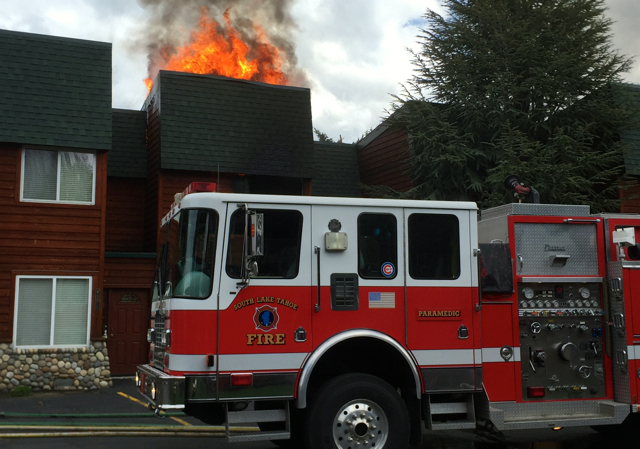
Fire destroys seven condos in Tahoe Keys on May 3. Photo/Kathryn Reed

Fire destroys seven condos in Tahoe Keys on May 3. Photo/Kathryn Reed

By Kathryn Reed

Old construction is one of the main reasons so many units in a Tahoe Keys condo complex were destroyed on Tuesday.

“The fire was hidden in a bunch of void spaces due to construction. Once it was in the common attic it was really hard to cut off. That is why it spread to the top of the units,” Karl Koeppen, shift commander with South Lake Tahoe Fire Department, told Lake Tahoe News.

Current building codes necessitate separate attic spaces with fire blocks.

The fire on Ala Wai was reported just before 2pm May 3 by a neighbor. The fire was contained at 4:10pm, with crews on scene until 9pm.

Seven of the nine units will have to be rebuilt because of fire, water and/or smoke damage. The two end units are still being assessed as to whether they will be habitable.

A handful of people were displaced. Some were assisted by the Red Cross, while others went to stay with friends.

Only smoke was visible when crews first arrived; from the originating unit and the eaves of neighboring ones.

Two holes were sawed into the roof to create a draft to help find the fire. Simultaneously firefighters were on each of the two floors looking for it. It had been spreading through the walls for about 90 minutes before firefighters arrived.

The unit where the fire started was having work done so it could be rented.

“With a torch, I took the fitting off,” contractor John Dean told Lake Tahoe News. “It hit insulation. I put water on it. When I left there was no indication of flames.”

When he came back smoke was everywhere.

Because there were no injuries no criminal charges are likely to be filed. The rough damage estimate is at $3 million.


McClintock faces hostile crowd in South Tahoe

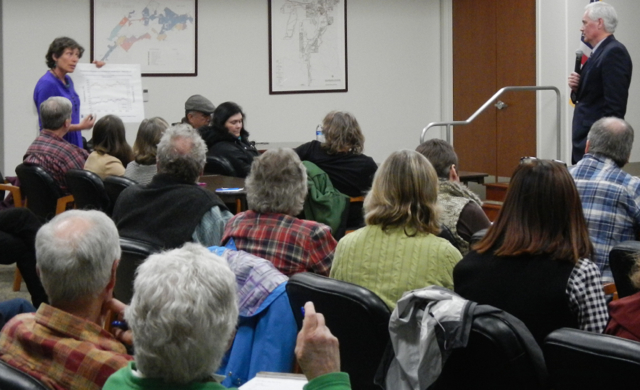
South Tahoe resident Bonnie Turnbull, left, spars with Rep. Tom McClintock over climate change. Photo/Kathryn reed

South Lake Tahoe resident Bonnie Turnbull, left, spars with Rep. Tom McClintock over climate change. Photo/Kathryn reed

By Kathryn Reed

Audience question: What causes climate change?

Rep. Tom McClintock’s answer: “It’s a natural phenomenon. It has more to do with solar cycles than human activity.”

To this, most of the 50 people in attendance at the May 3 town hall at South Tahoe Public Utility District’s board room erupted in disbelief. Based on reactions to and interactions with the congressman, it’s unlikely most of the attendees will be voting for the Republican this year.

McClintock is making the rounds of his district, spelling out what he has done back in Washington, D.C., and what he hopes to do going forward.

Climate change was an overriding theme at Tuesday’s gathering. Several people tried to engage McClintock in a debate, that at times escalated into a near shouting match.

Many were armed with facts. Local resident Bonnie Turnbull even had a chart to add to her concerns. John Friedrich, who was in Paris during the climate summit last year, read information from his tablet.

McClintock all the while stuck to his talking points – the climate has been changing for 4 billion years.

One person shouted, “Your naiveté is absolutely stunning.”

McClintock claims this is the first such meeting where the crowd wouldn’t let him finish his sentence. What they were upset with were the rehearsed answers that were not based on science. At no time did McClintock cite sources for his beliefs/facts.

Several asked how he can dispute the facts when 97 percent of the scientific community says climate change is real and human caused. McClintock’s assertion was that the data is nearly 20 years old. It’s actually a figure from 2013. This is when the congressman did what he accused the audience of — not listening.

Before opening the floor to questions, the congressman talked about if mandatory spending – like Medicare and Social Security – were under the discretionary column, that the budget would be easier to balance.

Forest health is another concern of his. Something he often says at these meetings is that the timber will come out one way or another – either harvested or via fire. He wants to allow trees to be felled for profit. That is not allowed in the basin anymore.

“The forests are dying because we’ve allowed them to be catastrophically overgrown,” McClintock said.

Part of his bill that is a scaled down version of the Senate’s Lake Tahoe Restoration Act calls for more forest thinning. It has passed out of committee.

He is also working to get more funding to fight fires, including having forest fires be listed as a natural disaster so they quality for federal aide in the same manner as earthquakes and hurricanes.

McClintock’s answer to dealing with drought was to create more storage. But in order to build more dams in California, he said, environmental regulations need to change.

An attendee brought up subsidies for oil companies.

“I’m against all subsidies. Period. People deserve honest pricing,” McClintock said.

Another person spoke about being against trade agreements, saying the United States usually comes out on the losing end.

McClintock disagreed, touted the merits of NAFTA, adding, “Generally speaking I support free trade.”

Jude Wood, executive director of the local Boys & Girls Club, asked McClintock what he is doing to help families and touched on immigration.

The congressman said he won’t help those who are here illegally, even if it were their parents who brought them here. He said a path to citizenship exists and that everyone should follow it.

As for families, he’d like to raise the child deduction when it comes to filing taxes.


Ex-Nev. power broker Whittemore out of prison

By Jeff German, Las Vegas Review-Journal

Former power broker Harvey Whittemore was released from a federal halfway house Monday after serving 21 months of a two-year prison term for breaking campaign contribution laws.

Whittemore, 63, who surrendered in August 2014 at a federal prison camp in Lompoc, California, spent the last three months in the halfway house. He now will serve two years of supervised release in Nevada.

His lead Las Vegas lawyer, Dominic Gentile, declined to comment Monday.

A Reno federal jury in 2013 found Whittemore guilty of funneling $133,400 in unlawful contributions to the campaign of Sen. Harry Reid, D-Nev.

Read the whole story


Fire consumes condo in Tahoe Keys

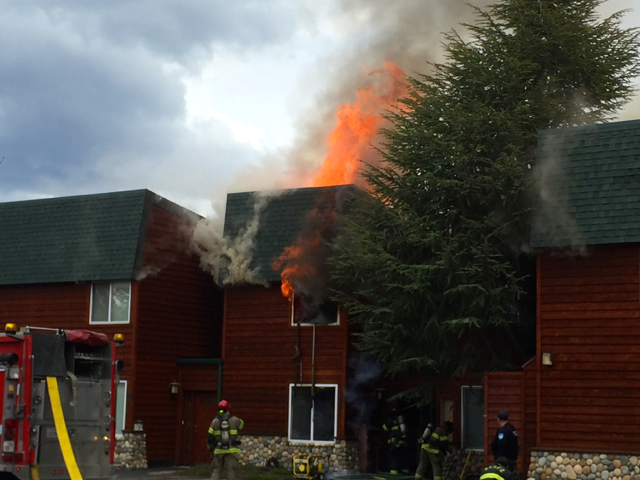
Flames shoot up from a condo in the Tahoe Keys on May 3. Photo/Kathryn Reed

Flames shoot up from a condo in the Tahoe Keys on May 3. Photo/Kathryn Reed

By Kathryn Reed

A fire is raging out of a control at a condo in the Tahoe Keys this afternoon.

Firefighters are working to get a handle on the blaze that erupted about 2pm May 3.

Flames were shooting at least 10 feet into the air from a middle unit on Ala Wai, just down from the four tennis courts. Smoke was coming from the attics of the adjacent condos.

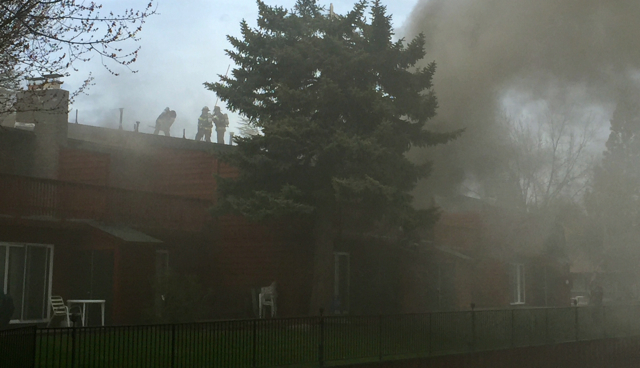
Before the flames shot up firefighters were on the roof with a chain saw to gain access. A second story window blew out and flames were coming through it as well.

John Dean told Lake Tahoe News he was working on the unit to get it ready to be rented. The city inspector had told him the washer and dryer could not block the circuit breakers, so he was moving the appliances and the plumbing to conform to code.

South Lake Tahoe firefighters gain access to the unit via the roof. Photo/Kathryn Reed

South Lake Tahoe firefighters gain access to the unit via the roof. Photo/Kathryn Reed

“With a torch, I took the fitting off,” Dean said. “It hit insulation. I put water on it. When I left there was no indication of flames.”

He was gone for 90 minutes to get a bite to eat and buy some materials.

On Tuesday he was sitting in his vehicle, dejected, wishing he had never left because he said the damage probably wouldn’t be anything like it will end up being.

Fire officials estimate the damage to be more than $3 million on the eight-plex. Initial reports are that six were damaged. The extent is still being assessed.

It was a neighbor three doors down who called 911 when she saw smoke.

She and about a half dozen other people were evacuated, as were some animals.


Lush Nevada could be trouble later on

By Benjamin Spillman, Reno Gazette-Journal

Instagram isn’t having a filter malfunction.

Nevada’s valleys and hillsides really are carpeted in lush, green vegetation.

Science, in the form of satellite data, is showing us that the country’s driest state is much greener than normal thanks to El Nino-fueled storms that dumped rain and snow across the Sierra Nevada and Great Basin all winter.

Read the whole story