Placer County supe candidates spar over development

By Brad Branan, Sacramento Bee

Granite Bay has some of the region’s most expensive real estate, with big homes on large rural lots that have attracted well-heeled buyers who prize the area for its pastoral quality near Folsom Lake.

Though the area has seen its share of development in recent years, turning into an affluent suburb of 20,000 residents, some are fighting to preserve the area’s more rural properties in the face of plans by home builders.

That fight has become the central issue in the supervisor race to represent Placer County District 4, which covers Granite Bay and parts of Roseville.

Longtime incumbent Kirk Uhler thinks developers should be able to build more homes on low-density land in Granite Bay. His support for home builders has attracted a late challenge from financial planner Victor Bekhet, who lives behind one of the proposed developments and has gathered support from neighbors who think Uhler is too aligned with builders who have contributed to his campaign.

Read the whole story


Nev. program tests drones to sniff out radiation

By Ken Ritter, AP

If there’s ever a radiological catastrophe in the U.S. like the 2011 Fukushima disaster in Japan, the stewards of the former national nuclear weapons proving ground in Nevada expect to be ready to deploy remote-controlled drones to check for contamination.

Nevada National Security Site officials have purchased two unmanned aerial vehicles to sniff the sky and provide an eye from above in the event of an emergency.

The idea, said Jim Holt, president of site contractor National Security Technologies, is to use pilotless aircraft “in situations where manned aircraft may not be used safely.”

The airplanes will be tested in coming months over a secure federal reservation north of Las Vegas with a goal of being ready to be sent elsewhere if needed.

“We’re evolving,” said Karen McCall, drone program manager for National Security Technologies, the company that manages the area for the U.S. Energy Department’s National Nuclear Security Administration. At 1,360 square miles, it’s almost the size of Long Island.

Formerly known as the Nevada Test Site, the area is now used for security and emergency response training, national security and defense experiments, and nuclear weapons stockpile maintenance.

Seven people — including remote-controllers, engineers and mechanics — are training to have the unmanned aerial systems program up and flying this fall, McCall said.

The team already uses a Bell 412 helicopter and a Beechcraft King Air twin-engine airplane based at Nellis Air Force Base for aerial radiological monitoring.

Team members left the aircraft in Nevada but took monitoring equipment to Japan for helicopter and fixed-wing aircraft surveys near the burning Fukushima Daiichi reactors after the March 2011 earthquake and tsunami.

The two Sandstorm drones are expected to upgrade gamma ray remote sensing, photos, environmental monitoring and site security.

The drones were acquired from Unmanned Systems Inc., a company based in nearby Henderson, under a one-year, $240,000 contract that includes training, service, and maintenance.

The turbine-driven propeller aircraft has an 8-foot fuselage, a 15-foot wingspan and weighs 44 pounds. It can carry another 20 pounds of sensors and cameras, company executive Bill Reynolds said.

The company does its testing at a facility in Kalispell, Montana. Reynolds noted that the Sandstorm was certified by the Federal Aviation Administration in 2010.

In recent years, drone programs have developed to spray crops, inspect power lines, collect seismic data and provide an eye in the sky to news crews and police.

Officials noted that Nevada was picked in December 2013 as one of six states for FAA-authorized testing of what officials officially call unmanned aerial systems. Alaska, New York, North Dakota, Texas and Virginia were others. The program in the Silver State is anchored by the Nevada Institute for Automatous Systems.


The solar battle on Nevada rooftops

By Jason Hidalgo, Reno Gazette-Journal

On May 20, 2015, an exasperated Nevada Legislature washed its hands of the net metering debate, punting its resolution to the Public Utilities Commission of Nevada.

Exactly one year later, the issue surrounding rates for rooftop solar is poised to come full circle as a state task force mulls sending it back to state lawmakers.

A May 26 meeting by the Governor’s New Energy Industry Task Force to determine whether existing rooftop solar customers should be grandfathered under older, more favorable rates is the latest in an ongoing drama that has garnered Nevada plenty of national attention — mostly of the negative kind.

The situation is a far cry from the heady days of the Nevada solar experiment. State lawmakers passed several policies through the years to support the budding renewables industry, including its first legislation for net metering back in 1997.

Read the whole story


Restaurants ditching no tipping

By NPR

In recent years, there’s been a no-tipping movement within the restaurant industry.

The idea has been to rectify a basic pay unfairness to even out the pay between tipped and untipped employees. Dishwashers and cooks at the back of the house don’t earn as much money as waiters because they don’t get tips.

So, do away with tipping, raise menu prices a little bit, and pay everyone a higher wage.

But that experiment has failed at some restaurants. Joe’s Crab Shack, the first large U.S. chain to implement a no-tip model, announced this month that it is moving away from the experiment, which only lasted three months.

Read the whole story


Placer County creates policy to stimulate development

Placer County said the reason it created an economic incentive program is to deal with the extraordinarily high costs of development, redevelopment and environmental improvements in the Lake Tahoe Basin.

Another reason the Board of Supervisors approved the plan this month is to spark investment in private projects. In particular the elected would like more places for tourists to stay, especially considering no tourist accommodations have been built in North Lake Tahoe in more than 40 years.

The program will focus on Kings Beach and Tahoe City.

The county will be able to fund and acquire tourist accommodation units (TAUs) and bank them so they may be issued for projects meeting certain criteria.

“The program is structured on the principle that redevelopment projects of a certain size and scale will produce an environmental and economic ripple effect creating additional investment,” the county said in a press release.

The Tahoe Regional Planning Agency made TAUs a commodity years ago as a way to curb growth. It worked. The problem is there is value to these units now so the free market is anything but free and redevelopment is stagnated because of the arbitrary value of a TAU.

— Lake Tahoe News staff report


California voter registration soaring

By Matthew Artz, Bay Area News Group

Californians are registering to vote in breathtaking numbers not seen since the Reagan Revolution, as the no-holds-barred presidential primary season and tech-based outreach efforts have rousted more than 1 million people from their political slumber.

More than twice as many Californians registered this year than in the same four-month period in 2012, according to Political Data Inc., a Los Angeles County firm that tracks state voter trends. The new voters are trending young and Democratic — two groups more inspired by Bernie Sanders than Donald Trump.

“There is no precedent for this in California since 1980 in terms of the overall surge in voter registration,” said Paul Mitchell, the firm’s vice president. “The motivation to register is as much to vote against somebody as it is to vote for somebody.”

Read the whole story


Overtime pay to expand to millions of U.S. workers

By Jeanne Sahadi, CNN Money

Starting later this year, millions more workers will become eligible for overtime pay.
Under a new rule announced by the White House Tuesday, anybody making a salary of less than $47,476 ($913 a week) will automatically qualify for overtime pay when they work more than 40 hours a week.

That’s roughly double the $23,660 threshold (or $455 a week) that’s currently in place.

The change — which has been criticized as too drastic by many employers — will go into effect on Dec. 1, 2016.

Read the whole story


California losing most land to development

By Paul Rogers, Mercury News

The natural landscape of the American West is gradually disappearing under a relentless march of new subdivisions, roads, oil and gas production, agricultural operations and other human development, according to a detailed mapping study released Tuesday.

From 2001 to 2011, an area totaling 4,321 square miles — or 15 times the size of San Jose, Oakland and San Francisco combined — was modified by development in the 11 Western states, the report found, with California losing the most natural land, and Wyoming and Utah changing at the fastest rate.

“We are nibbling away at our wild places at a fairly rapid clip,” said Mike Dombeck, former chief of the U.S. Forest Service and the U.S. Bureau of Land Management in the 1990s.

The report was produced by scientists at Conservation Science Partners, a nonprofit research organization based in Truckee, who spent a year analyzing more than 30 large databases and a decade of satellite images over Arizona, California, Colorado, Idaho, Montana, Nevada, New Mexico, Oregon, Utah, Washington and Wyoming.

Read the whole story


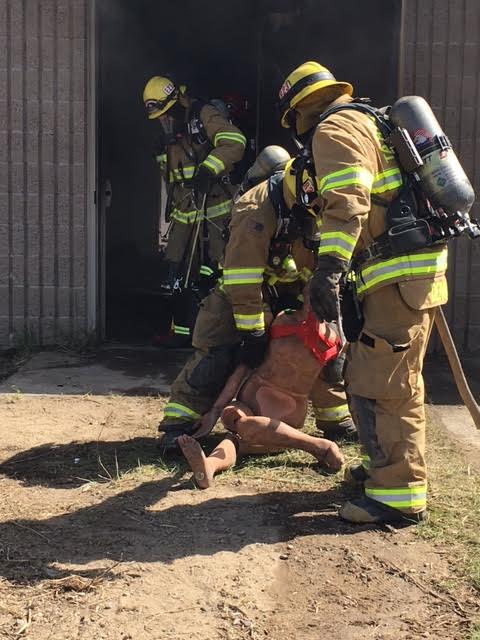
Firefighters test skills on live fire in Stateline


Tahoe Douglas firefighters practice rescuing a person from a burning building. Photo/Provided

Tahoe Douglas firefighters practice rescuing a person from a burning building. Photo/Provided

A building at the end of Kahle Drive burned for the better part of this week before firefighters fully extinguished it.

This was because Tahoe Douglas firefighters were training. They had access to the Kingsbury Grade Improvement District building that is no longer in use near the old trailer park in Stateline.

“We have had a lot of turnover in the last few years so there are a lot of guys who need live fire experience,” Assistant Chief Scott Baker told Lake Tahoe News.

The fire was started, then put out, and repeated several times. Crews watched how it would spread. Some were inside, some outside. Various scenarios were created so they could witness how the fire would react. They also were able to feel the effects of smoke and heat.

— Lake Tahoe News staff report


Why are ski towns seeing more suicides?

By Kelley McMillan, National Geographic

On a sunny morning in late February, Tom Slocum, a 57-year-old ski bum in Telluride, Colo., walked up Tomboy Road, a popular hiking route that winds above the north side of town. An avid athlete and skier, Slocum moved to Telluride in 1984, a couple of years after graduating college. Like many ski town residents, he’d worked several jobs over the years, in hotels, mostly. Over the last five or so years, he’d grown frustrated with his life—presumably by the fact the he was a middle-aged man living in a shack behind a multimillion dollar home, struggling to get by in one of the country’s most idyllic ski towns.

About a mile up Tomboy, Slocum pulled over and sat down next to a small creek. From his perch above Telluride, he looked out at the majestic San Juan Mountains, which towered above the 2,000-person town and its pastel Victorians. Across the valley, the Bear Creek basin etched up the east side of the resort and disappeared into a playground of snow-capped peaks. Then, just after dawn cast its first rays, Slocum pulled out a handgun and shot himself.

Slocum’s death was the first of three suicides that occurred in San Miguel County over two weeks in late February and early March. Then in May, a 46-year-old skier widely regarded as one of the best riders in the San Juans, took his life. The rash of self-inflicted deaths boosted the county’s rate of suicide by firearms over the past 12 months to more than six times higher than the national average. But Telluride isn’t alone. The number of suicides in Aspen, Colo., is three times the country’s mean rate. Utah’s Salt Lake County, home to Alta and Snowbird, has almost twice as many suicides as the national average. And six suicides over two and a half years in Truckee prompted the community to launch a suicide task force in 2014. Though tourists from around the world flock to these locales to ski their slopes and ride their single track, paradise harbors a darker reality: resort town residents are taking their lives at alarming rates.

Read the whole story