Nevada approves energy-storing train

By David Z. Morris, Fortune

One of the biggest challenges of the shift to renewable energy like solar and wind is energy storage.

The wind or sun don’t always generate power exactly when it’s needed, so infrastructure needs to bridge the gap. Batteries are the most frequently discussed solution, but there are other options out there, many of them surprisingly low-tech.

In April, the Nevada Bureau of Land Management granted environmental approval and a land lease to Advanced Rail Energy Storage (ARES), a startup with an energy storage solution that’s both novel and old-school.

Read the whole story


Study: Vegetation moving to adapt to climate

By Lake Tahoe News

Trees once found at lower elevations are moving higher in an attempt to adapt to climate change.

These are the findings of a study done by researchers at UC Davis.

The report was published this week in the “California Fish and Game” 2016 winter issue.

Signature tree species in the high Sierra Nevada forests – including mountain hemlock, red fir and western white pine – are shifting toward higher, cooler elevations, according to researchers.

They say the study foreshadows how climate warming may significantly alter entire habitats for multiple species. It will affect food supplies as well as forest soil.

The study says by the end of the century 16 of 29 vegetation communities in California, such as Pacific Coast salt marsh and high mountain conifer forest, are expected to be challenged by climate change.

Researchers at UC Davis completed the climate vulnerability study with funding from CDFW.


How earthquakes have changed history

By Amanda Foreman, Wall Street Journal

The Big One is looking a little more likely these days. Since the California earthquake of 1857, tectonic plates along the San Andreas Fault are thought to have shifted by as much as 26 feet.

Only last year, scientists raised the chances of a quake in California of magnitude 8.0 or greater in the next 30 years to 7 percent from 4.7 percent. Unfortunately, for all the sophisticated science behind this prediction, nobody knows whether this means devastation tomorrow or many decades from now.

The mystery surrounding earthquakes—the fact that they can strike at any time without warning—has puzzled humans for eons. The ancient Greeks believed that they were signals of the god Poseidon’s displeasure. Judeo-Christian cultures considered them divine punishment for individual or collective sin. Other societies avoided the blame game in favor of supernatural phenomena. One popular explanation involved giant animals moving underneath the Earth: a frog in Chinese stories, a catfish in Japan, a turtle according to some Native American tribes.

Read the whole story


El Dorado County hires CAO from within

By Kathryn Reed

El Dorado County will have a new chief administrative officer beginning at 8am May 25.

At today’s Board of Supervisors meeting Don Ashton was unanimously hired.

Don Ashton

Don Ashton

He knows what he is getting into, the systemic dysfunction, the questionable hires from predecessors and a budget process that is a mess.

The 45-year-old is currently the director of the county’s largest department, Health and Human Services.

Ashton told Lake Tahoe News his top three priorities are:

1.     “The budget and the budget process overall, not just the current year, but establishing a more timely budget process moving forward.”

2.     “Our culture … (creating) one of collaboration and trust based on following the county’s strategic plan.”

3.     “Looking at the organizational structure of the county, making sure people are in the right spots and moving them to where they would be most effective.”

Ashton has been with the county for a little more than five years, including working for the sheriff’s department. He moved here from Los Angeles County to be near to his fiancé, who is now his wife.

He knew after about two years of working for El Dorado County that he would like to be CAO. The timing, he said, was right for it to happen now. Ashton will be making nearly $215,000 year, plus benefits.

“Right now we have an outstanding board that is committed to changing the culture,” Ashton said. “No doubt it is going to be a lot of work.”

The county has gone through a handful of CAOs in the last few years who have had a penchant for hiring their friends and spending money on personnel instead of the basic needs of residents – like roads and other infrastructure.

Larry Combs has been the acting CAO for nearly a year, working part time and living in Auburn.

Ashton has the support of other elected officials in the county – all who wrote a letter in April to the board backing him.

He knows the days ahead won’t be easy, especially with budget hearing coming next month. Still, Ashton said he looks forward to the challenge.

“The way I’m going to go about it is to be as transparent and open as possible,” Ashton said. “I’m going to try to get the trust of the community, the board and other department heads.”


TRPA postpones hearing on Meyers hockey academy

The proposed hockey academy at the bottom of Old Meyers Grade will not be on the May 25 Tahoe Regional Planning Agency Governing Board agenda.

A TRPA spokesman said it will be heard at a later date, but at this time that date is unknown.

Lake Tahoe News on May 23 first reported that Tahoe Hockey Academy wanted to develop an academic-athletic facility in Meyers.

Since area residents were first notified last week of the proposal they have been writing letters to the bi-state regulatory agency about their concerns. The level of interest in the project led the agency to pull the item completely from the agenda. It had been on the consent agenda.

— Lake Tahoe News staff report


Program provides Nev. vets free legal help

By Melissa Gomez, Las Vegas Review-Journal

On Monday, James Dorsey sat with Nevada’s attorney general in a conference room, drafting up his will.

“We had a little bit of military talk ‘cause he was Navy also,” Dorsey, 74, said. “I enjoyed it.”

Attorney General Adam Laxalt was at Texas Station Monday morning with about 10 local attorneys, helping military veterans and active members through civil matters.

Laxalt said the program idea was on his platform when he ran for attorney general. Two weeks after being elected, he said he made calls, creating an advisory committee. In March, the Office of Military Legal Assistance was established.

Read the whole story


Drought parched Nev. warms up for fire season

By Benjamin Spillman, Reno Gazette-Journal

Nevada’s wildland firefighters are readying themselves for a treacherous fire season in months ahead.

That’s because a multi-year drought interrupted by El Nino moisture created conditions that cranked up the risk of wildfire in the Sierra Nevada and Great Basin.

The ramped up risk factors as well as measures fire officials will take to protect people and property were the topic of a briefing Monday for Gov. Brian Sandoval.

Read the whole story


Calif. water bill has three possible paths

By Michael Doyle, McClatchy Washington Bureau

House Republicans this week are adding a controversial California water bill to an unrelated Senate energy package, opening a new front in a fight that’s already put Democrats on the defensive.

The unexpected energy bill maneuver gives San Joaquin Valley lawmakers a third vehicle they might propel all the way to the White House. At the least, it builds up steam for the GOP drive to boost California water storage and divert more irrigation deliveries to Valley farms.

Today, the leadership-controlled House Rules Committee is scheduled to pack the California water bill and about three dozen other bills onto the Senate energy legislation. The full House will then take up the massive package, spanning more than 1,000 pages, later this week.

Read the whole story


Stormwater collection in Tahoe keeps evolving

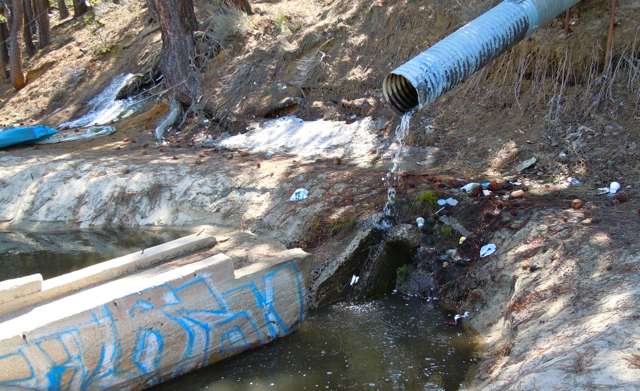
This storm drain and debris at El Dorado Beach were improved as part of the Lakeview Commons makeover in South Lake Tahoe. Photo/LTN file

This storm drain and debris at El Dorado Beach were improved as part of the Lakeview Commons makeover in South Lake Tahoe. Photo/LTN file

By Kathryn Reed

Those tasked with keeping gritty stormwater from reaching Lake Tahoe are looking into whether the roads are actually a problem.

“Pavement wear” is what Russ Wigart, with El Dorado County, called it.

“We completely annihilate our roads on an annual basis,” Wigart said. “Fifteen to 25 percent of fine sediment is from pavement. Maybe we could resurface our roads and call them water quality projects.”

Wigart, along with Jason Burke of South Lake Tahoe and Andrea Buxton of Tahoe Resource Conservation District, all stormwater coordinators, gave a presentation last week at Lake Tahoe Community College about what is going on with runoff in the basin.

Several years ago scientists determined that fine sediment is the main culprit for the diminishing clarity of Lake Tahoe. Much of this comes from runoff from roads, and some from tributaries carrying silt into the larger water body.

With so many roads throughout the Lake Tahoe Basin being categorized as near failing, it stands to reason that ground-up asphalt could be a problem.

The volatile suspendable solids found in the runoff are believed to be the road, Wigart said.

TRCD for three yeas has been monitoring eight catchments around the basin that deliver treated runoff into the lake. More oversight would be ideal, but funding is an issue.

The idea is that with more years of analysis true trends will be able to be established. This will prove if the various treatment systems are working.

TRCD staff sends samples to labs for analysis, monitors the amount of rain/snow that falls, assesses the turbidity (cloudiness), and measures the continuous flow during storms.

The varied erosion control measures that the large landowners are putting in cost millions of dollars. South Lake Tahoe spent $10 million at Sierra Tract and $7 million at Harrison Avenue.

Burke pointed out how retrofitting the city – and any location — after the fact is a more costly endeavor. Ideally, infrastructure like storm drains is put in when a jurisdiction is built. Plus, doing it all after the fact presents contractors with unknowns. When the improvements went in at Harrison a couple years ago five underground fuel tanks were discovered, with two of them being full.


Gas prices on the rise

The average price of gasoline has jumped by a nickel over the past two weeks to $2.32 a gallon for regular grade.

Industry analyst Trilby Lundberg said Sunday that the hike is mostly due to a continuing increase in crude oil prices. The price at the pump has risen 55 cents since late February.

In the Lower 48, the highest average price of regular gasoline was $2.85 per gallon in San Francisco. The lowest was $1.98 in Tucson, Arizona.

The U.S. average diesel price is $2.32 per gallon, up 4 cents from two weeks ago.

— Associated Press