Nev. attorneys want pot laws changed

By Chris Kudialis, Las Vegas Sun

Although Nevada law allows the sale and use of medical marijuana, attorneys in the state could soon face punishment for professional misconduct if they get involved in the business.

The Nevada Supreme Court is considering revising the rules of professional conduct for attorneys by adding a clause saying that the sale, use or possession of marijuana — even when allowed by state law — is prohibited by federal law and could result in misconduct actions. The court is seeking comments on the proposed addition and is scheduled to review it July 7 in Las Vegas.

“Marijuana is still considered an illegal substance under the feds,” explained Michael Sommermeyer, spokesman for the Nevada Supreme Court, “and federal law trumps state law.”

The hearing came about at the request of the State Bar of Nevada, “seeking guidance” from the court on the role of attorneys in the industry under its “Rule of Professional Conduct,” Sommermeyer said. It follows a 2014 comment on the same rule, which upheld Nevada attorneys’ right to provide counsel to clients in the industry.

Read the whole story


California groundwater law stirs debate

By Amy Quinton, Capital Public Radio

Two years ago, California became one of the last states in the West to pass a law to manage groundwater. The political will to do so took decades. But the bigger battle may be putting the law into practice.

Paso Robles in San Luis Obispo County may be a perfect example of how hard it’s going to be.

The region is known mostly for it’s more than 200 wineries. But amidst the rolling hills full of vineyards, it’s not unusual to see tanker trucks delivering water to rural homeowners whose wells have run dry.

Stephen Johansen with Crocker Water is filling storage tanks for one rural homeowner. He says business is booming.

Right next door, Sue Luft, a retired environmental engineer, started to see her well fail before the drought even started.

Read the whole story


Bill would keep drones out of emergency zones

A bill by state Sen. Ted Gaines, R-El Dorado, to protect forests, property and the lives of citizens, firefighters and emergency personnel from drone interference, this week passed out of the Assembly Committee on Privacy and Consumer Protection.

“To think that someone would interfere with firefighting or emergency response situations to get a sneak peek or to post a drone video on YouTube is an outrage that is deserving of punishment and condemnation,” Gaines said in a statement. “I look forward to Senate Bill 807’s continued support as it makes its way through the Assembly.”

The bill would grant civil immunity to any emergency responder who damages an unmanned aircraft in the course of firefighting, air ambulance, or search-and-rescue operations. The bill stems from reports of private, unauthorized drones causing mission-critical aircraft to be grounded during firefighting and medical response operations, putting pilots, firefighters, civilians and property at unnecessary risk.


Bad omen for dangerous Calif. fire season

By Joseph Serna, Alexia Fernandez and Jason Song, Los Angeles Times

The fire started smoldering Wednesday afternoon off a curvy mountain road in the coastal hills north of Santa Barbara.

Then,  infamous “sundowner” winds started blowing fiercely, and the Sherpa Fire suddenly exploded. Authorities frantically shut down the 101 Freeway and evacuated hundreds of homes within a 15-mile path of the blaze, which was being pushed by 50-mph gusts.

The fire was able to move so far because it was racing through overgrown hillsides and canyons that had not burned in more than 60 years.

The state is in its fourth year of drought, and officials say the Sherpa blaze is a grim omen for what could be a summer and fall of fire.

So far this year, wildfires have burned more than 30,000 acres on state and federal land. That is about equal or slightly higher than the same period in 2015, a particularly destructive year of fire that burned  307,598 acres and hundreds of homes and left at least nine people dead.

Read the whole story


NHP beefing up enforcement on highways

More than two dozen law enforcement agencies throughout Nevada will be joining forces to crack down on drivers exceeding speed limits or driving too fast for road conditions now through June 30.

Speeding is a contributing factor in approximately one-third of fatal crashes on the nation’s roadways, according to officials. Exceeding the speed limit is considered aggressive driving just as weaving in and out of traffic and failing to yield to other motorists.

The Nevada Highway Patrol will be increasing its staffing around the clock for this event. Troopers will be looking for a variety of traffic related violations to include speeding and aggressive driving.

According to National Highway Traffic Safety Administration, the consequences of driving too fast include:

·      Greater potential for loss of vehicle control

·      Reduced effectiveness of occupant protection equipment

·      Increased stopping distance when the driver perceives a danger

·      Increased degree of crash severity leading to more debilitating injuries

·      Unexpected economic and psychological implications of a speed-related crash.

Joining Forces enforcement is paid for by Nevada Department of Public Safety.


Douglas sewer conundrum in holding pattern

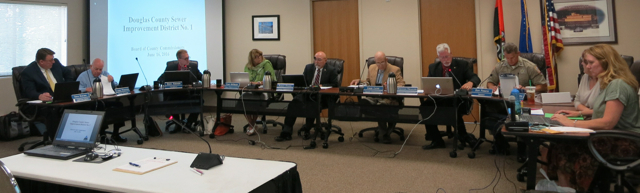
Douglas County commissioners are not all in agreement in how to handle the sewer district issue. Photo/Jessie Marchesseau

Douglas County commissioners are not all in agreement in how to handle the sewer district issue. Photo/Jessie Marchesseau

By Jessie Marchesseau

STATELINE – A possible ordinance dissolving the Douglas County Sewer Improvement District was by far the most popular item on the agenda for Thursday’s Douglas County Board of County Commissioners meeting.

So much so, the fire marshal was actively turning people away at the door because attendance exceeded the maximum capacity, set at 98 people, for the two front rooms at the Tahoe Transportation Center in Stateline. An estimated 50 or so people were directed to the judicial court across the street where the meeting was streamed live on TVs.

The state of the DCSID has been a hot topic since May 23 when Douglas County District Attorney Mark Jackson brought to light a handful of questionable practices at an open meeting in Gardnerville of county commissioners.

At the May 23 meeting, Jackson alleged corruption, illegal collusion and political malfeasance on the part of DCSID board members. Jackson played audio recordings from recent DCSID board meetings to support his accusations. The meetings were supposedly open to the public; however, no citizens were present.

In these recordings, board members can reportedly be heard discussing the need to find someone to file an ethics complaint against Planning Manager Hope Sullivan as part of their efforts to convince county commissioners to approve their plan for two lined effluent holding ponds, a gravel mining operation, and concrete and asphalt plants in the East Valley. The gravel mining, concrete and asphalt plants were included to subsidize the cost of building the ponds, board members said.

A few months later, the Ethics Commission received the aforementioned ethics complaint from Don Miner, a former Douglas County commissioner and personal friend of the DCSID engineer and one of the board members. DCSID board members said they were aware that Miner was filing the complaint, but it was not at their request.

The recordings were not played again at Thursday’s meeting, and Jackson said his charges are not focused specifically on the gravel pit or holding pond issues. The tapes were used as an example of the conduct of the DCSID board, these just happened to be the topics the board was discussing last November through February.

He pointed out DCSID is a public entity, but has not had an election in more than 30 years. Something Jackson said is a violation of Nevada state law. He also accused the board members of not being qualified to run a sewer district.

The DCSID board currently consists of three board members who run some of the largest corporations in Stateline and none of who lives within the district he is serving. Chairman of the DCSID board is Mike Bradford, CEO of Lakeside Inn & Casino, also on the board are John Koster, chief of operations for Harrah’s in Northern Nevada, and Steve Johnson who runs Edgewood and is overseeing the new Edgewood Lodge development.

Jackson cited Nevada statutes which outlawed local improvement districts like DCSID nearly 50 years ago, which require all improvement districts to abide by state election laws and which also require board members to reside within the district.

Severin Carlson, attorney for the district, said DA Jackson is not reading his statutes correctly and these laws do not apply as Jackson is indicating. Carlson did not make a formal presentation during the meeting, but did make some remarks during the public comment portion.

Since the BOCC was only considering whether or not to introduce the ordinance to dissolve the DCSID on June 16, meaning they would start considering the issue, but not actually make a decision until later, the district attorney was only tasked with presenting them with sufficient reasons to look into the matter further.

He enlisted the assistance of Carl Ruschmeyer, Douglas County director of public works, to present to the commissioners an analysis of the current workings of DCSID and identify possible inefficiencies. He pointed out how Incline Village GID operates more facilities than DCSID, is subject to the same environmental issues, and runs with fewer full-time employees. IVGID also performs cleaning and maintenance of their systems in-house, something DCSID contracts out for hundreds of thousands of dollars.

Ruschmeyer also compared DCSID to Douglas County Sewer Utility. It also operates with fewer employees than DCSID. His calculations indicate DCSU spends an average of about $73,000 per full-time employee. DCSID, however, spends more than $130,000, he said.

Ruschmeyer concluded that by allowing Douglas County to run the DCSID for a period of time, they could restructure it to run more efficiently, reduce the number of employees, cut back on the number and cost of contracted services by using Douglas County engineers, and save DCSID about $900,000 per year.

“It’s not just about those that are in control or believe that they’re in control. It’s not about the directors or trustees of the districts up here at the lake, or about those staff members that may possibly not have a job in the future,” Jackson said. “At the end of the day, it’s about the ratepayers.”

Jackson indicated Douglas County running the district would not be for the long term. They would work to return control to more qualified lake residents as soon as possible.

After a question and answer session between Jackson and the commissioners, the room was opened to public comment, and ratepayers had their say.

Several stepped up in support of the board, mostly emphasizing how much they like their low rates and don’t want them to go up, something they fear will happen if Douglas County or another entity were to take over. Few, however, offered opinions as to whether or not they believed the board was lawful or ethical.

Some called it just another lake versus valley dispute.

Several expressed support for DA Jackson, disgruntled with the DCSID board for what they saw as conflicts of interest, willfully disobeying laws and unduly influencing the system for their own benefit.

Assemblyman Jim Wheeler, R-Minden, let everyone know the Legislature would likely be discussing the issue at their next meeting in August.

The DCSID board members also had a chance to say a few words.

Koster explained when he was transferred by Harrah’s to Lake Tahoe in 2007, he was told he must join the DCSID to replace the outgoing Harrah’s representative. He said he had no idea at the time what running an improvement district was even about. He admitted their meetings are very informal and apologized for the off-color jokes he was heard making on the recordings.

Bradford, chairman of the DCSID board, said they are and always have been committed to their ratepayers. He took a moment to express how much he appreciated the friendship of some of the commissioners and other Douglas County political figures. One of the benefits of a small town, he said. He was disappointed the issues weren’t brought to him on a personal level before it blew up in public.

Board member Steve Johnson was not able to attend, however he submitted a letter which Commissioner Doug Johnson read to the room. In it, he said DCSID ratepayers are happy, and dissolving the district is not necessary, nor is it beneficial to anyone.

All board members indicated a willingness to work with the county to correct the issues at hand.

After another short question and answer session between the BOCC and the district attorney, Commissioner Greg Lynn motioned to table the ordinance pending an opinion from Nevada Secretary of State Barbara Cegavske. He also added into the motion that all interested parties, including existing GIDs at the lake, DCSID and Douglas County Board of Commissioners, work together to resolve the issues in question.

Commissioner Johnson reiterated that voting to introduce the ordinance, did not mean they were taking one side or another, but simply agreeing to look into the issue further and would prevent it from dragging on too long.

In the end, after nearly four and a half hours of discussions, the BOCC voted 4-1 in favor of Lynn’s motion, with Johnson in opposition. So DCSID returns to business as usual for the time being.

The BOCC plans to actively pursue an opinion from the secretary of state.


Truckee man dies in ATV accident

A Truckee man drowned Thursday when the all-terrain vehicle he was driving flipped near Prosser Creek Reservoir, trapping him in the water.

The name of the 52-year-old has not been released.

A passer-by came across the accident scene on June 16 about noon and then notified authorities.

— Lake Tahoe News staff report


Dems bullish in efforts to regain Nev. Legislature

By Michelle Rindels, AP

Democrats have been itching to regain their majority in the Nevada Legislature since 2014’s conservative red wave swept them out of power, and they say the results of Tuesday’s primary gave them a bit more encouragement they’ll succeed.

Three Republicans who last year voted for Gov. Brian Sandoval’s tax package toppled in their primaries against anti-tax challengers. It was a better outcome than it could have been for moderate Republicans, with seven other tax-supporting incumbents surviving such challenges. But every seat matters for a GOP that holds a 25-17 Assembly majority and is already expected to lose ground in a presidential election cycle.

Republicans’ inability to save tax-supporting incumbents P.K. O’Neill and Glenn Trowbridge in their primaries sent a message that their message and values aren’t resonating with people, Democratic Assemblywoman Irene Bustamante Adams said.

“That gave me a boost of confidence that the majority is ours to take back,” she said.

Democrats are well-poised to turn out their voters thanks to a new level of coordination between legislative and congressional campaign organizations, Bustamante Adams said. And internal divisions among Republicans will weaken them in their quest to retain power, she said.

Republicans are fresh off a bitter primary season that pitted moderates against anti-tax purists led by freshman Assemblyman Brent Jones. Most Jones-backed candidates lost, but Jones narrowly won a primary — meaning Republican leaders will have to mend fences with him to have a chance at keeping that Democratic-leaning district.

“The path to the majority runs right through that district,” Assembly Majority Leader Paul Anderson said. “We’re going to have to figure out how he can appeal to a wider audience.”

Assembly Republicans already expect to lose three heavily Democratic districts that they won in 2014. But they’re fighting to avoid losing any more, including Democratic-leaning districts held by vulnerable freshmen David Gardner and Derek Armstrong.

That means being more organized and strategic than in years past.

“I think we’re still the underdog, but that plays into our favor,” Anderson said. “They may not see us coming or understand our strategies.”

On the Senate side, Democrats who were in a 10-11 minority last session hope to flip seats in their favor and get back in the driver’s seat. The breakdown will depend on a handful of Senate races in swing districts.

Democrats need to hold on to a Henderson-area district held by Joyce Woodhouse, a retired educator who breezed through her primary but faces a tougher challenge from Republican charter school principal Carrie Buck.

They’re also watching a Reno-area race between Democratic attorney Devon Reese and Republican former lawmaker Heidi Gansert, who defeated anti-tax challenger Eugene Hoover; and one in Las Vegas between Republican incumbent Sen. Scott Hammond and Democratic challenger Alexander Marks.

But perhaps the most watched will be one in a Las Vegas-area Senate district that’s held by Republican Mark Lipparelli, who’s not seeking re-election. Republican Erv Nelson, who was backed by GOP Senate leaders and supported Sandoval’s tax plan when he was in the Assembly, lost badly in a brutal race against anti-tax Assemblywoman Victoria Seaman.

Seaman painted Nelson as a carpetbagger and a liar, fighting back when his campaign put out literature that highlighted an obscure tax cut but didn’t mention the more obvious tax hikes and extensions the Legislature approved.

“We take an aggressive posture … no issue is too small to respond to,” said her campaign consultant, Ryan Hamilton, who called Seaman a vigorous campaigner and the strongest Republican for the general election. “She appeals to nonpartisans, she appeals to conservatives, and she’s the hardest worker.”

Seaman faces Democrat Nicole Cannizzaro, a Clark County prosecutor who didn’t have a primary, in a district with a narrow Democratic registration advantage.

“I think the contrast is going to be readily apparent,” Democratic Senate Minority Leader Aaron Ford said. “The people of District 6 are … more accustomed to interacting with someone like Nicole Cannizzaro who is thoughtful, who is cordial and who is interacting on issues that are important for them, and not bombastic and offensive.”


Calstar to merge with rival air medical firm

By Mark Glover, Sacramento Bee

Calstar, the regional air ambulance service, and Santa Rosa’s Reach Air Medical Services announced Thursday that they are entering into a merger agreement that will create the largest network of air ambulance bases in California.

Officials said the agreement will position Calstar within the same holding company as Reach.

In a joint announcement, Sean Russell, Reach president, and Calstar CEO Lynn Malmstrom, said Calstar will become a limited liability company and operate under the current Calstar brand as Calstar Air Medical Services LLC.

Read the whole story


Raley’s to open first store in Truckee

By Mark Glover, Sacramento Bee

West Sacramento-based Raley’s is continuing its growth spurt.

The grocer, which had not announced a new store in six years at this time last year, on Friday announced its fifth new project in the past 10 months.

Raley’s said it will build a 35,000-square-foot supermarket at the corner of Highway 267 and Soaring Way, adjacent to the Truckee Tahoe Airport. Raley’s does not currently have a store in Truckee.

In partnership with JMA Ventures LLC – which has offices in Sacramento, San Francisco and Tahoe City – Raley’s said it also plans to develop a new retail center at the site. JMA owns Homewood Ski Resort.

Read the whole story