
May a good water conservation month in Calif.

By Kurtis Alexander, San Francisco Chronicle

Californians are saving an extraordinary amount of water, records show, even after winter rains prompted state regulators to begin easing drought-driven restrictions on cities and towns.

The State Water Resources Control Board reported July 6 that urban water use dropped 28.2 percent in May compared with the same period in 2013 — the second-biggest monthly reduction since the state’s water rationing program began last year. May’s savings followed an impressive 26.1 percent reduction in April.

With state regulators relaxing water rules, however, some are doubting whether such high levels of savings will continue — and whether they even need to. Already, many water agencies have passed the state’s new “stress test” and are no longer required to save water under a policy being praised by suppliers and criticized by conservationists.

Read the whole story


U.S. traffic deaths rise almost 8%

By Joan Lowy, AP

WASHINGTON — Traffic deaths surged last year as drivers racked up more miles behind the wheel than ever before, a result of an improved economy and lower gas prices, according to preliminary government data released last week.

Fatalities rose 7.7 percent to 35,200 in 2015, the National Highway Traffic Safety Administration said. That overall rate was significantly outpaced by non-motorist traffic deaths: Bicycle fatalities were up 13 percent; pedestrian deaths rose 10 percent, and motorcyclist deaths rose by 9 percent.

Last year was the deadliest driving year since 2008, when 37,423 people were killed. It was also the year in which American drove 3.1 trillion miles, more than ever before.

The fatality rate for 2015 increased to 1.12 deaths per 100 million vehicle miles traveled (VMT), up from 1.08 deaths in 2014.

The information comes as tens of millions of Americans were hitting the road for the Fourth of July holiday, one of the busiest and deadliest days on the year on the nation’s roadways.

Historical data show that, after peaking in the 1970s, traffic deaths have fluctuated quite a bit while generally trending downward, according to the Insurance Institute for Highway Safety. Large dips in deaths have corresponded to shocks to the economy: the oil embargo of the mid-1970s, the recessions of the early 1980s and early 1990s and the more recent downturn that began with the subprime mortgage crisis.

“It’s not just that Americans drive more miles when the economy improves; it’s the kind of miles they drive,” said Russ Rader, a spokesman for the insurance institute. “What comes back after a recession is the optional driving that’s riskier, like going out on the weekends or taking long trips — different driving than the daily commute.”

The national average price of gas in 2015 was $2.40 per gallon, which was the second-cheapest annual average of the past decade, according to AAA. It was about 94 cents per gallon less than the annual average in 2014, which also saw the lowest number of traffic deaths — 32,675 — since Harry Truman was president.

“The upticks (in deaths) we’re seeing correlate to lower fuel prices, but we don’t want to give ourselves that excuse so we are digging into different areas where we can have an impact on this,” Transportation Secretary Anthony Foxx told journalists. The department, which includes NHTSA, is looking at how advances in automotive technology can reduce the death toll, he said. NHTSA’s revamping last year of its safety rating system for new cars to include automated emergency braking technologies may help, he said.

Motorcycle deaths have risen in part because of weak state laws on wearing helmets, said Jonathan Adkins, executive director of the Governors Highway Safety Association, which represents state highway safety offices. A majority of states no longer require riders to wear helmets, he said.

“Motorcyclists are a bigger and bigger percentage of deaths each year,” Adkins said.

Just because the state of the economy is a significant factor in the rise and fall of traffic deaths, “it doesn’t mean that policymakers are powerless,” Rader said. If people followed a few simple measures like driving more slowly, buckling up and wearing a helmet when riding a motorcycle, he said, “the increases we’re seeing now wouldn’t be as large.”


Bills lining up for next Nev. legislative session

By Sandra Chereb, Las Vegas Review-Journal

CARSON CITY — Allowing terminally ill patients to end their lives, lowering Nevada’s gambling age and authorizing public marijuana venues are among the 108 early bill draft requests submitted by legislators for possible consideration by the 2017 Nevada Legislature.

The list released Friday offers a snapshot of some of the issues lawmakers will debate when they convene Feb. 6 in Carson City for a 120-day session held every two years. The list provides just snippet descriptions of what the proposals entail. Written details are not revealed until bills are actually introduced in the Senate or Assembly.

More than 1,000 bills are typically introduced during a session, but not all of them are heard in committees or voted upon.

Read the whole story


Nev. ending segregation of HIV-positive inmates

By Cy Ryan, Las Vegas Sun

CARSON CITY — Faced with the threat of a federal lawsuit, the Nevada prison system will no longer apply segregation policies that deny inmates with HIV access to work programs where other prisoners earn credits to reduce the length of their sentences.

The state Department of Corrections “will not support denying an inmate a job or housing an inmate differently from the general population based on the reasoning that they have HIV or other blood-borne disease,” prisons chief James Dzurenda said.

Dzurenda instructed prison officials not to disclose the condition of HIV-infected inmates to correctional officers or those who assign work details. He also said medical records that identify HIV inmates must be kept confidential.

Read the whole story


Hard Rock settles lawsuits with contractors

Update July 11, 2016, 4:20pm:

By Kathryn Reed

An infusion of cash from new owners of the Hard Rock Lake Tahoe has made the lawsuits go away that involved contractors who renovated the public areas of the Stateline property.

The Nevada Gaming Control Board has approved brothers Jon and David Park’s request to sell half of the assets to an affiliate of Paragon. Las Vegas-based Paragon HRLT is managing the property. The proposal was brought the Gaming Board in February.

The trial date with the general contractor who did the casino and lobby area is no longer on the court docket.

Neva One, the company the Carson Valley brothers formed as the umbrella of the Hard Rock, has been under fire almost since it was announced the former Horizon would undergo a $60 million facelift.

The hotel-casino reopened as the Hard Rock on Jan. 28, 2015. By many accounts it was a rush job. Finishing touches were being made as the media was getting a tour before the doors opened to the public later that day.

Soon thereafter the lawsuits started to be filed and employees began jumping ship. General contract SMC Contracting out of Reno said it was owed $10 million. That figure was later reduced to $6.4 million. The Park brothers balked at this, saying they had no idea the project costs were escalating to that amount. SMC said they let the owners know each step of the way, and the overruns were to make the deadline and add things the brothers wanted.

Savage & Sons in Reno, which did the plumbing at the property, filed a lawsuit trying to recover $820,000 from Neva One. Tahoe Specialty Flooring & Window Design of Tahoe City alleged it was owed $68,000.

No one from the three firms returned calls.

In all, 16 subcontractors who did work for SMC filed liens against Neva One.

The specifics of the settlement agreements have not been disclosed.

What hasn’t been resolved is the issue with the contractor and subs who did the work on the hotel rooms.

The Park brothers also did not return calls.

Since the Parks got rid of the initial management firm the exodus of employees has lessened. The duo’s lawsuit against Warner Hospitality alleging mismanagement and breach of contract has been resolved, but the details are unknown. The trial date was taken off the court calendar in June.

The pool, which has been off-limits almost since the get-go, is expected to be open in August. The 200,000-gallon pool was losing 5,000 gallons a day before it was drained. It was refilled this spring. To maintain their permit from Tahoe Douglas Fire Protection District the Hard Rock has to have the pool filled – it’s a source of water in the event of a fire.


Longest serving LTCC board member to retire

By Lake Tahoe News

Change is coming to the Lake Tahoe Community College board of education no matter the out come of the November election. Fritz Wenck is saying goodbye.

When Wenck’s term expires in December he will leave with the distinction of being the longest serving board member. Not only that, he was also one of the original board members for the two-year college in South Lake Tahoe.

Fritz Wenck

Fritz Wenck

He and Roberta Mason were first elected in 1974. She retired in December 2014.

With the college now having board members be elected by geographic district, it meant Wenck and Karen Borges were in the same district. The options were neither would run, they face-off against each other, or just one incumbent would be on the ballot. The latter will occur.

Wenck has seen plenty of changes during his 42-year tenure on the board. Classes were first taught in a hotel on Highway 50. Now the 164-acre campus off Al Tahoe Boulevard is undergoing a bit of a renaissance with the voter-approved bond infusing cash into the facility.

At the start there were 500 students, while today there are more than 5,000. Class offerings were limited, now there is a robust curriculum.

While there is plenty of work to be done in the next five months, one key vote he might have the opportunity to cast is who the next president of the college will be. This is because President Kindred Murillo tendered her resignation earlier this year, with the goal be being gone by early next year at the latest.

He is the current board president, a role he has had multiple times in the last four decades.

Wenck isn’t likely to be bored when he no longer has to attend the monthly board meetings. After all, he is still a dentist. Before opening his practice in South Lake Tahoe in 1970, he was a dentist for the Navy from 1966-70. He later spent 29 years in the Navy Reserves, retiring as a captain.

The Optimist Club has been a passion of his. He’s also an active host for foreign exchange students, including members of the local hockey team.

Between Wenck and his wife, Patience, they have seven children and 10 grandkids.


Lake Tahoe drowning victim identified

The man who drowned at Lake Tahoe on June 25 has been identified as 21-year-old Jawahar Kaliyamurthy.

Douglas County Sheriff’s Office did not release where he is from.

People on a boat found him unconscious floating between Meeks Bay and Cave Rock near a personal watercraft. The Good Samaritan began tried CPR until Placer County Marine 6. The boat patrollers continued CPR while transporting the victim to Cave Rock. He was pronounced deceased at the dock.

The cause of death and circumstances surrounding the incident have not been released.

— Lake Tahoe News staff report


Zero fatalities on Nev. highways over Fourth

This was the first Fourth of July weekend in more than a decade that Nevada did not record a fatality on its highways.

There were two fatal crashes in 2012, 2013 and 2014. In 2015, there were five fatalities.

Last Thursday the Nevada Department of Public Safety and the Nevada Highway Patrol partnered with Uber and MADD in an effort to raise awareness of the dangers of driving under the influence and to offer solutions to drinking and driving. Uber offered discounted ride promo cards throughout Nevada.

Officials are pointing toward those efforts for helping with the results.

— Lake Tahoe News staff report


Fight in Truckee ends in death of Chico man

A Chico man who was assaulted on the streets of Truckee last month died July 3 at Renown Medical Center in Reno.

Jesse Hill, 39, had been in intensive care with serious head injuries since June 18.

Bryan Luke Sperlin, 24, of Truckee was originally booked on two felony assault charges. Police believe there are a variety of charges that could apply depending on the completed investigation.

“We will continue to collaborate with the District Attorney’s Office and communicate with the victim’s family to find the most appropriate conclusion. Our focus at this point is to continue with a comprehensive and timely investigation that discloses the factual truths about the case,” Truckee police Capt. Rob Leftwich said in a press release.

The official cause of his death will be determined by the Washoe County Medical Examiner’s office after a review of medical documents and an autopsy that is scheduled in the coming days.

Hill was found unconscious on the sidewalk in front of the Pastime Club on June 18 at 11:05pm. Truckee police officers said Hill and Sperlin began arguing earlier in the evening at the Tourist Club bar. Hill left the Tourist Club and was later standing in front of the Pastime Club. As Sperlin was entering the Pastime Club he and Hill began a second argument that led to the physical altercation, officers said.

— Lake Tahoe News staff report


1,600 pounds of trash soil Tahoe beaches

Sue Westphal's 5 pounds of trash collected from Kiva Beach on July 5. Photo/Kathryn Reed

Sue Westphal’s 5 pounds of trash collected from Kiva Beach on July 5. Photo/Kathryn Reed

By Kathryn Reed

CAMP RICHARDSON – On a normal weekend it takes crews 60 to 90 minutes to clean up the trash at the U.S. Forest Service beaches on the California side of the South Shore. After a holiday weekend like today they need twice as long.

By 9am July 5, Paul Cleveland and Matt Diamond had emptied their cart three times. These bear box containers are emptied every day, so this was just one day’s worth of garbage.

When asked if he’s found any weird items, Cleveland told Lake Tahoe News, “You don’t want to know about them.”

They don’t grip the plastic bags from the bear boxes from the bottom in case there are needles.

This is year eight that Cleveland has been a summer volunteer with the Forest Service. In the last few years he’s noticed people are beginning to leave less trash at the beach.
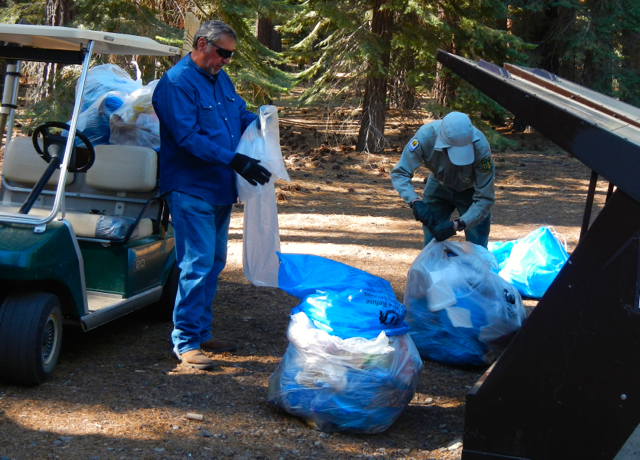
Paul Cleveland and Matt Diamond empty the trash from the bear boxes on July 5 at Kiva. Photo/Kathryn Reed

Paul Cleveland and Matt Diamond empty the trash from the bear boxes on July 5 at Kiva. Photo/Kathryn Reed

A lot of this has to do with a lawsuit filed in 2013 by a Marla Bay couple who were tired of the fireworks debris that kept floating on their property. The following year groups like the League to Save Lake Tahoe started organized beach cleanups. This has clearly helped get the beaches clean.

Meyers resident Kenny Curtzwiler was ahead of the curve. He started rallying his staff to 2000 to clean the majority of El Dorado Beach, along with Regan Beach and the walkways surrounding Highway 50 in South Lake Tahoe.

Now there is also a greater effort to get people to clean up after themselves. The Take Care campaign that was launched in 2015 through the Tahoe Fund is one effort.

Sue Westphal of San Jose was one of the League’s volunteers at Kiva Beach on Tuesday. She picked up a trash bag of trash. Apparently the next step is to convince people to actually take their garbage with them.

Hikers and backpackers are familiar with the motto: Pack it In, Pack it Out. Beachgoers, not so much.
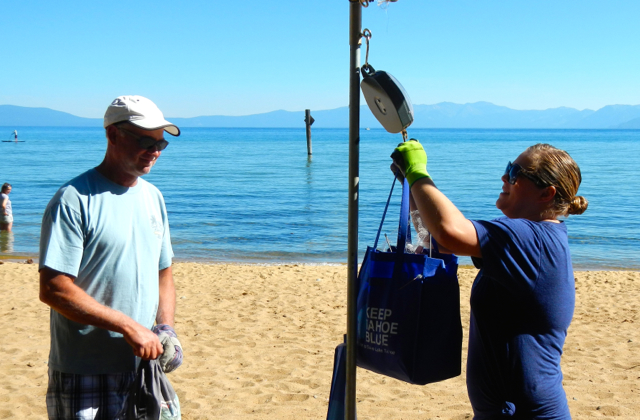
Gina Hunt with the League weighs the trash Greg Psilopholos collected. Photo/Kathryn Reed

Gina Hunt with the League weighs the trash Greg Psilopholos collected. Photo/Kathryn Reed

The League’s 330 volunteers collected nearly 1,600 pounds of trash on July 5 from nine beaches in the basin. They were scouring 4.5 miles of shoreline at Kiva Beach, Tallac Historic Site, Regan Beach, El Dorado Beach, Timber Cove, Nevada Beach, Zephyr Shoals, Kings Beach, and Commons Beach on the North Shore.

In that cache were 7,738 cigarette butts. Single use plastics such as straws, plastic bottle caps and bottles also turned up in high numbers.

“There was plenty to pick up (at Nevada Beach), but it’s not the worst I’ve seen it,” Chris Carney of the League told Lake Tahoe News.

That’s the beach Greg and Patty Psilopholos of South Lake Tahoe worked at last year. This July 5 they hauled in 20 pounds at Kiva. Nearly a case of empty Coors cans, clothing, a towel, snorkel, mask and other items were retrieved.

Alexa Burke of South Lake Tahoe brought out 2½-year-old Connor to Kiva for the clean up.

“It’s a good activity with the little one,” Burke told Lake Tahoe News. “You play at the beach and it’s like a scavenger hunt.”

Mostly what they were finding were cigarette butts.
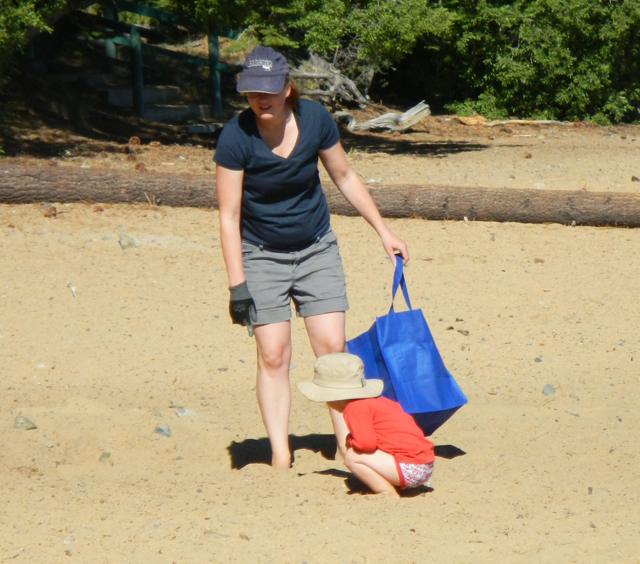
Alexa and Connor Burke are in search of trash at Kiva. Photo/Kathryn Reed

Alexa and Connor Burke are in search of trash at Kiva. Photo/Kathryn Reed

Paul Klempner of South Lake Tahoe was with his 10-year-old granddaughter, Sophia Arias of Sparks, at Kiva.

“The best part for me was to clean up trash that people didn’t cleanup after themselves. And to keep Tahoe clean,” Sophia told Lake Tahoe News.

The heaviest item in her 2 pounds of litter was a Jack Daniel’s bottle.

Lots of bags of dog poop were also found at Kiva; apparently people didn’t realize just bagging isn’t enough.