Caesars Entertainment, Caesars Acquisition amend merger deal

By Tom Hals, Las Vegas Review-Journal

Caesars Entertainment Corp and Caesars Acquisition Co. have amended their proposed merger agreement, which is intertwined with the $18 billion bankruptcy of the casino company’s main operating unit, the companies said on Monday.

The operating unit, Caesars Entertainment Operating Co., or CEOC, received approval from a U.S. bankruptcy judge last month to begin seeking votes from creditors on its plan to restructure its debt and exit bankruptcy.

The bankruptcy plan would slash $10 billion of debt and split the CEOC unit into a new operating company and a real estate investment trust.

Caesars Entertainment is the parent company of Harrah’s Lake Tahoe and Harveys in Stateline.

Read the whole story


EDC supes OK $60 million sheriff’s facility

By Kathryn Reed

By March 2019 it’s possible the El Dorado County Sheriff’s Department will be operating at one facility instead of the current 13 on the West Slope.

A multi-million dollar public safety facility has been talked about for years as the current buildings kept losing their usefulness and the cost of out-sourcing some operations continued to escalate. The Board of Supervisors at a special meeting on July 11 pulled the trigger to go forward with the project.

“This project will finally bring all the functions of the sheriff’s office to one location, enabling us to provide the best level of public safety to the people we serve and eliminate costly lease payments and create efficiencies in communication and crime solving,” Sheriff John D’Agostini told Lake Tahoe News.

The board was presented with multiple projects. In the end the most expensive — $60 million – was chosen. This provides the department with essentially everything it wanted.

In three years El Dorado County Sheriff's Department's operations should be on one campus in Placerville.

In three years El Dorado County Sheriff’s Department’s operations should be on one campus in Placerville.

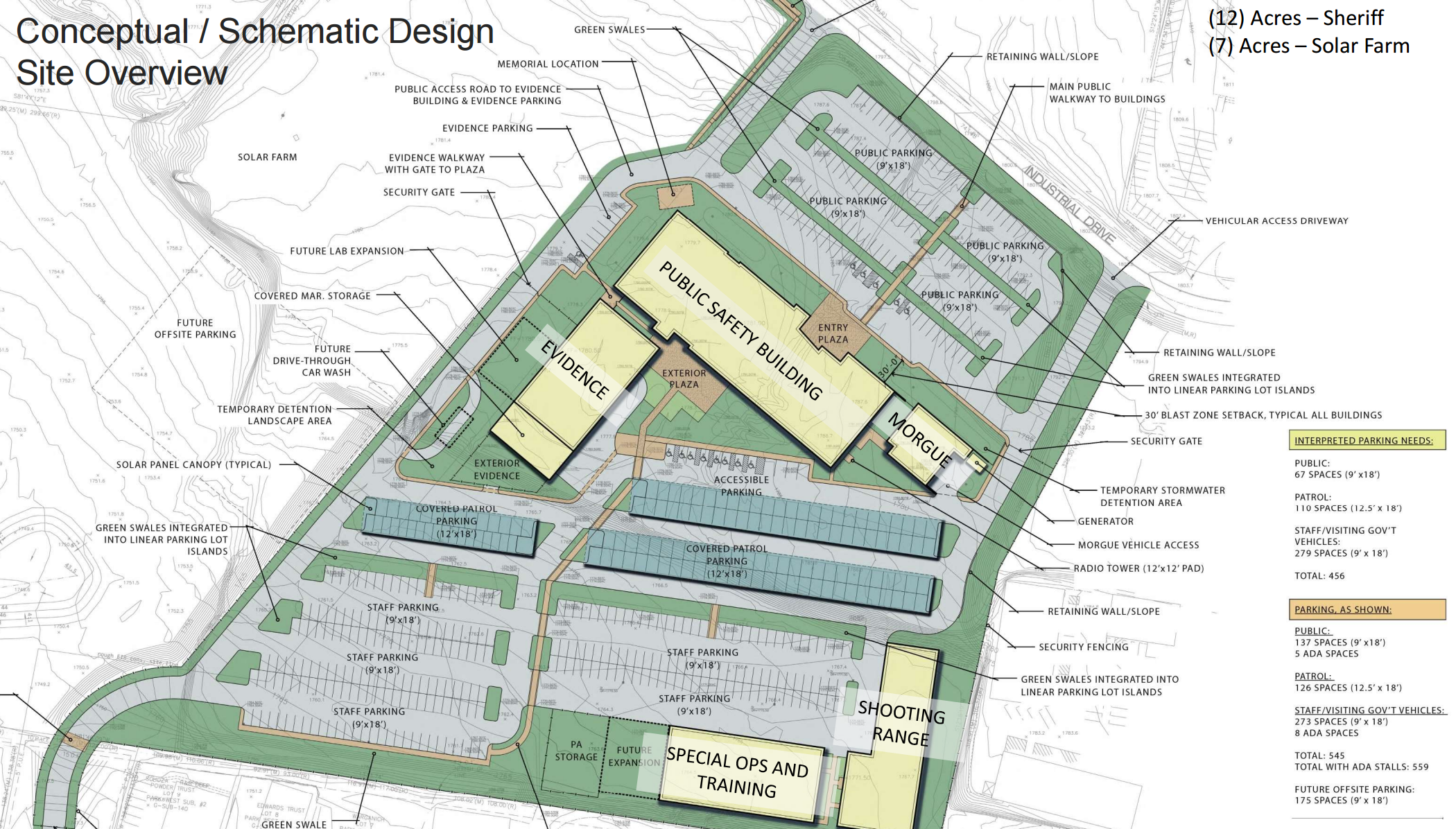
A 30.7-acre parcel off Missouri Flat and Industrial roads in Placerville had already been acquired, with the main use for the sheriff’s department. Five buildings on 12 acres will be for law enforcement. Another 7 acres may become a solar farm. Development has not yet been planned for the remaining acreage.

To pay for the facility, the county is going after a loan from the U.S. Department of Agriculture. Supervisors on July 26 will be asked to approve the final application. If the 40-year loan can be locked in by Sept. 30, the interest rate will be 2.75 percent, according to Shawne Corley, assistant chief administrative officer.

A criterion to qualify for this loan is to show five years’ of future balanced budgets. When former CAO Larry Combs this spring released the budget it neither had the sheriff’s department project in it nor future balanced budgets.

Supervisors at the June 28 meeting gave direction to current CAO Don Ashton to re-do Combs’ work. This means staff will be coming back to the electeds with ideas for how to fund the annual $2.6 million loan payments for the public safety facility.

“First we’ll work on efficiency and not necessarily just cut things,” Corley told Lake Tahoe News.

She said it’s too soon to know what the cost containment plan will look like. The final county budget for the 2016-17 fiscal year is due in September.

The staff report from Monday’s meeting said, “Regardless of which construction option is chosen, there will be a significant impact on the budget, requiring difficult service level decisions beginning this year.”

Corley said with her and Ashton being new to their jobs, they are apt to see things in the budget that others might not have – places that can be tightened or cut made without being a drastic sacrifice.

“I understand this is the biggest thing the county has ever taken on and the huge responsibility the Board of Supervisors has in regards to the overall county budget,” D’Agostini said. “This project is absolutely essential in providing the most important service to our communities and the county as a whole, that of public safety that the Board of Supervisors placed in the county’s strategic plan as the top priority. This project will never cost less than it does today. Not tomorrow, next week, next month or next year.”

The new operation will allow the county to conduct forensic autopsies on site instead of going to Sacramento. The gun range will also be part of the new campus. A training facility will also be incorporated. In all, 99,000-square-feet of space will be developed.

“The sheriff has need for extensive storage,” Russ Fackrell, county facilities manager, told Lake Tahoe News. “They have to keep evidence sometimes for more than 50 years. If the convicted person is in jail for life, they have to maintain that evidence for the whole time they are incarcerated.”

Land will also be used to store vehicles – from patrol cars, to boats, to command centers.

The main building being used today is slated to be demolished. In its place will be a juvenile detention center. The board has approved the project that comes with a price tag of nearly $12 million. Most of that — $9.6 million – will come from a state grant.

Many of the other facilities are leased, so that will be a savings.

Office space in the government complex now used by law enforcement will be taken over by other county entities.

These new buildings are expected to last 50 or more years.


Calif. property tax revenues to increase by $3B

By Dan Walters, Sacramento Bee

A strong surge in real estate transactions, new commercial and residential construction and rising housing prices should generate a $3-plus billion increase in property tax revenues for schools and local governments during the current fiscal year.

Local property tax assessors closed their books on June 30 and are reporting valuation gains ranging as high as 9 percent in San Francisco, which has the state’s hottest property market.

Just one major county, Kern, has reported a loss of taxable property values and it’s unique in that a major portion of its taxable property is underground, in the form of oil and has reserves.

Read the whole story


Chimney catches fire on North Shore

A chimney fire in Dollar Point on Tuesday night was contained to the roofline.

With temps in the 30s the past couple nights, people have been warming their homes with fires.

The full-time residents were not injured in the blaze that started about 8:30pm July 11.

“It’s a good idea to get your chimney cleaned and now is the perfect time to do it. We build fires year round. You need to keep them clean,” Beth Kenna with North Tahoe Fire told Lake Tahoe News.

— Lake Tahoe News staff report


Bike collision in Truckee may have led to death

A 57-year-old Truckee woman who died in her sleep may have succumbed to injuries from a bike accident.

Zoe King was pronounced dead at 5:14 this morning.

Jeremy Allen, the deceased’s boyfriend, told officers the two were riding bikes the night of July 11 on High Street when they collided. They reportedly got a ride home by Good Samaritans.

Officers would like to talk to the couple who provided the ride.

“No foul play is suspected at this time and the thoroughness of the investigation is a standard protocol for us in these types of situations,” Detective Sgt. Robert Womack said in a press release.

— Lake Tahoe News staff report


Brown looks to extend climate-change programs

By Ellen Knickmeyer and Juliet Williams, AP

SACRAMENTO – Gov. Jerry Brown has launched a campaign to extend some of the most ambitious climate-change programs in the country and ensure his environmental legacy when he leaves office in two years.

The centerpiece of the push is a cap-and-trade program that aims to reduce the use of fossil fuels by forcing manufacturers and other companies to meet tougher emissions limits or pay up to exceed them. The program has been one of the most-watched efforts in the world aimed at the climate-changing fuels.

The four-year-old program, however, is only authorized to operate until 2020 and faces a litany of challenges, including a lawsuit questioning its legality, poor sales of credits, and lukewarm support among Democratic legislators to extend it.

On Tuesday, the California Air Resources Board will release a proposed blueprint for continuing the cap-and-trade program until 2030, with a vote expected next year.

Supporters credit the strategy – born under previous Gov. Arnold Schwarzenegger, a Republican, and stemming from other climate change programs initiated under Brown – with helping to cut California’s overall output of emissions by 1.5 percent in its first two years, despite the massive energy demands of the state’s thriving economy.

With Brown set to leave office in 2018, a state appeals court is considering a challenge from the California Chamber of Commerce contending the pollution-credit program is an illegal tax, not a fee.

Environmental groups say the lawsuit and overall uncertainty about the survival of the program are undermining the market for pollution credits. A May auction saw companies buy only one-tenth of the available credits, leaving the state billions of dollars short in projected revenue from the sales.

Meanwhile, groups representing oil interests confirmed last week that they are in direct talks with the Brown administration over cap-and-trade.

California oil companies have long sought to alter or repeal the state’s low-carbon fuel standard. By 2020, those companies would be required to reduce the carbon content of gasoline and other fuels by 10 percent, a significant jump from the current 2 percent.

Any deal-making on climate change would reflect a pragmatic approach to the oil industry by Brown, who took office encouraging immediate boosts in oil and gas drilling to spur California’s economy, even as he promoted incentives that would reduce long-term reliance on fossil fuels.

“What you’re seeing now is an all-hands-on-deck effort to formulate the most responsible way forward.” said Derek Walker, an associate vice president of the Environmental Defense Fund. “They’re talking to the oil industry, talking to environmental groups, to organized labor – they’re talking to everybody.”

Brown has leveraged his position as governor to help draw attention to the battle against climate change. He has set non-binding mandates for increased use of solar, wind and other renewable energy sources in California in the decades to come while signing accords and global support statements aimed at easing climate change.

At home, though, Brown has encountered trouble from moderate Democrats in the state Assembly who last year blocked his plan to slash statewide petroleum use in half within 15 years.

The same lawmakers refused to endorse legislation by Sen. Fran Pavley, D-Agoura Hills, seeking to dramatically cut greenhouse gas emissions through 2050. Pavley was forced to scale back her proposal that now would extend only to 2030. She has since compromised even further, agreeing last month to merge parts of her plan with legislation mandating that revenues from such programs be spent in low-income communities affected by pollution.

Winning legislative support could be key for Brown in ensuring the survival of the cap-and-trade program, said Jessica Levinson, a political science professor at Loyola Law School.

“His ability to solidify cap and trade is a big part of being able to say to other governors, to other countries, ‘We’re doing something big and specific and real and it works,“’ Levinson said.

Should the program succumb to legal challenges, market weakness or legislative ambivalence: “Jerry Brown’s fingerprints will be on whatever we ultimately decide to do,” Levinson said.


Nev. drone institute sees broad horizons with FAA rules

By Associated Press

Officials in Nevada say they see broad horizons for the unmanned aerial systems industry following the posting of federal aviation rules designed for small drone aircraft.

As one of six states picked in 2013 for Federal Aviation Administration-authorized testing — and the first in 2014 to be able to issue airworthiness certificates — the Silver State is emerging as a key hub for the drone industry, said Chris Walach, operations director for unmanned aviation at the Nevada Institute of Autonomous Systems.

“We have the education structure, we have the knowledge set, we have the skills, we have the industry base and the resources … to become the thought leader in the global industry,” Walach told the Las Vegas Review-Journal.

In Congress, Democratic Rep. Dina Titus of Nevada noted this week that a House Transportation and Infrastructure Committee funding measure includes provisions to certify Nevada as an unmanned aviation systems testing state through 2020.

The FAA says the six drone testing states — the others are Alaska, New York, North Dakota, Texas and Virginia — are equals. But the Nevada Institute is the only FAA-designated airworthiness representative, able to independently certify unmanned aircraft.

Walach said the program, working with the governor’s economic development office, focuses on boosting drone industry small businesses, research, development, manufacturing and jobs.

The FAA regulation approved June 21, known as Part 107, sets standards for routine use of drones weighing less than 55 pounds by real estate agents, farmers, filmmakers and countless other commercial operators.

The long-anticipated rules mean commercial operators can fly drones without special permission.

William O’Donnell, an executive at Las Vegas-based AviSight, an aerospace and remote sensing services company, told the Review-Journal the new rule knocks down a huge barrier for drone operators who currently need a pilot’s license and a so-called 333 exemption from the FAA.

“And if people are getting their training here, they can open their businesses here and really push the state in becoming the best out there in terms of commercial drone activity,” O’Donnell said.

Researchers at the Desert Research Institute and UNLV College of Engineering are also studying applications for unmanned systems.

UNLV engineering Professor Woosoon Yim said one program he’s studying would allow plug-and-play interchangeable measuring devices for drones, including radiation, chemical and water vapor sensors.


Calif.’s economy bigger than all but five nations

By Associated Press

Data from the World Bank show that California’s economy was equivalent to the sixth largest in the world last year.

The World Bank’s annual rankings of countries’ gross domestic products, released on Friday, confirm an analysis published last month by the California Department of Finance.

The U.S. Bureau of Economic Analysis reported last month that California’s GDP was $2.5 trillion in 2015, up 4.1 percent from a year earlier.

California saw more economic growth than the United States as a whole, which was up 2.4 percent.

But California’s rise in the global rankings comes largely at the expense of Brazil, which is struggling economically, and France, which was burdened by a weaker currency.

Only five countries produced more last year than California: the U.S., China, Japan, Germany and the United Kingdom.


BLM firefighter from Zephyr Cove dies in crash

By KOLO-TV

A crash on Highway 140 north of Winnemucca killed two Bureau of Land Management firefighters and sent a third to a hospital Sunday.

The driver of the BLM fire truck was 27-year-old Jacob O’Malley of Zephyr Cove, according to the BLM. The right front passenger was 22-year-old Will Hawkins of Reno. Both men died in the crash.

The passenger seated in the middle of the truck is 23-year-old Zachery McElroy of Reno. He was transported to Renown Regional Medical Center via Care Flight with non-life-threatening injuries, according to the Nevada Highway Patrol.

Read the whole story


Past transfers of federal land to Nevada led to corruption, history suggests

By Sean Whaley, Las Vegas Review-Journal

CARSON CITY — Some Nevadans are pushing the federal government to transfer more public acreage to state control, but history suggests past management of these lands by those entrusted with their care was mired in corruption.

The current push for a transfer is underway because about 85 percent of Nevada is controlled by various federal agencies, primarily the U.S. Bureau of Land Management, according to the Nevada Legislature.

But if Nevada officials failed before, what guarantee is there that it won’t happen again?

The late Republican Gov. Charles Russell, in an oral history recorded in 1965-66, strongly criticized Nevada’s management of the lands the state received from the federal government when it became a state in 1864.

Read the whole story