College isn’t always the way to get ahead

By Shahien Nasiripour, Bloombert

For generations of Americans, a college degree was the best way to advance. These days, it may be a way to avoid losing ground.

That’s the unfortunate reality facing millions of Americans in an era of stagnant wages and soaring higher-education costs. Encouraged by government officials to seek out further education and provided with hundreds of billions of dollars in cheap taxpayer-backed credit to finance those dreams, Americans in recent years flocked to college campuses to obtain credentials they hoped would lead to more fulfilling or better-paying jobs.

The result? Outstanding student debt has doubled since 2009 to nearly $1.4 trillion, according to the Federal Reserve.

Read the whole story


Wildland fire burning in steep terrain near Kyburz

A fire that started Saturday afternoon in the American River Canyon on Highway 50 has burned 30 acres as of 8:20pm. It is 10 percent contained.

Flames could be seen from the highway. The Alder Fire started on the south side of Highway 50 near Sand Flat Campground. It is near Ice House Road between White Hall and Kyburz, burning in steep terrain.

The cause is unknown, though there had been no lightning on Aug. 6.

Air and ground resources have been deployed.

— Lake Tahoe News staff report


Big marijuana not calling the shots in Nevada

By Ric Anderson, Las Vegas Sun

As Nevada voters prepare to vote this fall on whether to decriminalize recreational marijuana use, they’re going to hear a sinister-sounding warning that the push for legalization is being fueled by out-of-state money.

Former Assemblyman Pat Hickey, a prominent opponent of legalization, already sounded the alarm in a June 21 post on his blog, Soup to Nuts. He wrote that “the term oligarchy (‘a business interest controlled by a small group of people’) applies to the mostly out-of-state special interests who are responsible and largely paid for the pot legalization question on this November’s ballot.”

Sounds foreboding. But voters should be aware that we do know where a great deal of the funding is coming from — longtime Nevadans who have invested in the business.

In fact, when state lawmakers crafted the licensing requirements for operators of marijuana businesses, they took pains not to open the door wide to outside control of the industry.

Read the whole story


Obama, fuels reduction funding may highlight Lake Tahoe Environmental Summit

Updated: Aug. 8 to reflect President Obama is definitely attending.

By Kathryn Reed

Protecting Lake Tahoe has been on the radar of the federal government for decades – and not just because the feds own 85 percent of the land in the basin. Congress implemented regulations mandating effluent be pumped out of the basin, created the Tahoe Regional Planning Agency, and funded the Lake Tahoe Restoration Act after President Bill Clinton’s visit in 1997.

The EIP – environmental improvement program – was established after the inaugural Lake Tahoe Environmental Summit when Clinton and Vice President Al Gore launched the annual event.

With this being the 20th anniversary of the summit and its being Sen. Harry Reid’s last one, it is being hailed as a bigger deal than the ones in recent years. Reid, D-Nev., is hosting the summit at Harveys in Stateline on Aug. 31 at 2pm.

New this year is that it costs to attend the event. Tickets are available online.

The Killers, the group that performs Nevada’s tourism theme song, will be putting on a concert for attendees.

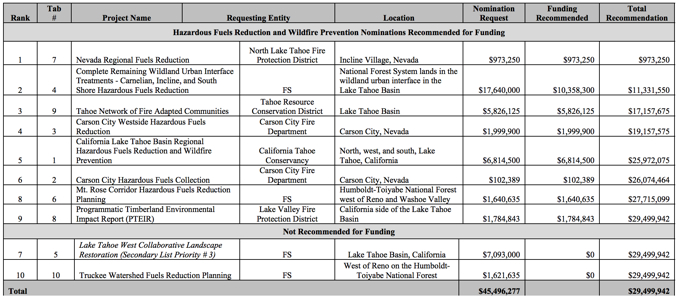
President Obama will be attending. Those close to the event are hoping he’ll bring news that the basin has been awarded the $29,499,942 for fuels reduction from the Southern Nevada Public Lands Management Act.

The White House has contacted Lake Tahoe Airport about Air Force One landing there.

Source: BLM

Source: BLM

SNPLMA was created in 1998. Land the federal government no longer wants in the Las Vegas Valley is sold, with the proceeds going to public entities. The Lake Tahoe Basin has received more than $300 million of these proceeds for environmental improvement program projects.

The Bureau of Land Management, which handles SNPLMA money, did not return a call asking when a decision will be made about this 16th round of funding. The comment period on allocations ended July 28.

The preliminary recommendation is for eight of the 10 funding requests to be filled. Though the sales are in Nevada, money can be spent in California in the basin. Of the nearly $30 million that would be just for forest fuels reduction, about $2 million is allocated to Carson City and the remainder in the Tahoe area.


Stoned-driving laws still half-baked

By Peter Fimrite, San Francisco Chronicle

There are certain telltale signs that a person is stoned: bloodshot eyes, forgetfulness, ravenous late-night cravings.

But the November ballot measure that would legalize recreational pot in California says nothing about how police should detect tokers who climb behind the wheel. There’s no marijuana equivalent to the famed blood-alcohol content tests — taken by breath, blood or urine — that have planted .08 into the American consciousness.

It’s not a pressing concern for marijuana advocates, even as entrepreneurs try to develop a better sobriety test for dope smokers. But it’s a big quandary for California law enforcement officers, who are facing a question that has vexed several other states where recreational pot is legal.

Read the whole story


Grim beginning to California fire season

By Joseph Serna and Veronica Rocha, Los Angeles Times

As California enters traditional brush-fire season, there is something ominous in the air and on the ground.

Drought-stricken and ready to burn, the tree canopy in the central and southern end of the Sierra Nevada is awash in yellows, browns and oranges. Many of the trees showing green are already dead, but they just haven’t shown it yet, said Jeffrey Moore, acting regional aerial survey program manager for the U.S. Forest Service.

“From our written history, this has probably been the worst situation California’s forests have faced,” Moore said. “If a fire comes in, it kills everything and leaves nothing behind.”

Already, the fire statistics for 2016 are grim.

State fire officials estimate roughly 223,600 acres, or 350 square miles, of California have burned so far this year in some 4,000 wildfires on state and federal land. More than 300 homes have burned, and eight people have been killed, including a bulldozer operator helping fight a fire.

Read the whole story


CHP makes record number of air rescues in July

By Kathy Park, KCRA-TV

California Highway Patrol air rescues hit a record last month in Northern California due to emergencies at popular outdoor attractions.

“We had the most rescues ever recorded in our unit, about 40 of them,” CHP pilot Jason Hertzell said.

In July 2015, CHP conducted 30 rescues.


Last month, most of the air rescues were between Colfax and the Lake Tahoe Basin, and half of them required a hoist.

Read the whole story


CTC chief could derail SLT Whole Foods deal

By Kathryn Reed

It’s true – a Whole Foods is looking at coming to South Lake Tahoe. But the deal has not been consummated.

It wouldn’t be the big grocery stores, but instead one of the chain’s new concepts called 365 by Whole Foods Market.

Some have compared them to a Trader Joe’s. Besides being smaller, more in the 30,000-square-foot ballpark, they have a large grab-and-go section, pricing is different so the moniker “whole paycheck” isn’t quite as true, and there is a rewards program.

Two of these stores opened this year – one in Southern California, the other Oregon. Eighteen others are in the development phase in eight states.

The South Lake Tahoe store would go where the Knights Inn is on Highway 50 near Ski Run Boulevard.

“We are not at the point where we can talk about the project we are doing with city just yet,” Chris Peto, COO with Halferty Development, told Lake Tahoe News.

He did say Whole Foods is one of the possible tenants, but would not commit. However, others close to the project have told LTN Whole Foods will be the anchor.

Halferty Development of Pasadena is purchasing the developable portion of that site for $4 million from South Lake Tahoe. The city is paying $6 million for the property that is owned by Pradip Patel. Halferty is also buying the adjacent parcel dubbed the “southwest corner” for $1.1 million from the city. The city will retain ownership of the non-developable acreage of the Knights parcel, the conference center on Lloyd Avenue and the current owner’s residence.

The area in green represents the area South Lake Tahoe wants to acquire, while the gold are is the "southwest corner" property at Ski Run and Highway 50. Map/South Lake Tahoe

The area in green represents the Knights Inn, while the gold are is the “southwest corner” property at Ski Run and Highway 50. Map/South Lake Tahoe

The combined retail complex will be four buildings that could open in fall 2018. The Whole Foods would be the largest building. A T-shape building is proposed to go in at Ski Run that will be about 12,000-square feet, with a 5,000-square-foot building at Herbert Avenue and another one that size that may be a restaurant in the middle of the complex.

This is likely to be a $10 million investment from Halferty.

While the other tenants have not been disclosed, a wine bar has been discussed.

The 110 hotel units can be converted into commercial floor area – two commodities the Tahoe Regional Planning Agency created as a way to curb development. (The rooms bring in about $100,000 a year in transit occupancy tax.)

At the end of the day, the city anticipates having excess commodities that can be used elsewhere or sold. The increase in property and sales taxes is estimated to bring in much more than the hotel tax ever did.

City officials have been working for nearly four years with Halferty on the southwest corner, and more recently on the Knights site. The development company originally wanted to put a drive-through pharmacy there. The city intervened in an attempt to get something better – in terms of adding variety to the commercial offerings in town, a project with a stronger tax base and buildings that would be more pleasing – especially at a key intersection.

For much of this year the negotiations have been touch-and-go. It has to do with environmental groups in the basin trying to dictate what should happen. TRPA – the bi-state regulatory agency, California Tahoe Conservancy – which has neighboring properties, and the League to Save Lake Tahoe – the basin’s environmental watchdog, have all been at meetings between the city and developer.

“In regard to potential redevelopment of the Knights Inn site, there was some early thought that California Tahoe Conservancy Prop. 1 funding might be available to help pay for environmental improvements as part of a project,” TRPA Executive Director Joanne Marchetta told Lake Tahoe News. “That Prop. 1 funding may not be available, so the parties are all working to negotiate the best possible redevelopment project. The city of South Lake Tahoe is still negotiating and fine-tuning the parameters of this potential redevelopment project with other partners. Those talks include incorporating things such as water quality improvements.”

(The city has jurisdiction over permits for the project. The TRPA would get involved with tourist bonus units.)

The city in March spoke to the CTC board about obtaining a multi-million dollar grant for stream environmental zone restoration and water quality improvements. This is a routine allocation of CTC money. The board is expected to vote on the grant in September.

CTC Executive Director Patrick Wright has indicated that now he will ask his board to not allocate the money. Publicly he has not said why. However, those close to the talks say it is because he isn’t getting the project he wants so he is being an obstructionist. Wright did not respond to inquiries from LTN.

Larry Sevison, who is chair of that board, was unaware of any issue with allocating funding to the city until LTN called and therefore wasn’t able to talk about the subject matter.

“… projects like the Knights Inn, which is already located in a designated town center, must maximize environmental benefits. We hope we do not lose the opportunity to restore the section of stream through the parcel, which would help reduce stormwater pollution that currently flows from neighborhoods and developed areas above the parcel and into the lake via pipes at Ski Run Marina,” Darcie Goodman Collins, executive director of the League, told Lake Tahoe News. “The currently existing infrastructure under the inn is failing and polluting the lake. Any new development on the site should repair and replace that infrastructure and daylight the creek.”

City Manager Nancy Kerry told Lake Tahoe News, “This project achieves those things. It achieves both economic and environmental goals.”

What it won’t achieve is all of the potential environmental goals without the state – aka CTC – helping.

City officials estimate 8,000 pounds of sediment could be prevented from reaching the lake with the proper erosion control measures put into place. This in turn would meet more than 20 percent of the city’s sediment reduction goals that Lahontan Water Quality Control Board has mandated for the five-year period starting this year.

Not having the CTC on board is forcing the developer to rethink what the project will ultimately look like and what it is willing to spend. Build-to-suit agreements with tenants are also in jeopardy.

If the CTC says no, the city is prepared to scale back the environmental improvement aspect of the project while at the same time seeking grant funding elsewhere, including from the state Department of Water Resources.

Kerry said this project shows why it is near impossible to get rid of old hotels and redevelop them. With hotel rooms (aka tourist accommodation units) and commercial space being commodities, it inflates the price of a building – in terms of purchasing it or constructing it from scratch – to the point it’s easier to do business outside the basin. There is little or no incentive for developers to go the extra step with the environmental fixes because there is no return on investment. It takes public dollars to get the big gains. That is why grants from the CTC and others help bring the biggest environmental benefits to a project.


Few Nevadans like their retirement prospects

By Jason Hildago, Reno Gazette-Journal

At 70 years old, Dee Goodman has clocked in decades as a member of the American workforce.

Ask the small business owner about retirement, however, and she just shakes her head. As the owner of Old West Barber in Reno, Goodman says she still loves doing her job. For many of the folks who sit in her barber chair and share their stories, however, retirement is easier said than done.

“Used to be, my financial man told me to put away 10 percent of my income to be able to live the way I want to live when I retired,” Goodman said. “People just don’t have that kind of money to put away.”

That sentiment was echoed by a majority of Nevadans surveyed in a new Wells Fargo/USA Today poll, which found 51 percent of respondents doubted they’d have enough income for an ideal retirement. In contrast, just 38 percent said they had confidence.

Read the whole story


Tahoe Douglas Fire hires bomb sniffing dog

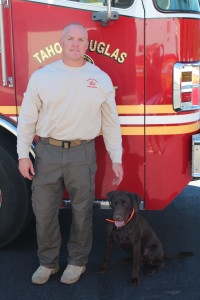
TDFPD Battalion Chief Todd Moss with Gunner. Photo/Provided

TDFPD Battalion Chief Todd Moss with Gunner. Photo/Provided

Gunner has a nose for danger.

He is the newest recruit at Tahoe Douglas Fire Protection District. He is officially a member of the Tahoe Douglas Explosive Ordinance Disposal team. Gunner is the seventh canine resource for the Northern Nevada Bomb Technicians Task Force.

Battalion Chief Todd Moss is his handler. Even though Gunner is still in training, one of his duties was to inspect Edgewood Tahoe Golf Course every day before the ACC celebrity tournament last month. When he is fully trained, he will be able to identify commercial and homemade explosives.

Tahoe Douglas Bomb Squad is one of the four FBI accredited bomb squads in Nevada – FEMA Type I classification. It is a joint effort between the Tahoe Douglas Fire Protection District and the Douglas County Sheriff’s Office