Caesars plans to convert corporations into LLCs

By Richard N. Velotta, Las Vegas Review-Journal

Nevada gaming regulators have recommended approval of Caesars Entertainment’s plan to convert its operating and real estate corporations into limited liability companies.

The conversion, approved Wednesday by the state Gaming Control Board and expected to be reviewed by the Nevada Gaming Commission Aug. 25, would minimize the companies’ and Caesars creditors’ tax liabilities in the bankruptcy case that has been ongoing since January 2015.

The action was part of two matters involving Caesars that included the recommended licensing of three executives, one of which led to extensive questioning by board members. The board ultimately recommended licensing for senior vice president Scott Wiegand, who serves as corporate secretary and deputy general counsel for Caesars Entertainment Operating Co. and secretary for subsidiaries Desert Palace Inc. and Harveys Tahoe Management Co. in Stateline.

Caesars is the parent company of Harrah’s Lake Tahoe and Harveys.

Read the whole story


Truckee man accused of felony DUI

A Truckee man was arrested early Thursday on charges of felony driving under the influence and and felony hit and run.

Richard Grundy Jr.

Richard Grundy Jr.

Richard Grundy Jr., 50, reportedly left his vehicle at Highway 89 and Rainbow drive after running off the road and hitting the dirt embankment about 1:20am Aug. 11.

“When the witness stopped to check on the driver and passenger, the driver told him not to call the police and he fled into the woods with the passenger,” Truckee police officers said in a press release.

Officers found Grundy and his passenger at their residence.

The passenger, whose name has not been released, was taken by ambulance to Tahoe Forest Hospital to be treated for injuries reportedly sustained in the accident.

Grundy has a prior conviction for felony DUI with injuries.

— Lake Tahoe News staff report


Calif. water supply pits farmers against fish

By Robin Abcarian, Los Angeles Times

The offer was too tempting to refuse: Westlands Water District, the ethically challenged agency that often finds itself in the news for all the wrong reasons, invited me on an aerial tour of its watershed.

From high above, I would be able to see the public works projects that have allowed the San Joaquin Valley to bloom, cities to explode and the natural environment to implode.

As someone who spends every flight between Los Angeles and Northern California with her nose pressed against the window, checking out reservoir levels, snow lines and lately, plumes of wildfire smoke, how could I say no? The engineering of water is the ultimate California story.

Soon, we were skirting the western edge of the Sierra Nevada, Yosemite’s granite peaks visible in the distance. Suddenly we were over Friant Dam, one of dozens of early- to mid-20th century federal dams, canals and reservoirs designed to transport Northern California’s abundant water to the dry but fertile San Joaquin Valley.

Friant harnessed the flow of the San Joaquin River, which was great for farmers. But it was a disaster for the river, and its Chinook salmon, which will probably never recover.

Read the whole story


Placer saving big with being energy efficient

Through a comprehensive effort to reduce energy use across its facilities Placer County has saved $1 million a year since 2008.

Without energy-saving efforts, the county’s annual energy costs would be about $1 million higher than current levels. Despite significant cost increases for energy in the last eight years, the county’s annual costs have seen an annual decrease of $160,000.

Initially, the county assessed the efficiency of energy systems and controls to understand how energy was being used and how much was being used. Facilities conducted cost-benefit analyses on building systems to determine if replacement or upgrades would cost less money over time.

Equipment and controls were upgrade, funded in part by grants and low-interest loans.

The Animal Services Center, when opened this year, will be the most energy efficient Placer County building ever constructed. The facility is a LEED gold building.

— Lake Tahoe News staff report


Hwy. 89 closures on South Shore coming in Sept.

Highway 89 near South Lake Tahoe from just south of the Cascade Creek Bridge to Bayview Campground and Inspiration Vista Point will be closed at various times in September.

The full roadway closure is scheduled starting Sept. 12 at 4am and ending Sept. 16 at 4pm,  and then again from Sept. 19 at 4am through Sept. 23 at 4pm.

During the closure traffic will be allowed to travel through the work zone between 4pm and 4am Tuesday-Friday. There will be no closure during the weekend from 4pm Friday to 4am Monday.

The work being done by Caltrans is part of the $13 million Emerald Bay water quality improvement project. The closure is for one portion of the project’s cold planing and hot mix asphalt paving work located on a ridge with steep slopes on either side of the roadway immediately adjacent to paved surfacing with steep mountainous terrain and tight switchbacks.


Nev. may allow gambling without cash

By Richard N. Velotta, Las Vegas Review-Journal

Nevada casino customers inched closer Thursday to being able to sign up for and fund a wagering account that could be used to gamble at slot machines, table games and bingo parlors.

The concept of using wagering accounts is already in play for sports betting, mobile wagering and online poker play within the state. Extending the use of an account through a loyalty card is the next iteration of making it more convenient for customers to play without cash.

Members of the state Gaming Control Board conducted a workshop meeting Thursday to discuss amendments to regulations that would enable play through pre-established accounts.

Read the whole story


Commissioners OK Squaw Valley mega project

squaw

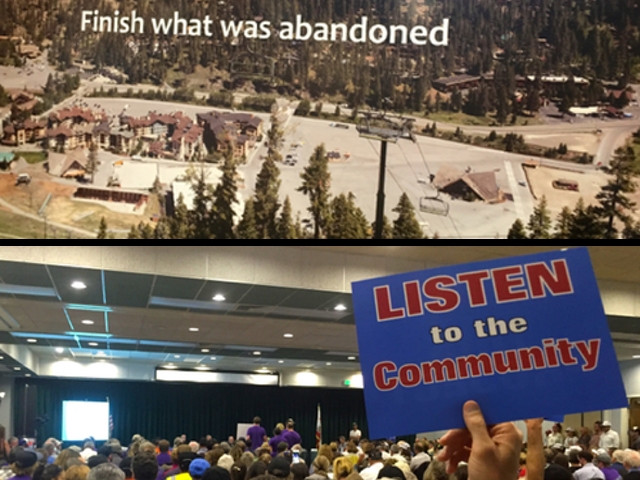
The two sides of the proposed development at Squaw Valley’s village. Photos/LTN

By Kathryn Reed

KINGS BEACH – On eight 4-2 votes, the Placer County Planning Commission on Thursday approved several items pertaining to the future of Squaw Valley.

KSL, which has owned Squaw since 2010, wants do what former Squaw Valley Village owner Intrawest did not do; complete the four-phase project. But this would be on a grander scale.

While the 1983 Squaw Valley General Plan allows for 4,200 bedrooms in Olympic Valley, the plan being proposed has 1,493 bedrooms. This includes 35 cabins (developer’s description) (time share mansions is opponents’ description) in Shirley Canyon – an area currently not developed.

“We would like to restore Squaw Valley-Alpine to a pre-eminent destination,” Andy Wirth, CEO of Squaw Valley, said. “There is a substantial deficit in the vacation experience in terms of the quality of lodging and variety.”

After nine hours, which included comments from nearly 100 people, the commissioners spent the next hour asking staff clarifying questions before they voted.

Commissioner Richard Johnson asked about issues in the 15-page letter Attorney General Kamala Harris sent on Tuesday.

Chief Deputy County Counsel Valerie Flood said, “I don’t see anything in the letter that would prevent us from going forward.” She said Harris didn’t say anything that others hadn’t already said.

(It is unusual for an AG to weigh in on an EIR.)

Harris wrote, “… the FEIR should be revised and recirculated to adequately address the project’s (green house gas) impacts and potential impacts to Lake Tahoe. Climate change is a critical issue for California and Lake Tahoe is a national, state, and local treasure and the county should not disregard impacts in these areas in reviewing the project. More information is needed to fully understand what the project’s impacts will be on greenhouse gas emissions and on Lake Tahoe.”

Immediately after the vote Aug. 11, Squaw CEO Andy Wirth, left, went to speak with Commissioner Wayne Nader, who voted no. Photo/LTN

Immediately after the Aug. 11 vote, Squaw CEO Andy Wirth, left, went to speak with Commissioner Wayne Nader, who voted no. Photo/LTN

Voting no were commissioners Wayne Nader and Mickey Gray. Gray represents the district where the project resides. Commissioner Fred Arcuri was absent.

The main decisions the commissioners had to make were whether to certify the final environmental impact report, approve the specific plan, amend the Squaw Valley General Plan, approve the development agreement and OK the water assessment.

Traffic was a main topic for the opponents – the level of service and the lack of analysis in regards to other proposed projects inside and outside the basin. (Squaw Valley is not in the Tahoe basin.)

Harris wrote, “Because of the proximity-of the proposed development to Lake Tahoe, we are concerned about the impacts the development will have within the Tahoe basin. We are particularly concerned with the project’s resulting increases in vehicular use and traffic within the basin.”

The EIR for the most part ignored Lake Tahoe.

Harris’ letter was one of more than 300 that were submitted.

This is not the end of the road for Squaw Valley Real Estate, the applicant and a subsidiary of resort owners KSL. The Board of Supervisors will have the final say regarding the potential billion-dollar, 25-year project. The supes are likely to hear the project proposal this fall.

The vote on Aug. 11 came after the Squaw Valley Municipal Advisory Council voted no in May.

More than 400 people turned out at the Squaw hearing, even though the capacity sign said 268. Photo/LTN

More than 400 people turned out for the Squaw hearing, even though the capacity sign said 268. Photo/LTN

Proponents say it’s necessary to offer year-round activities as well as something to do for non-skiers and for when the weather isn’t ideal. Opponents say the natural surroundings should be good enough.

Squaw is not unique in wanting to be more than a ski resort. Being a year-round destination and a self-contained playground is more profitable than a one-season business. Opponents don’t want resort owners to make a buck while sacrificing what the community is today.

It’s not that all opponents are satisfied with the status quo; many said they were open to improvements, but on a much smaller scale.

Wirth described the base of the mountain as being an 82-acre parking lot; in other words, it’s being wasted.

The plan includes a controversial mountain adventure center. Some call it a 90,000-square-foot indoor water park, others call it an athlete’s training facility. At the meeting a Squaw representative said it would be both and then some, with the final components decided as the resort gets closer to actually putting something in the ground.

A simulation was shown of what the buildings will look like as one drives up Squaw Valley Road from Highway 89. Six of them will be 96-feet tall, or eight stories.

About 400 people turned out for the daylong hearing – many showing their colors. Purple vs. white. If only it were that simple, the purple would have won by sheer numbers. They were the ones representing “Keep Tahoe True”. Those in white were about “Squaw Tomorrow”. The colors are strategic – purple and white have long been the colors of this resort.

The opposition was set out in front of the North Tahoe Event Center with signs, shirts and bumper stickers. Proponents were inside the lobby with large posters promoting the benefits. In the hearing room people held up signs saying “Deny this project” and “Listen to the community”.

Of the 98 people who spoke, 58 were against the project, while 40 were for it.

Most of those who spoke in favor of the project worked for Alpine or Squaw Valley, or somehow financially benefit from the resorts.

Water, traffic and affordable housing were the overriding concerns of opponents. The resort believes the water supply will be adequate even though data is based on wells yet to be drilled. Traffic is already an issue, as underlined by a captain with the California Highway Patrol. While commissioners touched on this, gridlock was not enough to derail the project. As for housing, 300 units will be built for people who work at the resort – some of which will be dormitory style.



Drones: the good, the bad and the ugly

By Katie Vane, High Country News

The Zapata Ranch in southern Colorado is one of the few places that bison can still roam freely. Until recently, scientists and volunteers surveyed the herd the old-fashioned way: with binoculars and the naked eye. “It’s a shock how you can lose track of 2,000 bison on a 45,000-acre unfenced pasture,” says Chris Pague, Colorado Nature Conservancy senior conservation ecologist. But last year, The Nature Conservancy counted the herd using an increasingly ubiquitous conservation tool: an unmanned aerial vehicle, more commonly known as a drone.

Drones can be cheaper, more efficient and safer than traditional manned aircraft, and may also provide more accurate data. A six-bladed drone and camera costs about $1,500, and can deliver imagery with resolution at the centimeter level. Government agencies and nonprofits are already exploring their use in conservation, land management and wildland firefighting, with at least a dozen pilot projects currently in the works.

But introducing new technology to wild areas is tricky. Drones may unduly stress wildlife, as a study of black bears in Current Biology last year demonstrated. Recreational drones have also endangered wildland firefighting crews.

And problems will likely mount as drone sales outpace regulations.

Read the whole story


3D-printed gun seized at Reno airport

By Scott Sonner, AP

RENO – The Transportation Security Administration says screening agents confiscated a plastic handgun produced with a 3-D printer from a man’s carry-on luggage last week at Reno-Tahoe International Airport.

TSA spokeswoman Lorie Dankers said Wednesday it’s not known if the plastic firearm would work, but it had five .22-caliber bullets with it.

She says the confiscation may be a first of its kind in the U.S.

Replica or not, Dankers says guns aren’t allowed on aircraft unless they’re in checked luggage.

Dankers says the passenger in Reno chose to leave the gun and ammunition behind and was allowed to board his flight last Thursday.

The man wasn’t arrested or issued a citation. Still, Dankers says he could face a civil fine up to $7,500.


Motorcyclist thrown from bike because of deer

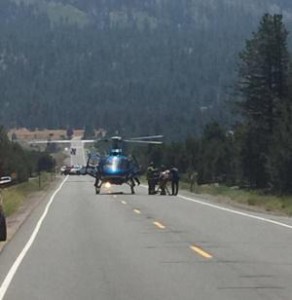
An Oregon man is airlifted to Renown in Reno from Alpine County. Photo/Provided

An Oregon man is airlifted to Renown in Reno from Alpine County. Photo/Provided

A Portland man sustained major injuries when the motorcycle he was riding collided with a deer in Hope Valley on Aug. 10.

Rudolf Jung, 32, was going south on Highway 89 near Picketts Junction when a deer ran out from the west side of the road. Jung was unable to avoid striking the animal. The motorcycle overturned and Jung was ejected.

He was airlifted to Renown Medical Center in Reno shortly after the 12:20 accident.

Friends he was traveling with administered aid until first responders arrived.

— Lake Tahoe News staff report