Expect ad blitz in Nev. for recreational pot

By Colton Lochhead, Las Vegas Review-Journal

Don’t be surprised to see a slew of television ads touting a measure to legalize recreational marijuana use during the weeks leading up to the general election in November.

A political action committee, the Coalition to Regulate Marijuana Like Alcohol, reserved more than $800,000 worth of advertising time slots across the major news stations, according to recent Federal Communications Commission filings.

The ads are scheduled to start in early October and run until Election Day on Nov. 8 when Nevadans will vote on Question 2, which will decide whether to legalize the recreational use of marijuana for adults in the state.

Read the whole story


Nev. among states with lowest student-loan debt

By Ian Whitaker, Las Vegas Sun

The western United States has lower levels of student debt than the rest of the country, and Nevada is no exception.

A report released Friday by LendEDU placed the Silver State 45th in the nation for student loan debt. (The lower the ranking, the better states did.)

About 48 percent of the state’s four-year graduates hold student debt, according to the study. Approximately 47 percent of UNLV graduates held student debt, slightly less than that of the 48 percent of graduates from the UNR, although UNLV graduates tended to have slightly more debt per person than their UNR counterparts.

Read the whole story


4 people rescued from middle of Lake Tahoe

Four people were rescued from Lake Tahoe early this morning after their boat sank off the South Shore.

Tahoe Douglas Fire Protection District crews said the men were pulled from the middle of the lake at 12:06am today.

The four could be heard shouting for help. They were found hanging onto debris from the wrecked boat.

“It was a good outcome and very lucky for the men who did not have life jackets on during the incident,” Fire Marshal Eric Guevin said in a statement.

Details of what led to the sinking of the boat on Aug. 13 have not been released. It is also not known if they are locals or were in a rental boat.

— Lake Tahoe News staff report


State money issues stall future EDC Courthouse

By Joann Eisenbrandt

The New Placerville Courthouse Project has traveled a rocky and contentious road since a new court facility on the West Slope was first envisioned several decades ago. It just hit another bump. The approximately $1.4 billion reduction in state funding originally allocated in the budget for new courthouse construction in California has put the brakes on the project, at least temporarily.

Since 2002, California courts have been under the jurisdiction of the Judicial Council. This state agency created a list of “immediate and critical need” courthouse projects. These were to be the first projects implemented once funding became available. The New Placerville Courthouse Project is on this list.

In 2008, Senate Bill 1407 authorized up to $5 billion in bonds to build or renovate courthouses in the state. Funding for these projects comes from increased court user fees. State budget problems since have caused funds to be diverted from the funding accounts for these projects, causing a number of delays. Finally, a site was selected for the Placerville project and the Judicial Council prepared and certified an environmental impact report under the California Environmental Quality Act (CEQA) in June 2015. This paved the way for the next steps: the transfer of land from the county to the state and the putting out of construction bids. Completion was projected to be in the second quarter of 2021.
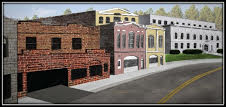
The two-colored building in the front to the left of the existing Main Street Courthouse is what used to be the Placerville City Hall. It is also an old, historic building.  If I remember it correctly, these two buildings are separate but have connecting doors on both floors. An additional building and a covered parking garage would be in back of that. Rendering/Placerville Historic Preservation League

An alternative to a new courthouse is an annex. The two-colored building in the front to the left of the existing Main Street Courthouse are what used to be the Placerville City Hall. An additional building and a covered parking garage would be in back of that. Rendering/Placerville Historic Preservation League

The Placerville project will replace current court facilities on the West Slope with one new 88,000-square-foot courthouse facility next to the existing county jail just off Forni Road in Placerville. Superior Court services are now divided between Building C at the County Government Center on Fair Lane, a civil court facility in Cameron Park and the historic courthouse on Main Street in downtown Placerville.

State budget problems have once again affected the project. Redirection of $1.4 billion from the critical needs account and $250 million of annual funds from the construction account, and a dramatic decrease in court filing fees has now drastically reduced the amount of money available for the bonds to finance the 23 current courthouse projects.

On Aug. 11, the Court Facilities Advisory Committee met in San Francisco to consider recommendations to the Judicial Council on how to proceed given current financial circumstances.

Committee Chairman Presiding Justice Brad Hill told those assembled that, “We understand how concerned you all are and what all of you in this room have gone through to get to this point. After years of planning, we are here to transmit some bad news in terms of current financing.”

Judges, members of boards of supervisors and staff from 16 counties with current courthouse projects gave presentations, all advocating strongly that their particular project be allowed to continue. Hill acknowledged at the beginning of the five-hour session that, “These facilities are the worst of the worst … everyone in this room is desperately in need of a new courthouse.” The extent of their need, he noted, is why these projects remain on the list while others have been cut along the way.

Presentations were in alphabetical order by county, so El Dorado County presented first. Presiding El Dorado County Superior Court Judge Suzanne Kingsbury gave a PowerPoint presentation outlining the problems with the county’s current court system. The fact that court services are divided among a number of different facilities makes them “operationally inefficient.” Kingsbury went through a laundry list of structural, environmental and safety deficiencies, especially highlighting those at the 100-plus year-old Main Street courthouse in downtown Placerville. These ranged from lack of ADA compliance, to an old and often non-operational elevator, lead in the water system, asbestos, lack of holding cells for in-custody defendants and lack of on-site parking.  Security for judges, jurors, witnesses and court staff is lacking. The abundance of windows gives direct line-of-sight to potential snipers from the nearby Highway 50 overpass and adjacent buildings. Security and space problems also exist at the facility in Building C at the county government center on Fair Lane.

All of the presenters from subsequent counties had very similar stories. The current Shasta County courthouse had experienced 108 elevator malfunctions; the courthouse in Siskiyou County can be so easily broken into that thieves got in and stole gold bars from a courthouse display.  Many courthouses have serious seismic issues, with some rated so low, at Level 5, that the state declined to have them transferred to state ownership.

Kirk Smith of the Placerville Historic Preservation League spoke during the public comment session that followed the presentations. In July 2015, the organization challenged the Judicial Council’s certification of the EIR for the Placerville Courthouse Project in San Francisco Superior Court. The EIR failed, the writ stated, to adequately address or provide mitigations for the impacts on downtown Placerville that removal of court services from the Main Street courthouse would cause. The Main Street economy would be seriously affected, leading to “urban blight and decay.” The writ was denied by the court last month.

Smith told advisory committee members that given the current financial shortfall for critical needs projects, the construction of a courthouse annex and covered parking structure next to the existing Main Street courthouse would be a much more cost-efficient option. Smith had made similar presentations to the Placerville City Council and the El Dorado County Board of Supervisors, but noted, “They weren’t interested.”

The annex concept would provide for approximately 140,000 square feet of space as compared to the 88,000 square feet of the project as currently approved. It would not require the construction of roads, sewer lines and other supporting infrastructure and would preserve the historic Main Street courthouse. Smith presented the committee with architectural renderings of the concept.

Smith later confirmed to Lake Tahoe News that the Placerville Historic Preservation Society still intends to appeal the denial of thee writ. Such an appeal would be to the First Appellate District Court of Appeals in San Francisco. The last day to file the appeal is Aug. 30.
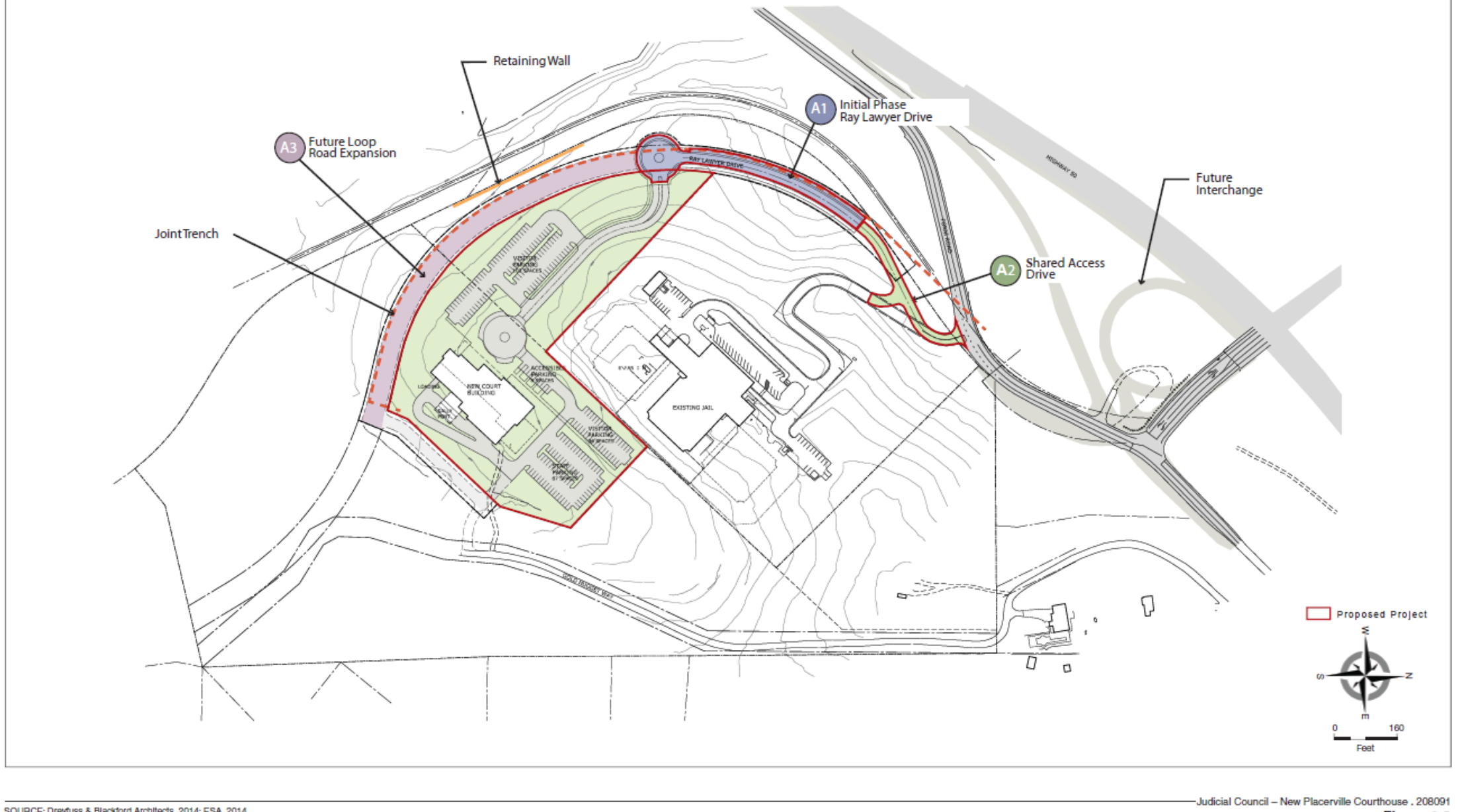
Architect's rending of how the future El Dorado County Courthouse could look.

Architect’s rending of how the future El Dorado County Courthouse could look.

The Court Facilities Advisory Committee then received a report from Capital Program Director Mike Courtney outlining recommendations on how to proceed. The courthouse projects were grouped into four categories based on their current status: currently under construction, acquisitions, ongoing design work, and 2016-17 construction awards. The New Placerville Courthouse Project is in the “acquisitions” category. The recommendation for projects in this category is to, “complete site due diligence then hold.” Due diligence means that site analysis, environmental review and associated studies have all been completed. The Placerville project has completed its due diligence and would, under Courtney’s recommendations, be placed on hold until needed funding became available.

The six projects currently under construction would complete construction, but projects in the other two categories would continue until they reached the end of their existing phase and then be put on hold.

Hill emphasized that this was just “day one” of effort to secure the needed funding. Now that the state is back on firmer financial footing, he noted, “We’d like our money back.” Members of the committee and representatives from the affected counties will be going to Sacramento soon to lobby the governor and legislators for that very purpose.

“We need to demonstrate to the Legislature that we will be good stewards of the money they give us now and will be in the future … we’re building courthouses that are safe and secure but are economical and cost-effective,” Hill said.

The committee approved Courtney’s recommendations. A report will be compiled and presented to the Judicial Council for their Aug. 25-26meeting. The Judicial Council can then adopt the recommendations, modify them or propose new ones.


Christie wants Supreme Court to rule on N.J. sports betting

By Associated Press

Gov. Chris Christie thinks the U.S. Supreme Court should decide whether New Jersey can legalize sports betting.

Christie commented Wednesday while co-hosting WFAN’s “Boomer and Carton” sports-talk radio show.

A federal appeals court on Tuesday set aside the state’s challenge to a federal betting ban. The 3rd U.S. Circuit Court of Appeals ruling invalidated a law passed by New Jersey in 2014 that would have allowed sports betting at casinos and racetracks. The court found New Jersey’s law repealing prohibitions against sports gambling violated the 1992 Professional and Amateur Sports Protection Act, which forbids state-authorized sports gambling.

Christie says officials are trying to stop New Jersey from legalizing illegal bets made on sports.

The Republican says it is “long shot” that the nation’s highest court would take the case.


Highway 28 delays expected through fall

Weekday lane closures will begin Aug. 15 on Highway 28 south of Incline Village as the Nevada Department of Transportation starts work on a multi-year project to construct a shared use path and make other roadway safety and water quality improvements.

Through fall, drivers should anticipate periodic lane closures during the day and night in the Ponderosa Ranch and Tunnel Creek areas.

Additional construction-related lane and road closures will take place over the next two summers as construction of the pathway continues through 2018.

The project will build a three-plus mile shared-use path from the south end of Incline Village to Sand Harbor State Park. Centerline rumble strips and emergency roadside turnouts will also be added. In addition, water quality improvements such as enhanced roadside drainage inlets, sediment filtration systems and erosion control will be installed.


Calif. public retirees with $100K pensions growing

By Teri Sforza, Orange County Register

Back in 2005, 1,841 retirees pulled down more than $100,000 a year in pension checks from the California Public Employees’ Retirement System.

A decade later, membership in the so-called $100K Club had swelled by nearly 20,000 souls.

CalPERS data provided to the conservative-leaning group Transparent California, and analyzed by the Register, found that 21,652 public retirees received annual benefits of more than $100,000 in 2015.

That’s a jump of 28 percent in just two years – which might seem jarring at first blush, but actually represents a slowdown in the club’s explosive growth of late.

Read the whole story


Local November ballot taking shape

The November election for Lake Tahoe candidates is starting to solidify. Aug. 12 was the deadline to file if the incumbent is in the race, while Aug. 17 is the deadline if the incumbent is not running.

While El Dorado County elections officials on Friday told Lake Tahoe News the website would be updated after the 5pm filing deadline, that clearly did not happen because it does not list any candidates for South Lake Tahoe City Council. City Clerk Suzie Alessi did not respond to an email asking if anyone besides Patrick Jarrett, Ted Long, JoAnn Conner and Robert Topel had qualified for the ballot.

Because Councilman Hal Cole is not running, people have until Wednesday to file. This is true in all races where an incumbent is not running.

In other races the candidates, according to the EDC elections website, are:

·       Lake Tahoe Community College Area 3: Karen Borges, incumbent.

·       LTCC Area 4: Nancy Dalton and Dave Hamilton. (This is Fritz Wenck’s seat; he is leaving the board.)

·       Lake Tahoe Unified School District Area 1: Annie Davidson and Larry Reilly. (Adam Jones is leaving the board.)

·       LTUSD Area 3: Mike Doyle is being challenged by Bonnie Turnbull.

·       LTUSD Area 4: Troy Matthews. (Larry Green is stepping down.)

·       Lake Valley Fire Protection District: (3 seats open) Incumbents are Bob Bettencourt and John Rice; challengers are Leona Allen and Tony Sears.

·       South Tahoe Public Utility District: Incumbents Randy Vogelgesang and Kelly Sheehan will face Kirk David and Nick Exline.

For more El Dorado County offices, go online. Here are the Placer County candidates and the Douglas County officer seekers.

— Lake Tahoe News staff report


LTCC-SNC launch 4-year degree partnership

By Kathryn Reed

It’s no longer necessary to leave South Lake Tahoe to obtain a four-year college degree – and this has nothing to do with online education.

Lake Tahoe Community College and Sierra Nevada College are partnering to offer a bachelor’s degree in global business management.

“Over the last five years they are the No. 1 transfer institution coming to our institution. We have been working with their students for a number of years,” SNC Provost Shannon Beets told Lake Tahoe News. “We talked about all the issues people face being place-bound — family, work obligations, snow. These are things that keep them from coming to the North Shore.”

With business being the No. 1 degree LTCC students seek after leaving the college, it was a natural that this be the first four-year degree offered students.

Sierra Nevada College is a private four-year school based in Incline Village. Instructors will come to LTCC to teach the classes.

The goal is for classes to start Aug. 29, with cross cultural management and international business the first two on the schedule. The limited schedule is because so many LTCC students attend school part time. SNC would like to start with 25 students.

Three open houses have occurred in the last few weeks to familiarize people with the program, with 17 interested students showing up this week.

Besides being convenient, it will cost less for students to obtain the degree at LTCC than if they were to go to SNC’s main campus.

“We were shooting to try to get as close to about $20,000 for a degree in four years. We got it down to about $23,000 for California residents if they come to Lake Tahoe Community College for two years and then transfer to the Sierra Nevada College program here,” Kindred Murillo, LTCC president, told Lake Tahoe News. It will cost Nevada residents approximately $31,000 for the same degree at LTCC.

That total cost is what some universities charge for one year.

“The shared goal for everyone is access to affordable, high-quality education,” Beets said. “We want to be good neighbors and good partners.”

The ability to obtain a four-year degree at LTCC was a goal of Murillo’s when she first started at the college, and is now in place to be a reality before she leaves in February. (She tendered her resignation in January. The notice for her position will go out Aug. 15.)

Plus, offering a bachelor’s degree was an overriding desire during a strategic planning session conducted in 2013.

If there aren’t enough students to start the program this fall, it will roll out in the spring. Also at that time four-year degrees in education and psychology might begin.

This, though, would just be the start of bachelor programs at LTCC.

“We set the goal to have three different colleges at the university center when it opens in fall 2018. We intend to meet that goal,” Murillo said.

Talks are under way with UC Davis and CSU Sacramento to be the other two partners.

Building student housing is one way to potentially draw even more students to LTCC for associate and bachelor programs. The lack of dorms and the expense of housing on the South Shore are roadblocks for some people.

“In the master plan we are looking at about 150 units, possibly expanding it to 200 beds. We’ll know more when the feasibility study is done,” Murillo said. The feasibility study should be completed in November, and the master plan is being worked on with the Tahoe Regional Planning Agency. “We put $1.5 million for site development in the (facilities) bond (for housing). We are looking for a private developer to own and operate it on our campus. Our preference is not to be in rental business. That seems to be working for a lot of colleges nationally.”

It is penciled to be built between the gym and student center in the forested area. Still to be worked out is whether this would be too close to the South Tahoe PUD plant in terms of odor regulations.

Student housing today is more like a suite of rooms with a shared living and kitchen, as opposed to traditional dormitories.

Murillo said it’s possible the college could request proposals for the student housing in the spring, and then have them ready in 2018 when the university center opens.


Boomers’ new retirement plan is millennials paying rent

By Patrick Clark, Bloomberg

Pete Pollinger and his wife, Julie, are relocating from Boca Raton to Melbourne, a city of about 70,000 on Florida’s Space Coast, named for its proximity to NASA rocket sites at Cape Canaveral and the Kennedy Space Center.
They weren’t just hunting for a place to live. As they get ready to move this year, they’re also looking for single-family homes they can buy, fix, and rent out.

“We want to be more in control of our financial destiny,” said Pollinger, 51, a computer systems consultant. “As far as traditional investments go, we have less control of what really happens to those.”

He and Julie hope to build a portfolio of about 10 homes, buying when they see good value or selling a fixed-up home when the market presents the opportunity to take a profit.

The Pollingers are joining the ranks of what Redfin Chief Executive Glenn Kelman calls Landlord Nation, a group of mom-and-pop investors who have seized on low mortgage rates and robust rent growth to plow savings into rental properties. Together, they’ve lifted the percentage of single-family houses used as rental properties to stratospheric heights, even as many would-be first-time home buyers struggle to reach ignition.

The number of starter homes on the market dropped by more than 44 percent from the first quarter of 2012 to the first quarter of this year, according to research published by Trulia. With entry-level homes in short supply, median prices in the category increased by nearly a third.

Read the whole story