Trump’s love affair with Nevada GOP

By Seth A. Richardson, Reno Gazette-Journal

Republican presidential nominee Donald Trump doesn’t have a lot of clout in Nevada’s political circles. He didn’t gain any major endorsements during the caucus and has raised only a paltry sum in the state compared to Democratic presidential nominee Hillary Clinton, but he has found a friend: Nevada Republican Party Chairman Michael McDonald.

Trump has often been at odds with the more official branch of the Republican Party, instead relying on grassroots support. Elected Republicans, including Gov. Brian Sandoval and Sen. Dean Heller, have openly decided not to endorse Trump. Even the ones who have use language like, “I will support the nominee,” or talk about the dangers of Clinton rather than state their outright support for Trump.

But with McDonald, it’s different.

Read the whole story


Tree mortality at ‘epidemic’ level in Tahoe basin

By Kathryn Reed

STATELINE – A healthy forest is the best deterrent to stop the bark beetle infestation. The problem is Tahoe forests aren’t healthy.

“We have seen this march of dead trees grow through the summer,” Joanne Marchetta, Tahoe Regional Planning Agency executive director, told her board this week.

Orange is becoming a dominant color in pockets of Tahoe, with the North Shore being hit the hardest. Sugar pines are dying off in alarming numbers.

With this being the fifth year of drought and forests being overly dense, the beetles are winning. Trees are too weak to fight off these native species. The dead trees then create more fuel for a wildfire.

The bi-state regulatory agency has been working with the Tahoe Fire Fuels team to devise a plan to combat the spread.

On Aug. 24 the Governing Board heard a presentation by fire and forest experts about the infestation. The Lake Tahoe Basin Tree Mortality Task Force has been created to spearhead the effort. There will be a larger discussion on Aug. 30 between local and state officials in advance of the following day’s Environmental Summit.

The dark orange represents beetle infestation. Photo/California Tree Mortality Task Force

The dark orange represents beetle infestation. Photo/California Tree Mortality Task Force

Mike Vollmer, environmental improvement program manager at TRPA, called the local situation an “epidemic.” And it’s nowhere near as bad as the forests south of here.

“Science says the best insurance we have to stop the beetle attack is to thin out the forests and do the treatments,” Vollmer said.

Local, state and federal agencies have made a concerted effort since the 2002 Gondola Fire in South Lake Tahoe to thin the forests. But it’s a process that takes time and money, and it is work that is only done seasonally. Six thousand acres are under contract this year to be thinned on federal land in the basin, with another 4,000 acres set for next year.

California initially included six counties in its Tree Mortality Task Force. Four were added in June – El Dorado, Placer, Amador and Calaveras counties. The idea is the northern counties will learn from their southern counterparts, with the goal of being proactive instead of reactive.

But it’s not that simple.

“There’s no magic pot of money to address this issue,” Chris Anthony, CalFire division chief, said.

Regulations can impede removal of trees, having no end user for the tree is another issue, and homeowners may not have the resources to fell an infected tree.

Forest Schafer, forester with North Lake Tahoe Fire Protection District, said life and safety need to be the guiding factors when deciding how to go forward. With two-thirds of the Lake Tahoe Basin Management Unit being in the wildland urban interface and this forest having the highest per acre visitor rate in the national forest system, the urgency is even greater to combat the beetles.

Jeff Marsolais, LTBMU forest supervisor, acknowledged that the regulations in place to get thinning projects approved is slow, which doesn’t work well in an epidemic situation like what is occurring now. Plus, no one knows where the beetles will strike next.

“We don’t actually know the trajectory of the tree mortality for when it will show up on this landscape,” Marsolais said.

Even when the trees are removed there isn’t much market for them.

“There are more dead trees than we know what to do with,” Anthony said.

Board member Larry Sevinson lamented how a biomass plant has been in the works for years between Tahoe City and Truckee, but that now Liberty Energy is pulling back because it’s not financially viable.

There aren’t as many mills. And the infected wood isn’t always desirable. One market for the trees is China, which turns it into coffins and chopsticks. The problem is there is a federal law on the books preventing them from going overseas. This is just more of the regulatory malaise.

What everyone pointed to this time around compared to when there was a bark beetle outbreak in the 1990s is that there is a team in place, people are talking and action is more likely.


2 arrests in South Lake Tahoe armed robbery

Two men well known to law enforcement are back behind bars, this time on armed robbery charges.

Logan Schwartz, 28, and Chris Mendonca, 20, both of South Lake Tahoe, allegedly robbed an acquaintance at gunpoint. Stolen were a cell phone and other belongings, according to officers.

The incident occurred Aug. 24 at the Blackjack Inn in South Lake Tahoe.

The two also face first-degree burglary charges.

— Lake Tahoe News staff report


Calif. students beat the national average on ACT

By Joy Resmovits, Los Angeles Times

California’s graduating class of 2016 outperformed peers on the ACT college-entrance test nationally across all four subject areas, according to a report released by the test company Wednesday.

Nationwide, students had an average overall score of 20.8 out of 36 on the test of English, math, reading and science. California students, on average, earned 22.6.

Of the 127,225 California class of 2016 students who took the test, 37 percent passed benchmarks in all four subjects.

Read the whole story


TRT worker hurt by falling tree

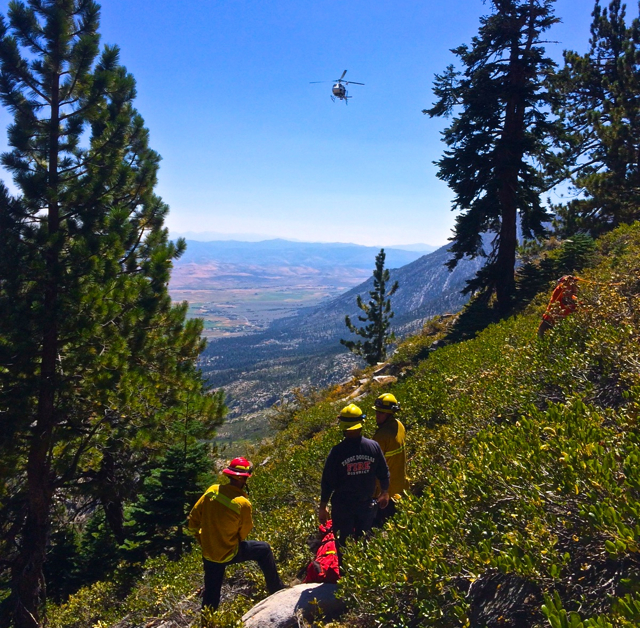
Crews work on an injured Tahoe Rim Trail worker on Aug. 25. Photo/Provided

Crews work on an injured Tahoe Rim Trail worker Aug. 25. Photo/Provided

A Tahoe Rim Trail worker was hit by a tree on Thursday afternoon.

The person was knocked down a 40 percent grade slope onto rocks.

Tahoe Douglas fire spokesman Eric Guevin told Lake Tahoe News the man sustained “multiple traumatic injuries.”

Tahoe Douglas firefighters and a search and rescue team responded to the Aug. 25 incident near the Mott Canyon chairlift in the out-of-bounds area of Heavenly Mountain Resort. The victim was working to remove a snag tree.

A California Highway Patrol helicopter out of Auburn with a long line lifted the victim to the Boulder Lodge. From there Tahoe Douglas took him to Barton Memorial Hospital.

The person’s name has not been released.

— Lake Tahoe News staff report


Nevada students ‘worst’ in country on ACT

By Trevon Milliard, Reno Gazette-Journal

For the first time in Nevada history, all students in this year’s high school graduating class took the ACT so schools could gauge their success in college preparation. And the results aren’t good.

Only 11 percent of the 32,261 students scored high enough to be considered ready for college-level courses, according to ACT scores released Wednesday.

Nationwide, about 26 percent of students taking the ACT out of the 2016 class scored college-ready, meaning they demonstrated the skills necessary in English, reading, math and science to survive entry-level college courses. In most states, the college-entrance exam is voluntary with 64 percent of students participating nationwide for the 2016 graduating class.

State education officials expected Nevada’s ACT scores to reach new lows for the class of 2016. Such is the case when a state forces all students to take the ACT as part of its graduation requirements. As more students are tested, average scores decline.

Read the whole story


Global warming more polarizing than abortion

By Seth Borenstein, AP

WASHINGTON — Tempers are rising in America, along with the temperatures.

Two decades ago, the issue of climate change wasn’t as contentious. The leading U.S. Senate proponent of taking action on global warming was Republican John McCain. George W. Bush wasn’t as zealous on the issue as his Democratic opponent for president in 2000, Al Gore, but he, too, talked of regulating carbon dioxide.

Then the Earth got even hotter , repeatedly breaking temperature records. But instead of drawing closer together, politicians polarized.

Democrats (and scientists) became more convinced that global warming was a real, man-made threat . But Republicans and Tea Party activists became more convinced that it was — to quote the repeated tweets of presidential nominee Donald Trump — a “hoax.”

When it comes to science, there’s more than climate that divides America’s leaders and people, such as evolution, vaccination and genetically modified food.

But nothing beats climate change for divisiveness.

“It’s more politically polarizing than abortion,” says Anthony Leiserowitz, director of the Yale Program on Climate Change Communication. “It’s more politically polarizing than gay marriage.”

Leiserowitz says his surveys show 17 percent of Americans, the fastest-growing group, are alarmed by climate change and want action now, with another 28 percent concerned but viewing it as a more distant threat. But there’s an often-vocal 10 percent who are dismissive, rejecting the concept of warming and the science

Sometimes dismissiveness and desire for action mix in one family.

Rick and Julie Joyner of Fort Mill, S.C., are founders of MorningStar ministries. Most of the people they associate with reject climate change. Their 31-year-old daughter, Anna Jane, is a climate change activist.

As part of a documentary a few years ago, Anna Jane introduced Rick to scientists who made the case for climate change. It did not work. He labels himself more skeptical than before.

“They’re both stubborn and equally entrenched in their positions,” says Julie, who is often in the middle. “It doesn’t get ugly too often.”

Tribalism

People in the 1960s “had faith in science, had hope in science. Most people thought science was responsible for improving their daily lives,” says Marcia McNutt, president of the National Academy of Sciences.

Now “we see partisan polarization or ideological polarization,” says Matthew Nisbet, a communications professor at Northeastern University. The split with science is most visible and strident when it comes to climate change because the nature of the global problem requires communal joint action, and “for conservatives that’s especially difficult to accept,” Nisbet says.

Climate change is more about tribalism, or who we identify with politically and socially, Nisbet and other experts say. Liberals believe in global warming, conservatives don’t.

Dave Woodard, a Clemson University political science professor and GOP consultant, helped South Carolina Republican Bob Inglis run for the U.S. House (successfully) and the Senate (unsuccessfully). They’d meet monthly at Inglis’ home for Bible study, and were in agreement that global warming wasn’t an issue and probably was not real.

After seeing the effects of warming first-hand in Antarctica and Australia’s Great Barrier Reef, Inglis changed his mind — and was overwhelmingly defeated in a GOP primary in 2010. Woodard helped run the campaign that beat him.

“I was seen as crossing to the other side, as helping the Al Gore tribe, and that could not be forgiven,” Inglis says.

Judy Curry, a Georgia Tech atmospheric scientist and self-described climate gadfly, has experienced ostracism from the other side. She repeatedly clashed with former colleagues after she publicly doubted the extent of global warming and criticized the way mainstream scientists operate. Now she says, no one will even look at her for other jobs in academia.

What changed

In 1997, then-Vice President Gore helped broker an international treaty to reduce heat-trapping gases from the burning of coal, oil and gas.

“And at that moment” says Leiserowitz, “the two parties begin to divide. They begin to split and go farther and farther and farther apart until we reach today’s environment where climate change is now one of the most polarized issues in America.”

Consider lobster scientist Diane Cowan in Friendship, Maine, who expresses dismay.

“I am definitely bearing witness to climate change,” Cowan says. “I read about climate change. I knew sea level was rising but I saw it and, until it impacted me directly, I didn’t feel it the same way.”

Republican Jodi Crosson, a 55-year-old single mother and production and sales manager in Bexley, Ohio, thinks global warming is a serious problem because she’s felt the wrath of extreme weather and rising heat. But to her, it’s not quite as big an issue as the economy.

Scott Tiller, a 59-year-old underground coal miner in West Virginia, has seen mine after mine close, and says coal is getting a bad rap.

“I think we’ve been treated unfairly and kind of looked down upon as polluters,” Tiller says. “They say the climate is changing, but are we doing it? Or is it just a natural thing that the Earth does?”

Bridging differences

Overwhelmingly, scientists who study the issue say it is man-made and a real problem. Using basic physics and chemistry and computer simulations, scientists have repeatedly calculated that most of the extra warming comes from humans, instead of nature. Dozens of scientific measurements show Earth is warming. Since 1997, the world has warmed by 0.44 degrees (0.25 degrees Celsius).

Repeatedly explaining science and showing data doesn’t convince some people to change their core beliefs, experts say. So instead some climate activists and even scientists try to build bridges to communities that might doubt that the Earth is warming but are not utterly dismissive.

The more people connect on a human level, the more people can “overcome these tribal attitudes,” Anna Jane Joyner says. “We really do have a lot more in common than we think.”


Calif. Assembly narrowly extends climate change bill

By Melody Gutierrez and Kate Galbraith, San Francisco Chronicle

The California Assembly approved sweeping climate-change legislation Tuesday that extends the state’s targets for reducing greenhouse gases from 2020 to 2030 in a controversial bill that saw White House officials and Gov. Jerry Brown privately urging lawmakers for support.

Under SB32, the state would reduce its greenhouse gas emissions to 40 percent below 1990 levels by 2030. The bill would piggyback on AB32, theCalifornia Global Warming Solutions Act of 2006, which calls for California to reduce greenhouse gases to 1990 levels by 2020. The state is expected to reach that target.

But one of the state’s programs to fight climate change — cap and trade — remains threatened by a legal challenge that has cast uncertainty on its future and has discouraged the carbon credit market. And, on Tuesday, officials revealed that the latest auction, once again, fell short of their hopes.

Read the whole story


More students add up to millions for Nev. colleges

By Siobhan McAndrew, Reno Gazette-Journal

More Nevada students completing college courses could mean millions in additional funds for the state’s seven colleges.

Nevada higher education officials said $60 million of its $622 million budget request for state funds is based on the number of students that completed courses in fiscal year 2016.

It is up about $10 million from 2014, the first where the state’s colleges faced a new funding formula that no longer funded schools based on enrollment. Colleges, including UNR and Truckee Meadows Community College, receive no funding for students that enroll in courses and drop out.

The Nevada System of Higher Education Board of Regents, the governing body of 13-elected officials over the state’s seven colleges and the Desert Research Institute, will hold a special meeting in Lake Tahoe Thursday and Friday.

Read the whole story


Tahoe Queen’s future remains unknown

While the charred Tahoe Queen sits at Zephyr Cove Marina, its future remains in limbo.

“We’ll make a decision only after we’ve fully assessed the damage and considered all of our options,” David Freireich with Aramark told Lake Tahoe News. Aramark owns the paddle-wheeler. It’s possible the boat will not be able to be salvaged.

A fire swept through the historic tourist boat on Aug. 16 while crews were on board remodeling the vessel.

The U.S. Coast Guard and National Transportation Safety Board are investigating the blaze. The Coast Guard on Aug. 24 told Lake Tahoe News the cause has still not been determined. Details of the agency’s investigation won’t be released until a final report is issued.

— Lake Tahoe News staff report