Nevada tribes push for satellite polling places

By Scott Sonner, AP

Tribal leaders in Nevada asked a U.S. judge Wednesday to order the state and two counties to establish satellite polling places on reservations where they say Native Americans are being denied an equal opportunity to vote in the November elections.

Two Paiute tribes filed a lawsuit in U.S. District Court in Reno accusing Nevada Secretary of State Barbara Cegavske and Washoe and Mineral counties of discriminating by illegally refusing tribe members voting access afforded to people in wealthier, mostly white neighborhoods.

Members of the Pyramid Lake Paiute Tribe living in Washoe County say they must travel 96 miles roundtrip to register to vote or to cast ballots in person in Sparks.

Members of the Walker River Paiute Tribe in rural Mineral County say they have to go 70 miles roundtrip to Hawthorne.

The lawsuit says that’s twice as far as voters who live on Lake Tahoe’s affluent north shore would have to travel to vote if the county had not set up a satellite poll in upscale Incline Village. As a result, both tribes say their rights are being violated under the Voting Rights Act of 1965 and the U.S. and Nevada constitutions.

Voter registrars in the two counties said earlier that there isn’t enough time to set up new sites before registration closes Oct. 18 and early voting begins Oct. 22.

The lawsuit seeks temporary and permanent injunctions against the state and the counties. It alleges failure to establish satellite polls on the reservations has a “significant disparate impact” on the tribes due to socio-economic factors as well as a history of racial discrimination and hostility toward the tribes.

The current practice is an apparent effort to dilute the voting strength of tribe members, according to the suit filed on behalf of the tribes by lawyer Rendal Miller.

Similar legal battles have been waged recently in Utah, Montana and the Dakotas over a variety of issues involving the Voting Rights Acts, including access to polling places as well as unreliable U.S. mail service on reservations.

“If we have the same access and opportunities, we will be able to increase participation by tribal members,” Pyramid Lake Paiute Tribe Chairman Vinton Hawley said.

Washoe County Registrar Luanne Cutler declined to comment specifically on the suit but said in a statement Wednesday the selection of polling sites began in January based on cost, voting populations and other logistics.

“With Election Day fast-approaching, the registrar’s plan for the general election remains in place and her decision regarding this matter is final,” the statement said.

Neither the secretary of state’s office nor Mineral County immediately responded to requests for comment.


Coyote warning for Northern Nevada

By Associated Press

The Nevada Department of Wildlife is issuing a warning to Northern Nevada residents about potential conflicts with coyotes.

Urban Wildlife Coordinator Jessica Heitt said coyote pups leave their mother in the fall and start hunting on their own. That leads to more sightings and conflicts, such as attacks on small dogs and cats, but attacks on humans are rare.

Heitt says people should work with their neighbors to remove things that might attract coyotes, like pet food, garbage and fruit from trees.

She says residents should keep dogs leashed and carry pepper spray and a noise maker while walking them. She also suggested keeping small children and pets inside at dusk and at night.


More time to comment on Squaw-Alpine gondola

The comment period on the proposed gondola that would link Squaw Valley and Alpine Meadows ski resorts has been extended.

This is because the U.S. Forest Service and Placer County have decided to do one environmental document. A revised notice of preparation has been created. The deadline to comment on it is Oct. 3. Here is the new document.

For decades there has been talk of combining the resorts. One of the main stumbling blocks has always been the private landholding. An agreement was reached with Tony Caldwell in April 2015 to have the towers erected on his land near the Granite Chief Wilderness Area.

Building anything so close to a wilderness area is one of the more controversial aspects of the project. While the gondola is designed to only operate during the winter, the towers would always be there. The eight-person cars would be detachable.

— Lake Tahoe News staff report


Tainted soil to be removed from ZC Resort

By Kathryn Reed

In the five years since a fuel leak was detected at Zephyr Cove Resort more than 1,400 tons of petroleum product have been extracted from the soil.

While work to clean up the site has been ongoing since the contamination was discovered in fall 2011, the next step in the process is about to begin. This will include digging a trench about 25-feet deep close to Highway 50 and back to the parking attendant kiosk.

Officials will test the soil throughout this next process, which will begin Sept. 12. The plan is to have this work done by Oct. 15. The goal is to remove even more contaminated dirt – 2,500 tons; all of which is shipped outside the basin. In the process more than a dozen trees had to be felled.

Jonathan Cook-Fisher with the U.S. Forest Service told Lake Tahoe News, “We very likely will be monitoring this site for years to come.”

The Forest Service owns the land, while Aramark operates the various businesses on site.

The commercial entities will remain open, though parking will be affected.

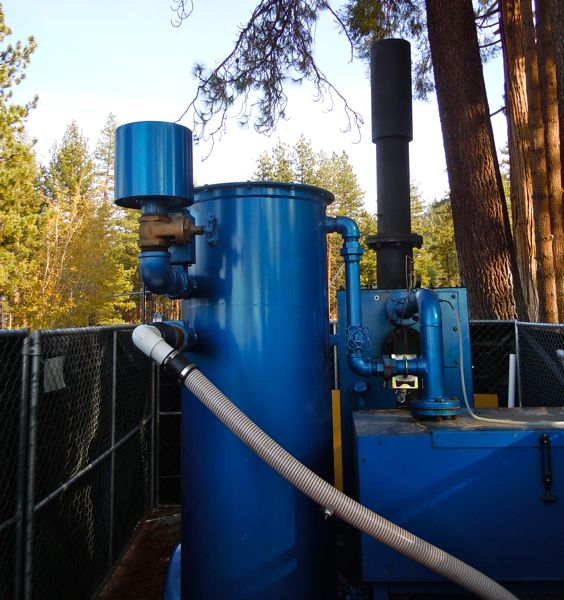
A sparge unit injects air into the soil to get the vapors out. Photo/LTN file

A sparge unit injects air into the soil to get the vapors out. Photo/LTN file

Even though the underground fuel tanks had been inspected annually, it wasn’t until five years ago that the leak was detected. It is not known how much gasoline actually escaped or how long it had been seeping out.

Cook-Fisher said the tanks were in place before the USFS owned the land. He said situations like this one underscore the hazards of underground tanks and why they are no longer in vogue.

Today the tanks are on the pier. And while this obviously puts them closer to the waters of Lake Tahoe, Cook-Fisher said it’s safer there because of the ability to conduct better tests on the equipment and the safety mechanisms that are in place. Plus, being above ground allows for the opportunity to smell and see the product.

While the plume is good size, it has not reached Lake Tahoe. It starts near where the tanks used to be (they were removed in 2012), goes under the restaurant parking lot and moves northwest toward the pier.

Monitoring of the test wells shows the extent of the contamination is decreasing, Cook-Fisher said.


Hwy. 50 high-speed chase ends in arrest

By CBS-13

Authorities say a driver led officers on a high-speed chase in the Sierra on Wednesday.

The chase began near South Lake Tahoe. California Highway Patrol officers tried to pull a 2006 BMW for speeding on Highway 50, but the driver would not pull over. The chase reached speeds of 100 mph.

The BMW swerved in and out of both lanes and into the shoulder to try and avoid officers. The driver even managed to avoid a spike strip laid out on Sly Park Road.

Read the whole story


Scuba diver who died at Tahoe was from Sac

The scuba diver who died at Lake Tahoe over Labor Day weekend has been identified as Michael Stephen Majewski.

The 63-year-old Sacramento man was diving with friends on Sept. 5 near Glenbrook when for unknown reasons he made an emergency ascent. He was unconscious when he surfaced.

The investigation is continuing by Douglas County sheriff’s investigators. The cause of death is pending autopsy and toxicology results.

— Lake Tahoe News staff report


Calif. may ban property seizures from non-criminals

By Glen Martin, CALmatters

She is known by the pseudonym of Elizabeth James — a retiree from the phone company who was contemplating a cross-country trip with her machinist husband. They had worked for decades raising two children and caring for her disabled sister, who lived in a home the couple had bought and remodeled in East Palo Alto. Then police raided the sister’s home and arrested the Jameses’ son, who had been living in a back room, for drug-dealing.

Although Elizabeth James was never charged with a crime — she insisted she didn’t know what her son was doing — city police worked with federal authorities who evicted her sister and seized the house under a process known as civil asset forfeiture.

More than 220 California law enforcement agencies have partnered with federal prosecutors to instigate civil asset forfeiture, allowing them to seize and liquidate the assets of people who weren’t convicted or even charged with crimes.

The goal: to deny drug dealers working capital and divert the value of their assets to crime-fighting efforts. But critics have condemned it as “policing for profit,” arguing that it strips citizens of their goods without due process.

After overcoming objections from some in law enforcement, a bill to curtail the practice cleared the Legislature by a wide margin and is awaiting Gov. Jerry Brown’s signature.

“SB443 isn’t the platinum reform standard for civil asset forfeiture, but it’s still a very good bill,” said Lee McGrath, legislative counsel for the Institute for Justice. “More to the point, this is a California bill. When California does something, everybody in the nation pays attention.”

State law already prevents civil asset forfeiture in most state cases — an exception being large bundles of cash — unless the owner is convicted. But it allows state and local police to collaborate on drug cases with the federal government, which not only doesn’t require convictions for civil asset forfeiture, but rewards cooperating agencies with up to 80 percent of the assets’ worth.

The result has been a big surge in the federal variety. A state Senate bill analysis indicates that the amount California agencies collected under the federal program in 2014 was $77 million.

The bill’s biggest impact: It would ban local and state police from reaping the gains of federal civil asset forfeiture unless the owner of the assets is convicted of a crime. It also would bolster existing protections under state law by raising the threshold for the forfeiture of cash absent a conviction from $25,000 to $40,000, and requiring a conviction before the government can claim property such as boats and cars.

Even if SB443 becomes law, it will be too late for Elizabeth James. Her lawyer recommended a deal: Their son pleaded guilty and the government would drop all claims to the house — although it would not reimburse the couple for legal fees or home damage from the raid.

Her case illustrates “why I think civil asset forfeiture is tantamount to theft,” said her attorney, James Cooper. He maintained James’ son was a “low-level dealer” and that “the house was in no way germane to the case,” he said. The U.S. Attorney’s Office and East Palo Alto police did not respond to questions about the 2009 case.

But Mica Doctoroff of the American Civil Liberties Union called it “a prime example of people not guilty of doing anything wrong getting swept up in asset forfeiture.”

Still, support for California’s SB443, sponsored by state Sen. Holly Mitchell, D-Los Angeles, and Assemblyman David Hadley, R-Manhattan Beach, wasn’t unanimous.

“My argument is that it’s just as important to take down the small-time dealers as the kingpins,” said Assemblyman Jim Cooper. “I served 30 years in the (Sacramento County) sheriff’s department, and worked 10 years in narcotics and gangs. I spent years undercover, buying drugs from ‘small-time’ dealers. I see what they do.”

The way to hobble drug traffickers, he says, “is to hit them in the pocketbook, and asset forfeiture is the most effective way to do that.”

But critics — from the conservative Heritage Foundation to the liberal ACLU — say more Jameses are being ensnared than El Chapos or Pablo Escobars. Examples:

  • The immigrant landlord in Anaheim whose modest commercial building was seized because his tenants included not just a dentist and an insurance company, but also a marijuana dispensary.
  • The taco truck operator who had $10,000 in cash confiscated after he was stopped by the Los Angeles Sheriff’s Department.
  • The Los Angeles music promoter who had to battle for the return of $13,000 cash seized in a Shasta County traffic stop — the door receipts from his Mexican music concerts.

In each instance, the property owner was not arrested. Sometimes they got their property back, but only after a costly legal battle.

Ventura Police Chief Ken Corney, president of the California Police Chiefs Association, said the bill strikes a balance.

“There are many times when it may not be possible to apprehend or convict a trafficker. Many would rather abandon their money or property than be held accountable for their acts. So denying them resources can at least inhibit some of their future activities, and helps us keep the pressure on them.”

Besides, he said, people can always go to court to get their property back.

“Most of the people who are caught up in this are poor and are often people of color, people who are struggling to get by under the best of circumstances,” countered Shillinger. “They may not speak English. They’re intimidated by the courts, they often can’t take time off from work to go through lengthy judicial proceedings, and they usually don’t have the wherewithal to hire an attorney. So they tend to just suffer their losses and walk away.

“And the police count on that.”


Significant progress on Cave Rock upgrades

Expect work zones on Highway 50 to be changing rapidly as crews clean up the Glenbrook area and begin moving traffic back and forth between the eastbound and westbound tunnels at night for paving and lighting work.

This month construction crews will finish placing concrete blocks at the Glenbrook worksite.

Near Cave Rock the focus is on lighting and aesthetics, with some final paving work to be completed. Asphalt paving began through the westbound tunnel, in the ditch south of Cave Rock.


Most of the new concrete barrier rail near Glenbrook has been constructed, the small remaining sections will be completed shortly.

The drainage pipes beneath the roadway up near Glenbrook have been installed, while the existing ones were repaired with pipe liners.


The aesthetic work on the exterior of the new tunnel has begun.


Calstar merger brings changes for members

By Susan Wood

Dan Gross of Roseville knows just how critical his Calstar air ambulance annual membership is when he recalls his snowmobiling adventure in April 2009.

Gross was riding around Highland Lakes in the Bear Valley area backcountry when he slipped off his sled, crashed and landed in a pile of rocks. Although injured, he was forced to drive the snowmobile for nearly 30 miles back to the Bear Valley fire station where Calstar picked him up. The math was against him – three people, three snowmobiles.

He could only drive it 10mph because of the pain.

“I didn’t break any bones, but I tore muscles in my lower abdomen. It was causing so much pain, I thought I was bleeding internally,” said the Bay Area former emergency medical technician, who did a mini assessment of himself at the time.

“It was pretty scary,” he told Lake Tahoe News.

It would have taken almost two hours to get him by ground to Sutter Hospital in Roseville.

Calstar, which awaits a finalized purchase in the coming weeks by Air Medical Group Holdings, got him there in 33 minutes.
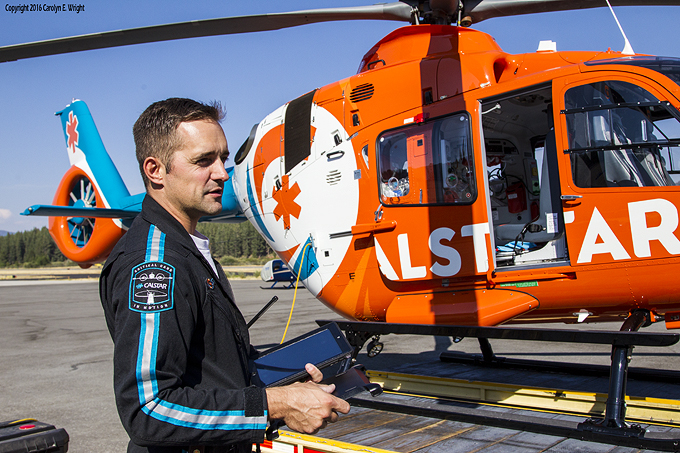
Calstar pilot Heiko Kafton is enjoying the new helicopters that are more technologically advanced. Photo Copyright 2016 Carolyn E. Wright

Calstar pilot Heiko Kafton is enjoying the new helicopters that are more technologically advanced. Photo Copyright 2016 Carolyn E. Wright

His $50 annual household membership for the air ambulance service picked up $18,000 of the $38,000 bill – with his Blue Cross health care plan absorbing the remaining $20,000. It is not required for Calstar members to have insurance.

“I don’t know many people who could write a check for $18,000 for an ambulance ride. I think everybody should be a member,” Gross said.

So when presented with the prospect of a different corporation owning Calstar, he carefully considered the impact of the parent company change.

“I don’t see it as a big deal,” he said, adding it appears the coverage area will be expanded through the West Plains, Mo., conglomerate.

The decade-old Air Medical Group provides access to more than 240 air ambulance locations across 32 states.

AirMed’s for-profit organization, Reach Air Medical, served as a quasi competitor to Calstar in some areas. The merger means Calstar – which locally operates out of Lake Tahoe Airport — loses its nonprofit tax status and can’t accept any donations.

Calstar members received a letter announcing the merger. Household membership is expected to rise to $65 under the expansive AirMedCare Network.

The crew will remain intact on the operations side affecting pilots, mechanics and flight nurses.

“I believe that the acquisition by AMGH will actually be beneficial for Calstar as an organization in that we will now be part of a larger company focused on air medical transport and the resources that come with it,” Tahoe’s chief flight nurse Bryan Pond told Lake Tahoe News.

Layoffs will occur at Calstar’s McClellan Park headquarters in Sacramento in mainly the development and outreach department. Director of Development and Outreach Mike Nichols is among the group receiving a pink slip.

“We don’t need a satellite membership office. But overall, it’s going to be better. Services will be more efficient and effective with Calstar and Reach as partners, not competitors,” Nichols insisted. “We hear from folks that Calstar has made a difference in saving their life or making the recovery better.”

Such is the case for Gross, who lives in the greater Sacramento area but often recreates in the Sierra Nevada Mountain Range.
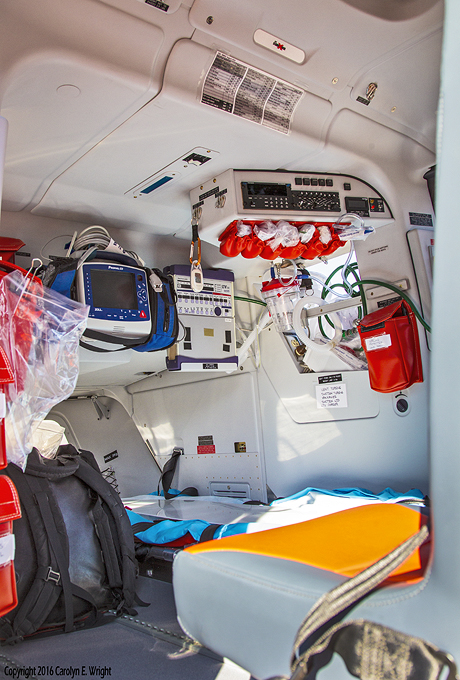
Medical helicopters are like being on a flying hospital. Photo Copyright 2016 Carolyn E. Wright

Medical helicopters are like being on a flying hospital. Photo Copyright 2016 Carolyn E. Wright

Calstar also operates bases in Auburn, Ukiah, Gilroy, Concord, Salinas and Santa Maria. It’s been stationed on the South Shore since October 2001. On any given day, the choppers can be seen flying over the lake, in and out of the wilderness as well as landing at Barton Memorial Hospital’s helipad.

Each county operates under its own guidelines for emergency air medical transports. First responders determine if an air ambulance is necessary.

In respect to specifically having an air ambulance membership at Lake Tahoe, Nichols mentioned that one might consider buying two club cards with Calstar and the Care Flight service – which operates out of the Truckee Airport and the Minden Airport and is based in Reno. That’s because at this moment the merger does not include the reciprocal agreement with Care Flight.

The understanding between the two providers, which is not a formal contract, results in the two ambulance services picking up each other’s patients when the other is busy.

Memberships for Care Flight – which also operates out of Chico, Boise and Spokane — run $55 – which means having both could cost more than $100.

Nonetheless, Nichols noted there’s a good chance a comparable reciprocal agreement will be made with Care Flight before the buyout takes place. The companies are in negotiations.

The fleet was going to change even without the merger. Calstar now uses an Airbus H135/P3, with graphics that look like its the Miami Dolphins charter. Photo Copyright 2016 Carolyn E. Wright

The fleet was going to change even without the merger. Calstar now uses an Airbus H135/P3, with colors that make it look like its the Miami Dolphins charter helicopter. Photo Copyright 2016 Carolyn E. Wright

“There are a lot of unknowns,” Care Flight spokesman J.W. Hodge said.

For now, when one air ambulance service covering Lake Tahoe is not available, “we call on the next closest resources,” Hodge added.

In respect to the Calstar merger with Reach through the AirMedCare Network, Care Flight joins Calstar in wanting to make the change as seamless as possible, Hodge insisted.

That’s comforting to longtime active South Shore residents Paul and Lisa Huard.

“I’d still do it in a heartbeat,” Lisa Huard said of joining Calstar’s membership.

She recalled the time when her husband suffered from a heart condition in November 2012. He passed out and hit his chest on the granite tile.

“When he came to he didn’t know what was going on,” she said.

A crew took him to Barton where tests were run before a recommendation was made to transport him via air ambulance to Reno – a $35,000 ride that took 20 minutes.

“In Paul’s case, he would have been fine (to transport by other means). But in other cases, every minute counts,” she said. “Calstar was so thorough. They told me what to expect, and I felt safer.”

Huard insisted she would pay more for membership.

“There shouldn’t be any question. Look, we pay $10 for a Tylenol at the hospital – no problem,” she said.


Airman dies hiking in S. Lake Tahoe

Tyler Oimoen

Tyler Oimoen

Details have not been released surrounding the Sept. 5 death of an airman hiking in South Lake Tahoe.

Airman 1st Class Tyler Oimoen was stationed at Beale Air Force Base in Marysville.


Oimoen was originally from Mount Horeb, Wis. He was a food service apprentice with the 9th Force Support Squadron.

“Our thoughts and prayers are with Airman Oimoen’s family, co-workers and friends. During this difficult time we are caring for his family and co-workers with the support of the Beale community,” Lt. Col. Matthew R. Mountcastle, 9th Force Support Squadron commander, said in a statement.

The cause of the death is under investigation.

— Lake Tahoe News staff report