Third option added for Kings Beach pier

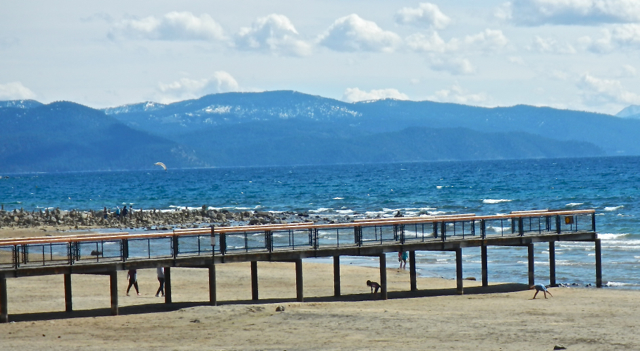
Studies are under way to replace the pier at Kings Beach. Photo/LTN file

Studies are under way to replace the pier at Kings Beach. Photo/LTN file

By Kathryn Reed

A third option to where the new pier at Kings Beach could go is being studied.

The North Lake Tahoe Resort Association gave the California Tahoe Conservancy nearly $70,000 to analyze a western location for the pier that would be near the North Tahoe Event Center.

“This pier is designed to serve recreation boating interests,” Sue Rae Irelan of the CTC told her board this month.

While small water taxis like the ones that have existed on the North Shore in recent summers would be able to access the new pier, the structure is not being built so a cross-lake ferry could dock there. A big issue is that the land operations for such an enterprise don’t exist.

It’s possible that elements of each of the proposals could be chosen to formulate what ultimately will be a preferred alternative. Differences include how a promenade through the beach would look, if the boat ramp stays – is eliminated – or is for non-motorized watercraft only, where the pier goes, along with what happens to the kids’ play area.

The goal is to have the draft environmental documents done by the end of 2017 or in early 2018. Then the public will be able to comment again.

Today the pier covers more sand than water. The new pier would be fixed at the shore, with a gangplank connecting to a floating pier. Even in droughts that connector would still meet ADA requirements.

Public comment on the proposals is being taken until Sept. 30.


Motorcyclist gunned down on I-80 near Truckee

By Associated Press

A motorcyclist was shot to death Sept. 24 on Interstate 80 near Truckee, prompting authorities to close the highway for hours to investigate.

The California Highway Patrol said three motorcyclists rode up to the victim Saturday afternoon and fired gunshots before taking off. The victim died at the scene.

CHP Officer Pete Mann told the Sacramento Bee the victim was associated with the Vagos biker gang. Investigators were trying to gather information about the assailants and were asking witnesses to come forward.

Westbound lanes of the interstate were closed at the Nevada state line, causing traffic to back up for miles.

Five years ago this weekend, members of the Vagos and Hells Angels game exchanged gunfire during a deadly brawl on the floor of a casino in nearby Sparks, Nevada.


Collin undergoing multiple surgeries on legs

South Lake Tahoe resident Jason Collin tonight on Facebook posted, “Thank you all so much for the amazing support, prayers and kindness. I am doing pretty well considering everything that’s happened. I had surgery to straighten out my right leg today. And will have surgery on Monday to straighten out my left ankle.”

The City Council candidate and six others were in an RV on Sept. 23 when it was struck head-on by an SUV. The driver of the SUV, a woman from Wellington, died at the scene.

The Tahoe group was headed down Kingsbury Grade on their way to Mammoth when the accident occurred.

Also in the RV with Collin was his wife, Natalie. She suffered a broken finger. The names and conditions of the other people in the vehicle have not been released.

The Nevada Highway Patrol is continuing to investigate the accident.

— Lake Tahoe News staff report


AAA: People waste money on premium gas

By Tom Krisher, AP

DETROIT — There is no sense paying a premium for premium gasoline if your car is designed to run on regular, according to research by the automobile club AAA.

Some drivers occasionally like to treat their cars to higher-octane fuel in the belief it boosts performance. But premium blends can cost around 50 cents a gallon more than regular.

AAA says it’s just money out the tailpipe — lots of it. In a national survey on gasoline use, AAA said 16.5 million U.S. drivers spent $2.1 billion they didn’t need to in the past year on premium gasoline.

Many think premium means quality. But AAA researchers found that while it has more octane, it didn’t increase horsepower or fuel economy, decrease emissions or clean engines any better than regular gas in cars that are designed by the manufacturer to run on 87-octane regular.

“Drivers see the ‘premium’ name at the pump and may assume the fuel is better for their vehicle,” said John Nielsen, AAA’s managing director of automotive engineering.

However, if your owner’s manual specifically says to run your car on 93 octane premium or 89 octane mid-grade gas, you should do it to make it perform optimally, according to the researchers. More luxury and performance brands are using turbocharging or supercharging to get better performance out of smaller engines, and those may require premium gas, Nielsen said.

AAA researchers joined with the Automobile Club of Southern California to test V8, V6 and four-cylinder engines, coming up with the same results each time, Nielsen said.

Seventy percent of U.S. drivers own vehicles that require regular gas, while 16 percent are required to use premium fuel. The rest, about 14 percent, must use at least mid-grade gas or have an alternative fuel such as electricity, AAA says.

People also waste money on gasoline in another key way, according to AAA. Earlier this year the association studied fuel quality at a number of gas stations to see if some were better than others.

Researchers found that brands that meet the industry’s “Top Tier” standards had better additives that prevented ash deposits on valves and cleaned engines better than non-Top Tier brands. And the Top Tier gasoline usually costs about the same as other brands, the association said.

Researchers found that ash deposits could cause cars to hesitate, run rough and make the engines run less efficiently, Nielsen said.

Generally the major brands meet the Top Tier standards, including BP, Exxon, Mobil, Amoco and Shell. But lesser-known brands also are in there, such as Holiday, Costco and Kwik Star.


California starts tracking police use of force

By Associated Press

From a broken bone to a fatal shooting, all 800 police departments in California must begin using an online tool launched Thursday to report and help track every time officers use force that causes serious injuries.

The tool’s developers hail it as the first statewide dataset of its kind in the country and a model for other states. Those more critical of law enforcement call it a big step toward better police accountability.

The tool, named URSUS for the bear on California’s flag, includes fields for the race of those injured and the officers involved, how their interaction began and why force was deemed necessary.

“It’s sort of like TurboTax for use-of-force incidents,” said Justin Erlich, a special assistant attorney general overseeing the data collection and analysis.

Departments must report the data under a new state law passed last November. Though some departments already tracked such data on their own, many did not.

Working with the California Department of Justice, a technology nonprofit called Bayes Impact developed the tool in hopes of making the data easy for departments to report and easy for the state to analyze.

The tool was built as an open-source project, and California will share the software code with interested law enforcement agencies across the U.S.

Only three other states – Texas, Colorado and Connecticut – now require departments to track similar use-of-force data but their systems aren’t digital, and in Colorado’s case, only capture shootings, according to the National Conference of State Legislatures.

“As a country, we must engage in an honest, transparent, and data-driven conversation about police use of force,” California Attorney General Kamala Harris said in a news release.

The goal is to capture all incidents that cause serious injuries but not minor ones, like bruises.

“How do we get enough information where we can really focus on how to improve or inform policy? How do we make sure it’s not too big?” Erlich said. “Capturing stubbed toes muddies the data but not capturing broken bones would be a huge miss.”

California’s efforts come as the FBI has made such data collection a priority in the wake of a number of officer-involved deaths of unarmed black people across the country.

Last year, the FBI announced it would begin collecting all use-of-force data and make it public, though departments don’t have to participate.

FBI Director James Comey has expressed frustration over the absence of nationwide use-of-force data and said its collection will “dispel misperceptions, foster accountability and promote transparency.”

California’s police departments will report their use-of-force data to the state once a year beginning in January. It will be made public as early as the spring.

Until now, California only tracked deaths in custody, not non-lethal uses of force. And it did so using paper forms.

“This is hugely important,” said Peter Bibring, director of police practices at the American Civil Liberties Union of Southern California. “We’re not taking use of force seriously until we’re tracking information about every use-of-force incident.”

Patrisse Cullors, co-founder of Black Lives Matter, said she thinks the new data will show a pattern of abuse across the state. But actually collecting that data is positive, she said.

“We live in a culture that perpetuates racism and we need to be able to verify that racism through data,” she said. “For the people who continue to deny racial disparities exist in this country, this data will allow us to have those living room and dinner conversations and share facts.”

Many in law enforcement think the data will show just how rare force incidents are, said Louis Dekmar, vice president of the International Association of Chiefs of Police and chief of the LaGrange Police Department in Georgia.

But the data also will help pinpoint excessive force and help departments make key changes, he added.

“I see it as something long overdue,” Dekmar said. “When we screw up we should own up to it and do something to fix it.”


EDC land to be restored once building is gone

Restoration of this site will be finished in 2017. Photo/CTC

Restoration of this site will be finished in 2017. Photo/CTC

The old blue building at the corner of Highway 50 and Sawmill Road near Meyers is coming down. Demolition began this week.

The 1.05-acre parcel was acquired by the California Tahoe Conservancy in December 2015. The structure was located on sensitive land near the former site of historic Ethel’s Pie Shop in El Dorado County. This is how the climbing area next door — The Pie Shop — got its name.

The Conservancy’s Tahoe Livable Communities Program allows aging developments on environmentally sensitive land to be acquired, demolished and restored. Development rights from the property are transferred to town centers as identified in the Tahoe Regional Planning Agency’s Regional Plan.

Demolition, site stabilization, and initial restoration activities will be completed this fall. Full restoration will occur next year.


Red tape may hamper Chinese visiting Nev.

By Richard N. Velotta, Las Vegas Review-Journal

OLYMPIC VALLEY — An estimated 3.5 million Chinese tourists want to travel to the United States next year but may never get here because of regulatory issues, government red tape and airlines and airports that aren’t ready for them.

The rush of international visitors is occurring at a time when the aviation industry is in the midst of massive change, Mike Boyd, president and CEO of Evergreen, Colo.-based Boyd Group International, said this week.

About 300 people are attending Boyd’s 21st annual International Aviation Forecast Summit at the Resort at Squaw Creek.

Industry leaders are projecting that 20 million Chinese visitors will travel to the U.S. over the next 10 years.

Read the whole story


Tahoe Keys wants to use herbicides in canals

To learn more about the efforts in the Keys to combat aquatic invasive species, the community is invited to attend a public workshop on November 1, 6 to 8 p.m. at the South Tahoe Public Utility District Building, 1275 Meadow Crest Drive.  Find out more at keysweedsmanagement.org

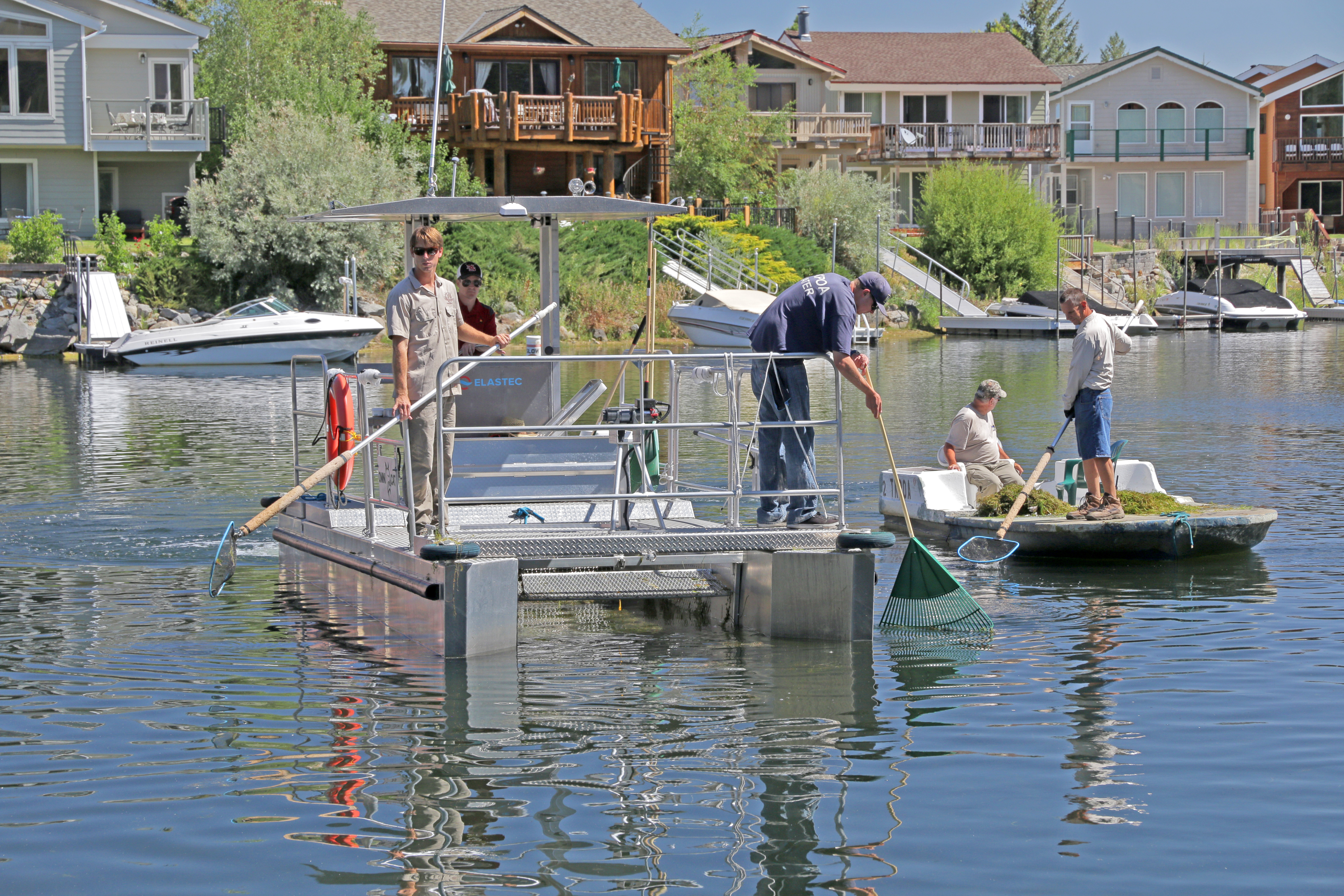
There will be a public workshop on Nov. 1 from 6-8pm at the South Tahoe Public Utility District Building, 1275 Meadow Crest Drive, to learn more about the plan to use herbicides in the Tahoe Keys. Photo/Provided

By Lake Tahoe News

The Tahoe Keys Property Owners Association is going forward with plans to use an herbicide to rid the canals of invasive species, Eurasian milfoil and curly leaf pondweed in particular.

It will be up to the Lahontan Water Quality Control Board to issue the permit.

In December 2011 the water board voted to allow herbicides to be used on a case-by-case basis. If this is permitted, it would be the first time.

TKPOA wants a permit to use aquatic herbicides in 2018 on 13 of its 172 acres. The plan is to apply low levels of the herbicides Endothall, Triclopyr and Penoxsulam on nine sites. None of the chemicals should reach the lake, according to officials.

The two plants being targeted have taken over more than 90 percent of the Tahoe Keys lagoon system.

“Comprehensive dye studies conducted in 2011 and again in 2016 have shown that water movement will not carry the herbicides out of the back channel lagoons into Lake Tahoe during the test period.  Surface-to-bottom curtains and/or other barriers will be placed at select sites as an extra layer of precaution to isolate the herbicide demonstration areas,” TKPOA officials said in a statement. “Secondary barriers will be ready to be deployed as contingency measures in case trace amounts are detected during the test, ensuring no movement of herbicides into Lake Tahoe.”

The plants have been choking the canals and have spread to other parts of the lake. They affect the lake’s ecosystems and clarity.

The warming shallow waters are helping the plants to proliferate.

Herbicides are not the only mechanism being used. TKPOA has made improvements to its harvesting and collection of the fragments. However, this is just like mowing – the plant keeps growing. Bottom barrier mats and dredging are also methods to curtail the weeds.

TKPOA also installed a boat backup station that is designed to reduce the spread of weeds, and purchasing the Lake Tallac lagoon in part to better control the infestations.


Simulator trains crews for rigor of fighting fire

By Kathryn Reed

The hose is full throttle and still the fire jumps along the wall. At one point it dances overhead on the ceiling like it wants to wrap its potentially deadly tentacles around those who want to kill it.

It’s as though the fire is alive. Oxygen – it feeds off of it.

The room goes dark. There’s smoke. It’s a game of hide and seek.

“Everything we do is by touch,” South Lake Tahoe Fire Chief Jeff Meston told Lake Tahoe News. “It’s all done at knee level. We are usually on the bottom third of the building because if you stand, you get burned.”

It’s normal for a fire to spread overhead and temperatures to reach 1,700 degrees.

What made this particular fire different is that with a push of the button the flames went away.

The simulator helps crews train for live fire action. Photo/Provided

The simulator helps crews train for live fire action. Photo/Provided

South Lake Tahoe firefighters are getting to experience three scenarios – a kitchen, hazardous materials and second floor bedroom fires – during four days of training in a simulator.

Many of the younger guys are lacking real fire experience. This time inside the trailer is about 75 percent realistic. The heat is much less at about 500 degrees. And the level of smoke is nowhere near what it would be in the real world. A lot of this has to do with natural gas being used during training.

Even for the veterans, what they are encountering in buildings compared to last century is different.

“The biggest difference between fires today and 20 years ago is synthetics. Instead of a clean fire, it’s a carbon fire,” Battalion Chief Jim Drennan told Lake Tahoe News. “It’s highly toxic.”

Tactics are changing in how to fight these types of fires. The books are being rewritten to take into account the substances firefighters will find in today’s structures.

Building code changes have benefited owners when it comes to snow loads, but some ceiling joints are quick to collapse in a fire. Time is of the essence, though safety is always the priority.

Firefighters have 60 seconds to get dressed from the time a call comes in. In just more than three minutes the hose lines should be laid. In South Lake Tahoe, they expect to be at the fire between 10 and 12 minutes after they get the call.

Two firefighters usually go in at a time. This is for safety as well as muscle. Those hoses are heavy. Turnouts are not light. And with a breathing apparatus on, they are carrying about 65 pounds of extra weight.

South Lake Tahoe had been a bit negligent in upgrading uniforms for the men and women. Turnouts that were to last eight years have been used for 12. That’s now changing, with each firefighter given two sets.

And in Tahoe there’s always the threat of a wildland fire. That requires completely different gear.

Then there is the added element of weather. All that water usually means icicles form on the firefighters during winter. Slipping on the ice they’ve created becomes another concern.

And while training is a daily activity, there is nothing routine about their jobs.


Gardnerville duo suspects in Truckee thefts

Ryan Huddin

Ryan Huddin

Jessica McGee

Jessica McGee

Two Gardnerville residents were arrested Thursday on a slew of charges in Truckee.

Ryan Huddin, 31, and Jessica McGee, 29, face numerous charges related to recent thefts in the Truckee area. The were arrested Sept. 22 at 10:30pm after officers responded to the area of the Glenshire General Store for a report of two suspicious subjects loitering near closed businesses.

Officers said both suspects provided false information. A brief investigation revealed they both had numerous warrants from out of the area.

In their possession was a large quantity of stolen property they have acquired over the past few days, officers said. Property included multiple bicycles (one was valued at more than $7,000), miscellaneous power tools, as well as heroin and drug paraphernalia.

— Lake Tahoe News staff report