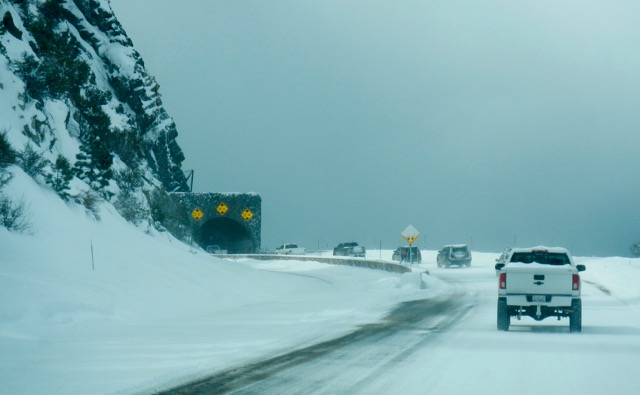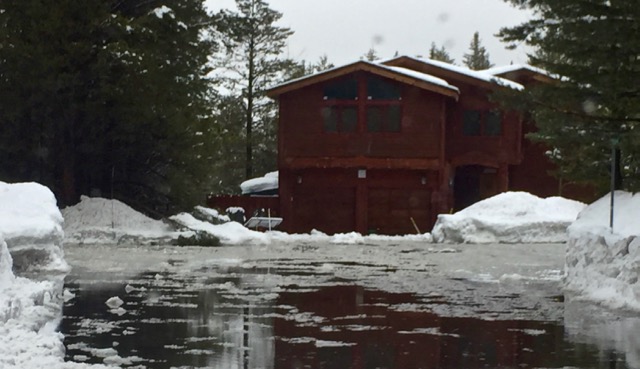
Water from flooded South Lake Tahoe streets entered several houses this year. Photo/LTN
By Bre McGee
At the far end of Christmas Valley, there are at least two members of Reds and Julie Regan’s household enjoying the detriments of flooding that recently effected many homes around Lake Tahoe. Having had to rip up flooded carpet and move furniture from the Regans’ dining and living rooms has left a new play area for the couple’s two dogs.
“They love running on the concrete floor. We’re trying to keep them out of there because of the debris, but it’s like they have a new race track,” Julie Regan said while talking about one small benefit of now living in a slowly progressing construction zone.
The Regans’ story is a familiar one around the Lake Tahoe Basin. Many residences and vacation rental properties were flooded due to a string of rain storms earlier this year that melted snow and obstructed sewer drains, resulting in water seeping into the lower levels of homes around the area. Even though the Regans carry homeowner’s insurance, their policy does not cover damage ensued by flooding.
According to Carson City-based AAA insurance agent Mike Johnson, the majority of homeowners opt-out of the voluntary flood insurance policy.
My home flooded. Now what?
1. Thoroughly read your flood insurance policy to find out the extent of the coverage.
2. Take photos of any damage to your home and belongings.
3. Begin writing a list of damaged property for the insurance claim’s adjuster.
4. Separate the damaged from the undamaged property; maintain control over the damaged property (keep it in the back yard or garage or shed if possible so thieves do not remove it).
5. If your carpet is damp, pull the carpet loose, remove the pad and dry the floor.
-or-
If your carpet and pad have been saturated by the floodwater, cut and remove the carpet and pad; save a small (2-feet by 2-feet square) piece of the carpet to show to the adjuster.
6. Keep air conditioner (or furnace in cold months) running, to aid in drying out of the property. Use fans (and open windows in warm months) to speed up the drying process.
7. Clean floors, walls, cabinets with mixture of 1-part bleach, 4-parts water. If removing water lines, take photos of interior and exterior water line depth.
8. Check any effected appliances for damage. If necessary, schedule a service technician to clean, service and provide repair estimate for flood-damaged appliances.
9. Call for heating company to have technician clean, service and provide repair estimate for flood-damaged heating/cooling equipment.
10. Decide if repairs need to be adjusted to avoided similar damage in future (swapping carpeted floors for tiled floors).
11. Even without an existing flood insurance policy, it’s good practice to inquire about the extent of your homeowner’s insurance policy. Sometimes clean-up may be covered.
Source: National Flood Insurance Program
“The majority that do carry it are forced into it by their lender. I would say maybe one in 10 carry a policy. With the requirement of a lender, maybe three of 10 carry it,” Johnson told Lake Tahoe News.
Homeowners insurance was originally developed as a policy to safeguard insureds against the financial burdens from fire damage. According to Tally Meek, vice president of Personal Insurance at Sierra Insurance Associates in Truckee, more pieces were added to the original type of homeowner’s policy.
“The insurance agencies then became unable to make enough money from premiums due to the rising amounts of damages insureds were seeking payments for,” Meek said. “In turn, separate policies were created for damages from natural disasters including floods, earthquakes, hail and hurricanes.”
In 1968, the National Flood Insurance Program (NFIP) was created by Congress to issue flood insurance protection to both homeowners and renters. All flood insurance policies are written through NFIP as an optional add-on to existing insurance. While it may seem like a costly addition, it can prove to be worthwhile.
Summit Partners Insurance Services agent and flood insurance specialist Jim DeGraffenreid, explains just how important flood insurance can be. “Next to nothing is covered without an existing flood insurance policy,” DeGraffenreid said. “Almost every regular homeowner’s insurance policy excludes flood insurance.”
Without a flood insurance policy, neither the structure of a home, nor the contents inside, are covered. However, not all water damage is covered equally. Depending upon the source of the water, you could be covered without a flood insurance policy.
“Did it escape from an interior plumbing device? Did it back up from a sewer drain? Or did it seep up from the ground water through the foundation? Is it coming from the street and coming into your house? It really depends where the source of the water happened,” Meek said. “Once they [the insurance company claims adjuster] find the source of the water, they interpret the policy to determine if there’s coverage in the policy.”
Each flood insurance policy is written on a case-by-case basis because there is not a one-size-fits-all policy. Similar to homeowner’s insurance, various elements affect the annual cost and deductible. The location of insured property is the biggest factor. There are several types of flood zones mapped out across the Lake Tahoe Basin by the Federal Emergency Management Agency (FEMA) which determine the amount of risk in any given location.
The Lake Tahoe area features special and non-special flood zone areas. In South and North Lake Tahoe, special flood hazard areas (SFHA) begin with the letter “A.” According to the NFIP, a Zone A is a high-risk area with at least a 25 percent chance of flooding during a 30-year mortgage. Most lenders require a flood insurance policy to cover the price of the home in order to write a mortgage to homeowners in this zone.
The next most common flood zone in Lake Tahoe, according to DeGraffenreid, is Zone X, a non-special flood hazard area (NSFHA), carries a moderate- to low-risk of flooding. The NFIP reports that homeowners in these areas submit more than 20 percent of flood insurance claims and receive one-third of federal disaster assistance for flooding. While flood insurance is not required in this zone, it is recommended to all homeowners and renters.
“For most properties in Zone X, a policy costs between $400 and $500 a year at the maximum amount of insurance ($250,000),” DeGraffenreid told Lake Tahoe News. Properties in Zone X are considered to be less expensive to insure than those in Zone A because it’s less likely to flood in NSFHAs.
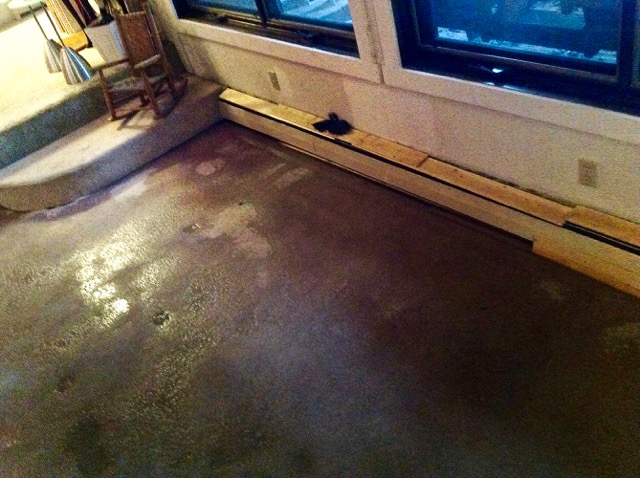
The carpet of Julie and Reds Regans’ living room was saturated with water during rain storms the second week of February. Photo/Provided
Though it’s recommended, the dilemma many homeowners and renters struggle with is deciding if flood insurance is worth the investment. Insurance agents around the area have seen a surge of flood insurance inquiries. Meek has had only one inquiry turned in a purchased policy this year. She believes this is associated with cost and a mandatory, 30-day waiting period required by the NFIP to ensure there are no preexisting damage at the insured property. The policy Meek wrote insures a high value home in a Zone D flood area, an undetermined flood hazard area, in Truckee at $2,100 annually. Though this particular home is valued at more than $1 million, the maximum amount of flood insurance coverage, as mandated by the NFIP, protects $250,000 of structural home damage and $100,000 of contents inside the home.
While an additional flood insurance policy may seem costly, NFIP’s website, floodsmart.gov, explains the expensive consequences of not having it. It states that California’s average flood insurance claim totaled $28,253 in 2014. An interactive flood cost estimate tool on NFIP’s website indicates that 1inch of water in a 2,000-square-foot home could cost an uninsured homeowner up to $20,000, depending on the extent of the damage.
Even though there are high-risk flood areas around Lake Tahoe, there are few flood insurance policies written for the area. According to FEMA, there are only 95 total policies written for South Lake Tahoe; 42 policies written for high-risk (A) zones and 53 policies written for low-risk (X) zones. There are even fewer policies written for Truckee; only 16 policies for high-risk zones and 28 in low-risk zones.
According to Johnson, between 20 and 30 percent of clients carry flood insurance, including those required to carry it by their lender.
“It’s just something that doesn’t come to mind. It’s not cheap. Up here where we live, there’s just not a lot of historic flooding. More people would say earthquake insurance would be more important than flood insurance,” Johnson said. “The majority of people think that flood insurance is going to be $50 or $100. Flood insurance is written though NFIP and it’s not an easy process. It takes me a couple of days to do one flood policy.”
Meek said, “Homeowners, in my experience, have only purchased it when there is a loan on the house and the lender is requiring flood insurance for the loan. It’s only been recently, with all the current flood threats that we’re having that I’ve had an increase in inquiries about flood insurance that were generated because the mortgage is requiring it.”
The Regans’ pre-flooding plan to update their home included removing the 1970s trademark sunken living room and updating the carpet to hardwood floors. Without an existing flood insurance policy prior to experiencing extensive water damage, the couple won’t be able to recoup any repair costs to their home.
“It was definitely on our homeowner’s ‘to-do’ list and now it’s moved to the top of the list, by matter of necessity,” Julie Regan said. “I think we’ve learned now. We were contemplating hardwood at one point but I think we’re going with ceramic tile just in case we end up in this situation again. I think we’re definitely going to look at it [flood insurance] in the future.”