Calif. could require doctors to tell patients they’re on probation

By Claudia Buck, Sacramento Bee

Complaints against physicians for misconduct have dogged the Medical Board of California for years. Some say the system is broken, with patients unable to easily figure out if their doctor has been disciplined.

With complaints rising – more than 8,000 lodged annually over the past three years – the issue was revived last week as lawmakers, patients and a consumer group demanded answers on why the number of medical complaints keeps growing and how the medical board is informing patients.

Carmen Balber, executive director of the watchdog group Consumers Union, said little has changed since the board was last up for review four years ago, when it was reprimanded for not doing enough to inform patients of doctors’ disciplinary history.

Read the whole story


2nd warmest winter on record

By Doyle Rice, USA Today

The planet sizzled to its second-warmest winter on record, failing to oust the 2015-2016 season from the top spot, federal scientists announced Friday.

The global temperature for the months of December, January and February soared to 1.6 degrees above average this winter, according to National Oceanic and Atmospheric Administration data. That’s a huge amount in climate science, where records are often broken by hundredths or tenths of degrees.

Still, this winter was nowhere close to the past season’s record, when the planet sweltered to a tremendous 2 degrees above average.

Read the whole story


Money key to closing last Nev. coal plant

By Scott Sonner, AP

Sierra Club lawyers who’ve preached against the environmental evils of coal-burning power plants for decades are trying to force the closure of the last significant one in renewable energy-rich Nevada with arguments based on a different sort of green: money.

“It used to be that we had to come in and say closing these plants might cost us a bit more, but it’s the right thing to do because of the social and environmental impacts — kids with asthma, dirty air and dirty water,” said Travis Ritchie, a lawyer for the club’s environmental law program in Oakland.

Critics of the Valmy coal plant scored a key victory last month when state regulators formally ordered Nevada’s largest utility to reassess its economic efficiency after experts projected it will cost ratepayers $30 million or more under current plans to keep it open until 2025.

Read the whole story


Nev. lawmakers pledge resistance to Yucca Mountain

By Gary Martin, Las Vegas Review-Journal

A $1.1 trillion budget blueprint by President Trump that includes a revival of Yucca Mountain as a repository for nuclear waste was declared “dead on arrival” Thursday by Nevada’s two U.S. senators.

And Nevada Gov. Brian Sandoval, a Republican, said opposition in the state to the proposal would be fierce.

The president’s budget proposal for the 2018 fiscal year includes spending hikes that could benefit Nevada veterans and military, but it also includes sharp spending cuts that could impact research at UNLV.

Read the whole story


Sandoval: Recreational pot to carry on in Nev.

By Chris Kudialis, Las Vegas Sun

CARSON CITY — If recent assertions against recreational marijuana made by leaders in President Donald Trump’s administration come to fruition, Nevada would have few options for stopping federal intervention, Gov. Brian Sandoval said this week.

“That was always an issue — it’s illegal under federal law,” Sandoval told the Sun. “That hasn’t changed.”

Sandoval, who opposed the initiative last November allowing adults 21 and older to possess and recreationally use up to one ounce of marijuana flower or one-eighth of an ounce of marijuana concentrates, said his office will continue to push forward framework for the voter-approved initiative, which passed 54 percent to 45 percent last fall.

Read the whole story


Ultraviolet light to be used to kill Tahoe weeds

By Kathryn Reed

TAHOE CITY – Killing aquatic invasive weeds in Lake Tahoe with ultraviolet C light will be tried for the first time this summer.

The California Tahoe Conservancy board on March 16 agreed to spend $260,128 on the pilot project in South Lake Tahoe. The money was awarded to the Tahoe Resource Conservation District, which has been integral in working on ways to eradicate various invasive species from Lake Tahoe.

John J. Paoluccio of Inventive Resources Inc. has developed a system in which the plants are killed – almost like getting a lethal sun burn. The light damages the DNA and cell structure of the aquatic invasive weeds. This stops reproduction and eliminates the weed in a few days.

The CTC staff report says, “The project will help the Tahoe RCD determine the optimum intensity and duration of treatment necessary for eradication of AIS plants.”

Milfoil is choking about 20 locations in Lake Tahoe. Photo/LTN file

An area inside Lakeside Marina and then along its shore in South Lake Tahoe will be tested this summer. About one-quarter of an acre will be treated.

The light can be applied either by dropping a box like device that resembles how an umbrella works over the infested area or using a mat. The latter would be good to reach under docks.

Eurasian watermilfoil and Curlyleaf pond weed will be the targeted weeds. Leaving native plants alone is the other goal, as is protecting fish.

“What we are doing is pioneering,” Paoluccio told Lake Tahoe News.

While Paoluccio has been building the necessary apparatuses for this project at his home in the Central Valley, he also has a house in South Lake Tahoe. He has been watching the proliferation of the invasive weeds through the years and knows all too well the negative impacts they have on recreation, navigation and the ecosystem.

Tests have been conducted in his lab using Tahoe water and the two targeted weed species. A video at the CTC meeting on Thursday showed in a controlled environment the rapid decimation of the weeds.

Paoluccio wants to start the program at Lakeside when the water warms up a bit and plants are still young; probably in June. Pre- and post-treatment monitoring are covered in the costs. Data will be collected on how many plants are killed, if a second treatment is required, different durations for the application to see what works best, conditions of the lake when applied, and any other details about the two treatment locations. The entire process is expected to be completed in November 2018.

If it’s successful, the plan would be to use this method in a larger area.

Paoluccio built an 8-foot-by-16-foot boat just for this process. He has two units ready to kill the weeds. The devices can go to a depth of about 20 feet.

Eurasian milfoil first started to take hold in the warm canals of the Tahoe Keys in South Lake Tahoe in the 1970s. It has since spread to various parts of the lake. The Keys has tried a variety of methods to rid its waters, with the next step being an herbicide. The homeowners’ association is looking to use chemicals starting in 2018.  The Lahontan Regional Water Quality Control Board needs to approve this first. In December 2011 the state agency said on a case-by-case basis chemicals could be used in the lake.

The Keys also needs the money for the project. Ballots for a special assessment were mailed to Tahoe Keys Property Owners Association members this week.


One city’s answer to bad roads — gravel

By Mitch Smith, New York Times

OMAHA — After living more than 40 years along a road plagued by potholes, Jo Anne Amoura was excited to see city crews shred her block of Leavenworth Street into gravel.

“I thought, ‘Oh my gosh, this is great. We’re going to get a new street,’” Ms. Amoura recalled. “And then we waited and waited and waited.”

Fresh pavement never arrived. Only after the asphalt had been ripped out almost three years ago did Ms. Amoura and her neighbors learn that their street had been “reclaimed,” Omaha City Hall’s euphemism for unpaving a road.

Read the whole story


Runoff should have Tahoe reaching capacity

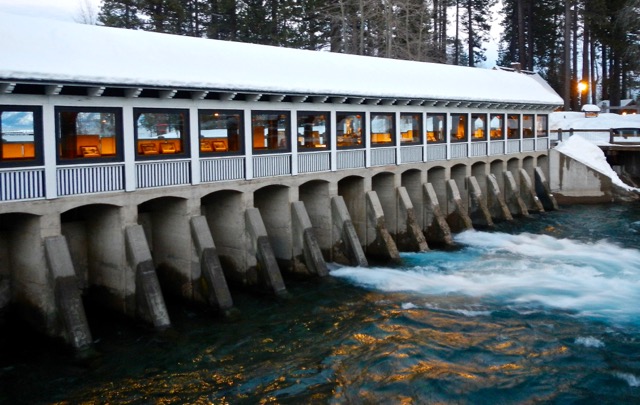
Water is flowing from Lake Tahoe through the dam in Tahoe into the Truckee River. Photo/LTN

By Amy Graff, San Francisco Chronicle

The depressing scene of boat docks sitting high and dry on wide beaches around Lake Tahoe will likely be a fleeting memory this summer.

Winter’s unrelenting storms built up a substantial Sierra snowpack and are expected to fill the lake for the first time in 11 years.

Lake Tahoe’s natural rim is at 6,223 feet above sea level. The lake can store an additional 6.1 feet in its reservoir and climbs up to 6,229 feet at full capacity, its legal maximum limit. Tahoe’s water level reached 6,226.84 feet on Wednesday; the lake needs about 88 billion gallons of water to jump up the 2.26 feet required to be completely full.

Read the whole story


U.S. budget cuts would be widely felt across Calif.

By Evan Halper and Sarah D. Wire, Tribune Washington Bureau
 
President Trump’s budget would deliver a painful financial blow to California, with the potential to push a state that has struggled for years to keep its books balanced back into the kind of red ink that consumed it after the housing market collapse a decade ago.

The only solace state and local officials are taking out of a White House budget plan that would cut most federal departments by about 10 percent to 12 percent is that even Republicans in Congress probably will find all the cuts on the table too hard to stomach.

The president’s blueprint would disrupt almost everything California does, in some cases quite brutally.

Read the whole story


S. Tahoe gas prices top the list in N. California

South Lake Tahoe has the highest gasoline prices in Northern California, according to AAA.

The price on average is $3.23 a gallon, while the lowest is in Marysville at $2.71 per gallon.

“Gas prices in California are the highest they’ve been in nearly five years,” John Moreno, spokesman for AAA Northern California, said in a statement. “While national gas prices are declining, on the West Coast, refinery maintenance and the process of switching to summer-blend gasoline is continuing to have an impact on prices.”

This week the average price for a gallon of regular unleaded gasoline in California reached $3. Nationally the average is $2.92.

— Lake Tahoe News staff report