Tahoe Democrats taking action locally, beyond

By Kathryn Reed

MEYERS – Health care, immigration, human rights, climate change – these are some of the topics that have united a group of politically active South Shore residents.

It was a year ago this month that Susan Chandler hosted a meeting for Bob Derlet who was challenging Tom McClintock for the 4th Congressional seat. From there it was decided the area needed a Democratic Club. That is how the resurrection of the Lake Tahoe Democrats came about.

After the November election even more people wanted to be involved.

“I don’t consider us to be an anti-Trump group. We are pro human rights, working for the community and pushing our agendas forward,” Chandler told Lake Tahoe News. “We are definitely working to get progressive people in office and those people tend to be Democrats.”

Susan Chandler and Jody Dayberry talk to the Lake Tahoe Democrats. Photo/LTN

South Lake Tahoe’s Democratic Club petered out several years ago. This rebirth has required writing new bylaws, electing officers (Chandler is the president), creating committees, opening a bank account and being active. It encompasses the entire South Shore.

More than 400 people are on the email list and more than 60 are paid members.

“We are energized,” Chandler said.

This was obvious at last week’s meeting, which was attended by more than 50 people. Updates on Trumpcare, California health care initiatives, social plans, voter registration, what local governments are doing regarding immigration, and other issues were discussed.

Getting Democrats elected in 2018 is a main goal.

The group wants to be involved at all levels.

More immediate concerns are the responsibility of the rapid response committee. Members are tasked with getting information out to the group or acting on issues outside of the regular meetings. The problem could be legislation this group would oppose and getting people to contact their representatives, or it could be ICE being in the area threatening undocumented residents.

They meet once a month – the third Thursday of the month – at 6pm at Lake Tahoe Golf Course in Meyers. Meetings are open to non-members. A Facebook page has been established. A website will be forthcoming. A logo also needs to be created.

The group is also working with other clubs in the area as well as Central Committees.


Online tool gives Calif. parents education data

By Jill Tucker, San Francisco Chronicle

California parents who want to know more about the progress of their children’s schools will be given to a system that uses color-coded charts and graphics to offer a comprehensive assessment of classrooms that goes well beyond standardized test scores.

The new online portal, called the California School Dashboard, measures school and district performance using a variety of criteria, including graduation and suspension rates, progress of English learners and success at preparing students for college, as well as math and English test scores.

In the future, the dashboard will also include parent participation and feedback from students and parents on school safety and available support, among other things.

Read the whole story


Nevada lawmakers press BLM for answers

By Benjamin Spillman, Reno Gazette-Journal

Nevada lawmakers sought answers from a high ranking public land manager on everything from wild horses to wilderness study areas.

John Ruhs, Nevada state director for the Bureau of Land Management, testified Tuesday before a join committee of the Legislature’s natural resources committee.

Ruhs’ appearance before the Legislature was a routine briefing aimed at helping lawmakers better understand the role of the BLM.

Read the whole story


What this week’s storms mean for California

By Ryan Sabalow and Phillip Reese, Sacramento Bee

While a nearly record-breaking rainy season has battered California’s dams and stretched the limits of local levees, the storms that began to hit Sacramento on Tuesday aren’t expected to put much additional strain on the state’s flood-control system.

Spanning into next week, the storms are expected to drop as much as two inches of rain in Sacramento and two feet of snow in the higher elevations of the Sierra Nevada. But federal weather forecasters said Tuesday they aren’t too worried about widespread problems.

“These series of storms are definitely wet, but they’re not what we saw in January and February, by any means,” said Michelle Mead with the National Weather Service in Sacramento. “They’re more typical of our winter-into-spring storms, meaning we’re getting into that shower and thunderstorm season.”

Read the whole story


Nevada contemplates plastic bag ban

A bill introduced this week in the Nevada Legislature would eliminated plastic bags in the state.

Lawmakers are considering a five-year approach to ban the one-time use bags at grocery stores, restaurants and other retailers.

Through 2021 customers would pay 10 cents per bag. That money would be earmarked for environmental purposes.

Then in 2022 the ban would be in place. Fines would be levied against businesses that don’t comply.

— Lake Tahoe News staff report


Group exploring options to solve housing dilemma

Publisher’s note: This is one in a series of stories about affordable housing in the Lake Tahoe-Truckee region. All articles may be accessed via the home page under Special Projects, 2017 Affordable Housing.

By Kathryn Reed

Tackling the South Shore housing crisis from as many fronts as possible is the goal of Progress for Tahoe.

Members of this South Lake Tahoe grass roots group recognize no one solution will solve the problem, but instead are entertaining as many ideas as possible. But they also want to be action oriented. For now, they are still in research mode.

At a meeting last week of the housing subgroup, Bill Roby with the El Dorado Community Foundation talked about his desire to create a land trust that would assess every property that is sold in South Lake Tahoe 3 percent to fund the land trust.

He pointed to other locales on both sides of the United States with similar programs.
Roby’s analysis shows that a 3 percent surcharge to every property sold in the city would bring in between $5 million and $7 million a year. That money could be used to buy old hotels and turn them into deed restricted apartments.

Voters would have to approve having the equity in their home be spent on paying for someone else to have a place to live instead of being able to take what is rightfully theirs. Then there would be the issue if someone is upside down on a property; they’d be losing even more. Roby is taking his idea to more than a dozen groups in the next few weeks. He was asked to come back to the Progress for Tahoe group to report in what others think of the idea.

El Dorado County Supervisor Sue Novasel wondered if taxing only higher end properties would be better so those who are in affordable housing would not be punished.

Doug Williams, who has worked in the mortgage industry, said sellers will essentially pass this on to buyers via a higher price.

Michael Ward, the consultant working with Novasel’s housing task force that is separate from this group, said land trusts work. But he worries an assessment like what Roby is proposing would be a punishment for owners.

“It could crush some purchase for locals,” Williams warned of the assessment.

David Orr with Tahoe Mountain Lab brought up the idea of a vacancy tax that would be applied to second homeowners. His calculations are this could generate about $20 million a year with about a 1 percent tax.

However, California’s Proposition 13 would probably now allow for a vacancy tax.

This group has not clearly defined what affordable housing means to the members. They interchanged affordable and work force housing. Technically, there is a legal definition to affordable housing that involves income levels.

An issue throughout the basin is that there will always be limited supply because there is only so much land that can be developed.

Novasel said this is why area plans, like the one in Meyers that is yet to be completed, should have regulations that allow for higher density. This would help developers be able to build affordable housing.

Some members of the group will be talking to city staff this week to find out what happened to the silent second mortgage program. Others want to address the possibility of neighborhood zones for vacation home rentals.

Troy Mathews, who is on the Lake Tahoe Unified School District board, wants land the district owns to be developed for teacher housing. Students could be working in a vocational setting to learn a trade as the housing is constructed. The problem is the district has limited developable land.

While getting rid of the rundown motels that are labeled single room occupancy or SRO is desirable, it was pointed out that they are profitable for owners. People living there don’t have the means for first and last months’ rent, plus a deposit so they stay in this SROs.

The Tahoe Regional Planning Agency’s commodity regulations is another barrier – for developers and getting rid of SROs. Instead of having a truly free marketplace TRPA has put a value on each hotel room, every residential unit and all commercial floor area – and then has decided how many or much of each is available. Changes to the bi-state regulatory agency’s rules are at least a couple years away, and even then there is no guarantee the next incarnation will be transformative.


Technology IDs gamblers who disguise their location

By Todd Prince, Las Vegas Review-Journal

Backing up about 100 feet from the California border near the Fashion Outlet in Primm, Nev., a reporter is finally able to log into the World Series of Poker application on an iPhone.

The reporter is here to test the accuracy of the geolocation service used by the poker application to ensure people physically outside Nevada cannot access the game. WSOP uses the geolocation technology of Vancouver-based GeoComply, a 5-year-old company that also serves daily fantasy sports company Draft Kings and MGM Resorts.
 
Geolocation and age identification services have been at the heart of the debate over legalizing online gaming. Opponents have sought to ban online gaming in part on the basis that neither technology is fool-proof.

Read the whole story


Douglas County OKs $10M for road repairs

Douglas County roads – especially those in the valley – are a nightmare. So much so that they need more than $10 million to be fixed.

At the March 16 Board of Commissioners meeting the electeds approved a five-year plan that includes the millions needed to fully rebuild of Jacks Valley and Dump roads and Centerville and Tillman lanes.

This winter’s storms have wreaked havoc on the asphalt. There were times when many roads had standing water or such large pot holes that the roads closed.

The main focus of the meeting was to discuss the county’s strategic plan. The top priorities are: infrastructure, organizational sustainability and financial. The final plan is expected to be adopted at the April 20 meeting.

— Lake Tahoe News staff report


LTUSD suing company responsible for STMS field

Updated 9:45am:

By Kathryn Reed

The nearly 10-year-old artificial turf field at South Tahoe Middle School is substandard and the manufacture knew this at the time of sale, according to a lawsuit.

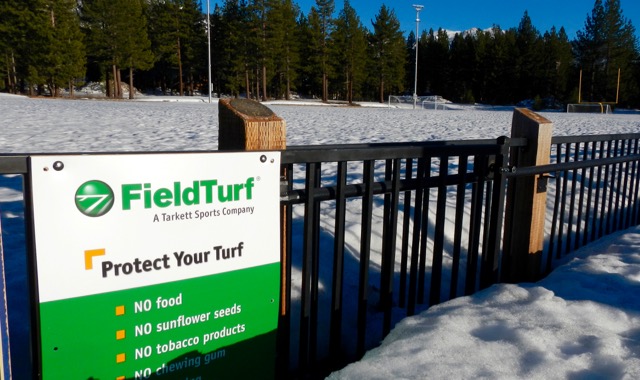
Lake Tahoe Unified School District is suing FieldTurf for breach of contract.

According to court documents, “Between 2005 and 2012, FieldTurf sold and installed approximately 1,700 artificial turf fields throughout the United States, which generated reported revenues of $570,000,000. Unfortunately for its customers, the fibers that FieldTurf used to make its artificial turf was defective – and FieldTurf knew it.”

The knowledge stems from FieldTurf suing its supplier of artificial fibers in 2011. That lawsuit was settled in 2014 for an undisclosed amount.

Lake Tahoe Unified School District’s lawsuit contends FieldTurf kept the money it received and did nothing to repair the fields that it knew had substandard fibers.

FieldTurf stopped using the product in 2012.

STMS defects include breaking, splitting, and thinning of the individual fibers. Those inadequacies are the same reasons FieldTurf sued its supplier.

“When you look at the fiber it was laying down and it had been for a couple years,” LTUSD Superintendent Jim Tarwater told Lake Tahoe News. Sweeping it, which is part of the regular maintenance of the field, did not make it stand up.

There is no danger to anyone using the field. It’s about the quality and lifespan of the field.

LTUSD believes it was sold a substandard artificial field and is suing for compensation. Photo/LTN

FieldTurf is the same company that was used for South Tahoe High School’s field three years ago, though it had a different supplier. The community ball field, which is being replaced by Lake Tahoe Community College, is a different manufacturer.

The original cost for the 92,104 square feet of Duraspine artificial turf field at STMS was $471,300. The contract was signed in March 2007, and the field installed the following August. Part of the agreement was a guarantee of eight years of premature wear and ultraviolet degradation. The field was supposed to have a “useful” lifespan of more than 10 years.

LTUSD didn’t know it was sold a substandard product until December 2016 when media in New Jersey exposed the FieldTurf story.

Internal FieldTurf emails that are part of the court filings show the company knew it was installing a less than durable product and that the fields were failing prematurely.

The district believes it is owed at least $500,000 from the turf company. This would compensate LTUSD for “the loss of the soccer field, costs to investigate these damages, costs to replace the defective field, attorneys’ fees and other economic and special damages.” The district said it would amend damage totals if need be prior to going to trial.

Montreal-based FieldTurf told Lake Tahoe News, “We strongly disagree with the representation of the facts in this complaint. Since we first became aware of the issue with Duraspine, we have tried to be forthcoming with our customers and we have not hid from this problem. Additionally, it is important to note that the issue with Duraspine has not impacted safety – only how a field looks as it wears.  We are committed to honoring our warranties and working with our customers to address any issues if they arise.”

“South Tahoe Middle School’s field was installed in 2007 and is still in use.  This means that the school has gotten roughly a decade of use from the field – well beyond the standard eight-year warranty term.” 

FieldTurf is a big company – having provided turf for 21 out of the 32 National Football League stadiums. The company recently hired Ted Wells, the attorney who led the National Football League’s investigation into New England Patriots quarterback Tom Brady in what was called Deflategate. In addition to the LTUSD lawsuit, FieldTurf faces seven other fraud lawsuits. More lawsuits are possible.

The LTUSD lawsuit was filed in U.S. District Court in Sacramento in February.


Asia air pollution increasing smog in West

By Doyle Rice, USA Today

Air pollution from China, India and several other Asian countries has wafted across the Pacific Ocean over the past 25 years, increasing levels of smog in the western U.S., a study finds.

Smog, also known as ground-level ozone, is harmful to human health, because it can exacerbate asthma attacks and cause difficulty breathing. It also harms sensitive trees and crops. It’s different than the “good” ozone up in the stratosphere, which protects life on Earth from the sun’s harmful ultraviolet rays.

Scientists measured ozone levels recorded at springtime for the past 25 years in 16 national parks in the western U.S., including Yellowstone, Yosemite and Grand Canyon. The parks’ locations farther away from cities, where smog is typically expected, made them ideal spots for the study.

Read the whole story