Lake Tahoe Airport noise monitoring to change

By Kathryn Reed

Military helicopters are the No. 1 noise problem at Lake Tahoe Airport and there is nothing city officials can do about it.

With the city having taken millions of dollars in grants from the Federal Aviation Administration, it is obligated to allow military aircraft to access the airport. It is often used as a high elevation training airport for the various branches.

Noise at the airport – specifically how to monitor it – was a topic at a council meeting this month. The five decided to push a decision to later this spring.

Things have been rather lackadaisical since the 20-year 1992 settlement agreement expired. That document was the result of a lawsuit against the city filed by TRPA and the League to Save Lake Tahoe. With commercial airliners no longer coming to Tahoe and jets becoming much quieter, the issue is barely an issue today.

The airport receives on average 12 noise complaints a year. It’s the military and planes associated with the celebrity golf tournament that generate the bulk of the calls.

Military aircraft are regularly flying into Lake Tahoe Airport. Photo/LTN

“Lake Tahoe Airport under federal and state regulations is not required to have noise requirements. It is strictly voluntary for our customers,” airport manager Mark Gibbs told the council.

Still, that does not mean monitoring can just go away. The Tahoe Regional Planning Agency is a huge player. The bi-state regulatory agency reviews its thresholds every four years and would like the city to be in alignment with its schedule.

This spring TRPA hopes to “identify priority threshold standards to work on and update.” The criteria are for them to be SMART – specific, measurable, agreed upon, realistic, time-related.

“The city’s proposed approach to the noise exposure contour mapping and validation will happen every four years, not annually. It’s my understanding the city agreed to recommend to move forward with a four-year mapping/validation cycle to help meet TRPA’s threshold evaluation reporting requirements,” Tom Lotshaw, spokesman for TRPA, told Lake Tahoe News.  While that was the recommendation in the original staff report, it could change next go-round.

What the council will have to decide at a future meeting is what if any standards it wants to abide by.

Gibbs told Lake Tahoe News one option “is to develop a noise exposure map showing cumulative noise impacts based on the state of California standard for calculating and producing an aviation noise impact metric for public consumption. The TRPA also has a CNEL (community noise equivalent level) cumulative impact standard for the airport impact on residential areas. This standard is 60 CNEL.”

CNEL measures decibels at a location over time.

Gibbs said the state and FAA have determined cumulative noise event reporting is “the best means of quantifying and reporting aviation noise to the public.”

If the city goes this route, in all likelihood data from single noise events would not be collected.

CNEL doesn’t address the problem of a plane flying over a person’s house at 85 decibels once a day because once those numbers are averaged in to show the CNEL level that one incident is just a blip.

The TRPA, though, is not completely on board with only having cumulative data.

“In regards to the single-event noise monitoring, we’re going to evaluate and determine how best to proceed on that front,” Lotshaw said. “In the past, we used noise monitoring equipment at Barton Beach to monitor both shore zone noise events and airport-related noise events in the flight path. So a situation like that might be the best way to monitor for multiple needs with one piece of equipment, given limited funding and resources.”

The agreement the city had with BridgeNet International to collect noise information from six monitoring locations and report the findings expired earlier this year. The agreement with Versadial Inc. also expired this year. That firm provided airport aviation radio recording services in regards to aircraft noise.

It is the ending of these contracts that is allowing the city to rethink how it monitors noise. Gibbs is proposing using a computer model developed by the FAA that is used in other resort locations like Aspen, Colo., and Jackson Hole, Wyo.



4 homeless SLT men involved in stabbing

An argument over cigarettes led to four people being transported to Barton Memorial Hospital with stab wounds.

The names of the South Lake Tahoe men have not been released by police. Nor is it known how they might know each other.

It started as a verbal argument on March 24 just before 5pm near the transit center at the Y. Officers said all four were hanging out for a couple hours before the nearby warm room opened.

A 45-year-old allegedly pulled out a knife and stabbed a 48-year-old in the chest. A 26-year-old man and a fourth male, age 46, jumped into the fight to try and disarm the suspect, according to officers.

The youngest person sustained cuts to his hands while getting the knife away from the suspect. The 46-year-old sustained a blunt force injury to his chest.

The initial stabbing victim was transported to Barton Memorial Hospital with life threatening injuries. He is out of surgery and was expected to survive, according to officers. The 45-year-old was in stable condition. The condition of the 26-year-old was unknown after being treated in the emergency room. The 46-year-old was treated and released.

This was the eighth call this month to the South Y Transit Center involving homeless people. The calls have been for fighting, public intoxication and disturbing the peace.

Anyone with information related to this case is asked to call 530.542.6100.

— Lake Tahoe News staff report


Travelers concerned about terrorism

By Beth J. Harpaz, AP

Turkey. France. Belgium. Now London. As yet another destination is hit by terror, travelers are sighing with dismay and thinking carefully about personal safety, even while saying the latest attack won’t keep them home.

“I don’t want to be afraid, but I also have this extra layer of being on heightened alert,” said Nikki Stephens, 26, of Dallas, who’s planning her first trip to London next month. She’s been thinking about precautions like always knowing where exits are and walking on the inside of roads, away from cars. That said, she added, “We can’t quit our lives and run from terror. I am going to London and plan on having a wonderful time.”

A report issued Tuesday by the World Travel & Tourism Council showed that tourism dropped in destinations hit by terrorism in 2016, decreasing 4 percent in Belgium, 7 percent in France and 22 percent in Turkey. At the same time, WTTC said, tourism is growing in Portugal, Spain and Eastern Europe as travelers seek destinations they perceive as safer.

Read the whole story


Douglas County may expand VHRs to valley

Douglas County is contemplating allowing vacation home rentals in the valley.

Today VHRs are only allowed at the lake.

Commissioners discussed the topic March 21. A revision to the 2005 ordinance will be brought back later this spring.

It’s possible the fees will be amended, which would affect the nearly 400 Lake Tahoe homeowners renting out their properties on a short-term basis. The current initial application fee is $100, with the renewal fee being $75.

— Lake Tahoe News staff report


TART bus routes cut because of driver shortage

A lack of bus drivers is forcing bus service on the North Shore to be cut back.

Tahoe Truckee Area Regional Transit will not be able to provide all of its expanded winter routes for the rest of the winter schedule.

TART’s half-hourly service between Tahoe City and Crystal Bay will now run hourly. In addition, the below winter route times have been canceled:

  • 7:30am route from Crystal Bay to Tahoe City
  • 8am route from Tahoe City to Squaw Valley
  • 5:35pm route from Squaw Valley to Tahoe City
  • 6pm route from Tahoe City to Crystal Bay .

All other winter services, including added night and daytime routes, will operate as scheduled through April 9.


Fire crews working to make Tahoe basin safe

By Kathryn Reed

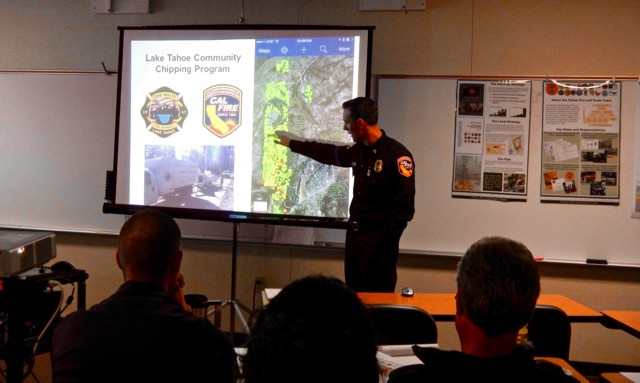
MEYERS – In an effort to get ahead of the fire season, crews from various fire agencies in the Lake Tahoe Basin have been gathering to talk about a united approach.

“Wildfires are becoming more problematic because of the changing landscape and more homes are where fires burn,” Forest Schafer with North Lake Tahoe Fire Protection District said. “We want human communities to co-exist with fire so it is not a disaster.”

Shafer was speaking at a meeting this month to fellow fire officials at the main Lake Valley station.

Creating fire adapted communities and working to thin the forest where it interfaces with developed areas are ways to achieve those goals.

A fire adapted community “can survive a wildfire with little or no assistance from firefighters. These communities are characterized by homes that are built of fire resistant materials and where vegetation and flammable items have been reduced around the home to provide good defensible space. They are buffered by fuel breaks where flammable vegetation has been modified to slow the spark of flames and provide a zone where firefighter can aggressively fight a fire.”

Chris Anthony with CalFire talks about fuel reduction in the Lake Tahoe Basin. Photo/LTN

Last fall’s Emerald Fire was used as an example of how fire behaves when the forest has been treated. It had similar characteristics to the devastating 2007 Angora fire that reduced 254 houses on the outskirts of South Lake Tahoe to ash. The winds and humidity were comparable. Both started in the forest and ran toward subdivisions.

The big difference is the amount of treated forest was much greater in the Emerald terrain. Firefighters just finished studying the effectiveness of fuels reduction in that area off Highway 89 between Camp Richardson and Emerald Bay.

“There is a big change in ember production if we can keep it on the ground,” CalFire Division Chief Chris Anthony said.

That’s not to say a thinned forest won’t have crown fires, but the likelihood decreases and the negative impact can be less.

Money is needed to keep the thinning going forward. (Since 2000 nearly 47,000 acres have been treated in the basin on private, local, state and federal lands.) Agencies continually apply for grants, with the Southern Nevada Public Lands Management Act being a primary source.

With June marking the 10-year anniversary of the devastating Angora Fire, the horrors of a wildfire are very much on the minds of fire officials.

The good that came out of that inferno was the creation of the Nevada Fire Safe Council. While it went bankrupt amid lots of controversy, in its place is the Tahoe Fire and Fuels Team (TFFT). It is comprised of 20 agencies and has more of a basinwide approach.

TFFT recognizes three distinct geographic regions in the basin – the South, West and North shores. The group looks to identify the areas in most need of fuels treatment regardless of ownership.

TFFT is able to cross state, county and city lines. Many grants can be used throughout the territory. The team aspect is very real and not in name only. This is important because a fire doesn’t see boundaries.

Van Sickle Bi-State Park and land owned by South Tahoe Public Utility District are two of the more troublesome locations that will be addressed this year.

There is also money ($150 million) in the recently passed Lake Tahoe Restoration Act for fuels reduction. The problem is Congress has not allocated the money.

Coming up on March 27 is the third annual Nevada Network of Fire Adapted Communities Conference in Reno. Participants will include stakeholders in Nevada’s wildland urban interface, including members of wildfire-prone communities; local, state and federal agencies; and Community Emergency Response Team volunteers from Carson City, Douglas and Washoe counties.


Veteran EDC supervisorial assistant gone

Judi McCallum, longtime assistant to the District 5 supervisor in El Dorado County, abruptly left her job.

Judi McCallum

She worked for the county from March 26, 1991, to March 20, 2017.

McCallum’s resignation letter is not being made public. However, those inside the county said the separation was not McCallum’s idea.

McCallum and Supervisor Sue Novasel have had a touchy relationship. McCallum was used to working for Norma Santiago, who when she was supervisor, did not require McCallum to come into work every day and instead would allegedly work from home. Novasel put an end to that practice.

According to the Human Resources Department, “There are two types of recruitment that may be conducted. When an open recruitment is conducted, any eligible applicant can participate in the recruitment process. When a county promotional recruitment takes place, it is open to all current county employees and those who meet qualifications for the job participate in the process.”

— Lake Tahoe News staff report


Nevada ratifies Equal Rights Amendment

By Sandra Chereb, Las Vegas Review-Journal

CARSON CITY — The Nevada Senate on Wednesday put an exclamation point on the state’s ratification of the Equal Rights Amendment, 45 years to the day after it was passed by Congress and sent to states.

The Senate on a voice vote concurred with minor adjustments made by the Assembly, making Nevada the 36th state to ratify the amendment that seeks equal rights for women under the U.S. Constitution.

Senate Joint Resolution 2 passed the Senate and Assembly on largely party-line votes, with Sen. Heidi Gansert and Assemblywoman Jill Tolles, both Reno Republicans, joining Democrats to approve it. It now goes to Congress.

Read the whole story


Nev. moves to join 11 other states in popular-vote effort

By Yvonne Gonzalez, Las Vegas Sun

Lawmakers are considering legislation to make Nevada the 12th state to become part of an interstate compact to elect the president and vice president based on the popular vote.

The compact says that once states with 270 electoral college votes sign on, those electors would be required to vote based on the popular vote for president and vice president.

Assemblyman Nelson Araujo, D-Las Vegas, sponsored Assembly Bill 274 and said during a legislative operations and elections committee hearing Tuesday that, if passed, the state would retain the ability to leave the compact.

Read the whole story


2 roofs collapse in Lake Tahoe

Two roofs collapsed on houses in the Tahoe basin this week.

The first was on Old Mountain Road in Carnelian Bay on March 20.

No one was home at the time. However, about half of the structure had collapsed from the weight of the snow.

The propane tank had to be dug out and secured.

The other was on March 22 in Meyers on Nahane Street. The flat roof and deck over the two car garage fell.

This was a second residence and no one was home or injured at the time.

— Lake Tahoe News staff report