Police arrests plummet across California

By James Queally, Kate Mather and Cindy Chang, Los Angeles Times
 
In 2013, something changed on the streets of Los Angeles. Police officers began making fewer arrests. The following year, the Los Angeles Police Department’s arrest numbers dipped even lower and continued to fall, dropping by 25 percent from 2013 to 2015.

The statewide numbers are just as striking: Police recorded the lowest number of arrests in nearly 50 years, according to the California attorney general’s office, with about 1.1 million arrests in 2015 compared with 1.5 million in 2006.

It is unclear why officers are making fewer arrests. Some in law enforcement cite diminished manpower and changes in deployment strategies. Others say officers have lost motivation in the face of increased scrutiny — from the public as well as their supervisors.
Read the whole story


Report: Tahoe estate sold for $29 million

By David Caraccio, Sacramento Bee
 
A historical and prominent estate in Lake Tahoe has sold for nearly $29 million, according to several reports.

The 10-acre property, known as the Drum Estate, on the north shore of Meeks Bay, boasts over 700 feet of shoreline, two piers and a compound of structures. A vintage main lodge dates back to the 1920s.

In 1923, John Drum, president of American Trust Co., bought the property and planned to create a Tahoe sanctuary for relaxation and entertaining, according to Tahoe Luxury Properties. Guests as famous as aviator Charles Lindbergh visited the property. It was purchased by Erik Jonsson, the founder of Texas Instruments, in 1961, Tahoe Luxury Properties said in an article about the sale.

The buyer is Drum Lodge LLC of Redwood City, according to the Sacramento Business Journal, and shares the same address as two foundations started by technology billionaire Thomas Siebel.

Read the whole story


Travel ban could cost $18B in U.S. tourism

By Bart Jansen, USA Today

President Trump’s temporary travel ban and an inhospitable political climate could punch an $18 billion hole in U.S. tourism by international visitors over the next two years, projections by travel analysts show.

Foreign tourism is a $250 billion-a-year business in the United States, and Trump’s original and revised executive orders temporarily banning travel from six majority-Muslim countries — put on hold by federal courts — have dampened interest worldwide in visiting the U.S., travel and tourism executives told USA Today.

“The U.S. has put an unwelcome mat at our front door,” said Henry Harteveldt, president of Atmosphere Research Group, which conducts travel research.

Read the whole story


Brown lobbying for taxes, fees to fix Calif. roads

By Christopher Cadelago, Sacramento Bee
 
When Gov. Jerry Brown campaigned for his sales and income tax increase five years ago, he appealed to statewide voters by arguing it would cost them just “one penny more” for their cappuccinos.

In the Bay Area trying to build support for his $5.2 billion road-funding package, Brown acknowledged Thursday that convincing the Legislature to raise fees and taxes on motorists was more akin to feeding them green vegetables than sweet confections.

Brown and the leaders announced the deal Wednesday in Sacramento, setting off a political struggle to pass it in the Legislature. The plan would raise gas taxes and user fees on motorists, costing California drivers about $10 more per month, depending on the value of their cars and the miles they travel.

Read the whole story


Skier extracted from Desolation Wilderness

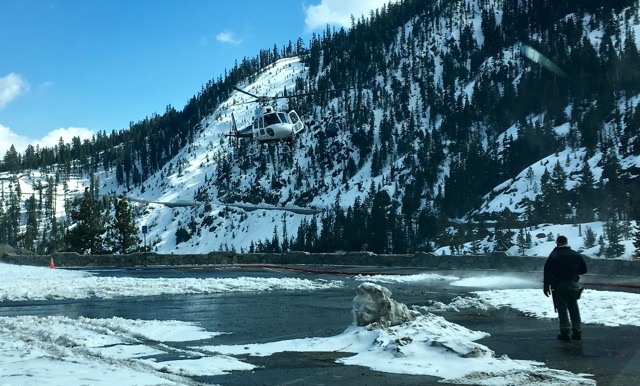
A CHP helicopter uses Vikingsholm parking lot as a landing zone. Photo/EDSO

A 24-year-old San Luis Obispo man had to be airlifted out of Desolation Wilderness on the afternoon of March 30 after injuring his leg.

A California Highway Patrol helicopter dropped El Dorado County search and rescue volunteers onto Jakes Peak. They then skied to the victim. Because he could not ski out a hoisting seat was used to lift him out of the back country to safety, and then he was transported to Barton Memorial Hospital.

Jakes Peak is located north of Emerald Bay.

— Lake Tahoe News staff report


Kirkwood house destroyed in explosion

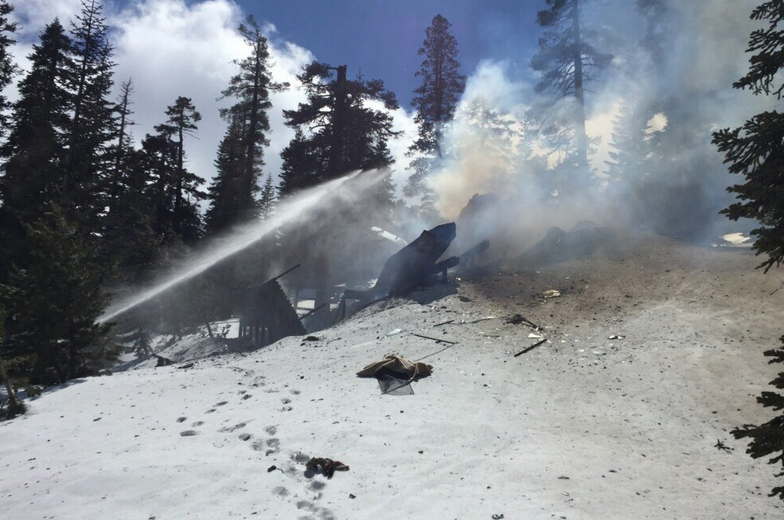
Firefighters extinguish a blaze in Kirkwood on March 31. Photo/CHP

A house in Kirkwood was totally destroyed today because of a gas line.

This was the second house to catch fire in seven days because of a gas line.

The March 31 incident leveled the house. It was on Dangberg Street, about a half mile from the March 25 explosion. In the first incident the house was only partially damaged.

It is not known if anyone was injured in Friday’s blast.

No one from Kirkwood Fire Department or Kirkwood Meadows Public Utility District was available to comment. What is causing the gas explosions has not been disclosed. Nor is it known if more houses are at risk.

— Lake Tahoe News staff report


S. Tahoe man arrested in kidnap-assault case

A 30-year-old South Lake Tahoe man has been arrested in the beating that left another local man fighting for his life.

Alberto Ochoa

Alberto Ochoa was arrested March 30 in Rancho Cucamonga on charges of robbery, kidnapping and assault with a deadly weapon. He was reportedly driving the Subaru that had been stolen in South Lake Tahoe.

Ochoa is accused of binding and gagging a 43-year-old local man who was found at his Spruce Avenue residence March 29 by a co-worker. He had been in that state for at least 20 hours, officers said. The victim was still in stable condition March 31 at Renown Medical Center in Reno

The victim and suspect know each other, but exactly what their relationship is has not been disclosed by officers. Officers believe Ochoa acted alone.

“Our detectives are interviewing Ochoa right now. Hopefully, he sheds some light on this case,” SLTPD Sgt. Shannon Laney told Lake Tahoe News.

Ochoa was being detained at the San Bernardino County Jail on $1 million bail. 

— Lake Tahoe News staff report


Scientists warn enormous floods may be more likely

By Krista Langlois, High Country News

In the late 1980s, a Japanese scientist named Koji Minoura stumbled on a medieval poem that described a tsunami so large it had swept away a castle and killed a thousand people. Intrigued, Minoura and his team began looking for paleontological evidence of the tsunami beneath rice paddies, and discovered not one but three massive, earthquake-triggered waves that had wracked the Sendai coast over the past three thousand years.

In a 2001 paper, Minoura concluded that the possibility of another tsunami was significant. But Tokyo Electric Power was slow to respond to the science, leaving the Fukushima Daiichi nuclear power plant unprepared for the 15-meter wave that inundated it in 2011. The wave resulted in a $188 billion natural disaster. More than 20,000 people died.

Earlier this year, when a spillway at the nation’s tallest dam in Oroville nearly buckled under the pressure of record rainfall, the consequences of under-estimating flood risks were brought into sharp relief. Dams aren’t built to withstand every curveball nature can throw — only the weather events that engineers deem most likely to occur within the dam’s lifespan. When many Western dams were built in the mid-20th century, the best science to determine such probabilities came from historical records and stream gauges.

Read the whole story


Bill to ban dogs in Nev. bear hunting draws opposition

By Sean Whaley, Las Vegas Review-Journal

CARSON CITY — Opponents of the use of dogs and GPS technology to hunt black bears testified for a bill Thursday to ban the practice in Nevada.

The Assembly Natural Resources, Agriculture and Mining Committee heard Assembly Bill 443, which would follow the lead of other Western states, including Washington, Oregon, California, Montana and Colorado, in banning the use of dogs to chase bears so they can be treed and shot.

GPS and other technologies have made the use of dogs even easier, since the animals can be located without significant effort.

Read the whole story


Calif. retired teachers’ account 63.7% funded

By Adam Ashton, Sacramento Bee

The pension fund for California teachers is about $97 billion short of the assets it would need to pay all of the benefits it owes to its members today, according to a new valuation from the California State Teachers’ Retirement System.

CalSTRS released the new accounting ahead of its monthly meeting, which is scheduled for next week.

The $202 billion fund has about 63.7 percent of the assets it needs to pay the benefits it owes. That reflects a 4.8 percent decrease in CalSTRS’ funded ratio from its most recent assessment.

Read the whole story