Driving while stoned — not a party for anyone

Goggles simulate what it’s like to driver under the influence of marijuana. Photo/Michael Rohm

By Michael Rohm

RENO – I could see the sharp S-curve approaching, but my vision was blurred and I hit the wall on the first corner. My body recoiled with the shock and I overcorrected, striking the opposite wall. With my peripherals reduced and the walls seemingly amorphous, I continued to bump my front fender, jolting  my car and body during the final hairpin turn. On a straightaway at last, and on the verge of vomiting, I stopped the car and sat quietly, willing the world to stop spinning. I waited with my eyes closed as two uniformed officers approached the vehicle.

“That was some bad driving,” Lt. Kevin Honea with the Nevada Highway Patrol said. Still reeling, I unbuckled the harness straps and stepped from the go-kart, then pulled off the green-tinted goggles and padded helmet.

“Did you notice the difference?” asked NPH Trooper Dan Gordon.

He was referring to the goggles I had just removed; large, snowboard-style ones with the words “Marijuana: Fatal Vision” emblazoned on a green sticker dead center of the forehead.
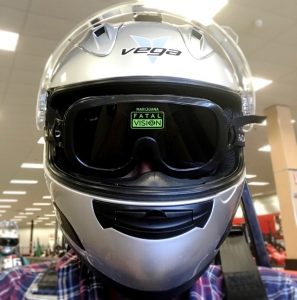
A padded helmet protects those trying out the pot goggles while driving. Photo/Michael Rohm

To put it mildly: yes, I noticed the difference. The first lap around the go-kart course I completed unimpaired. For round two I was very, very impaired.

This zero fatalities event coordinated by the NHP gave people a chance to see and feel what it is like to drive under the influence of marijuana without lighting up or ingesting anything.

This difference between unimpaired and impaired driving is exactly why the NHP partnered with Need 2 Speed, an indoor go-kart track – to get the message out that pot affects one’s ability to drive. Now that the use of recreational marijuana is legal in Nevada, and in preparation for the dispensaries that are planning to open for business as soon as July 1, officers want to remind people that impaired driving is and always will be unsafe and unlawful.

“It doesn’t matter what you’re on if you’re driving,” Gordon said. “Anything that impairs your ability to drive a car will get you arrested.”

Unlike alcohol, where the legal limit is clearly stated and easily defined, marijuana impairment is more misunderstood. According Gordon, many people think eating edibles, food items cooked with THC, does not count as using marijuana. Others think marijuana doesn’t impair one’s ability to drive. Some don’t even know there is an age restriction for the use of marijuana.

“It’s very clear,” Gordon said. “You must be 21 years old to use marijuana, including edibles. And if you are 21 or older and you decide to legally use marijuana, please don’t get behind the wheel.”

Despite the information campaign, Gordon knows there will be an increase in marijuana impaired driving.

“When the use of marijuana was legalized in Nevada, we began to look at states that had legalized marijuana prior to us. We saw a clear pattern in the increase of impaired driving and we knew we were going to see a rise in marijuana impaired drivers here in Nevada. That’s just a given.”

To meet the increase in marijuana impaired drivers, officers are trained to identify drivers who are under the influence. Unlike alcohol, where breathalyzers can pinpoint the exact level of intoxication, marijuana intake is harder to measure. Instead, officers learn techniques in field sobriety tests aimed specifically at marijuana impairment.

When an officer pulls over a driver suspected of marijuana impairment—usually one who fails to stay in his lane at consistent speeds—the officer will request a field sobriety test to determine signs of marijuana inebriation. The Rhomberg Balance Test is one component, in which the driver is asked to hold his hands at his side, tilt his head back, close his eyes and silently count to 30. Because marijuana is a depressant, impaired drivers will often count much longer than 30 seconds.

Another test unique to marijuana inebriation is Lack of Convergence. An officer will hold an object—his finger or pen—in front of the driver, moving it back and forth before moving it closer to the bridge of the driver’s nose, forcing the eyes to cross or “converge.” If the eyes do not converge, it is an additional component in building probable cause for the arrest of the suspected impaired driver.

“These tests are very accurate,” Honea said. “If we pull you over and you show signs of impairment, we will request a field sobriety test.”

As I drove home after the event, I found myself looking at the cars around me and wondering if any of the drivers were impaired by marijuana. With weed legal, it seemed plausible that I was sharing the road with a high driver. Wasn’t that blue Subaru in front of me driving a little too slow? Hadn’t the black Charger beside me switched lanes a time too many?

But then I thought of Gordon’s parting words.

“We’re prepared, we’re getting the word out,” he told Lake Tahoe News. “We will continue to do our best to curtail negative decisions about impaired driving.”

And in the words of Honea: “Individual responsibility is imperative. Don’t drive high.”


Jobs grant to benefit El Dorado, Placer counties

By Mark Glover, Sacramento Bee

California’s Employment Development Department says it has received up to $36 million in a National Dislocated Worker Grant to help 34 counties clean up in the aftermath of recent rainstorms.

EDD said the funds approved by the U.S. Department of Labor will provide temporary jobs for 1,800 unemployed workers in the affected counties for clean-up and repair projects. The affected counties include Sacramento, El Dorado, Placer and Yolo.

At the request of Gov. Jerry Brown, the Federal Emergency Management Agency made three major disaster declarations in California following storms that began in early January.

Read the whole story


Trump approves funds for California relief

By Christopher Cadelago, Sacramento Bee
 
President Trump announced Sunday more than a half-billion dollars would be coming to California to help cover the damage from the winter storms, including $274 million for repairs to the Oroville Dam spillway.

The fulfillment of the fourth presidential declaration for damage from the winter storms totals an estimated $540 million.

Trump’s fourth declaration makes available money for hazard mitigation measures statewide. It covers 42 counties, including Sacramento, Yolo, Amador, Yuba, El Dorado, Merced and San Luis Obispo. The White House said additional designations can be made later if requested by the state and warranted by further damage assessments.

Read the whole story


Task force analyzing LTCC theater’s future

By the end of June a recommendation is expected about what the future of Lake Tahoe Community College’s theater program should look like.

The 20-member community task force that was convened to delve into the program has met twice, and will continue to meet every other Thursday until June. Solutions are expected to be presented to the board by the end of the academic year.

The two main areas of discussion are the credit program currently offered and what role the college could play in the community in regards to performing arts.

Theater arts has been under scrutiny internally at the college for a couple years because classes are not highly sought after and it is expensive to run. Last fall it appeared the department was headed for elimination by the administration. Community outcry put a stop to that.

Michelle Risdon, LTCC’s interim vice president of Academic Affairs, said one thing that needs to be addressed is how to attract more students from Lake Tahoe Unified School District. Tahoe Valley Elementary School’s focus is performing arts and South Tahoe High School’s theater program is outstanding, so LTUSD should be a natural feeder into LTCC in this regards.

For now, all possibilities are still on the table.

— Lake Tahoe News staff report


Former Truckee High School coach dies in crash

By Marcella Corona, Reno Gazette-Journal

A former Truckee High School football coach was killed in a head-on car crash Saturday outside of Sierraville, according to the California Highway Patrol.

Former football coach Robert Shaffer died at the scene. His wife Lisa Shaffer and his 22-year-old son, Patrick, suffered minor to moderate injuries, CHP said in an incident report.

The crash was reported at about 9:29pm Saturday along Highway 89 just south of Cold Creek Campground in Sierra County, authorities said.

Read the whole story


Is Nevada’s death penalty a ‘broken system?’

By Marcella Corona, Reno Gazette-Journal
 
In the last 40 years, 160 Nevadans have been sentenced to death.

Only 12 were ever executed.

That’s a key argument proponents of a bill to effectively abolish the death penalty are using now that Assembly Bill 237 is making its initial steps through the Nevada Legislature. In short, the death penalty costs too much and isn’t delivering results.

The future of the state’s death penalty is being debated in the Nevada Legislature, and the bill got its first hearing on Wednesday. Supporters argued that a death penalty case costs half-a-million more than a non-death penalty case, and it’s rarely used because the state lacks the lethal drugs it needs.

Read the whole story


Nevada minimum wage stays stagnant

People with minimum wage jobs in Nevada will be stuck at that wage for the next fiscal year that begins July 1.

Since 2006 the Office of the Labor Commissioner has been conducting an annual review of the hourly rate. The group takes the federal minimum wage and cost of living into consideration when making the decision. The federal wage is $7.25 an hour.

Nevada’s minimum wage is $8.25 an hour, but drops to $7.25 an hour if the employer offers qualified health benefits. Rules and rates for overtime for 2017-18 will also remain unchanged.

California’s minimum wage is $10.50/hour and will gradually increase to $15 by 2022.

— Lake Tahoe News staff report


The West is moving away from coal

By Daniel Rothberg, Las Vegas Sun

Southern Nevada’s last coal plant closed March 16. That same day, a New Mexico power company said a plant on Navajo land might be next to shutter. And in a somewhat unexpected decision the month before, regional utilities announced the early shutdown of the West’s largest coal plant, also on the Navajo Nation. President Trump might have pledged to invigorate the industry, but most economists agree on one trend: Western coal is unraveling.

The outlook was different in 2010, when the Sierra Club launched its Beyond Coal campaign. It deployed lawyers, mobilized supporters and lobbied state legislatures to shut down coal-fired power plants across the U.S. in an effort to curb carbon emissions. Then something changed. The argument against coal expanded from one about the environmental costs to one that cited economics.

“The economics of power generation don’t support replacing coal-fired generation,” said Robert Godby, who directs the Center for Energy Economics and Public Policy at the University of Wyoming.

That’s a primary reason why utilities across the West are retiring old coal plants instead of building new facilities or investing in modern infrastructure.

Read the whole story


State grant to help rid toxins in SLT groundwater

The State Water Resources Board is giving South Tahoe Public Utility District $294,270 to help resolve the groundwater contamination issue near the Y.

The money will be used to conduct an engineering feasibility study of alternatives to remove Tetrachloroethylene or PCE from the groundwater. Tahoe Keys Water Company and Lukins Brothers Water Company are partners with STPUD in this process because their wells have been contaminated.

Chemicals once used in the dry cleaning business have been known to be contaminating the ground water in South Lake Tahoe since 1989, mostly at the Y where a dry cleaner used to operate. While different remediation measures have been tried, the plume is still detectable.

“Removal of PCE is necessary in order to both supply clean drinking water to customers in the area as well as preventing the further spread of the contaminant plume through the drinking water aquifer,” Richard Solbrig, general manager of South Tahoe PUD, told Lake Tahoe News.

The money is part of a $20 million allocation by the state to cleanup or prevent the spread of groundwater contamination to aquifers that serve as a source of drinking water. This is bond money from Proposition 1 that voters approved in November 2014.

— Lake Tahoe News staff report


Traffic stop leads to arrest on drug charges

Two people were arrested this week in Truckee after a traffic stop revealed heroin in their vehicle, according to officers.

Dylan Tanner Robert Surrock, 25, of Kings Beach faces charges of possession of a narcotic for sale and sale or transport of a controlled substance. Abbigail Starr Baker, 27, of Bremerton, Wash., was arrested on charges of possession of a controlled substance paraphernalia.

A vehicle code violation was the initial reason for the stop March 28 on Highway 89, according to the California Highway Patrol. A K-9 alerted officers that a search of the vehicle was warranted. Officers said more than an ounce of heroin was found.

— Lake Tahoe News staff report