2016-17 nears record for wettest winter in N. Calif.

By Nashelly Chavez, Sacramento Bee

The northern Sierra Nevada, which supplies water for much of the rest of California, is poised to surpass its wettest year in recorded history well before the rainy season comes to a close.

As of Saturday morning, the region had accumulated an average of 87.5 inches of water across eight northern Sierra stations since the beginning of the season on Oct. 1, according to data from the California Department of Water Resources.

Erick Kurth, a meteorologist for the National Weather Service, said rain and snow predicted for the upcoming week could help bring the extra water needed to exceed the 1982-1983 record. Areas throughout the Sierra mountains saw snowfall into Saturday afternoon. Rain is expected to shower the region again beginning Tuesday and last through Thursday.

The current record for the northern Sierra was established when the water year running from Oct. 1, 1982 through Sept. 30, 1983 saw a total of 88.5 inches.

Read the whole story


Traffic flowing again on Kingsbury Grade

Kingsbury Grade is open following repairs to an eroding roadside slope and extensive rockfall.

NDOT has been monitoring roadside slopes across the region, including a slope on Kingsbury Grade which had slid approximately 1 foot within a recent 24-hour period, posing the threat of bringing mud, rock and debris across the highway. Additionally, approximately four-foot diameter boulders fell from a nearby hill onto the roadway.

The highway was closed early Friday afternoon as NDOT and contractor Q&D Construction removed loose trees and earth from the slope to reduce rock and mud fall onto the highway. On Saturday, rockfall mitigation experts removed boulders perched on top of a separate roadside slope. The boulders had loosened during recent heavy precipitation.

Soil saturation and additional winter weather may lead to future road closures as repairs are made to other roadside slopes.


Huge winter, hostile politics headline climate forum

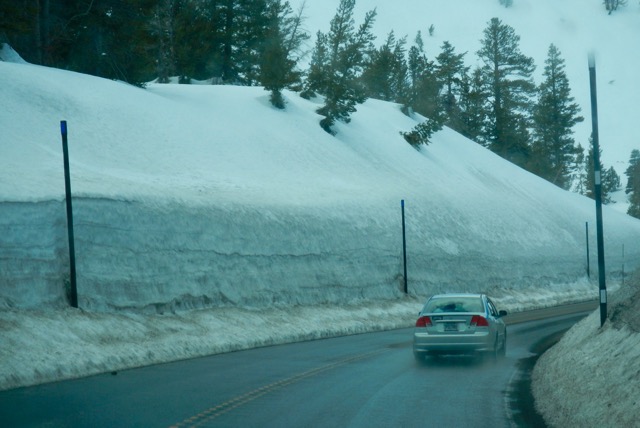
Several feet of snow still line the Mt. Rose Highway. Photo/LTN

By Benjamin Spillman, Reno Gazette-Journal 

The mountain snowpack is fat but funding to unravel what it means for western communities and the environment is thin.

That’s the dynamic facing scientists who study climate, snow and water in California and Nevada.

They gathered Thursday for the fifth Great Basin Climate Forum at the Desert Research Institute in Reno to watch presentations about the drought-busting winter season.

They also talked about how hostility from President Trump and a Republican-controlled Congress could undermine scientific research into climate, water and fire behavior that shape the environment of the western United States.

Read the whole story


Truckee flowing faster to make room for snow melt

By Cassie Wilson, KRNV-TV

The water flows of the Truckee River are currently 3.5 times the average rate, thanks to early snow melt as well as precaution.

Crews have been releasing water from Lake Tahoe and other upstream reservoirs since the end of February to make room for snow melt still to come.

Lake Tahoe has gained nearly 4 feet of water since Jan. 1, and it is well above its natural rim. So water is now flowing at a controlled rate out of Tahoe City and into the river.

Read the whole story


California’s public pensions breaking the bank

By Judy Lin, Los Angeles Times

More than 20 times in the last 15 years, political leaders looking to control California’s fast-growing public pension costs have tried to put reform initiatives before the voters.

None of the proposals has made it onto the ballot.

Often, advocates could not raise enough money for signature gathering, advertising and other costs of an initiative campaign. Some of the most promising efforts, however, ran into a different kind of obstacle: an official summary, written by the state attorney general, that described the initiative in terms likely to alienate voters. Facing bleak prospects at the polls, the sponsors abandoned the campaigns.

Taxpayer advocates contend that the attorneys general — Democrats elected with robust support from organized labor — put a finger on the scale, distilling the initiatives in language that echoed labor’s rhetoric. Labor leaders say the summaries were neutral and accurate, and that the problem lay with the initiatives — which, they contend, would have diluted benefits already promised to public employees.

Read the whole story


Feds target Calif.’s efforts to get people to save

By Ben Steverman, Bloomberg

Nancy Harvey has a goal. “I’d like to retire before dying,” she said.

Harvey, 55, has almost nothing saved for retirement. She’s a child-care provider in Oakland, and there isn’t much left over at the end of the month. “It’s not a lucrative field,” she said.

She was looking forward to a new way to save, courtesy of her home state’s government. The California Secure Choice Retirement Savings Program would create state-sponsored individual retirement accounts. Employers would be required to offer their own retirement plans or sign workers up for the voluntary IRAs. Four other states—Illinois, Maryland, Oregon, and Connecticut—are launching similar programs, also designed to make it easier to save on the job through payroll deductions.

Now, lawmakers in Washington are threatening to end the states’ auto-IRA programs before they start, setting up another likely confrontation between the Trump administration and Democrat-run state governments such as California’s.

Read the whole story


Douglas County declares emergency in anticipation of runoff

The Douglas County Board of Commissioners have declared a state of emergency in preparation for the potential of flooding associated with spring runoff and for stormy conditions such as this weekend. The declaration has been submitted to the state and will allow regional partners to expedite mitigation efforts as well as speed up the delivery of resources required to more effectively respond to an emergency.

The county has concentrated the majority of its efforts in debris removal, road side drainage restoration, road repairs, culvert and bridge repair and cleaning, and snow removal, all related to the two prior flood events. 

Douglas County is requesting that the state:

·        Assist with expediting any and all permitting required for mitigation work in or near the Carson River, including permits issued by the Nevada Department of Environmental Protection, State Lands, or the Army Corps of Engineers.

·        Directly assist with river bank stabilization and debris removal on the Carson River. This is particularly  true in areas where river bank failure or breaches have impacted Aspen Mobile Home Park in Gardnerville, and have forced the closure of US 395 in northern Douglas County during both 2017 flood events.

·        Directly assist with river debris, sand, gravel bar, and sediment removal on the Carson River in areas where significant deposition occurred during the 2017 flood events.

·        Directly encourage Nevada State Lands and the Army Corp of Engineers to engage in active measures within their jurisdiction of the Carson River and/or to work in concert with the Carson Valley Conservation District and agricultural interest along the river.

·        Directly assist with vegetation removal impeding flows through the bypass underflow north of the 395 bridges in northern Douglas County.

·        To assist specifically in identifying and providing bank stabilization and repair in areas which allow flood waters to escape the prescribed waterway resulting in the closure of US 395 in northern Douglas County.

·        To assist in evaluating potential snow melt originating in the Hope Valley area and feeding the West Fork of the Carson River.

·        To assist with public awareness and information to help people prepare for and respond to flood events.

·        To assist our local agricultural community in any way possible to facilitate their efforts to repair diversion structures and other such structures ahead of irrigation season.

·        To assist and support both short and long term mitigation planning and projects.

·        To coordinate all efforts with our Federal partners to the highest degree.


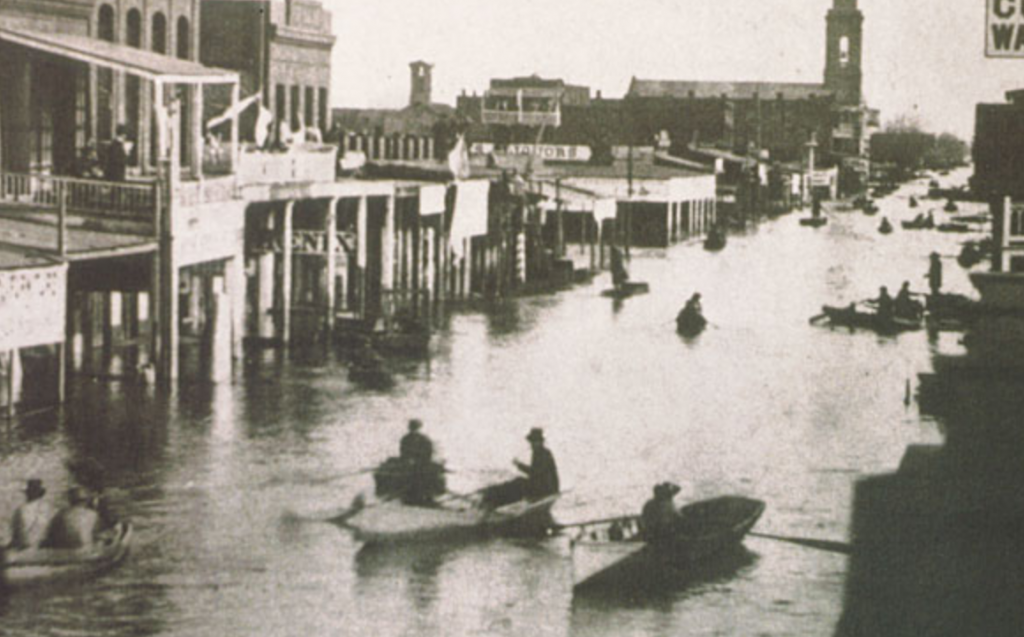
1862: California’s most devastating winter

Sacramento under water, circa 1862. | Photo/California Historical Society

By Mark McLaughlin, Tahoe Weekly

There’s been a lot of talk about weather records being broken this winter, but it was only January’s epic snowfall totals that have made it into the record books so far. In January 2017, the Central Sierra Snow Lab near Donner Pass and many Tahoe Sierra resorts set new monthly snowfall tallies ranging from 20 to 25 feet.

But the current seasonal snowfall total of about 42 feet at the CSSL means we still have a long way to go to reach Top 10 status at Donner Pass, let alone exceed the 68 feet that fell in 1938. We are, however, closing in on the wettest year in the precipitation category, currently holding at third place behind 1982 and 1995, the first- and second-ranked water years since 1871. Remember, precipitation is rain and the water content of snow combined.

There have been plenty of weather-related issues across the West this winter, but even if this year manages to exceed the all-time precipitation record of 112 inches measured in 1982, it won’t compare to 1861-62, the most devastating winter in California history. The predominant weather characteristic in 1862 was also an onslaught of powerful atmospheric rivers, but significantly more intense. The mega-flood that they caused took thousands of lives and destroyed 25 percent of the state’s economy. The devastation forced California into bankruptcy.

Read the whole story


Slide closes Kingsbury Grade indefinitely

Updated 4:56pm:

Kingsbury Grade will remain closed indefinitely between Daggett Summit and Foothill Road.

The highway was expected to be closed temporarily on Friday as NDOT and contractor Q&D Construction removed loose trees and earth from a roadside slope to help reduce rock and mud fall onto the highway.

What they found is the slope had slid approximately 1 foot within the past 24 hours, posing the threat of bringing mud, rock and debris across the highway.

While that slope was repaired, additional boulders approximately 4 feet in diameter began falling from other areas onto the highway.

Residential and commercial access on the Tahoe side of Kingsbury Grade remains available via Highway 50.

— Lake Tahoe News staff report


Brown: California drought officially over

By Bettina Boxall, Los Angeles Times
 
Startlingly green hills, surging rivers and the snow-wrapped Sierra Nevada had already signaled what Gov. Jerry Brown made official on Friday: The long California drought is over.

“This drought emergency is over, but the next drought could be around the corner,” Brown said in a statement. “Conservation must remain a way of life.”

The five-year drought won’t just be remembered for its stubborn severity. It produced a historic groundwater use law and the first-ever statewide restrictions on urban water consumption

Read the whole story