EDC lax in getting consultants to disclose info

By Lake Tahoe News

Consultants hire by El Dorado County have a habit of not abiding by state law that requires them to disclose financial interests.

This could be a problem if consultants have competing financial interests that lead to illegal favors.

The county’s Community Development Agency was singled out in a letter that auditor Joe Harn sent to the Board of Supervisors.

“The county’s land use planners are required to make public financial disclosures of their income, gifts received, etc.  Consultants that CDA uses and relies on to make land use recommendations are required by state law to make the same disclosures. The county and CDA have not been asking for the required disclosures,” Harn wrote.

CAO Don Ashton believes the problem should be resolved now.

“I recommended the board amend a contract to identify the auditor as the contract administrator for a consultant providing financial impact analysis studies for the Community Development Agency. As a result of this recommendation, Mr. Harn identified this error and between the CAO’s office and the auditor-controller’s office, we will take appropriate corrective action to educate our staff, correct any deficiencies, and prevent this from occurring in the future,” Ashton told Lake Tahoe News.

Harn wants all county consulting contracts to be reviewed to make sure they are in compliance.


Lake Valley Fire contemplating new station

If they could do it all over, a fire station would never have been built at Golden Bear.

Lake Valley Fire Protection District is in the preliminary stages of looking to build a station elsewhere. The primary parcel being looked at is at the corner of Pioneer Trail and Black Bart Avenue, which is owned by South Tahoe Public Utility District. A post office used to be on this site.

“It’s on the edge of the district, but it’s nice open country, easy to get around,” Fire Chief Tim Alameda told Lake Tahoe News. He’s walked and driven around the area, but has not done a full assessment to determine if that location would provide adequate coverage for the department.

Problems with the current station 6 include it being on a stream environmental zone, it’s hard to maneuver engines there, it’s too small and it’s not up to code.

South Tahoe PUD will be discussing the matter at its meeting on Thursday.

While money is an issue for the district, Alameda believes it’s better to start the dialog now before the need is dire.

— Lake Tahoe News staff report


Extra patrols enhance VHR enforcement in SLT

By Kathryn Reed

Enforcement is what people have been calling for in regards to vacation home rentals and the city finally delivered on that request.

The South Lake Tahoe City Council on Tuesday will hear a report about the outcome of the 90-day enhanced enforcement. The council is likely to discuss the possibility of continuing the added patrols during peak tourism months in the summer and winter.

“The neighbors are clearly seeing patrol vehicles come through with the VHR patrol. They are being listened to,” Police Chief Brian Uhler told Lake Tahoe News.

He believes the combination of the rules the council has put in place, the storms happening on weekends, VHR owners putting pressure on tenants and the extra patrols have contributed to make vacation home rentals be less of a problem in town.

The High Sierra Patrol workers did not interact directly with people at the VHR, but instead reported back to the community service officer who made the face-to-face contact.

The security teams worked from mid-December through mid-March, daily from 4pm-2am. High Sierra Patrol personnel were tasked with checking on 120 properties with closed permits to see if they were operating illegally, houses where a complaint had been filed and residential areas outside of the tourist core.

Findings include:

·      26 properties were operating without a valid permit

·      33 properties are on a watch list because of the higher number of calls

·      85 rental signs were not visible because of snow, lighting or a sign didn’t exist

·      36 VHR owners received an advisory notice

·      10 owners were issued warnings

·      3 administrative citations were given

·      Dispatch during the same time frame received 68 calls for loud noise, of which 16 were from VHRs

·      In addition to those 68 calls, dispatch received specific VHR complaints – 14 for noise, 20 for parking and four for trash.

Where people were cited, the city sent out bills totaling $26,750.

The cost to the city for High Sierra Patrol for those 90 days was $26,310.

Earlier this month the council approved the hiring of a full-time permanent community service officer who will handle VHR issues. This has been a temporary position.

Uhler said it has been difficult in the past to keep people in this CSO job. Having more consistency with staff has also made for better tracking of problem properties and getting out a consistent message.


Ex-El Dorado, Alpine worker a defendant in harassment case

El Dorado County’s former human resources director and one-time interim chief administrative officer will be in court April 17 defending her practices when she was an Alpine County employee.

Pamela Knorr

Robert Levy, former Alpine County undersheriff, has filed a lawsuit against Pamela Knorr, three supervisors and Alpine County in federal court in Sacramento. Knorr was CAO at the time of the alleged harassment. (Knorr is currently employed as Butte County’s human resources director.)

The 19-page lawsuit states, “In the aftermath of county and Knorr harassing, attacking, and demoting plaintiff, these defendants assigned certain of plaintiff’s job duties – including certain law enforcement tasks as well as tasks related to plaintiff’s years-long work on county communications projects – to individuals who possessed inferior job qualifications and experience, and who were significantly younger than plaintiff. As a direct, foreseeable, and proximate result of defendants’ discriminatory actions, plaintiff has suffered and continues to suffer substantial losses in earnings and related employment benefits, and has suffered and continues to suffer extreme emotional distress, humiliation, damage to his professional reputation, and diminished employment advancement opportunities in his chosen profession, all to his damage in an amount to be proven at trial.”

Knorr filed her own lawsuit against Alpine County, the sheriff, auditor-controller, and members of the Board of Supervisors while employed there. Alpine County and Knorr settled that dispute for $10,000.

Knorr on April 11, 2013, filed a claim against the county alleging harassment that dated to April 2012 – three months prior to signing the long-term contract. Her last day with Alpine was Aug. 2, 2013. She was paid $80,145.50 on Aug. 7, 2013, and another $80,145.50, on July 1, 2014, as severance per the contract.

— Lake Tahoe News staff report


Avalanche causes delays over Echo Summit

Traffic is flowing on Echo Summit after snow cascaded down April 16. Photo/Kathryn Reed

What started as an easy trek from the South Shore over Echo Summit changed mid-morning when a snowslide occurred.

About halfway up the summit snow came tumbling down on Highway 50, causing backups in both directions.

The slide, which covered all lanes, was at least 4-feet deep. It was reported at 10:15am. Just before noon Aprl 16 traffic was flowing in both directions.

Traffic, though, was backed up beyond Pioneer Trail on Highway 50, along North Upper Truckee Road, and a short ways down Pioneer Trail.

— Lake Tahoe News staff report


Caesars CEO nets 25% less compensation in 2016

By Todd Prince, Las Vegas Review-Journal

Caesars Entertainment Corp. Chief Executive Officer Mark Frissora received 25 percent less in total compensation last year as no stock options were awarded.

Frissora received $9.5 million last year compared with $12.8 million for 2015, according to SEC filings posted on Wednesday. The 2015 compensation package was boosted by $5 million in option awards.

Caesars is the parent company of Harrah’s and Harveys at Stateline.

Read the whole story


Purity of Lake Tahoe water a source of pride

By Kathryn Reed

“Drink Tahoe tap.” It’s the mantra Madonna Dunbar wants everyone to embrace. She’s so passionate about it that she got the phrase trademarked.

Dunbar is the executive director of the Tahoe Water Suppliers Association. This is a 12-member group, with all but South Tahoe Public Utility District getting its water directly from the lake. The other members are: Cave Rock Water System, Edgewood Water Company, Glenbrook Water Cooperative, Incline Village General Improvement District, Kingsbury General Improvement District, North Tahoe Public Utility District, Round Hill General Improvement District, Skyland Water Company, Tahoe City Public Utility District, Zephyr Water Utility, and Lakeside Park Association. The EPA oversees the water association.

Dunbar gave a talk last week at Lake Tahoe Community College about all things water at the invitation of the American Association of University Women.

“We advocate for protecting Tahoe as a drinking source,” Dunbar said. That is one reason the group is not supportive of the Tahoe Keys wanting to use herbicides to rid its canals of invasive weeds.

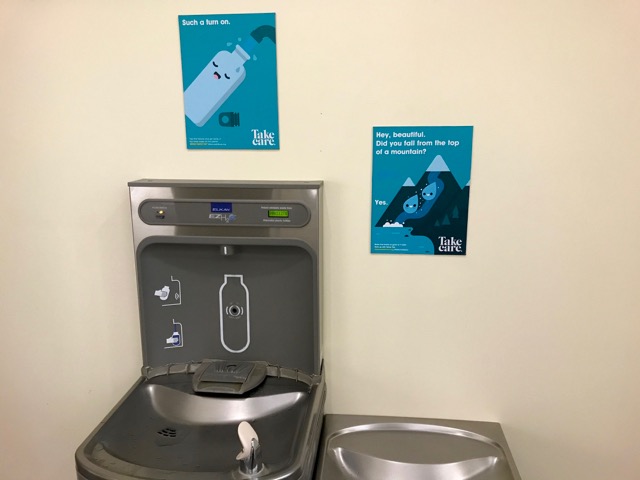
Messages about Tahoe’s tap water are becoming the norm around water fountains. Photo/LTN

Adding chemicals, even ones approved by the EPA, to Lake Tahoe’s water is not something they can support. In-take pipes for the various water agencies are 1,000 to 3,000 feet from the shoreline. That lake water services 20,838 connections and 34,179 full-time residents.

“We are trying to find money to do anything but herbicides,” Dunbar said.

What the water association does strongly back is the boating program that mandates inspections of watercraft in order to keep more invasive species from inhabiting Lake Tahoe.

Six members of TWSA have the rare “filtration exemption” status from the Environmental Protection Agency. This means the water is not filtered; Lake Tahoe is that pure.

There are only 60 of these permits throughout the Unites States. Dunbar said most are in remote areas, like Hetch Hetchy, and usually don’t allow recreation on the water body.

A noticeable difference between lake and groundwater is that the latter will have a mineral taste.

She cited the Porter Cologne Act as being the “single biggest thing to protect Tahoe as a clean drinking water source.” Two aspects of the bill include the ban of septic tanks and the requirement that wastewater be pumped out of the basin.

One thing Dunbar shakes her head at is bottled water.

“Forty to 50 percent of packaged water is filtered tap water that is sold at 1,000 times the price,” Dunbar said. To meet the suggested eight glasses of water a day it would cost 49 cents a year with tap water and $1,400 with bottled water, she said.

Those bottles take a lot of petroleum to make, most aren’t recycled and there is little regulation with bottled water. Dunbar said tap water is more strictly regulated than bottled.

She likes that Truckee is considering banning water that comes in containers less than a gallon, which is something San Francisco already did.

Education about the quality of Tahoe’s water is critical, she said, to get people to realize bottled water is a waste in so many regards.


Damaged sewer line creates sink hole in Tahoe Keys

Crews on April 15 work to fix the broken sewer line in the Tahoe Keys. Photo/Kathryn Reed

By Kathryn Reed

A collapsed sewer line in the Tahoe Keys has caused a sink hole that will take several days to fix.

Tahoe Keys Boulevard west of where it intersects with Venice Drive is closed, and will be for a few days as South Tahoe Public Utility District crews work to fix the break.

“We don’t know how it collapsed,” Chris Stanley, field operations manager for STPUD, told Lake Tahoe News.

The road started to buckle on April 14. About half of the street and the median area have created a sink hole that is more than 10-feet in diameter.

No sewage has leaked, according to Stanley. The wastewater is being rerouted to the Tahoe Keys pump station via specialty pumps that bypass where the break is.

“We are keeping up with all of the flows,” Stanley said. He added it would help if customers tried to reduce their water use for the next few days.

The line serves the entire Tahoe Keys as well Fallen Leaf Lake and the beach areas off Highway 89 owned by the U.S. Forest Service. From this area the wastewater is then pumped to the South Tahoe PUD plant.

This 24-inch gravity line that has failed is several decades old. It is 16 feet below ground. Before crews start to dig plugs are being put in on both ends to prevent sewage from filling the hole.

Traffic is being rerouted to a side street off Venice that hooks up with Tahoe Keys Boulevard beyond the road closure.


Nev. prepares for potential Katrina-style spring flooding

By Benjamin Spillman, Reno Gazette-Journal

Nevada could see weeks of Katrina-style flooding when warm spring and summer sunshine melts the massive snowpack blanketing the Sierra Nevada.

That’s according to the Nevada National Guard and other emergency planners and responders who briefed Gov. Brian Sandoval on potential disaster scenarios.

“Typically, Nevada experiences flash flooding,” Col. Cory Schulz told Sandoval, referencing hurricane flooding in 2005 that devastated New Orleans and southern Mississippi. “This will be saturation flooding, much like Katrina.”

The state has already endured two flood situations that triggered federal disaster declarations in February and March for western and northern parts of the state.

Three counties, Churchill, Lyon and Douglas, have declared emergencies in advance of the coming snowmelt and more could join that group, Sandoval said.

Read the whole story


STPUD, SLT officials embracing renewable energy

Updated April 17:

By Kathryn Reed

South Tahoe Public Utility District’s hydroelectric plant in Alpine County is expected to be online this fall, with power being sold to Liberty Utilities.

The South Lake Tahoe-based water-sewer district had hoped to have the plant operational a few years ago, but money and construction delays pushed the date back. The project is slated to be completed this summer.

Federal law mandates that all wastewater in the Lake Tahoe Basin must be discharged outside the basin. South Tahoe PUD’s treated wastewater goes through a series of pipes over Luther Pass to Harvey Place Reservoir. Then much of the water is distributed to ranchers in the area.
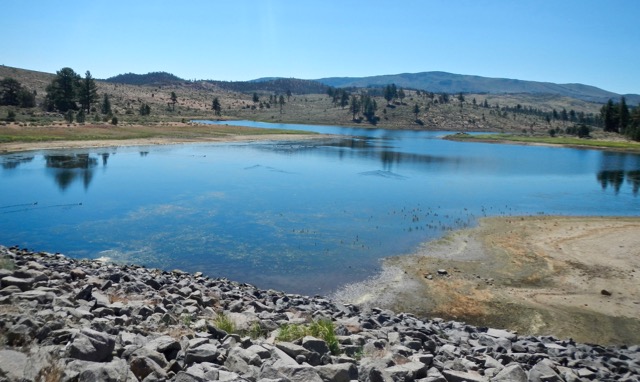
The South Shore’s wastewater ends up in the Harvey Place Reservoir in the Diamond Valley. Photo/LTN file

The utility district bought the old Heise Ranch 12 years ago after farmers started to divvy up their land. Laws require the treated water be sprayed on 100-acre parcels or larger.

The district entered into an agreement this month with Liberty to sell the company some of the electricity that will be generated. The plant is expected to start operating Oct. 1.

“Power will be generated whenever recycled water is not being sprayed through the center pivot rigs onto the Diamond Valley Ranch property (the district owns), so, at least all winter and whenever the alfalfa crops don’t need to be irrigated with recycled water,” Richard Solbrig, general manager of South Tahoe PUD, told Lake Tahoe News. “The district also produces significantly more recycled water than our contracts with all the ranchers guarantee that we will supply to them. Since we have very good working relationships with all the ranchers, there will be active discussions on an annual basis in order to decide the exact amounts and timing for the delivery of recycled water to the six ranchers.”

STPUD estimates that between $25,000 and $30,000 in gross revenues will be generated from the hydroelectric plant.

This marker is at the end of South Tahoe PUD’s export line. Photo/LTN file

“With this estimated level of revenue, all costs attributed to the hydropower facilities will be paid for in just over eight years. Life expectancy of the pump and generator are 25 years, while the pressure pipeline itself is expected to last a minimum of 50 years,” Solbrig explained. “The pricing portion of the contract is 10 years, at a unit price established by the CPUC. Buyback price after the first 10 years will be adjusted based upon CPUC review of the value of power at that time.”

In 2015, Gov. Jerry Brown signed a bill mandating that by 2030 state-regulated utilities must get at least 50 percent of their electricity from renewable energy sources, such as wind, solar, and hydro.

This deal will help Liberty achieve that goal.

“This facility is unique because it takes advantage of capturing energy that would have been wasted otherwise,” Travis Johnson, vice president of operations for Liberty, told Lake Tahoe News. 

The city of South Lake Tahoe is contemplating putting even more stringent regulations on Liberty. On the April 18 City Council agenda is a resolution for the city to be using 100 percent renewable energy by 2032. The idea was first brought forward earlier this year by members of the public as the council was working on its strategic goals.

The city is in the process of negotiating its franchise agreement with Liberty. If the council on Tuesday supports the renewable energy initiative, it could then be part of a future contract between the city and Liberty.

“Could Liberty provide the city 100 percent renewable energy in that time frame? Yes, we could. Would it cost more for ratepayers It is possible that it could be more expensive,” Johnson said. “However, two factors come into play: 1) The state already mandates 50 percent renewable by 2030 and 2) Renewable prices continue to fall each year. These two factors will help lower the incremental cost to move to 100 percent.”

He added that wind energy today less expensive than fossil fuels in some regions of the country, with solar getting close.

To prove the city was getting all renewable energy Liberty “would do it by total energy consumed in the region. For easy numbers, if the region consumes 100,000 mega-watt hours per year, we could develop a solar project that produces 100,000 MWh. It is all about putting more renewable energy into the grid.”

A related matter on the council agenda would have the city reduce carbon emissions by 80 percent by 2040.