Incline bike path work to impact drivers on Hwy. 28

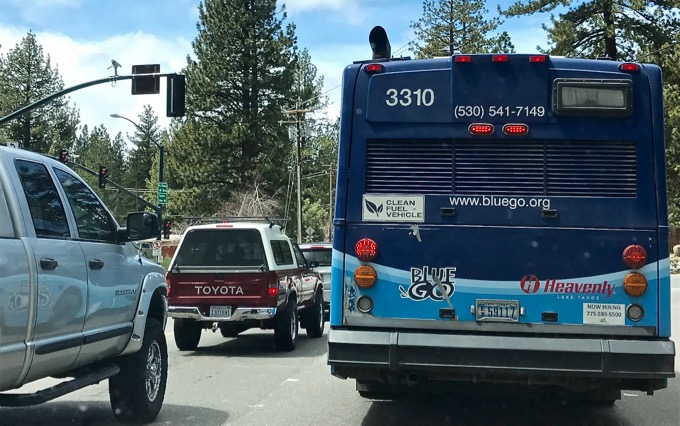
Beginning May 1, single lane closures will take place on Highway 28 south of Incline Village as the Nevada Department of Transportation launches the second season of shared-use path construction.

Construction will start on the pathway and retaining walls, and roadside water quality and erosion control improvements will be built to help preserve the quality of storm water entering Lake Tahoe.

Beginning May 1 through late fall, daytime single lane closures will take place on Highway 28 from the southern end of Incline Village to three miles south of Sand Harbor State Park. Nighttime single lane closures are planned between Hidden Beach to three miles south of Sand Harbor State Park-. Most of the lane closures will take place Sunday night through Friday at noon, although weekend closures may occur during off-peak season. Anticipate 20 to 30-minute travel delays. 

Short-duration full road closures may periodically take place during off peak season (May through early-June; late-August/early September through Oct. 15). Advance notice will be provided. The Memorial Point roadside parking lot and restroom will be closed for the season for construction staging. Beach and trail access between Lakeshore Boulevard and Sand Harbor State Park may be limited or closed during construction. For safety, travelers are encouraged not to access beaches or trails through the construction zones.

Roadside parking from Ponderosa Ranch Road to approximately three-plus miles south of Sand Harbor State Park will not be allowed during construction. Officials encourage travelers to pay special attention to no parking/tow-away zones throughout the project area as towing will be enforced in no parking zones.

The project = is anticipated to complete as early as the end of 2018, but may extend into 2019.


Heller bill aimed at attacking Endangered Species Act

By Henry Brean, Las Vegas Review-Journal

Citing Nevada’s long fight to keep the sage grouse from being listed, Sen. Dean Heller has introduced legislation that would significantly weaken the Endangered Species Act and give states almost unchecked control over how — or whether — certain animals and plants are protected.

The bill would require congressional approval before a species is listed as threatened or endangered by the U.S. Fish and Wildlife Service. Any listed species would automatically lose protection after five years without another vote of Congress in consultation with the states where the species is found.

Heller and fellow Republican Sen. Rand Paul of Kentucky unveiled their Endangered Species Management Self-Determination Act on Tuesday.

Conservationists are calling it something else: an all-out attack on the federal protections that saved the bald eagle and other once-threatened animals.

Read the whole story


1 fatality reported in West Slope house fire

One person has died in a Pollock Pines house fire.

Firefighters found the body while working to extinguish the flames early Friday morning.

The fire on North Street was reported at approximately 5:30am April 28.

No further details have been released.

— Lake Tahoe News staff report


Tax fraud lands EDC woman in prison

An El Dorado County woman was sentenced to 120 months in prison for conspiring to file more than 250 false tax refund claims.

Teresa Marty, 57, of Pollock Pines was the owner of Advanced Financial Services (AFS), a Placerville tax return preparation business. Marty conspired with her office manager, Pamela Harris, and Rebecca Bandera-Marty to file fraudulent federal tax returns claiming more than $60 million in refunds. According to court records, Marty and Harris recruited clients by falsely representing that the clients could legally receive large refunds by filing tax returns using IRS Forms 1099-OID. AFS prepared false Forms 1099-OID that reported the clients’ debts as income and the same amount as income tax withheld, resulting in significant claims for refund to which the clients were not entitled.

The scheme included clients from 26 states and caused the IRS to pay out more than 40 tax refunds, totaling more than $9 million. The IRS listed the use of false Forms 1099-OID on its website as one of the “dirty dozen” tax schemes for the years 2009 through 2014.

In addition to the prison term, Marty was ordered to serve two years of supervised release and to pay $9,500,492 in restitution to the IRS.

— Lake Tahoe News staff report


Alpine County wins lawsuit filed by ex-worker

A decision came out this week in favor of Alpine County in a lawsuit filed by former Undersheriff Robert Levy.

Levy had sued the county, former CAO Pamela Knorr and county supervisors on grounds that they allegedly violated his First Amendment right to free speech, age discrimination, retaliation, and defamation.

Judge Robert Whaley with the U.S. District Court in Sacramento wrote, “Mr. Levy failed to demonstrate an intolerable working situation that would have forced a reasonable employee to have no option other than resignation.”

Neither Levy’s attorney Douglas Watts nor David Prentice, Alpine County’s chief counsel, returned calls.

— Lake Tahoe News staff report


LTCC not sure it wants SnowGlobe to return

By Kathryn Reed

Lake Tahoe Community College is so frustrated with how long it took SnowGlobe vendors to clean up their mess that a future contract is in jeopardy.

“For me, the board and staff we take pride in the fact that is our front door. We had to drive in by it every day,” LTCC President Jeff DeFranco told Lake Tahoe News. “We would give tours to perspective students and have to explain what that was all about. We can’t have that again.”

DeFranco was referring to the mangled chain link fencing, portable structures and other debris left for months after the three-day music festival had long ended. The crap left on college and city property made the area look like a junkyard.

The contract said everything was supposed to be removed by Jan. 3. The reality is things remained on site into April. It took the city sending a threatening letter for the promoter to finally do something. (The city’s contract say things must be removed as soon as possible, weather contingent.)

While South Lake Tahoe has a multi-year contract with promoter Chad Donnelly, which ends this year, the college has always been on a year-to-year contract. LTCC’s facilities are instrumental to a successful event. The parking lot is huge. The physical education building and food services are other key components.

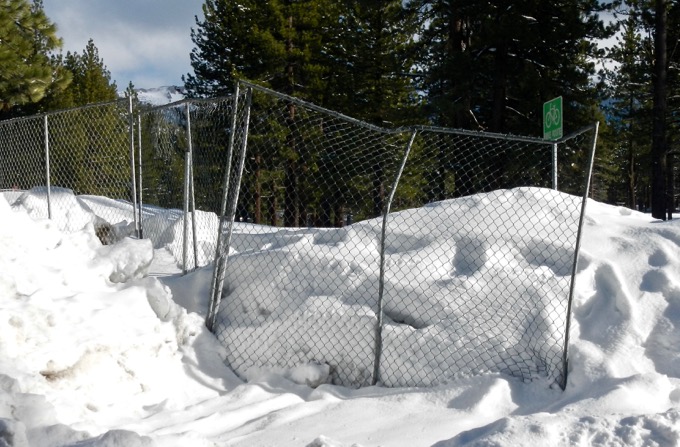
Damaged chain link fences remained for months after SnowGlobe. Photo/LTN

The college board of trustees this week heard a presentation about how the 2016 event went. Normally the annual recap comes in February, but that was impossible with evidence of the event still visible.

While DeFranco said it was too early to know exactly what language might be in a future contract – if there is a contract – he said wording to ensure everything is removed before winter quarter starts would be a biggie.

“Our facility was ready to go, but access and parking wasn’t because of SnowGlobe remnants,” DeFranco said. “Another big issue is any blight from SnowGlobe and how it reflects on the campus and community.”

Much of the discussion on April 25 centered on the lack of demobilization. January snowstorms prevented the timely removal of the perimeter fencing and other items. Apparently, though, there was no contingency for this. It’s not like snow in Tahoe in winter should surprise anyone, especially in January.

Donnelly is expected to be at a future LTCC board meeting to plead his case. This could be as soon as May.

While DeFranco said the college wants to be a community partner and help with tourist related events that drive the local economy, he said those pursuits will always be secondary to the college’s main mission of being an institution of higher learning.

Ultimately it will be up to the five elected to decide if LTCC enters a contract of any kind with SnowGlobe. Things they are considering include:

·      A larger damage deposit;

·      Enhanced video surveillance;

·      Limiting how the parking lot is used;

·      Having the community play consortium have a contract for the use of the field;

·      Establishing a wristband entrance fee for the consortium to offset the cost of maintaining the field. (The college and city are members of the consortium.)


Feds eye private sector as tool to offset housing cuts

By Associated Press

COLUMBUS, Ohio — Housing and Urban Development Secretary Ben Carson said Wednesday he expects to release a policy agenda within the next few months that delivers “bang for the buck,” partly by encouraging more private-sector collaboration.

In an interview with the Associated Press, Carson said he expects to advance public-private partnerships, extending low-income housing tax credits and providing more opportunities for public-housing residents to get jobs at the buildings where they live.

“The biggest tools are the partnerships — public, private, nonprofit and faith community partnerships — which allow us to leverage those federal dollars, anywhere from 2, 3, 4, 5 to 20-to-1,” Carson said.

Read the whole story


Committee talking about opening Nev. power market

By Ben Botkin, Las Vegas Review-Journal

CARSON CITY — Nevadans may one day be able to shop around for their electrical provider, weighing options like the cost and source of the power.

The Governor’s Committee on Energy Choice held its first meeting Wednesday to look at ways to make that happen, including recommendations for potential policies or new laws needed to open up the retail electric market in Nevada.

Read the whole story


Flood concerns with release of Tahoe water

Release of water from Lake Tahoe at the dam in Tahoe City has led to a flood warning by the National Weather Service in Reno.

The warning is in effect through May 2 for sections of the Truckee River in Placer, Nevada and Washoe counties.

The weather service expects the flow on the Truckee River near the dam to be highest since February 1999.

As the snow melts at the higher elevations and fills Lake Tahoe, more water will be released. The high flows on the river could last well into the summer, according to officials.

— Lake Tahoe News staff report


TTD develops road map for functional transit

Reliable, coordinated transit is not something the Lake Tahoe Basin is known for. Photo/LTN

By Kathryn Reed

STATELINE – Transit is about getting people where they want to go, providing choices and creating connections.

That is what Tahoe Transportation District is striving for in the basin and beyond.

Carl Hasty, the bi-state agency’s leader, on April 26 talked to the Tahoe Regional Planning Agency’s Governing Board about the Lake Tahoe Basin Transit Master Plan. It is a multi-year plan with short- and long-term goals.

“The vision here really means we are going to see buses everywhere,” Hasty said.

Transit operators know that just putting buses into the mix and having them stopped in traffic is not solving the problem. Removing individual vehicles from the roads will lessen congestion. Those people, though, need to be able to rely on transit. Today, that is not possible.

The ultimate goal is bus service every 15 minutes.

Today 1.4 percent of road trips in the basin are via transit. The most aggressive planning scenario has the percentage growing to 20. That is projected to remove more than 7 million auto trips a year. Benefits would include having fewer vehicles on the road, and less emissions – a boon for air and water quality. The net operating cost to do is estimated to be more than $13.6 million a year.

Before all those new buses are ordered (once the money is in hand to do so) transit officials need to figure out where they will be housed, along with where to set up maintenance and fueling locations. Space is tight for the current operations in the basin.

The board appeared to be in consensus that the tourist should be footing the bulk of the transit bill. How exactly remains to be seen. Toll roads and taxes of some kind are potential outcomes.

Hasty said it’s likely federal transit dollars will be dramatically cut in the Trump administration’s “skinny” budget.

Layers of service are what’s needed to accommodate locals and the influx of tourists. And then it’s adapting to the different tourists – their activities and desired destinations. It also means keeping an eye on points west and east in regards to people coming to the basin in hopes that down the road an even broader public transit system could be coordinated with one that is focused on the Tahoe-Truckee areas.

“It needs to be seamless to the public. They don’t care as long as it gets them to where they want to go and it’s safe,” Hasty said.

Hasty didn’t mince words in stating it’s time to realize parking – the lack of it – is one of Tahoe’s major problems. People park on highways, clog trailheads and creates dangerous situations. Much of the parking in the basin is on private property. Public parking is what’s needed.

Mobility hubs is the newest catch phrase. It’s a place to connect people to transit, as well as bike-foot paths. TTD staff has plotted out where they might be located.