Fighting compulsive gambling among women

By Tanya Mohn, New York Times

Blinking lights, the clicking sound of coins, and perks like free or inexpensive food, drinks and casino bus trips are enticing many older women to gamble.

For some people, that seductive environment can be extremely dangerous.

“Casinos are trained to make you feel welcome, while you lose your life,” said Sandra Adell, 70, a literature professor in the Department of Afro-American Studies at the University of Wisconsin-Madison, who recounted her experiences as a compulsive gambler in the book “Confessions of a Slot Machine Queen.” “What the industry is doing, the way it markets and keeps casinos filled with elderly people, is morally reprehensible.”

Hard numbers are difficult to find, but Keith Whyte, the executive director of the National Council on Problem Gambling, said that gambling addiction among older women near or in retirement appears to be increasing in scope and severity, with a devastating impact on personal finances.

Read the whole story


Submerged sailboat lifted from depths of Tahoe

Updated 5:57pm:

A mast has been sticking up offshore from Lakeview Commons for most of the winter.

Lake Tahoe News had asked police officers about it; they in turn said the Coast Guard was notified. The choice was to just leave it there for a while.

TowBoatUS Lake Tahoe tried to remove the sailboat on May 9, but wasn’t able to because it was discovered the cabin windows were no longer intact. Crews came back on Wednesday and were able to bring the boat to the surface. For now, the owner wants to keep it anchored where it its.

There was no rush to get the sailboat out of the water because officials said it was not a problem for other boaters and was not an environmental concern.

— Lake Tahoe News staff report


44-unit subdivision to break ground in Stateline

By Kathryn Reed

A new neighborhood is about to be erected on the South Shore.

With a severe housing shortage in Lake Tahoe, inane rules governing development and tourist accommodations usually what anyone wants to build, this is almost revolutionary.

Ten units will be four bedrooms and the remaining 34 will have three bedrooms. Fourteen will be standalone residences, the others will be townhomes. They will range in square footage from about 2,200 to 2,800.

This housing project has gone through several incarnations – because of a lawsuit brought by the League to Save Lake Tahoe, market conditions, and a desire to have more open space. Twelve years after purchasing the 18-acre parcel in Stateline, Steve Kenninger and Gail Jaquish are starting to build what is known as Sierra Colina.

“Our big focus is we are trying to create a community or neighborhood that provides that feeling of being more like a local neighborhood. We expect a large portion of our owners to be full-time residents of the Tahoe basin,” Brian Helm, managing partner of Sierra Colina, told Lake Tahoe News.

This is the eastern entrance to Sierra Colina off Lake Village Drive. There will be a second entrance/exit down the hill to the west, closer to the office building. Photo/Kathryn Reed

Sierra Colina will be accessed off Lake Village Drive from Highway 50 in Stateline. A loop will connect the neighborhood.

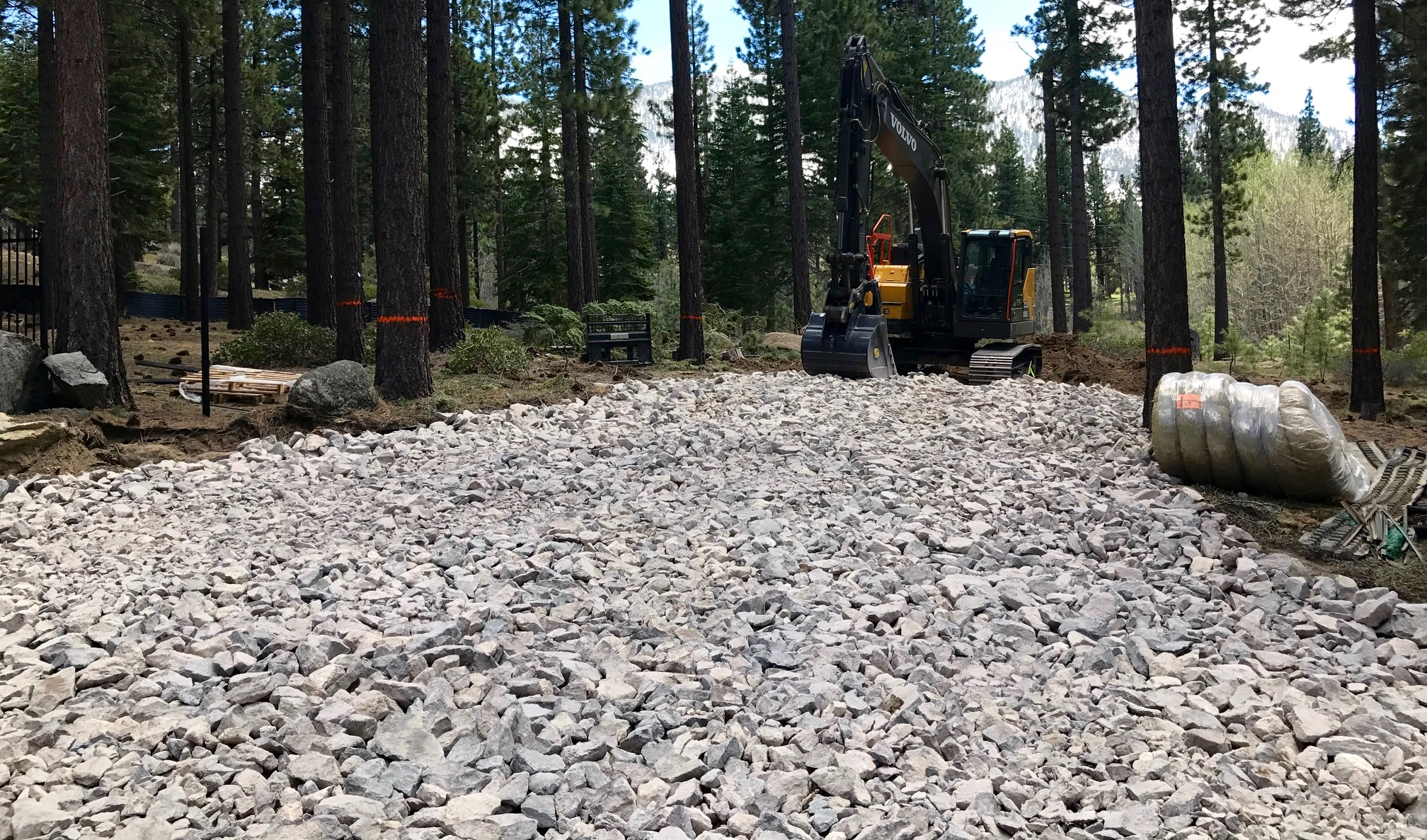
The bulk of the work this building season will be putting in what will be private roads – not county owned – utilities, and other infrastructure. Final details on Highway 50 improvements are being ironed out.

This season 10 units will have their foundations laid, with anticipation people could be moving in in 2018. Seventeen units will be built in each of the following two years.

The exact price for the dwellings will be released this summer. That’s when sales will begin as well.

The original project called for nine moderate-income deed restricted single-family residences. Those fell by the wayside post-lawsuit, which the League won.

“The way we look at it market rate and affordable housing are part of a connected chain. As we add market rate housing, it frees up rentals,” Helm said.

It’s not expected that people will be able to see much of the neighborhood when they drive by on Highway 50 because everything will be set back at least 200 feet.

For the new residents, some will have partial views of Lake Tahoe, Rabe Meadow, Mount Tallac and Heavenly.

The goal is to leave as many of the large trees and boulders as possible so there is a sense of being in the mountains while being immersed in the neighborhood. Only 4 of the 18 acres will be touched. The rest will remain natural.

“We will be providing a little bit of an updated look with mountain architecture; something that feels very warm and relates to Lake Tahoe from an aesthetic and maintenance perspective,” Helm said. “It’s important to us to have timeless mountain architecture.”

Wood and rock will be used extensively.

Also being constructed this year is the commons building that will be a gathering spot for residents. A homeowners’ association will govern the property after build out.


Nearly 1,500 lbs. of trash picked up by volunteers

Inversion Gym volunteers fill bags of garbage on May 6. Photo/Amy Thompson

The record-breaking winter revealed record-breaking amounts of litter as the snow melted. 

On May 6, 118 volunteers scoured South Tahoe neighborhoods to help clean it up and kick off the summer with a litter-free town.  The groups covered 15 locations, and gathered 1,484 pounds of trash and debris.  

Volunteers took to the streets around Stateline, Bijou, Al Tahoe, Lakeview Commons, Sierra Tract, Tahoe Island, Gardner Mountain, the Y, and Meyers. Some neighborhoods had multiple groups fanning out to cover more ground.  

The overwhelming majority of the litter was single-use plastics, packaging, and cigarette butts. Volunteers reported finding a variety of other items as well: broken and discarded bicycles, clothing, diapers, dog poop bags, car parts, and drug paraphernalia.

The event was coordinated by the Clean Tahoe Program, with the help of sponsors Harrah’s/Harveys Lake Tahoe and South Tahoe Refuse. In addition, a number of local businesses and organizations participated by coordinating volunteers, including: Harrah’s HEROs program, Hard Rock casino, Hard Rock Café, Inversion Gym, and Tahoe Coalition for the Homeless.


Monitor Pass open; Tioga, Sonora covered in snow

Monitor Pass is open, but there is still mounds of snow along the sides of this section of Highway 89.

The two other key Sierra passes — Tioga and Sonora — remain covered in snow. Crews are working to clear them.

Tioga Pass (Highway 120) is the east entrance to Yosemite National Park. Caltrans says the snow is 15-feet deep in places.

The same goes for Sonora Pass (Highway 108).

With the storm system that passed through last weekend, even more white stuff covers these highways. There is no estimated date when either pass will open.

— Lake Tahoe News staff report


USFS to study Meeks Bay’s future; marina closed

Meeks Bay Marina is closed indefinitely. Photo/LTN file

By Kathryn Reed

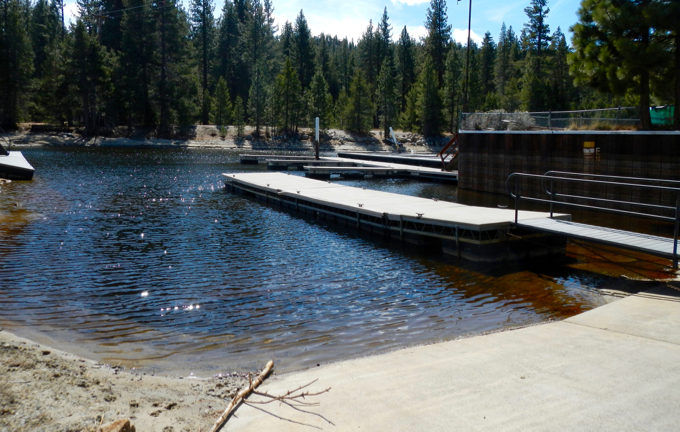
It’s possible Meeks Bay Marina will never see another boat launched there.

The rest of the operations at the resort remain open. But what the area will look like in eight years remains to be seen.

A settlement agreement is expected to be approved Wednesday by the Lahontan Regional Water Quality Control Board. The state agency went after the U.S. Forest Service – the landowner; Washoe Tribe – which has a 20-year contract that expires in two years to run all of the operations; and Action Water Sports owner Bob Hassett, the marina operator.

It has been an ongoing dilemma that finally has a resolution that includes long-term planning. Multiple citations had been issued and nothing changed. A dirt parking lot was dumping fine sediment into Lake Tahoe at a rapid rate.

Last year the marina was shut down. The Forest Service has removed it from the special use permit. Its future will likely be studied in forthcoming environmental and planning documents.

“It’s unfortunate the marina is at the mouth of the creek. I’m not sure if they have an opportunity to put the ramp somewhere else,” Cathe Pool, senior engineer with the water board, told Lake Tahoe News.

Heather Noel with the Lake Tahoe Basin Management Unit said, “I don’t have an idea of when it could open until we are through the planning process and a decision on the use and restoration of the marina is determined.”

No one from the tribe returned a call.

The Forest Service this summer intends to issue a notice of preparation, which is the prelude to environmental documents being initiated.

“We are looking forward to finalizing the proposed action this summer to get the public’s weigh-in on what they would prefer to see at Meeks Marina,” Noel told Lake Tahoe News. “The Forest Service developed a proposal using our existing appropriations budget, however we will need to identify the path forward on paying for planning and improvements.”

By November the feds are supposed to present to Lahontan “a first phase assessment for the project identifying expected environmental benefits, multi-benefit success criteria, and a five-year monitoring plan.”

Lahontan wants whatever the project is to be completed by 2025.

“I feel like we are getting more benefit to water quality than if they just paved the parking lot,” Pool said. That is what was initially asked of the USFS by Lahontan. Ultimately a more diverse project with enhanced environmental gains will be developed.

Temporary erosion control measures are in place, and according to Pool, held up well through this winter.

—–

Notes:

·      The Lahontan board meeting is May 10 at 7pm, 971 Silver Dollar Ave., South Lake Tahoe.


U.S. plan to improve firefighter shelters falters

By Keith Ridler, AP

Crews who battle wildfires will have to wait at least another year before getting better fire shelters than those that failed to save 19 firefighters trapped by flames in Arizona four years ago, officials told The Associated Press on Thursday.

The deaths pushed the U.S. Forest Service to speed up work to get an upgraded shelter in place this year, but the effort has been delayed a year after prototypes could not outperform the shelter developed in 2002.

It comes as firefighters are facing more destructive wildfires and the struggle to protect more homes being built in or near remote areas.

Read the whole story


Skunk-dog encounter reported on South Shore

While it’s not common to see skunks in the Lake Tahoe Basin, they are here.

A dog recently got sprayed in the Cathedral Road area of the South Shore.

“We do have skunks in the basin, but the main population is on the Western Slope,” Carla Hass, spokeswoman for El Dorado County, told Lake Tahoe News. “We haven’t received rabies reports or other issues in the last 17 years. We’d simply remind people to obey the leash laws as they help keep dogs from interacting with wildlife, which in turn keep dogs from having to be quarantined.”

Tom Millham, co-owner of Lake Tahoe Wildlife Care, said one of the great things about skunks is they help reduce the mice population.

“If you have mice under your house and a skunk moves in, no more mice,” Millham told Lake Tahoe News. “Once the skunk has taken care of all the mice there, it will move on to another location and look for a meal there.”

He said there isn’t much dog owners can do if they don’t have their pets leashed. The dog is going to get sprayed if it comes near a skunk. And the smell – it lingers and is hard to get rid of.

 — Lake Tahoe News staff report


Power struggle between Placer County, NLTRA

By Kathryn Reed

TAHOE CITY – Placer County is making substantive changes to the contract it has with the North Lake Tahoe Resort Association. Something is broken, but county officials aren’t saying exactly what is wrong.

Change – Placer County plans to rescind NLTRA’s power when it comes to capital improvement projects and transportation. NLTRA wants to keep negotiating. The county says the changes will save $300,000 a year; money that can be spent in the Tahoe region. NLTRA disagrees about that dollar figure. The county wants to create a 15-member committee, which the NLTRA and chamber would be part, to make recommendations for how to spend the money going forward. The plan would be for member groups to appoint people, not the county.

Control – Placer County and the North Lake Tahoe Resort Association want it. The county believes it can give a bigger voice to county residents. NLTRA believes more control in Auburn, the county seat, can never be a good thing for those in the eastern part of the county. The county believes with the increased role it has had with transportation and the goal of creating a more regional system, that it is better for it to be in the driver’s seat. NLTRA believes it is more innovative and thinks outside of government constraints.

Access to the public – Placer County wants more. NLTRA wants to be that conduit. The county doesn’t want a middleman. The NLTRA board is elected by NLTRA/North Lake Tahoe Chamber of Commerce members. Members do not need to live in the county. NLTRA believes it has the ear of the business community, and says it listens to non-members. The county wants to hear from more than businesses, as well as non-member businesses.

“We want to communicate directly with the community, not just a microcosm,” said Jennifer Merchant, deputy CEO for Placer County.

“I believe the resort association is better equipped to engage the community in these projects,” said Adam Wilson, NLTRA board president.

History – The relationship has been in place for about 20 years, and started when the county had about zero presence at the lake. In that time all but one project the NLTRA recommended to the Board of Supervisors has been approved. Each year the two entities renew the contract to carry out work in the Tourism Master Plan. The county tells NLTRA what its budget is based on revenues it has collected. The money comes from hotel taxes. Elsewhere in the unincorporated areas of Placer County the transient occupancy tax rate is 8 percent. In 1996 it was increased to 10 percent for the North Lake Tahoe area. That extra 2 percent is to be spent on tourist services in the Tahoe area. In that time about $37 million in TOT money has been spent in Tahoe on nearly 100 projects, with about another $265 million able to be leveraged.

Many people are suspicious of the county, especially when the electeds have been backing projects like Squaw Valley, Fanny Bridge-Highway 89 realignment and Martis Valley West that were opposed by hundreds of local residents. At the same time, the county – elected and staff – is there to make the tough decisions, ideally without personal, political or financial gain, and putting emotions aside. In theory they make decisions for the greater good.

It was the North Lake Tahoe Chamber of Commerce that called for the meeting last week for both sides to air facts and opinions, and for the public to ask questions and make comments. About 50 people filled the room at Granlibakken.

One question was: Does the county feel there have been problems with how the things have been run?

“In some cases, yes,” Merchant said. She added, “I don’t want to be in a position to bash the organization.”

Some in the audience are worried about transparency or the lack of it, especially if the county has more control. NLTRA questions why it wasn’t given any warning, especially since it has been in an 18-month process studying how to be more efficient and looking at ways to make improvements. County reps were part of this process since they have a seat on the board. The resort association didn’t know the changes were coming until it received the 2017-18 contract on March 31.

A contract needs to be finalized by June 1 so it can be on the June 13 Board of Supervisors agenda.

To give a broader voice to constituents, the county has scheduled meetings about the changes:

·      May 8, 5-8pm, North Tahoe Event Center, Kings Beach

·      May 11, 4-6pm, Placer County Administrative Center, Tahoe City

·      May 12, 8am-noon, Squaw Valley Public Service District, Olympic Valley.


EPA just buried its climate change website for kids

By Juliet Eilperin, Washington Post

The Environmental Protection Agency has sidelined a website aimed at teaching schoolchildren about climate change, a public watchdog group has determined, as part of the agency’s efforts to align online content with the new administration’s values.

When the EPA announced on April 28 that its site was “undergoing changes that reflect the agency’s new direction under President Donald Trump and Administrator Scott Pruitt,” it pointed to a snapshot of the website as it looked on Jan. 19, the day before Trump took office.

While it made it clear that this snapshot would not be updated, the idea was to allow the public to see what was being changed under the new administration.

But “A Student’s Guide to Global Climate Change,” a popular site that used to occupy a prominent place on the agency’s main website, is not accessible from either the snapshot or by navigating the agency’s home page, according to the Environmental Data and Governance Initiative, a group that has been tracking what changes the new administration has been making to public science and environmental sites.

Read the whole story