
Climate change shrinking West’s water supply

By Emily Benson, High Country News

Picture a snowflake drifting down from a frigid February sky in western Colorado and settling high in the Rocky Mountains. By mid-April, the alpine snowpack is likely at its peak. Warming temperatures in May or June will then melt the snow, sending droplets rushing down a mountain stream or seeping into the soil to replenish an aquifer.

The West’s water supply depends on each of these interconnected sources: the frozen reservoir of snow atop mountain peaks, mighty rivers like the Colorado and groundwater reserves deep below the earth’s surface. But the snowpack is becoming less reliable, one of the region’s most important rivers is diminishing and in many places the groundwater level has dropped.

Three recent studies illuminate the magnitude of these declines, the role climate change has played and the outlook for the future.

Read the whole story


Guilty pleas in theft of USFS recreation fees

Two El Dorado County residents have admitted they stole recreation fee tubes from the U.S. Forest Service and at other sites.

Brian Lisanti, 46, and Deseree Tougas, 26, both of Colfax, are scheduled to be in El Dorado County Superior Court on June 5 for a restitution hearing.

Lisanti remains in custody with no bail. He pleaded guilty to conspiracy to commit a crime with theft and second degree felony burglary. He will serve 120 days in county jail and be on probation for four years.

Tougas posted $50,000 bail. She pleaded guilty to a misdemeanor charge of petty theft. She will serve a 45-day jail alternative sentence and be on probation for three years.

The case broke when officials with the Eldorado National Forest were told about a large number of used Forest Service fee envelopes found in a dumpster. The exact location of the thefts, amount of money stolen and time period the crimes occurred have not been released.

“This evidence indicated that over $700 in visitor fees had been stolen from a forest recreation site on at least one occasion,” officials said in a press release.

— Lake Tahoe News staff report


Action lacking to overhaul Calif. pension fund

                                                                                                                                                                       Source: CalPERS

By Kathryn Reed

“CalPERS is about people. It is about the dedicated individuals who serve, or have served, the state of California through a career in public service. For more than eight decades, CalPERS has built retirement and health security for these public servants. As the nation’s largest public pension fund, we ensure that our members’ benefits and earned retirements are as enduring as the state they maintain.”

That is how the California Public Employees’ Retirement System describes itself on its website. If one were to take the last sentence literally, everyone in California should be worried. This is because the earnings are dismal. And this is at a time when the stock market is soaring.

The Dow Jones Industrial Average on March 1 hit a record high of 21,115.55. On May 16 it closed at 20,979.75. The S&P 500 hit its record high on May 15 at 2,402.32. The Nasdaq hit record highs on Monday and Tuesday, with the latter finishing at 6,169.87.

The S&P 500 in the last five years has increased 15 percent, while CalPERS in that same period has averaged a 6 percent gain. CalPERS reported a 0.61 percent net return on investments for the 12-month period that ended June 30, 2016. CalPERS spends millions of dollars every year on investment management fees. Someone is getting wealthy at taxpayers’ expense.

Political and social issues play into what it will invest in. It divested from RJ Reynolds not for monetary reasons, but because of political pressure. And, yet, the only reason CalPERS exists is to make money.

This is a huge organization with nearly 3,000 employees.
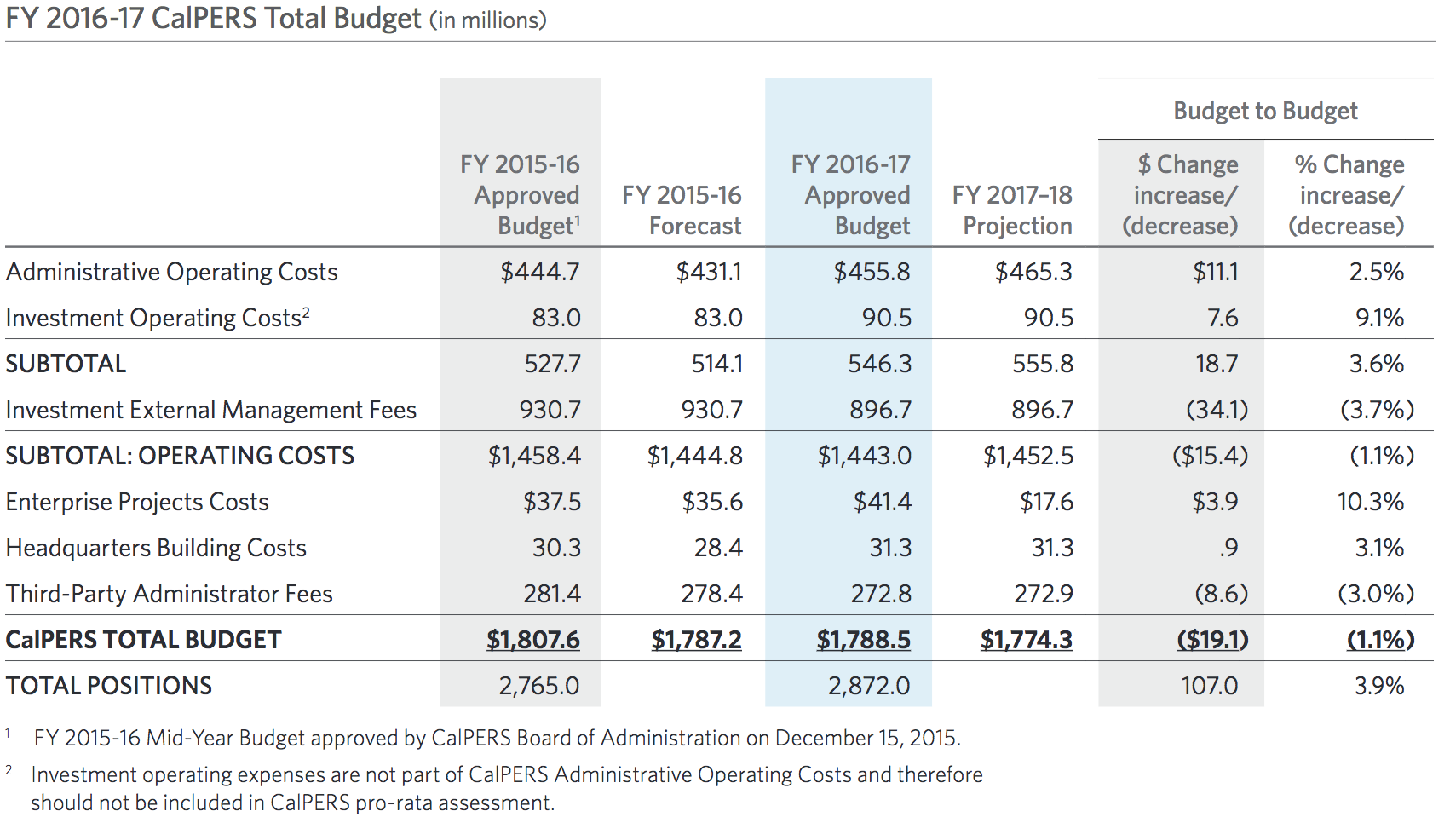
                                                                                                                                                                   Source: CalPERS

CalPERS with its current total market value of $321.83 billion isn’t making enough money to pay all of the retirees. It has a shortfall of more than $200 billion based on everyone in the system retiring at their retirement age.

The deficit isn’t completely the fault of poor investment choices. The agency along with state and local lawmakers share a tremendous amount of burden.

At what is now known as the apex of the funding level in 1997 CalPERS told everyone it was superfunded. This meant it had 120 percent of the money it needed to pay all the retirees/employees at that time. This was assuming nothing changed.

But things did change – some deliberate, some beyond most people’s control. The deliberate actions were to reduce the minimum age at which people could retire. Payments were even made retroactively. The percentage retirees would be paid also increased. Then investments went south with the dot com collapse. Also needing to be factored in is that people are living longer today compared to when CalPERS started in the 1930s, so those guaranteed paychecks keep being written.

History of CalPERS:
• 1932 – CalPERS was established as the State Employees’ Retirement System (SERS).
• 1939 – The state Legislature passed a bill that allowed counties, cities, and school districts to participate in SERS.
• 1962 – Health insurance began for SERS members with the passage of a law that was later amended to become the Public Employees’ Medical and Hospital Care Act.
• 1986 – The headquarters building now called Lincoln Plaza North was completed in Sacramento.
• 1992 – To avoid confusion with retirement systems in other states, the organization’s name was changed to California Public Employees’ Retirement System (CalPERS).
• 2005 – CalPERS expanded its headquarters to include the Lincoln Plaza East and West buildings, which achieved a gold LEED rating.
• 2013 – CalPERS board adopted set of Investment Beliefs to help guide investment strategy.
• 2014 – CalPERS surpassed $300 billion in total fund market value.
• 2014 – CalPERS board adopted set of Pension Beliefs to guide pension fund practices and decisions.
                                                             Source: CalPERS

The above combination was a recipe for disaster. It’s as though these factors have been percolating on some back burner and it’s just now that the pot is boiling over to the point no one is immune from the blistering effects.

According to the California Department of Finance, in 2016 taxpayers paid $5.4 billion for state employee pensions. CalPERS says this is 30 times more than what was paid before the pension law changes took effect in 2000.

It’s not the retirees or current employees’ fault this is happening. But it’s also not the taxpayers’ fault either, and they are the ones left footing the bill, which in turn means fewer tangible benefits – like improved roads, better facilities and lower fees.

The retirement agency likes to paint itself as this great organization. It sends out mailers to members about how everything is rosy. Those who pay into CalPERS or are drawing on their retirement all got a letter this spring saying things are just fine. What wasn’t included was a copy of the letter sent to their employers with the forecast saying that their contribution is going to double in five years.

Corruption is part of CalPERS’ legacy. It wasn’t that many years ago that the headlines were all about the financial scandal within the organization. One-time Stateline resident Alfred Villalobos conveniently killed himself in January 2015 just weeks before his federal trial on bribery and fraud charges was to start. He had been a deputy mayor in Los Angeles, and then was a CalPERS board member from 1993-95. Villalobos reportedly earned $50 million between 2005-09 as a middleman between CalPERS and private equity clients.

In May 2016, Federico Buenrostro Jr. was sentenced to 4½ years in prison for accepting more than $200,000 in bribes and trying to steer investments to help an associate. He did so while he was CEO of CalPERS from 2002-08.

CalPERS at the May 16 South Lake Tahoe City Council meeting was called “inept” by Austin Sass. And while the council as a whole is not thrilled with the bleak financial picture, only Brooke Laine said it might be time to get their butts down to Sacramento and give CalPERS an earful.

After the meeting Lake Tahoe News asked Sass and Wendy David: “Does the council intend to engage CalPERS in any way or any elected officials who might have some ability to address the CalPERS dilemma?” No response.

CalPERS says the responsibilities of its 13-member board “include setting employer contribution rates, determining investment asset allocations, providing actuarial valuations, and much more. However, the board does not have the authority to add, change, or delete benefits without the concurrence of the Legislature.”

The South Lake Tahoe council hasn’t written any letters to its state representatives or tried to engage them in any manner.

Why any member agency would enter into a contract it can’t change or back out of can only be answered by those who made the decision at that time.

CalPERS for the most part is run by former government employees who collect a CalPERS check. They have zero incentive to make changes even though their member agencies could eventually go bankrupt. It’s like the fox is protecting the hen house.

CalPERS issues a bill that has to be paid or else pensions are cut. It’s a non-negotiable contract. CalPERS would come collecting even if it meant a lawsuit.


Kitchen fire damages South Tahoe duplex

One half of a duplex in South Lake Tahoe was severely damaged by fire on Tuesday.

Oil in a frying pan is the reported cause of the blaze.

It started in the afternoon of May 16 on Shepherds Drive in a two-story duplex. Firefighters said the smoke spread into the attic space.

“It’s imperative to watch what you’re cooking, have a fire extinguisher nearby and to be sure your smoke detector is working,” firefighters said.

— Lake Tahoe News staff report


1 in 3 can afford median-priced California home

By Mark Glover, Sacramento Bee
 
Only 32 percent of California households could afford to purchase the $496,620 median-priced Golden State home in the first quarter of 2017, according to a report issued Monday by the Los Angeles-based California Association of Realtors.

That marked the 16th consecutive quarter that the index has been below 40 percent and is near the mid-2008 low level of 29 percent.

In this year’s first quarter, CAR said a minimum annual income of $102,050 was needed to make monthly payments of $2,550 – including principal, interest and taxes – on a 30-year fixed-rate mortgage at a 4.36 percent interest rate for a median-priced home in the state.

Read the whole story


Cyclist dies after being hit by vehicle in SLT

A 64-year-old cyclist died Saturday night after being struck by a vehicle on Highway 50 in South Lake Tahoe.

The name of the victim and his hometown have not been released.

The cyclist and vehicle were both going west on the highway near Takela Boulevard at about 7:40pm May 13 when the bicyclist cut in front of the driver, according to police reports.

“He was in the travel lanes when he was struck,” Sgt. Brandon Auxier told Lake Tahoe News.

The cyclist was pronounced dead at Barton Memorial Hospital that night. It is not known if he was wearing a helmet.

The driver of the vehicle, who lives in South Lake Tahoe, sustained minor injuries.

Drugs and alcohol are not believed to be factors in the collision. Weather and road conditions also did not play into the fatality.

The investigation is ongoing.

— Lake Tahoe News staff report


Is it good to be a woman in Nevada?

By Las Vegas Sun

A giant step backward. A declaration of war. The worst legislation for women’s health in a generation.

These were among reactions to the May 4 passage of the American Health Care Act through the U.S. House of Representatives, from the American Civil Liberties Union, advocacy group UltraViolet and health care provider Planned Parenthood, which will lose all federal grants and reimbursements for a year if the bill were to clear the Senate.

“This disastrous legislation once again makes being a woman a pre-existing condition,” Planned Parenthood President Cecile Richards said in a news release, referring to the Republican bill’s callback to an era when insurers could treat pregnancy, C-sections, postpartum depression, domestic violence and sexual assault as pre-existing conditions, charging affected women more or denying coverage. The AHCA would allow states to opt out of the Affordable Care Act’s provision for pre-existing conditions, and it would block private plans from covering abortion and limit options for low-income women on Medicaid.

The GOP’s website asserts that “praise has poured in” for the party’s plan, rounding up op-eds from Forbes, Fortune, Wall Street Journal, Washington Post and some smaller outlets, as well as statements from the National Federation of Independent Business and other trade groups, mostly lauding fiscal aspects such as cutting industry taxes and lifting regulations imposed by the Affordable Care Act. Polls show some support for its intended replacement, though a majority stands in opposition. Quinnipiac University Polling revealed that out of more than 1,000 Americans surveyed, only 22 percent of men and 13 percent of women were in favor of “Trumpcare.” Nearly a quarter of respondents who identified as Republicans were not among them.

The Status of Women in the States is an ongoing national data project of the Institute for Women’s Policy Research, a think tank launched in 1987 to analyze public policy through the lens of gender. “Women in Nevada have made considerable advances in recent years but still face inequities that often prevent them from reaching their full potential,” IWPR reported in 2015.

Read the whole story


Amodei won’t revive bill to unload federal land

By Benjamin Spillman, Reno Gazette-Journal

A proposal for the federal government to unload millions of acres of land in Nevada probably won’t return to Congress.

That’s according to Rep. Mark Amodei, R-Carson City, who introduced a massive lands bill last session and had considered reviving it.

“Transferring millions of acres of public lands … is not something I think the majority of people think is a good idea,” Amodei said during an interview with the Reno Gazette-Journal editorial board.

Read the whole story


TRPA toys with linking building allocations to VHRs

By Kathryn Reed

STATELINE – Residential building allocations and vacation home rentals may one day be linked, but it won’t be this year if the Tahoe Regional Planning Agency’s Governing Board listens to its Local Government Committee.

The committee is made up of representatives from South Lake Tahoe, El Dorado County, Placer County, Douglas County, Washoe County and Carson City. They all agreed last week that it is imperative the allocations, which are released every two years, go forward as scheduled. The Governing Board at its May 24 meeting is expected to release the allocations.

The bi-state regulatory agency doles out these allocations based on whether the jurisdictions meet certain environmental criteria.

“You can’t change the rules in the middle of the process,” Shelley Aldean, who represents Carson City, said.

Some on the 15-member Governing Board – the ones who don’t live here and don’t have to deal with the impacts of their decisions – are advocating for regulations that would prohibit a residential allocation to end up being used as a vacation rental and not for a full-time resident.

Residential allocations:
South Lake Tahoe, 33 for 2017, 33 for 2018
El Dorado County, 30 for 2017, 30 for 2018
Placer County, 37 for 2017, 37 for 2018
Douglas County, 10 for 2017, 10 for 2018
Washoe County, 10 for 2017, 10 for 2018
                                                                                      Source: TRPA

There are 46,962 residential units in the Lake Tahoe Basin today. The Regional Plan allows for up to 130 residential allocations per year. The total residential units will be 50,637.

Some of the discussion on May 11 centered on whether people intending to build a house to be used exclusively as a VHR should be denied an allocation. TRPA code already says a residence used exclusively as a VHR must have a tourist accommodation unit assigned to it.

Committee members questioned why this was being discussed. The answer – because other board members want TRPA to be in the driver’s seat on the VHR issue. Allowing local control on any issue has always be an issue for the Governing Board as a whole.

Austin Sass, who represents South Lake Tahoe, said for a science-based organization he is not seeing any science behind making changes to allocation distributions and VHRs.

Enforcement is another issue that really wasn’t touched upon. And exclusively can be slippery; an owner can stay there or have friends be there for free for a couple nights. Then it’s no longer exclusively rented to tourists. And what happens when the dwelling is sold?

The committee members all recognize housing – or the lack of it – is an issue in the basin. They acknowledge vacation rentals may be impacting availability. However, those in the industry say owners won’t turn their property into a long-term rental if VHR rules change. That’s the conundrum.

Exploring how many VHRs can be in a neighborhood was brought up.

Douglas County has a VHR policy for the lake, and is now looking to expand it to the valley. A special use permit might also be required.

Local TRPA members are all in favor of discussing the matter further. First, though, they’d like to see the outcome of South Lake Tahoe’s VHR economic study that is expected to be released in June. Current VHR numbers supplied by South Lake Tahoe for just the city 1,287 single-family VHRs, 58 multiple family VHRs and 376 tourist accommodations for a total of 1,721.


Pay for news? More than half in U.S. say they do

By David Bauder, AP

A battered news industry can find some flickers of hope in a survey that gauges public willingness to pay for journalism, as long as its leaders plan judiciously.

A little more than half of American adults regularly pay for news, through newspaper and magazine subscriptions, apps on electronic devices or contributions to public media, according to the Media Insight Project, a collaboration between the American Press Institute and the Associated Press-NORC Center for Public Affairs Research.

It’s not only greybeards, either. Although they’re less likely than their parents’ generation to subscribe, close to 4 in 10 people under age 35 also pay. Younger people are also more likely to express a desire to support a news organization’s mission as a reason for subscribing, the project’s study found.

Read the whole story