Placer County hosting 2 housing meetings

Placer County has scheduled two housing fee study workshops in June, one in Kings Beach and another in Auburn. The workshops will offer an opportunity to comment on two recently completed studies about fees charged to developers to help fund workforce and affordable housing projects.

The Kings Beach meeting will be June 6 from 6-7:30pm at the North Tahoe Event Center. The Auburn meeting is June 7 from 6-7:30pm at the Community Development Resources Center.

The studies look into workforce housing fees for the eastern side of the county and affordable housing on the western side of the county. They were done to establish the relationship between development and the housing demand it creates. The studies will also help determine what fees should be charged to developers.

In addition to the public workshops, comments can be submitted to the county prior to mid-July, when the issue is expected to come before the Board of Supervisors. Send comments to spurvine@placer.ca.gov.


Nevada dual-credit bill gets approval

By Sean Whaley and Ben Botkin, Las Vegas Review-Journal

CARSON CITY — A bill that requires school districts statewide to offer dual credit courses to high school students so they can simultaneously pursue higher education degrees and certifications was signed into law Wednesday by Gov. Brian Sandoval.

Sandoval signed Senate Bill 19 at Western Nevada College in the capital, where 89 high school students graduated on Monday through the college’s dual credit initiative called the “Jump Start” program.

The program allows students to take college courses while in high school and apply them to the credits needed for high school graduation.

Read the whole story


LTUSD board wants to have louder voice

By Kathryn Reed

Communication. It was a dominate part of Lake Tahoe Unified School District’s board of education’s discussion this week.

There are some board members who want to get their message out to parents and the broader community in a more proactive way.

Communication from the district, though, has usually been through the superintendent’s secretary who acts as the public information officer. An email is sent out to a large group (anyone may receive the email) that talks a bit about the upcoming meeting, school happenings, larger education topics and community events.

It is nowhere near the professional correspondence that Tahoe Truckee Unified sends out, nor as comprehensive in terms of being district specific.

LTUSD’s presence on social media is almost non-existent. The last Facebook post was on Feb. 14, and that was from a member of the public at a board meeting. LTUSD is random with its 241 tweets; and only has 179 followers on Twitter.

It has been the board’s policy to have the president speak for the five even though they are all elected officials with the same weight on the board. Lake Tahoe News finds this to be problematic when the president doesn’t return phone calls, even for a benign story like a feature on the new high school principal.

At the May 23 meeting it was agreed that other board members could start writing guest columns. There was talk of having them be vetted by the district office. It remains to be seen if this is for fact checking, substance, tone or some other reason.

This is the first board in more than a decade that has members who openly don’t want to be subservient to the district office and understand they are the boss of the superintendent, not the other way around.

The conversation Tuesday revolved around some members wanting to have a voice in the accreditation process, and to at least make it easier for the public to get information.

It was noted the information on South Tahoe High School’s website is not easy to find and what is there is not written in a manner that is simple to understand. Staff agreed to place it more prominently and have it written with less jargon.

STHS is in the middle of a two-year probation from the Western Association of Schools and Colleges. This was the first time the school had not receive a six-year accreditation. Staff and administrators this last year have been making changes in hopes of securing that longer accreditation when evaluated next school year.

While the electeds can help disseminate information, their actual involvement in the WASC process is limited. They can monitor time lines and be aware of the scope of work, as well as set any policies that would help the school achieve its goals, but too much active involvement is a red flag to WASC officials.

Even so, the electeds agreed that they want their voices to be louder going forward – no matter the topic.


Sandoval mandates body cameras on all officers

By Associated Press

Nevada is joining South Carolina as the only states with laws directing all police officers to wear body cameras.

Republican Gov. Brian Sandoval signed a Democratic bill on Thursday making audio-visual recording devices a standard feature of uniforms for any law enforcement officer who routinely interacts with the public.

It expands a 2015 law directing Nevada Highway Patrol officers to wear body cameras on duty.

Read the whole story


EDC school population declining fastest in state

By Phillip Reese, Sacramento Bee

Schools in the El Dorado County community of Georgetown thrived a decade ago, with close to 2,000 students enrolled in classes. Today, barely 1,250 students attend Georgetown schools – a number that will likely continue to fall.

New enrollment projections from the California Department of Finance predict El Dorado will lose another 4,000 students in the next decade, a 15 percent decline. No other California county will lose a higher percentage of its students, the state predicts.

School funding is directly tied to enrollment. Fewer children means less dollars, which can mean staff layoffs, service cuts, school consolidation and even school closures.

Read the whole story


Additional cameras on lookout for wildland fires

By Mike Wolterbeek

With a record mountain snowpack changing to a “robust,” above normal, significant fire potential, wildland firefighting agencies are gearing up for another fire season – and UNR is ramping up its AlertTahoe HD/4K fire camera system, which overlooks and helps protect dozens of western mountain ranges and hundreds of square miles of Nevada’s Great Basin.

The university’s Nevada Seismological Laboratory hasn’t waited for the record Sierra snowpack to melt. They’ve already added two new mountaintop fire cameras to the 29-camera system, on 9,700-foot Slide Mountain on the east side of Lake Tahoe, giving wildland firefighting managers a panoramic view of the Truckee Meadows, parts of Washoe Valley, Lake Tahoe and the surrounding mountain ranges.

One camera will spin 360 degrees continuously, and one will have manual direct monitoring.

The AlertTahoe project, is in its third year.

The Tahoe-Incline, Incline Village, Tahoe City, Rotary Club of Truckee, Truckee Sunrise and Tahoe-Douglas Rotary clubs participated in the Slide Mountain installation.

“The Rotary clubs didn’t just write a check; they actually came with us to the site on Slide Mountain, rode up in our over-snow vehicle and shoveled snow to dig out our building that had been buried in a 20-foot-deep snowpack,” Graham Kent, geosciences professor and director of the Nevada Seismological Laboratory, said. “Coming off a successful season of spotting fires last year, it’s great to get more support. We’re able to start filling in the gaps of coverage. Tahoe Prosperity Center has been critical in finding funding for us to fill those gaps.”

In the weeks following the Slide Mountain install, the Nevada Seismological Laboratory crew installed two more cameras, one on Bald Mountain in the lower reaches of the Sierra Nevada to the west of Tahoe near Georgetown and one on TV Hill near Hawthorne in central Nevada. Both cameras are live and ready for wildland fire managers to use.

The network is built on the backbone of the Seismological Lab’s statewide earthquake network communication system, discovered seven wildland fires in the Tahoe basin in a two-year period and provided discovery, early intel and/or monitoring of 133 others, allowing wildland firefighting managers to move quickly and efficiently assign appropriate resources to each incident.

“2017 is an exciting year to build upon 2016 successes,” Kent said. “In addition to new, continuously rotating cameras, we’ll be working with ITforNature to deploy their machine-vision auto-detect software that is designed to automatically detect and report smoke. We’ll install the software suite on most of our cameras this summer as a trial run.”

The installation is the first of as many as 18 more cameras for the 2017 fire season, including some planned in Oregon and Idaho, as the successful, proven technology is adopted by forest and rangeland fire managers in other states. UNR’s fire camera system is the only one of its kind in the nation using a private high-speed internet microwave communications system for real-time fire-spotting and monitoring. It covers the Lake Tahoe Basin and surrounding mountains, hundreds of square miles of Northern Nevada’s Great Basin and as far south as Bishop in the Eastern Sierra.
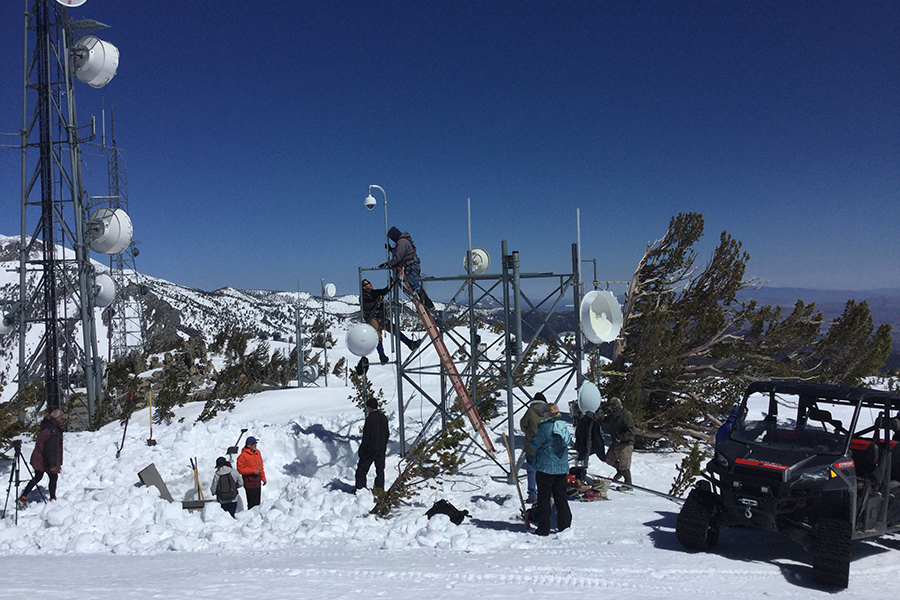
Local Rotary clubs helped fund and install two mountaintop fire cameras in the AlertTahoe network. Photo/UNR

The cameras are used by wildland firefighting agencies for early detection, to spot and track fires, and for quicker, cheaper and more tactical response and suppression. Traditionally, fire managers would send planes to spot and monitor fires, which takes time and resources. They can now use the cameras in the areas of coverage to do the same, as if they were sitting on the mountaintop overlooking the fires.

Last fall, the fast moving Emerald Fire near South Lake Tahoe started at 1:16am. Though no one was watching, the cameras picked up the first signs of the fire 14 minutes before the first 911 call came in, highlighting the need for an auto-detect capability.

“The cameras have to be monitored for them to be most effective,” Kent said. “The on-demand time-lapse video we produce is a useful first step, but we’re excited for the auto-detect software to capture critical intel even earlier. And on the Emerald Fire video you can also see a smaller fire break out in the foreground 1 minute, 45 seconds later. Crews were able to get a jump on that smaller one and put it out before it caused any damage, and the camera played a critical role.” 

There are dozens of examples of the success of the system. The system is monitored by firefighting agencies during fire season. They can manually rotate, tilt, pan and zoom the camera. YouTube channel, nvseismolab, has a library of videos captured from the network.

“Public lands managers are seeing the value in having the rapid look at a fire, as soon as a whiff of smoke is spotted or the near-IR picks up the glare of flames at night,” Kent said. “We can even track lighting strikes, then aim the cameras to see if a fire has started. We’ve been fortunate to have great partners, the BLM, U.S Forest Service and local agency support for land, tower access and funding.”

The Seismological Lab, a public service department in the university’s College of Science, continues to work with the Bureau of Land Management to expand its footprint of fire coverage in northern and central Nevada planning to add up to four more cameras this year to the current nine. Last year, the system helped fire managers get a rapid deployment of resources by being able to show the explosive nature of the Hot Pot wildland fire that at one point was burning at 10,000 acres an hour.

With the private, high-speed internet communications network in place, these sites easily adapt to earthquake early warning detection systems that can provide public notification of expected, potentially damaging ground shaking. The sites can also be used for environmental monitoring research and as extreme weather stations. The university is in a lead position nationwide developing the inexpensive, multi-use, high-throughput, research-grade Internet Protocol networks and expanding their use for all-hazard monitoring.  

“No other system worldwide could actually compete to these standards, as far as we know,” Kent said. “While we’re helping other areas in the West adopt the system, we’ve also had interest from other countries.”

The Tahoe Prosperity Center, a regional collaborative organization, has raised about $150,000 from donors for the system so far. Other areas slated for new TPC-funded cameras at Lake Tahoe this year are Zephyr Cove, Alpine Meadows and Martis Peak.

Mike Wolterbeek works for UNR.


TRPA releases residential allocations

The Tahoe Regional Planning Agency Governing Board on May 24 approved the residential allocation numbers.

They are handed out every two years.

For 2017-18:

  • 20 for Douglas County
  • 60 for El Dorado County
  • 74 for Placer County
  • 66 for South Lake Tahoe
  • 20 for Washoe County.

When the Local Government Committee meets in August, the plan is to continue to discuss the connection between allocations, housing, and vacation home rentals. This was a topic at the committee’s May meeting. Between now and August the city’s commissioned VHR study should be released.

— Lake Tahoe News staff report


Man seriously injured in rollover accident

Nevada Highway Patrol investigators believe speed contributed to the Tuesday night rollover accident near the bottom of Kingsbury Grade in Carson Valley that injured one person.

The man was heading east on the grade at 9:30pm May 23.

“He was negotiating a curve, overcorrected to the right, went broadside, came in contact with the end of the guard rail, overturned and went down the embankment, continuing to overturn,” Trooper Dan Gordon told Lake Tahoe News.

The man, whose name, age and hometown have not been released, was airlifted to Renown Medical Center in Reno. He sustained a broken femur, collapsed lung and spine fracture. 

— Lake Tahoe News staff report


Nevada braces for booming wildfire season

By Benjamin Spillman, Reno Gazette-Journal

Nevada’s peak wildfire season could be late but it won’t be meek, if history is any guide.

That’s because the record-busting winter snow and rain that soaked the state will leave behind a bumper crop rangeland grasses that will serve as fuel for late-summer fires.

The northern and central areas of the state, in fact, are among the three spots in the U.S. with the highest potential for significant wildland fires, the others are in Northern California and a region from southern Georgia to central Florida.

Read the whole story


Drought’s end doesn’t eradicate tree-killing insect

By Kathryn Reed

One incredibly wet winter will not rid the West of the beetle infestation that has devastated forests, especially in California where more than 102 million trees have died since 2010.

“Bark beetles are still there. They will hatch and fly in early summer. Then we’ll expect to see additional mortality, but at what rate is anyone’s guess,” Chris Anthony, CalFire division chief, told Lake Tahoe News.

What to do with all that fuel remains an unknown. Leaving it in the forests creates a fire hazard. Removing it is a financial conundrum. Even the wood that can be harvested doesn’t necessarily then have a home. Trees that come off federal or state land cannot be sold oversees unless they have been milled to a certain dimension prior to exporting. That in itself can be cost prohibitive.

According to the regional U.S. Forest Service office, lots of people in California have looked into the export issue and potential legislation, but the agency could not provide any new information. This is a federal issue. No one from Rep. Tom McClintock’s office responded to an inquiry. He is the Republican congressman representing Lake Tahoe and a large swath of the Sierra in the House.

The U.S. is the world leader in the production of timber for industrial products, accounting for approximately 25 percent of world production, according to the U.S. Forest Service. China is a big consumer of wood from the U.S.

While the law was set up to protect the domestic market, it is now a hindrance. There are no limits from private property when it comes to being able to export wood.

This dead wood doesn’t have an unlimited shelf life in terms of having monetary value. Once it starts rotting, no one wants it. If it has been stained blue by the beetles, it’s value is also diminished, sometimes to the point of being worthless.

“When you look at the massive amount of wood there is still not enough markets to utilize all of the dead material,” Anthony said.

Biomass, while effective, is also not financially feasible. It’s cheaper to generate energy other ways or to just use natural gas. That is one reason the plant between Tahoe City and Truckee never got built

“They’ve done some experimenting to cut down trees and burn them on site. It’s not efficient and it’s dangerous,” South Lake Tahoe Fire Chief Jeff Meston told Lake Tahoe News.

The state has had a tree mortality task force since October 2015, which Anthony was on from November 2015-July 2016. It was set up as the beetles became prolific during the drought. It is comprised of state and federal agencies, local governments, utilities, and various stakeholders. The Lake Tahoe Basin has a task force regarding beetles, too.

Three types of bark beetles are indigenous to the Sierra Nevada: mountain pine beetles, Jeffrey pine beetles, and fir engraver beetles. The mountain pine beetle is the most aggressive.

A healthy tree is able to use pitch to stop beetles from burrowing under the bark. Drought weakens trees and they become defenseless. Eventually the beetle wins and the tree dies.

“It’s hard to predict what level of mortality we will continue to see,” Anthony said. “Overall, I expect to see the mortality rates decline over what they were the last five years, but there is this tremendous population of bark beetle. It takes trees time to get the vigor and strength to fend off bark beets. One good winter is not enough.”