Publisher’s note: Lake Tahoe News this month will be running several stories leading up to the 10th anniversary of the Angora Fire on June 24, 2007.
By Kathryn Reed
It will happen again – another devastating fire in the Lake Tahoe Basin.
But next time could be different based on the lessons learned from the destructive 2007 Angora Fire, as well as the changes that have taken place in the last 10 years.
“Really, there was nothing that could have been done differently to change the outcome based on the conditions we faced that day,” Kit Bailey, with the U.S. Forest Service, told Lake Tahoe News. Bailey was the initial incident commander for Angora.
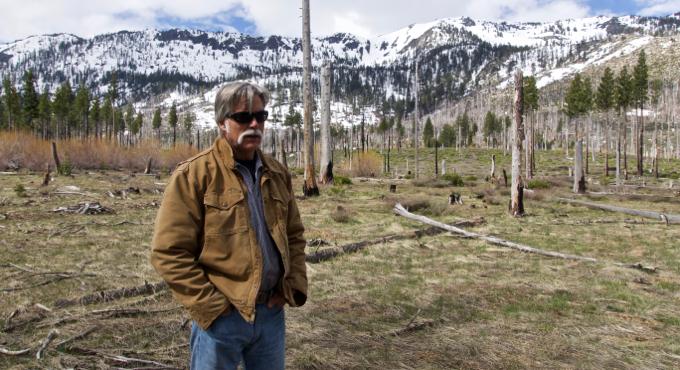
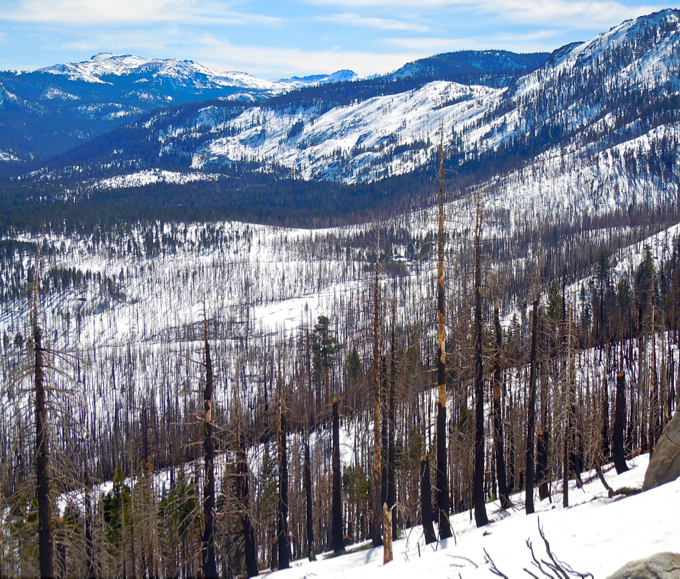
Kit Bailey, LTBMU’s fire chief, surveys what the landscape looks like today. Photo/Kathryn Reed
The humidity, temperature and wind created a perfect scenario for a wildland fire. Fuels treatment were not as robust then. “Extreme fire behavior” is a common refrain when fire officials talk about Angora.
Walking near where the fire started at Seneca Pond, the landscape looks like two worlds. It’s clear to see where the forest had been treated and where it wasn’t. To this day the scar on the forest is prominent and will be for decades to come.
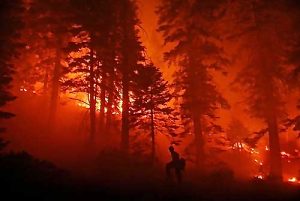
It was a hot, fast fire. Flames were in the canopy, jumping from one tree to the next as though it were a race to destroy as much as possible.
“You can almost draw a line where it was treated,” Bailey said as he looked out onto the forest. “It gave the firefighters an opportunity to engage and retreat when they needed to.”
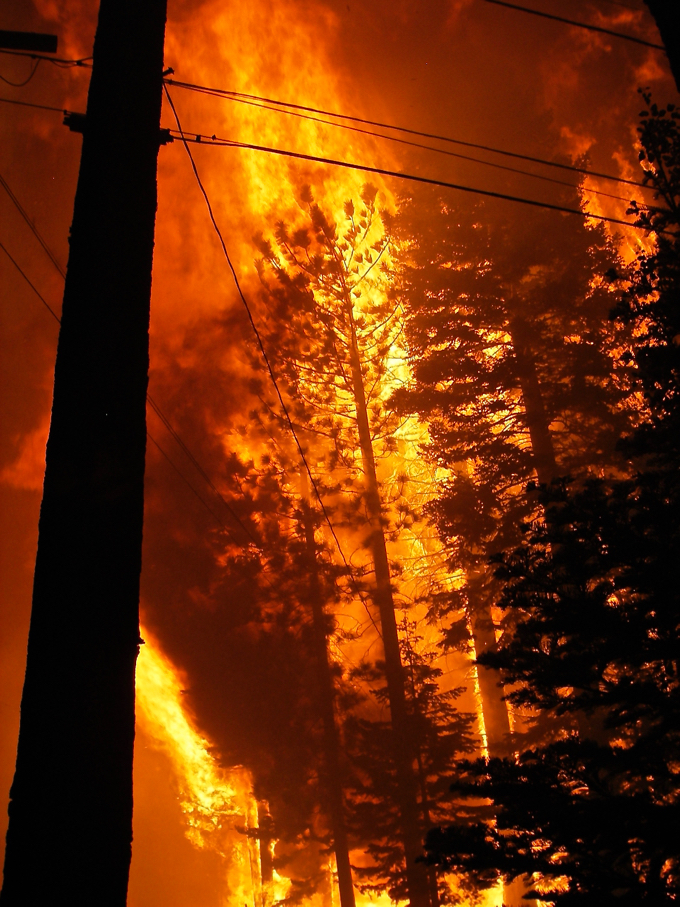
The Angora Fire burned hot and intense in the tree canopy. Photo/LVFPD
Fire behavior is very different between treated and untreated terrain. If it’s been thinned, then the fire tends to say in the understory where it is more easily suppressed. Fighting a running crown fire, even with air support, is a difficult, near impossible endeavor.
The fuels work on Tahoe Mountain and below Angora Highlands prior to that fateful day contributed enormously to only one house in that area being lost.
It has been proven that more prescribed fire means fewer wildland fires.
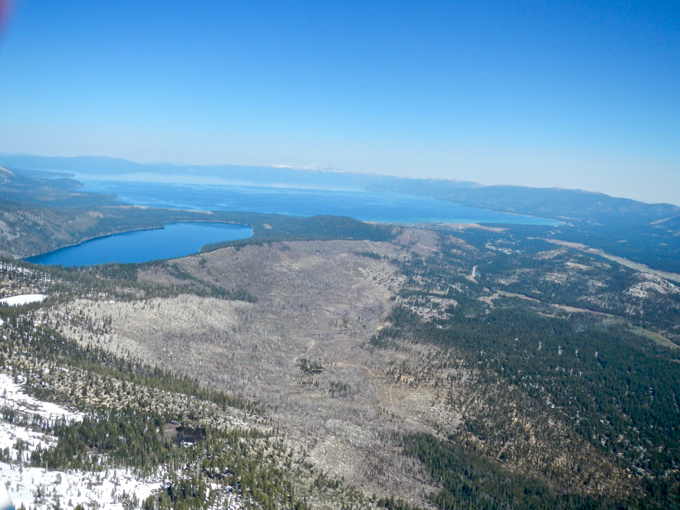
The scar from the Angora Fire will be visible for years to come. Photo/LTN file
“Some post fire studies showed homes with better defensible space had a better likelihood to survive. This was not new news, but it helped solidify that need in the Lake Tahoe Basin,” CalFire Division Chief Chris Anthony told Lake Tahoe News.
Equipment and manpower were quick to arrive that Sunday afternoon. But not before 254 houses were reduced to ash. Most of the damage to structures and land happened in the first eight hours.
Three significant tools are now available that weren’t during Angora. Lake Tahoe Basin Management Unit now has a hot shot crew. The Super Scooper plane is another tool that is new. Alert Tahoe, the camera system, is quick to spot puffs of smoke.
Another change since Angora is that CalFire now has a year-round presence in the basin. Personnel had always been here, but not equipment. Now there are engines at Lake Valley and North Tahoe fire stations. Then-Gov. Arnold Schwarzenegger’s emergency funding for the rigs became a permanent line item in the budget.
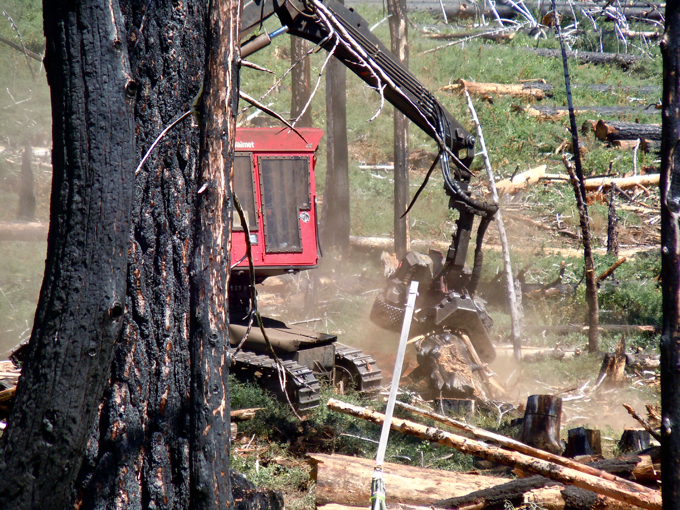
It was four years after the Angora Fire before many of the charred trees were removed. Photo/LTN file
Anthony, who was here for Angora, says the relationship between the fire agencies has been a significant change.
“One of the biggest lessons was the need for the increased collaboration between different agencies in the Lake Tahoe Basin,” Anthony said. “It’s very clear in the commission report that the local fire protection districts, land managers and regulatory agencies needed to do a better job working together.”
The report he speaks of is the bi-state Blue Ribbon Commission that was tasked with analyzing what needed to change to help prevent another Angora.
It is still a tool. Both states and TRPA annually monitor progress being made based on recommendations in the report.
“There was a lot of work that went into the commission hearings and lot of public input. It’s important we continue that legacy established by the commission,” Anthony said.
Looking toward the neighborhood off North Upper Truckee Road from Angora Ridge. Photo/LTN file
A formal, comprehensive report detailing the last 10 years is expected to be completed by the end of the month.
The Tahoe Fire and Fuels Team came out of Angora. It includes all the fire departments in the basin and other agencies. They work on getting grants for fuels reduction projects for the greater good of the community. They essentially have each other’s back in a more formalized structure when an emergency occurs. The wildland protection plan, which encompasses the basin, has been developed. A multi-jurisdictional approach to managing public lands is in place.
A sub-geographical operating plan has been established that goes into more detail when it comes to moving local, state and federal resources.
“I think there are a lot of lessons, not on suppression, but on the land regulations side of the house,” Bailey said. “We’ve streamlined the permit process with TRPA and somewhat with Lahontan. Lahontan has the biggest impact on what we can do on the ground and the timeliness. It’s like pulling teeth to get a permit. It costs a lot of time and money.”
Angora Fire facts:
• June 24, 2007, Angora Fire started at Seneca Pond
• Cause: Illegal campfire
• No arrests ever made; investigation considered cold case
• July 2, 2007, fire fully contained
• More than 3,100 acres burned; mostly U.S. Forest Service land
• 80 percent of the terrain burned in the first eight hours
• 254 houses destroyed
• Fire caused more than $150 million in damage
• It cost about $23 million to fight the fire
• July 5, 2007, bi-state commission formed
• 56,317 tons of ash and rubble were removed and transported for disposal (2,823 truckloads); 6,134 tons of concrete (352 truckloads) and 2,001 tons of metal were recycled (90 truckloads); and 8,511 tons of trees were recycled for lumber (405 truckloads)
• May 27, 2008, governors declare state of emergency in Lake Tahoe Basin. Fire commission’s 247-page report’s six categories are: Environmental Protection, Issues of Governance, Community and Homeowner Fire Prevention, Forest and Fuels Management, Fire Suppression, and Funding.
• June 2008, 63 percent of the homeowners had filed building plans with the county
• June 2017, 63 lots remain vacant.
Photo/Dennis Cocking
Shortly after the fire there was a community meeting at South Tahoe Middle School where it was almost a mob mentality. The audience shouted down John Singlaub who was the director of the Tahoe Regional Planning Agency. While TRPA has some arbitrary rules in place that affect homeowners, they were not a huge impediment to what large landowners wanted to do in regards to fire safety.
The same cannot be said for the Lahontan Regional Water Quality Control Board. To this day it is still a stumbling block for the U.S. Forest Service and others on the California side. The difference with Lahontan and TRPA is that the former doesn’t have much to do with individual residents, so the anger toward that state agency has never risen to the level that it still can with the federal regulatory organization.
TRPA now allows the fire agencies to decide if trees should be removed from an individual parcel. People may cut trees of 14 diameters or less without a permit; it was 6 inches pre-Angora. And no longer are piles of pine needles recommended as mulch or for erosion prevention.
“When you look at fire statistics since 1990, California has had 15 of its 20 largest fires. We are seeing more damaging fires,” Anthony said. “We can’t totally prevent large and damaging fires in the state, but we can change the landscape where they burn. Again, out of the commission report was the need to accelerate the pace of fuels reduction work in wildland urban interface, to increase the number of defensible space inspections around the lake and to prioritize where those are going to occur based on the greatest need.”
Fire officials worry that people have become complacent in the last 10 years and don’t necessarily take the threat of fire as seriously as they did immediately after Angora.