Crusade under way to pass SLT sales tax for roads

By Kathryn Reed

When South Lake Tahoe was incorporated in 1965 many of the roads were still dirt. The engineering at the time called for asphalt to be laid on top of the dirt. That’s not how things are done today, especially in an environment with a freeze-thaw cycle like Tahoe.

Bad roads to begin with and no plan to deal with maintaining them has led to the city to have streets that some say resemble Third World countries.

Advocates to raise money for South Lake Tahoe’s roads via increasing the sales tax are making their rounds to various groups.

Many at the Progress for Tahoe meeting on Aug. 16 admitted it was like preaching to the choir.

Leon Malmed, who is one of the main leaders behind the city’s efforts of Measure C, led the discussion, with council members Austin Sass and Wendy David adding additional facts. Attendees offered advice on how to spread the message and what to say to the naysayers.

The question on the November ballot asks to raise the sales tax from 7.75 percent to 8.25 percent. It will require two-thirds of the voters to say yes. This equates to an additional 50 cents on every $100 spent. Locals are expected to be impacted by $25 to $50 a year, according to Malmed.

While there is no definitive proof, Measure C advocates say about 75 percent of sales tax dollars collected in the city are from tourists. The biggest contributor to those dollars are restaurants, with Ted Kennedy’s three restaurants at Heavenly Village collectively being the No. 1 generator of sales tax in South Lake Tahoe.
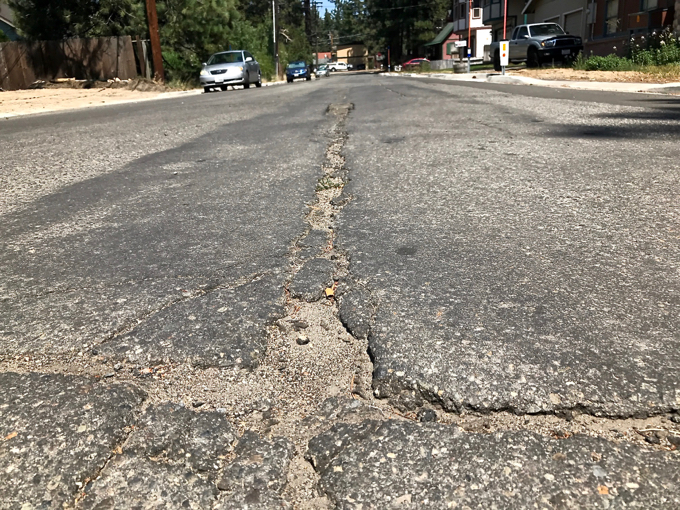
Palmira Avenue between Reno and Carson avenues is rated 4 out of 100. It’s the worst rated road in South Lake Tahoe. Photo/LTN

The $2.5 million that is expected to be raised annually could only be spent on roads. Where appropriate, this will also include curbs, gutters and bike lanes. A bike lane is on the street, not a separated trail. It essentially requires a line of white paint and the lane is created.

David pointed to how Al Tahoe Boulevard was rebuilt nearly a decade ago. It was reconstructed as a road should be and still is in good condition. That is the type of work these new dollars would go toward – not patches and pothole repair – true road construction.

Measure C is designed to sunset after 15 years. This would give taxpayers an opportunity to assess if the money is being well spent.

Two ways the city wants to ensure transparency is with a roads management authority and a roads oversight committee. The latter is just like what Lake Tahoe Unified School District and Lake Tahoe Community College created for measures G and F, respectively. It’s community members analyzing the books after the fact to make sure the money was spent as the agencies said it would be. It’s an audit of sorts.

The roads management authority, which the council approved at its Aug. 15 meeting, is more akin to the Planning Commission. The main difference is that all decisions will go before the council. In essence the RMA is the one deciding what gets done first. City staff will give input and be at those public meetings. The RMA will consist of members of the public appointed by the council. The council, though, will have the ability to overrule what the RMA recommends.

The plan is for these roads groups to be formed before the voters even weigh in. This is so the RMA in particular can be working this winter – if the measure passes – to start prioritizing projects.

Another advantage to having an RMA is that the state requires jurisdictions to have one to qualify for funding from the recently passed gas tax. Malmed said the city is expected to receive $134,000 the first year from the gas tax and then $300,000/year.

At Wednesday’s meeting it was noted that so many grants require matching dollars. Measure C would qualify as the city’s portion of those roads dollars from other outlets.

The city also intends to work with utility companies which are doing work that tears up local roads. Southwest Gas in the next 10 years intends to replace all of its underground lines in South Lake Tahoe. The city plans to coordinate efforts so the road is torn up once and fixed to a higher level than what the utility would have been required to do.

The other added bonus is that with a dedicated source of money it means contracts can be long term. This will add to job creation in the area and trickle down spending. This work will be done by outside contractors – not city staff. All projects valued at more than $70,000 must go out for bid. The local employees will still be doing the pothole repairs, storm drain and other summer work.



Nev. judge clears way for expanded pot distribution

By Scott Sonner, AP

A judge cleared the way Thursday for Nevada to allow more businesses to move marijuana from growers to stores in an effort to keep up with overwhelming demand since recreational pot sales began last month.

Carson City District Judge James Russell lifted an order blocking regulators from issuing pot distribution licenses to anyone other than alcohol wholesalers. Nevada’s voter-approved law is unique among pot states in providing liquor wholesalers exclusive rights to distribute marijuana unless they could not keep up with demand.

Russell said after an hourlong hearing that there is overwhelming evidence alcohol wholesalers don’t have the capability to meet the needs of dozens of recreational pot dispensaries from Las Vegas to Reno.

Read the whole story


Int’l travelers to U.S. increase after dip in 2016

By Beth J. Harpaz, AP

International arrivals to the U.S. increased 2 percent in January 2017 compared with January 2016, the U.S. Department of Commerce announced Wednesday.

The 5.6 million international visitors who arrived this past January represented the first monthly increase in inbound international visits to the U.S. since June 2016, the agency said in a release in Washington, D.C.

The Department of Commerce also issued its final report on the 2016 calendar year last week, counting a total of 75.6 million international visitors to the U.S. last year. That 2016 figure represented a decrease of 2 percent compared to the 77.5 million non-resident international travelers who arrived in 2015. Those visitors collectively spent $244.7 billion here in 2016, a 1 percent decrease in spending over 2015.

Read the whole story


Reno airline capacity still trails pre-recession levels

By Richard N. Velotta Las Vegas Review-Journal

Airline seat capacity has grown at Reno-Tahoe International Airport over the past 2½ years, but it still hasn’t reached levels prior to the Great Recession, the Nevada Commission on Tourism was told Wednesday.

About 5 million seats are flown into the airport serving Reno on nine airlines from 23 destinations, thanks in part to marketing efforts by the Regional Air Service Corp., which receives funding from the commission. In 2008, capacity at the airport that is key to Northern Nevada’s rural tourism economy, was 6.5 million seats.

By comparison, capacity at McCarran International Airport in Las Vegas is about 28.3 million seats a year.

Read the whole story


Douglas library issues warning about eclipse glasses

The eclipse glasses the Douglas County library handed out are being recalled.

The vendor informed the library administration on Aug. 17 that it had “not received confirmation from the supplier of your order that they sourced the item from a recommended manufacturer. We recommend that you do not use this product to view the sun or the eclipse.”

The library advises people to discard the eclipse glasses received at the Library.

Five hundred glasses had been distributed.

Regular sunglasses are not enough to shield damaging rays that could result in blindness.

— Lake Tahoe News staff report


Squaw appealing state fine from patroller’s death

Squaw Valley Ski Holdings is appealing the decision by CalOSHA that found infractions at the ski resort after the death of ski patroller Joseph Zuiches.

The state Occupational Safety and Health Administration this month said it was fining Squaw $11,250 for “failing to correct an identified unsafe working condition by implementing a procedure for protection against the workplace hazards associated with hang cord entanglement during hang cord blasting operations.” The second fine of $9,000 was for “failing to ensure that all crew members maintained visual contact or awareness of physical location of crew members at all times during avalanche control activities.”

Zuiches died Jan. 24 at the resort working in avalanche control.

Squaw believes the state’s findings are not accurate and the fines not justified. The resort wants to keep investigating the death.

— Lake Tahoe News staff report


Efforts to keep sediment from Tahoe paying off

By Kathryn Reed

“It’s about finding opportunities and doing the work we know needs to be done.”

This is how Bob Larsen with the Lahontan Regional Water Quality Control Board summarized the ongoing efforts to reduce the pollutants reaching Lake Tahoe. Much of that is fine sediment that is washed into the lake, which then degrades the clarity of the water.

His agency along with the Nevada Division of Environmental Protection are the overseers of the total maximum daily load program in the basin. Goals are set for each government jurisdiction in Tahoe – from the city to the counties, state departments of transportation, U.S. Forest Service and state land owners.

The 2017 performance report was released Aug. 17.

“Exceeding the target was expected based on the work done,” Larsen told Lake Tahoe News.

The five-year goal was to reduce sediment reaching the lake by 10 percent. Collectively, there was a 12 percent reduction from the 2004 base year. (The TMDL program started in 2011.) In the process, the amount of phosphorus reaching the lake decreased by 8.5 percent and nitrogen by 6 percent.

The sediment reduction equates to 268,500 pounds or 70 dump trucks worth of fine dirt that have been keep from the water.

In the spring, South Lake Tahoe, El Dorado County and Placer County were notified they met their goals. The next five-year goal for each is reducing pollutant loads by another 15 percent.

Throughout the basin the next five-year goal is another 11 percent reduction on top of the last 10 percent goal.

“It will be a challenge, but I feel it’s a challenge we can overcome,” Larsen said.

Runoff from roads is a primary source of sediment reaching the lake. The worst roads, according to officials, mean more gunk going into the water.

“There is some new information we have showing roads contribute upward of 30 percent of the sediment into the lake,” Russ Wigart with El Dorado County said last spring.

Different surface materials are being studied and various catch basins installed.

The long-term goal of the TMDL is to restore the lake’s clarity to 97.4 feet by 2076. This means when scientists put what looks like a white dinner plate into the water it will be able to be seen by the naked eye to that depth.

In 2016 the average depth of clarity was 69.2 feet. Sixty-four feet is the worst it’s been. That was recorded in 1997; the same year as the first environmental summit at Lake Tahoe. Since that time about $2 billion worth of environmental improvement projects have been implemented in the basin, all with the ultimate goal of protecting Lake Tahoe.

Other factors besides sediment are contributing to the clarity loss-gain. Climate change is a biggie, according to scientists. Time will tell if the millions of dollars spent each year on these TMDL projects will be enough to keep Tahoe blue and not have it look brown like so many lakes in the world.


El Dorado Savings’ quarterly profits increase

El Dorado Savings Bank’s second quarter profits were $723,944 above the same period a year ago, at $3,607,198.

Earnings for the first half of 2017 totaled $6,581,965, compared to $6,465,488 in 2016.

“The continued strong profits reflect the stable performance of the loan and investment portfolios,” CEO George L. Cook Jr. said in a statement. ““The bank remains in excellent financial condition with strong capital, high liquidity and excellent asset quality. We ended the first half of 2017 with no foreclosed property on the books.”

El Dorado ended the quarter with $2.165 billion in total assets and savings deposits of $1.92 billion.

As of June, El Dorado Savings Bank maintained its top five star rating with Bauer Financial Reports, a recognition El Dorado has had since December 1993.

The bank operates 35 branches, 31 in California and four in Northern Nevada.

— Lake Tahoe News staff report


South Lake Tahoe city attorney calling it quits

By Kathryn Reed

South Lake Tahoe City Attorney Tom Watson tendered his resignation Aug. 16, with his last day being at the end of September.

Tom Watson

Watson told council members he is leaving to become city attorney for Tracy.

When he was hired in May 2013 he told Lake Tahoe News the Tahoe position was a “dream job.” Clearly, things changed. He did not return calls Wednesday.

Mayor Austin Sass said he was not surprised Watson is leaving based on his wife living in Fresno, which is where he lived before taking the Tahoe job. She was not able to get a job in this area; she is the coordinator for the Department of Educational Leadership at California State University, Fresno.

The new job will put him much closer to his wife. There was a time she lived here, along with their daughter. She is now in college.

Watson has been a victim of the housing shortage in the basin. He never owned here, and has had to move when his long-term rental became a vacation home. Being gone so much for personal reasons he never made Tahoe his home and was not immersed in the community.

“I enjoyed working with Tom. I enjoyed the fact that he had a background in private industry and a public service background. I thought his perspective on things was good,” Sass told Lake Tahoe News. “He could look at things from both sides of the aisle, so to speak.”

Sass and Councilwoman Wendy David plan to meet with City Manager Nancy Kerry this afternoon to discuss how to proceed. The entire council at the Sept. 5 meeting will likely make a decision about the next steps.

The two city employees who report directly to the council are the city manager and city attorney; therefore, they are the ones who hire, fire and review those individuals. This will be the first time Sass, David and Councilmember Jason Collin have gone through this process for either of those jobs. David, though, was part of Lake Tahoe Unified School District’s board when Diane Scheerhorn and Jim Tarwater were hired as superintendent.

Most likely the city will hire a consulting firm to aid in the search. Inevitably it will take several months to fill the position. And depending on how much time that person would need to give notice it could be after the winter holidays before someone is on board.

Watson is leaving at a time when two key issues are before the City Council. It’s likely the revise of the vacation home rental ordinance will essentially be written next month before he leaves, but the marijuana issue could be unresolved.

In the interim, the city has a deputy city attorney and a legal secretary. The city also contracts with Burke, Williams & Sorensen LLP out of Oakland for Nira Doherty to come up once a month for one week. Doherty was the assistant city attorney for South Lake Tahoe before leaving to be a partner in the private law firm. On that firm’s website she is listed as the assistant city attorney for South Lake Tahoe, though on the city’s website there is no mention of her.

Nonetheless, Doherty is well versed in many city legal issues. She gave the last presentation about marijuana and will likely be at the workshop later this month.


California confronts its Confederate past

By Esmeralda Bermudez, Corina Knoll and Anh Do, Los Angeles Times

The backhoe crept into the graveyard as the city lay still.

It had come for the 6-foot granite monument with the bronze plaque, a salute to the Confederate Army veterans interred below.

Hollywood Forever Cemetery had housed the marker since 1925, but the recent events in Charlottesville, Va., had sparked phone calls, emails and social media rants calling for its removal. An online petition circulated. Vandalism threats were made. By Tuesday, the word “No” had been written across the monument in black. The staff of a generally beloved institution was overwhelmed; the monument owners uneasy.

And so at 3am Wednesday, the monument aged with a green patina was excavated, covered with a blue tarp and carted away in a pickup, a patch of fresh sod patted into its place.

California has been grappling with uncomfortable symbols of past racism and cruelty for years.

Read the whole story