Calif. lawmakers approve $4B ballot measure for parks, water projects

By Paul Rogers, Bay Area News Group

Immigration and housing dominated the headlines from Sacramento this year. But with little fanfare, state lawmakers working with Gov. Jerry Brown also approved a sweeping measure to provide $4.1 billion in new funding for parks and water projects — everything from building Bay Area hiking trails to expanding Lake Tahoe beaches to constructing new inner city parks in Los Angeles.

The bill, SB5, passed near midnight Friday and now sits on Brown’s desk. If he signs it, as expected, it would be placed on the June 5 statewide ballot. It also would represent the first statewide parks and water bond to appear on a state ballot in 12 years, since Proposition 84 in 2006, which won approval of 54 percent of voters and provided $5.4 billion.

Unlike other parks bonds in the past — all the way back to California’s first parks bond, which voters approved in 1928 to preserve areas like Mount Diablo, Mount Tamalpais and Del Norte Redwoods state parks — this one is heavily tilted toward urban parks and Southern California, along with water improvements in low-income communities.

Read the whole story


SLT wants help getting VHRs to comply

By Kathryn Reed

If your vacation rental in South Lake Tahoe – full house or just a room – is not permitted, get ready to be fined.

The City Council is contemplating hiring a firm to clamp down on those who are operating without a permit and therefore presumably not paying transient occupancy tax.

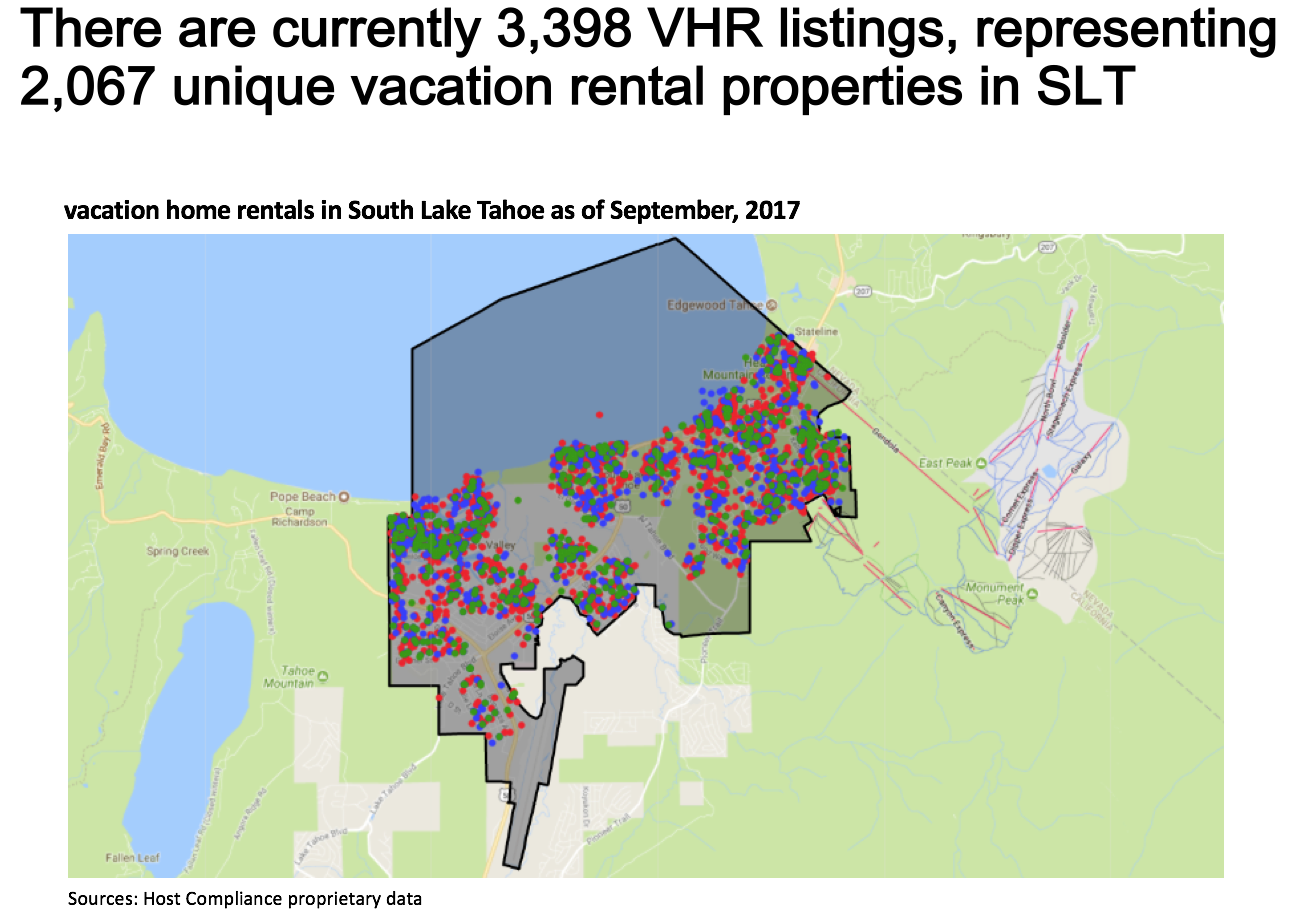
The electeds on Sept. 19 heard a presentation from Ulrik Binzer, co-founder and CEO of Host Compliance. The Bay Area firm has a suite of services designed to essentially manage the vacation home rental business for cities and counties.

At the end of the discussion the council members said they were interested in a software-based business like Host Compliance, wants staff to bring back a proposal for what services Host Compliance would provide, and wants to know if it’s necessary to go out for bid.

Services available include:

·      Address identification

·      Compliance monitoring

·      Tax collection and audit support

·      Permitting solutions

·      24/7 hot line

·      Short-term rental ordinance consulting

·      Rental data and analytics.

Contracts are usually on an annual basis. The cost to the city would be determined on the services requested. It’s based on the number of listings that would need to be monitored. A benefit is that when the contract ends, the city would retain the rights to information obtained by Host Compliance.

Binzer’s data about the city shows how the number of vacation rentals has changed over the last year – how it is a fluid industry with listings coming and going. This is why it takes time to analyze – it’s not a static situation. For instance, in the last year 1,832 VHRs have been added to the market in South Lake Tahoe, with 1,488 being deactivated. Fifty-four percent of the listings are new in the last 11 months.

Plus, there are renters who try to skirt the law. Binzer said his team is able to ferret out those offenders.

Host Compliance uses letterhead from the jurisdiction it represents to send correspondence to out-of-compliant property owners. This way the owner never knows a third party is involved.

Binzer said about 4 percent of the letters are returned because of bad address information. Another 1 percent of the identified properties are not actually out of compliance.

Vacation rentals have been a divisive topic in town. Enforcement is a constant refrain, with a loud chorus saying whatever ordinance is in effect has never been enforced. Another complaint is that for years the city has been leaving money on the table. That comes in the form of not making people be compliant via permits or tax collection.

With the around-the-clock hot line Host Compliance staffs, the complaining party is asked to provide a photo, video or other evidence of a violation. Assuming the property is registered, a Host Compliance rep calls the host. The database is able to easily identify repeat offenders.

TOT represents 22 percent of the city’s General Fund budget in the 2017-18 budget that was approved Tuesday. While it keeps going up, it is leveling off. Of note, though, was that the TOT from hotels dipped in July. This could be because Knights Inn no longer exists, and/or because more people are in vacation rentals. After all, TOT was up more than $60,000 in July compared to 2016.

Placer County and Truckee use Host Compliance. In the first nine months, Placer saw a four times ROI with $780,000 in TOT collected. Its annual fee is $196,000. Truckee in the first two months of using Host Compliance had an ROI of 1½ times, with $111,289 collected at an annual cost of $72,600. In other words, at least at the start the service is more than paying for itself.

The company said its clients – there are 70 throughout the United States, with 30 in California — see three to five times return on investment.

Expedia, which is the parent company of 18 vacation rental sites (representing 38 percent of the local online sites), TripAdvisor – owner of seven sites (19 percent of market), and Airbnb (43 percent of listings) are the primary entities scrutinized.

South Lake Tahoe a few years ago hired an employee with the purpose of cracking down on VHR violators. Her job includes managing VHR permits, auditing non-reporting TOT, and being the point person for citations and appeals. Her work is time consuming.

Host Compliance has software that would be more time efficient, as well as provide more services than what the one staff member can currently do.


Motorcyclist from SLT dies in Hope Valley

A South Lake Tahoe woman died Sunday from injuries sustained in a motorcycle accident in Hope Valley.

The 64-year-old woman’s name is not being released pending notification of next of kin. She died on her way to Renown Medical Center in Reno.

Just before 5pm Sept. 17 the motorcyclist was driving on Highway 88 about to turn on Highway 89. According to the California Highway Patrol, the motorcyclist turned in front of a vehicle driven by a 58-year-old woman from Gardnerville. She did not have time to stop or avoid the motorcyclist, CHP said.

— Lake Tahoe News staff report


South Lake Tahoe man killed in Carson Valley

A South Lake Tahoe man died Sunday night when he was struck by a vehicle on Highway 395 in Gardnerville.

For unknown reasons Rosendo Ramirez Amaya, 54, was lying in the middle of the northbound lane, according to the Nevada Highway Patrol.

The driver was not able to avoid Amaya. The driver called emergency personnel immediately, but Amaya was pronounced dead at the scene just after the 8pm Sept. 17 incident.

— Lake Tahoe News staff report


West Slope courthouse clears litigation hurdle

By Joann Eisenbrandt

The legal roadblock that has prevented construction of a new courthouse facility in Placerville has just been removed. More than two years after the Placerville Historic Preservation League first challenged the environmental document approving the courthouse, the First Appellate Court of Appeal in San Francisco denied the appeal.

Currently, the county’s Superior Court services on the West Slope are divided among the historic 1912 courthouse on Main Street in Placerville, Building C in the County Government Center on Fair Lane, and a small court facility in Cameron Park. The new courthouse would consolidate court services in an 88,000-square-foot facility on Forni Road off Highway 50 just west of Placerville and adjacent to the county jail.

A decadeslong process

El Dorado County has been considering constructing a new courthouse adjacent to the jail since the jail was built in 1988. It prepared its own environmental document on such a project in 2000. The courts were under the jurisdiction of the counties until 2002, when the state of California took them over under the oversight of the Judicial Council. The land on which the new courthouse would be built will eventually be given by the county to the state.

The process has been a contentious one. The Judicial Council certified its environmental impact report (EIR) for the Placerville courthouse in June 2015. Some have alleged that favoritism, back-door dealings, and a flawed site selection process led to the choice of a site beneficial to special political interests. Concerns were also raised about the impacts on downtown Placerville if the Main Street courthouse and the economic benefit it brings were to be removed.

The courthouse, Kirk Smith of the Placerville Historic Preservation League contends, is essential to the economic health of the downtown business area. Its removal would lead to “absolutely horrendous blight to Placerville’s Main Street, all but turning this historic community into a ghost town.”

Jurors, other court visitors and courthouse staff would no longer contribute to the downtown economy. Court-related county agencies and private legal firms would move to the new courthouse site. Smith proposed leaving some court services at the existing Main Street courthouse and adding an annex.

Opponents of the Placerville Courthouse project lost their appeal. Photo/LTN

The legal battle

In July 2015, Smith’s group filed a lawsuit in San Francisco Superior Court against the Judicial Council’s EIR. El Dorado County and the Board of Supervisors were real parties in interest and respondents in the case as was former state Sen. John Briggs. Briggs swapped 5.2 landlocked acres he owned adjacent to the proposed courthouse site for land the county owned. This was done, the county said, to allow for the best facility site design. Briggs received $10,000 for two yearlong option agreements with the county. The transfer of land has already taken place.

The preservation league contended the Judicial Council failed to adequately consider the “urban decay” the removal of the Main Street courthouse would create. Projects by public agencies must comply with the rules of CEQA, the California Environmental Quality Act. It requires them to identify any substantial environmental effects of proposed projects and outline mitigation measures that would reduce such impacts to less than significant. In July 2016, the court denied the league’s writ.

The league appealed this decision to the First Appellate District Court of Appeal in San Francisco. On Sept. 15, the appellate court agreed with the earlier trial court decision that the Judicial Council’s EIR was not defective and should be upheld. The decision said, “The trial court rejected the argument (of the Placerville Historic Preservation League) and denied the petition in a thorough and well-reasoned written decision that hardly needs elaboration. The decision of the trial court is affirmed.”

Money talks

El Dorado County Chief Administrative Officer Don Ashton told Lake Tahoe News, “The county is very pleased with the appellate court’s decision. It allows the county to move forward with this essential project.”

But this does not mean that construction of the new Placerville Courthouse project will be starting anytime soon.

With the legal obstacles removed, it now becomes an issue of money. In 2008, Senate Bill 1407 authorized up to $5 billion to renovate existing substandard courthouses and build new ones. The Judicial Council reviewed and prioritized the state’s court facilities and created an “Immediate and Critical Need” list of court facilities they termed “the worst of the worst.” El Dorado County’s courts are on that list with funding first approved in 2009.

A critical needs account was created to pay for the projects. Over the intervening years, state budget problems caused money to be withdrawn by the state from the courthouse construction fund and diverted to other uses. This caused some court projects to be scrapped and others like the Placerville project to be delayed. The Judicial Council plans to ask the state to return the money borrowed in the past, but this will take time. In August 2016, the Judicial Council accepted the recommendation of their Court Facilities Advisory Committee to allow courthouse projects like the one in Placerville, which is still in the “site acquisition” phase, to complete the phase they are in, but then be put indefinitely on hold, awaiting an influx of funding.

The Judicial Council website says the projected completion date for the Placerville Courthouse is spring 2022.

Don Mooney, attorney for the Placerville Historic Preservation League told Lake Tahoe News, “We are disappointed in the court’s decision and continue to believe that the project will result in significant impacts to the downtown area.”

What the court said

In its decision, the First Appellate Court of Appeal noted that the Judicial Council’s EIR did address “the possible economic impact of moving judicial activities from the downtown courthouse, it concluded the impact was not likely to be severe enough to cause urban decay.”

CEQA does not usually require agencies to address economic and social impacts of their proposed projects, except when these changes will cause a serious physical change in the environment. It describes “urban decay” as “… physical deterioration of properties or structures that is so prevalent, substantial, and lasting a significant period of time that it impairs the proper utilization of the properties and structures, and the health, safety, and welfare of the surrounding community.” Smith believes this is what will happen. The Judicial Council does not.

The court agreed with the Judicial Council. “Substantial evidence supports the Judicial Council’s conclusion that the type of physical deterioration embodied in the term ‘urban decay’ is not a reasonably foreseeable consequence of withdrawing judicial functions from the Main Street Courthouse and relocating them to a new building outside the downtown district.”

Repurposing the Main Street courthouse

The court concluded that repurposing the building will mitigate economic impacts. Its decision pointed to the creation of a Blue Ribbon Committee to study potential re-uses. The Blue Ribbon Committee was formed in 2015 and consists of members from the city, county and Placerville business owners.

The Judicial Council agreed to provide funding for a consultant to facilitate the committee’s meetings and help identify workable new uses for the courthouse. Although a consultant firm was selected in 2015, the Judicial Council has not finalized their contract due to the current freeze on the courthouse project. The Blue Ribbon Committee has only met sporadically. A survey was created asking residents to prioritize new uses for the Main Street courthouse, with a meeting in April 2017 to go over the results.

Smith told Lake Tahoe News, “The Blue Ribbon Committee was created as a ploy to support the baseless argument that serious efforts were made to mitigate blight. The committee held off meeting until before the case was argued before the trial court, stopped meeting not long after that, resumed as needed when the case was before the appellate court and then they stopped meeting after that. That’s irresponsible.”

According to Smith, “The stakes are too high to give up.” The league will be considering all its options, including appealing the appellate court’s decision.


Court: Consent not required in all Nev. phone recordings

By Sean Whaley, Las Vegas Review-Journal
 
CARSON CITY — The Nevada Supreme Court has ruled that a state law requiring both parties to consent to a recording of a telephone conversation does not apply when the recordings are made by a party located outside of the state.

The unanimous decision, dated Thursday, was in response to a request for an interpretation of Nevada law from the U.S. District Court.

Read the whole story


How Trump will affect Nevada midterm election

By Las Vegas Sun

When will they stop running and start governing? It’s a question voters increasingly have been asking themselves for at least four decades.

Democratic pollster Patrick Caddell first described the phenomenon in 1976, and it was explored more thoroughly by journalist Sidney Blumenthal in a 1980 book, “The Permanent Campaign.” Those who have been elected immediately govern with an eye toward re-election and those who were vanquished look for a way back as soon as the votes are counted.

What had been a latent instinct for politicians developed in the cable news era and accelerated in the internet age with shorter news cycles to be “won.” The same day he was sworn in as the 45th president, Donald Trump filed with the Federal Election Commission to become a candidate for re-election in 2020.

So, no, it’s not too soon to consider how the 2018 midterm elections will unfold. With the balance of the U.S. Senate in part dependent on the Nevada race and a wide-open race for governor, here are key questions about the 2018 elections.

Read the whole story


Driver arrested on DUI charges; 3 people injured

Three people were injured and one arrested after the vehicle they were in struck a tree on Pioneer Trail on Sunday.

Amber Sabourin, 21, of Novato was driving east on Pioneer Trail on Sept. 17 about 1:25am when she told California Highway Patrol officers she saw an animal and swerved to miss it. She missed it. But in doing so the vehicle left the road and came to a stop against a tree.

Sabourin was taken to Barton Memorial Hospital with a broken leg. She was later arrested on charges of driving under the influence.

A 27-year-old passenger from Las Vegas sustained facial lacerations and a 26-year-old South Lake Tahoe resident who was also a passenger broke an arm.

— Lake Tahoe News staff report


Tahoe CEQA lawsuits: Public good or private gain?

By Melissa Siig, Moonshine Ink

When Kila Properties purchased the dilapidated Henrikson building in 2013, the majority of Tahoe City residents and businesses breathed a sigh of relief. The run-down Henrikson building, built in the late 1950s (much of it without permits), today is only partially occupied and serves as an eyesore at a key location — the west gateway to Tahoe City.

Kila Properties’ plan to demolish the crumbling building and replace it with the 118-room Tahoe City Lodge, complete with a restaurant, rooftop pool, and bar, met with widespread community support. At the end of 2016, as part of the Tahoe Basin Area Plan, it was unanimously approved by the Placer County Board of Supervisors and the Tahoe Regional Planning Agency, and even received the hard-to-come-by endorsement of the League to Save Lake Tahoe. Demolition was set to occur this spring.

And then it all came to a grinding halt.

In January, the Davis-based California Clean Energy Committee (CCEC) filed a lawsuit to stop the implementation of Placer County’s Tahoe Basin Area Plan, claiming that the environmental analysis of traffic impacts under the California Environmental Quality Act (CEQA) was inadequate. The lawsuit named the Tahoe City Lodge as a party of interest.

Read the whole story


Crews get upper hand on West Slope fire

Updated 5:15pm:

The French Fire burning near Shingle Springs grew to 136 acres and is now 75 percent contained.

It started in the afternoon of Sept. 17 off French Creek Road.

CalFire says forward progress has been stopped.

The cause is under investigation.

— Lake Tahoe News staff report