Officials: Muck on roadways not from change in de-icing

By Kathryn Reed

Every spring the sides of the roads in the basin and on the highways leading to Lake Tahoe are black and not the pristine white of fresh snow. The difference this year is locals have noticed the black has been more prominent throughout the winter.

However, snow removal officials on both sides of the state line say nothing new is going on.
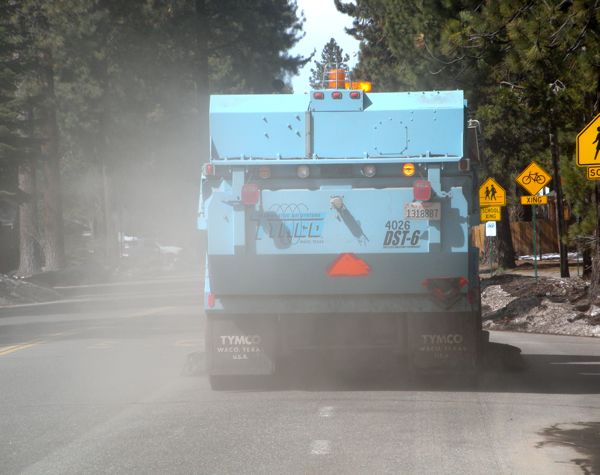
A South Lake Tahoe street sweeper creates dust. Photos/Kathryn Reed

A South Lake Tahoe street sweeper creates dust. Photos/Kathryn Reed

Caltrans is responsible for the highways throughout Lake Tahoe in California, while the Nevada Department of Transportation handles them in the Silver State. On city streets and in the county it is those jurisdictions that take care of the side streets.

The Tahoe Regional Planning Agency does not oversee what is put on the roads each season, but it does take a look at the reports the various jurisdictions compile. On the California side, the Lahontan Regional Water Control Board looks at what was put on the roads and what the sweepers took off.

“We don’t regulate public safety,” TRPA spokesman Jeff Cowen said.

Public safety is the main focus of snow removal policy.

“You have to find that fine line to provide for public safety and be environmentally conscious,” said Tom Celio with the El Dorado County Department of Transportation. “Our primary skid resistance material we use for ice control are cinders, volcanic cinders. We’ve been using them for 20 years. There’s been no change.”

Those cinders are also what are used in South Lake Tahoe. In the city it’s a mix of two-thirds cinders and one-third salt.

John Greenhut, public works director for South Lake Tahoe, said his department believes cinders create less fine sediment. It’s the fine sediment that people charged with protecting the clarity of Lake Tahoe want to keep from reaching the water.

Caltrans uses a mix of sand and salt. Years ago the agency was blamed for the dying trees along state highways because of the amount of salt being used. Part of the problem was blowers spraying the salt into the foliage and then the conifers turning a rust color.

“If the sand is wet, it may appear black in color. It’s gray or brown in color when it’s dry,” Deanna Shoopman, Caltrans spokeswoman said. “We use the purest sand we can get for Tahoe.”

The state and an independent environmental agency tests each delivery of sand and salt to make sure it meets appropriate standards, Shoopman said. The same components used in the basin are used on the highways on the outskirts of Tahoe.

NDOT uses three parts sand to one part salt on the 150 lane miles it services in Lake Tahoe.

“This ratio, with a relatively smaller amount of sand than used in some other situations, helps reduce sand particulates form being blown into the air,” said Meg Ragonese, NDOT spokeswoman. “When spread on the roads, salt and sand is wetted with brine (a water-salt solution) to create heavier sand that keep roads ice-free at lower temperatures and will not as easily bounce off roadway surfaces. Brine is also sprayed on wet road surfaces prior to snowfall to delay ice pack build up.”

NDOT has reduced the amount of sand it uses from about 4,300 cubic yards in 1990 to a little more than 800 cubic yards in recent years.

Celio said one of the benefits of the cinder is they are easier to pick up with a sweeper because they are coarser than sand.

“We sweep it up as soon as it is practical, as soon as we get dust,” Celio said.

Lahontan requires the county and city to keep a log of the material put on the road, what is swept off and what is collected in sediment traps the in various detention basins.

Russ Wigart, an engineer with the county DOT, along with others in the basin keep researching the best methods to melt snow and ice. Crushed walnuts have been used other places, but it’s cost prohibitive at $300/ton. Cinders cost about $20/ton.

ngg_shortcode_0_placeholder


Green building movement attracting tenants

By Jim Wasserman, Sacramento Bee

Sacramento has for years outperformed much larger cities when it comes to green building construction, thanks mainly to the eco-conscious policies of state government.

Now the green trend has engulfed the private office market as well. Developers in Sacramento – and nationwide – are using sustainability as a key marketing tool in their effort to attract tenants. It’s one more selling point in a real estate climate with vacancy rates well into the double digits.

Altogether, nearly 100 commercial and institutional buildings in Sacramento, Placer, El Dorado and Yolo counties now meet either the “Energy Star” standards established by the U.S. Environmental Protection Agency or the LEED (Leadership in Energy and Environmental Design) standards of the U.S. Green Building Council, which designates buildings “silver,” “gold” or “platinum.”

Read the whole story


Room tax expected to increase 3% in Douglas County

By Kathryn Reed

MINDEN — Starting June 1 the cost of a hotel room in Douglas County is likely going to be 3 percent higher.

Notices were sent out Tuesday to the hundreds of properties that will be affected by increasing the hotel tax from 10 percent to 13 percent. The commissioners on April 15 will hear the first reading of the ordinance to create the higher tax, with implementation expected June 1.

For every 1 percent increase it’s expected to generate $400,000 at Lake Tahoe and $60,000 in the Carson Valley. The 3 percent will be split with 1 percent going to the county for parks and recreation and the tourism agencies taking 2 percent. The money generated at the lake stays at the lake; the money in the valley stays there.

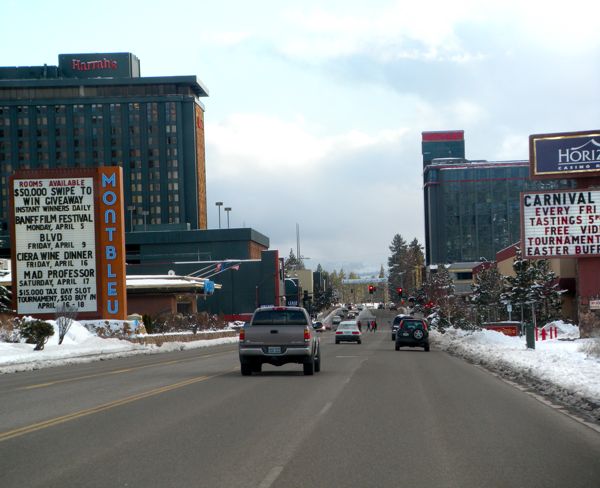
The room tax at Stateline casinos may go from 10 to 13 percent in June. Photo/Kathryn Reed

The room tax at Stateline casinos may go from 10 to 13 percent in June. Photo/Kathryn Reed

“The additional fees collected will bolster Lake Tahoe South Shore’s efforts to stay competitive as a premier vacation destination,” said Carol Chaplin, executive director of Tahoe Douglas and Lake Tahoe visitors’ authorities. “Uses for the increased revenues have yet to be discussed, but should the license fee be implemented, it allows us to look toward the 2011 budget for a more impactful presence in our markets through advertising, online and public relations efforts.”

TDVA board chairman John Packer did not return multiple calls.

“I like the nexus between the tax and the service,” Douglas County Manager Michael Brown said. “If the promotional agencies were not pushing for it, we wouldn’t be doing it.”

Tourism is the largest industry in Douglas County. Officially called the Transient Lodgers License Tax, the fee is assessed on every room in the county including vacation rentals. With fewer people traveling and hoteliers dropping room rates to attract people, the income generated has been declining for the past 10 years.

In 2000-01, just more than $7 million was collected from the room tax. That figure dropped to $5.46 million in 2008-09.

From the 10 percent collected at the lake the division is:

• 1 percent goes to the Tahoe Douglas Visitors Authority;

• 1 percent to the Tahoe Douglas Transportation District;

• 1 percent is split with five-eighths going to the State Economic Development, $75,000 of three-eighths going to the South Shore Lake Tahoe Chamber of Commerce, and the rest of the three-eighths to the Lake Tahoe Visitors Authority;

• 7 percent is split with TDVA getting 65 percent of the 7 percent and the county getting 35 percent.

The threat of the state taking money from local jurisdictions is one reason Douglas officials opted to not have the voters decide the measure. Even if the outcome were to increase TOT, the state would have to sign off on it and could have redirected where the money was spent.

With the county implementing the plan, the state cannot take the money.

In a memo from Brown to the commissioners dated March 24, it says, “The state may impose a 3 percent increase in the TOT rate for all Nevada counties in order to raise funds to help address its financial crisis. In the last legislative session, the state increased the TOT 3 percent to be charged and collected in Washoe and Clark counties. The extra funds collected can be used for a variety of state [not local] purposed until 2011 when the funds will be directed to ‘public education’.”

If the state increases TOT, this would be on top of what Douglas County is proposing.

Plus, the language is being written so tourism agencies at the lake and in the valley get the money and the county can’t change its mind about how to distribute it. This is partly in response to what many say South Lake Tahoe did with the hotel tax collected in the city – it uses the money for things other than marketing the area to tourists even though tourists have paid the tax.

The other benefit is being able to start collections a year earlier than if the state were involved. This equates to a projected $1.36 million.

“Putting these additional funds to work as soon as possible is critical to support our local economy, as well as our park and recreation facility and equipment needs,” Brown said in his report.

A 13 percent room tax is in line with other areas. Reno’s ranges from 12-13.5 percent; South Lake Tahoe is from 10-12 percent, plus the Tourism Improvement District flat rate fee of a few dollars a night; San Francisco is 14 percent; Seattle 16 percent and Houston 17 percent.


Lower Kingsbury Grade aims to improve infrastructure

By Kathryn Reed

MINDEN — A wish list of more than $64 million worth of improvements to the Lower Kingsbury Grade area is circulating among Douglas County officials and property owners.

“It’s a major public policy decision to create a district like this,” Douglas County Manager Michael Brown said. “We would use the tax increment for water quality and transportation improvements.”

With papers scattered about him in his Minden office, all that was missing was a crystal ball to know how the proposed tax increment area might actually transform the Stateline area.

Douglas County Michael Brown talks about the TIA. Photos/Kathryn Reed

Douglas County Manager Michael Brown talks about the TIA. Photos/Kathryn Reed

The TIA has been talked about for close to two years. A decision to go forward or not needs to be made by the commissioners by September to have everything in order for that next fiscal year, 2011-12.

At the April 15 Board of Commissioners meeting county staff will update the elected officials with the proposed list of projects.

The tax increment area is somewhat of a hybrid of what the city of South Lake Tahoe is trying to do with its proposed redevelopment area No. 2 and what Ski Run Boulevard has done with creating a business improvement district.

Besides the TIA, in Nevada a special assessment district could be created. The major difference between a TIA and SAD is funding for the SAD comes from additional fees or charges to properties in the area.

A redevelopment area could also be designated instead of a TIA. Differences include properties in a RDA being able to opt out of the plan, no taxing agencies are exempt and there is more flexibility in what can be funded.

With a TIA, it means Douglas County School District would not be impacted.

The TIA works on tax increment just like redevelopment in South Lake Tahoe. A base line year is established. From then on entities in the plan area that receive a portion of property tax dollars would be locked into that rate for the most part. As property values increase, the increased property taxes that are collected go to the TIA or redevelopment area.

Click on map to see the proposed area outlined in pink.

In the case of Lower Kingsbury Grade, if the TIA were approved, the money would go toward capital improvement and water/environmental quality projects.

“A tax increment area is helping me look at what projects I might do and how the Lower Kingsbury area might change,” Mike Bradford, who runs Lakeside Inn and Casino, said. “It provides some funding for improvements, like sidewalks and particularly for drainage.”

All jurisdictions in the basin must do a certain amount of Environmental Improvement Projects to comply with Tahoe Regional Planning Agency mandates. The TIA could help Douglas County fund its share of those projects.

“It’s something the county, TRPA and property owners have been working on,” TRPA spokesman Dennis Oliver said. “(The TIA) could be used for water quality.”

Some of the proposed projects include stream environmental restoration to Edgewood and Burke creeks as well as improving run-off from area roads.

Overhead wires on Kahle Drive may disappear of the Tax Increment Area is created.

Overhead wires on Kahle Drive may disappear if the Tax Increment Area is created.

Capital improvement projects might include putting overhead utilities underground on Kahle Drive. If Lakeside Inn goes forward with plans to overhaul its hotel and have rooms with a view, it would mean an unobstructed vista over Rabe Meadow if the lines went away.

Improving Kahle Drive would also mean a more inviting entry to Tahoe Beach Club; another planned development that has been stalled by the economy.

Money could also go toward improving the loop road around the Stateline casinos.

The TIA would be for 30 years. The amount collected in that time is unknown. It’s determined by the base year and how fast values go up.

JNA Consulting Group out of Boulder City in Southern Nevada has come up with a few scenarios. They are contingent on when three major developments — Sierra Colina, Edgewood Hotel and Tahoe Beach Club — come onto the tax role. Those properties will be valued higher when construction is complete. That property tax will help fuel a large part of the TIA.

Brown acknowledged that for the TIA now would be a good time to create it because property values are stagnant and therefore as the economy picks up, the tax increment will accordingly. However, he points out, this could be a negative for the rest of Douglas County because it will not reap the benefits of those gains.

He said it is something the commissioners have been discussing. Commissioner Nancy McDermid, who has been a proponent of the TIA, did not return phone calls or emails.


Former Zephyr Cove priest’s lawsuit tossed

By Martha Bellisle, Reno Gazette-Journal

A Washoe District Court judge has thrown out a lawsuit filed by a Catholic priest who claimed the Diocese of Reno and its bishop defamed and wrongly fired him after he raised concerns about a deacon and alleged death threats.

In his order, Judge Patrick Flanagan granted the diocese’s motion to dismiss the case filed by Richard DeMolen, the former pastor of Our Lady of Lake Tahoe church in Zephyr Cove, saying the First Amendment prevents a court from becoming involved in a contractual dispute involving a religious organization.

Jeffrey Dickerson, DeMolen’s lawyer, said they plan to appeal the ruling.

Read the whole story


Barton closes Carson Valley thrift store

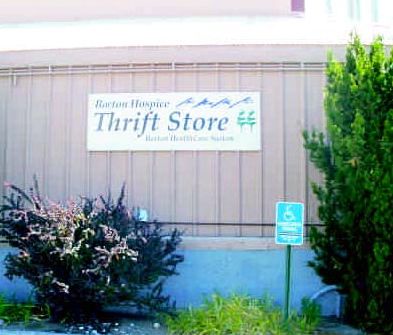
Hospice Thrift signThe Barton Hospice Thrift Store in Minden closed Thursday.

The Highway 395 store was not profitable.

The store in South Lake Tahoe remains open.

A final sale will be April 17 from 8am-5pm. One standard grocery bag filled to the brim will cost $2.50. There is a limit of five bags per person. All proceeds will benefit the American Cancer Society’s “Relay for Life.”

People who donated items to the Hospice Thrift Store may donate to FISH (Friends in Service Helping) at 1231 Service Drive in Gardnerville; Advocates Thrift Store at 411 Hot Springs Road in Carson City; or Helping Hands Thrift Store at 1418 Industrial Way in Gardnerville.

The 4,200-square-foot building will remain office space for Valley Home Health & Hospice personnel, plus consolidated storage space.


Gaming win good in Nevada, but not in Stateline

By Bill O’Driscoll, Reno Gazette-Journal

The streak is over. It wasn’t much, but after 31 months of declining gaming revenues, Washoe County reversed course in February.

The Gaming Control Board’s February report today showed a small 2.73 percent rise from February 2009 across the region.

Statewide, gaming revenues improved 13.9 percent on the strength of a 32.9 percent spike on the Las Vegas Strip, which by itself generates more than one-half of the entire state total.

Read the whole story


SLT council can’t even agree on firm to find city manager

City Seal-Colored_RGBBy Kathryn Reed

Along familiar lines, it was a 3-2 vote by the South Lake Tahoe City Council to pick the firm to handle the search for the next city manager.

With Dave Jinkens calling it quits when his contract expires in August, the council needs someone to replace him. The group had previously agreed to spend no more than $15,000 to hire a headhunter to whittle the applicants to a manageable pool.

Two firms made presentations Tuesday, with Bob Murray & Associates wining out over Peckham/McKenney.

Councilmen Jerry Birdwell and Bill Crawford cast the dissenting votes.

“I don’t think we interviewed enough people. I didn’t see the necessity to rush in (to a contract),” Birdwell said.

He would have preferred having time to digest what the candidates said instead of making a decision on the spot.

Crawford is less than thrilled with the job Murray has done in the past. Murray brought Jinkens and former City Manager Dave Childs to the forefront for consideration.

“Murray is too slick,” Crawford said.

During his presentation Murray said he would try to meet that day’s deadline for the May issue of “Western Cities” trade publication to get an ad out for the city manager job.

Crawford questions the need to have someone else do it when the city handled the ad in the same publication when it sought two city attorneys without the assistance of a headhunter.

Murray said it’s possible the council could be interviewing candidates in 90 days, with someone seated a month later.


Red Hawk Casino lawsuit not dimissed by state Supreme Court

By Dale Kasler, Sacramento Bee

Long before it opened Red Hawk Casino, the Shingle Springs Band of Miwok Indians ran a small gambling hall in a tent-like structure off Highway 50.

The tribe’s Crystal Mountain Casino operated just briefly and intermittently – but generated a $107 million lawsuit that continues to hound the Miwoks. Last week the California Supreme Court refused the tribe’s appeal to dismiss the suit, and the case could go to trial this fall.

The suit was filed by Sharp Image Gaming, a Southern California supplier of gambling devices and the Miwoks’ partner in the tent casino. The company argues that the tribe broke its contract with Sharp Image by teaming up with Lakes Entertainment Inc., the Minnesota casino-management firm that opened Red Hawk in late 2008.

Read the whole story


No Saturday mail delivery inches closer to reality

bijouBy Kathryn Reed

If officials keep moving in the direction they are headed, Saturday home delivery mail service may not exist this time next year.

The U.S. Postal Service is projecting a $238 billion deficit for the next decade.

Eliminating Saturday service would also mean 49,000 full- and part-time jobs would be axed. More than half are likely to evaporate through attrition.

In South Lake Tahoe there are 14 rural routes. Some of the carriers work six days a week, while others rotate the sixth day. They are paid based on the volume of mail and the number of customers.

The most amount of mail is delivered on Mondays, while Tuesdays have the least volume. The average U.S. mailbox receives four pieces of mail a day. Officials say that number will drop to three in 10 years. Mail volume was down 12.7 percent in 2009.

The Postal Service says it makes $1.40 for each delivery. That figure will drop to $1 by 2020, according the USPS. The agency if funded entirely by its own revenue and receives zero taxpayer dollars.

Going from six to five days a week is projected to save $3.3 billion the first year and $5.1 billion a year starting in 2020.

South Lake Tahoe Postmaster Toni Passot said she isn’t sure how cutting Saturday delivery would affect the employees she oversees or workers throughout the Lake Tahoe Basin.

“The rural carriers still need to negotiate through their unions,” Passot said. “The retail would still be open (Saturdays).”

People with post office boxes would continue to get mail on Saturdays, too.

The Postal Service board of governors approved the cuts this spring. Now it’s up to the Postal Regulatory Commission to take action. Congress has the ultimate authority to change the number of days people receive mail even though the USPS is an independent government agency.

“Mostly residential customers would be affected. Most businesses in South Lake Tahoe don’t get mail Saturday because the business is closed,” Passot said.

She has not heard any feedback from customers about the potential changes.

The change, is approved, is slated to begin early next year.

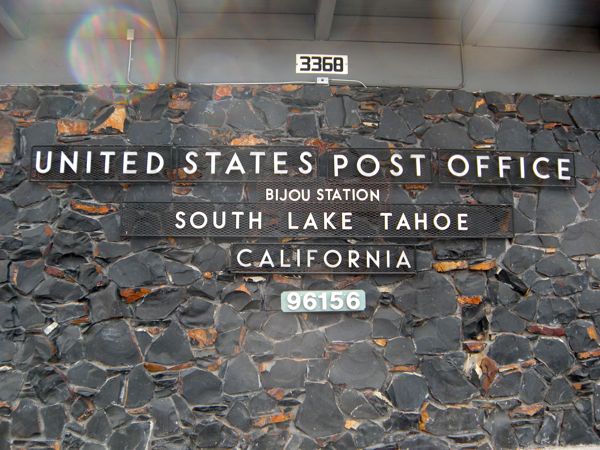
Locally, the status of the Bijou Post Office remains up in the air. A decision is expected this month as to whether it will be closed. The Postal Service owns the building for the main office in South Lake Tahoe. It leases the buildings for the outlying offices.