Feeding nuisance bears may be a good idea

By Lia Kvatum, National Geographic News

It flies in the face of conventional wisdom, but one solution to control nuisance black bears in the United States may be to offer them snacks, one biologist says.

Especially in the western United States, black bears will often break into cars, homes, and campsites in search of food. And as humans increasingly move into bears’ habitats, more bear-human interactions have been occurring, experts say.

Many scientists say feeding black bears makes the animals more aggressive, in part because the animals come to see people as food sources. But black bear biologist Lynn Rogers thinks 
it may not be so clear-cut. Instead, hunger is largely to
 blame for so-called nuisance behaviors, he said.

Read the whole story


Ex-STHS security guard enters plea

Larry Brown, the former South Tahoe High School security guard accused of providing marijuana to a minor, pleaded not guilty Friday during his arraignment in El Dorado County Superior Court.

Brown, 63, was charged with one felony count and two misdemeanor counts related to his arrest in November involving marijuana and a 16-year-old female student.

Brown was arrested Nov. 6 during a routine traffic stop in South Lake Tahoe after El Dorado County sheriff’s deputies said they smelled marijuana coming from the vehicle.


STPUD to vote on budget after rate hike is settled

stpudBy Claire Fortier

How could the South Tahoe Public Utilities District justify a 4 percent increase when the economy of South Lake Tahoe has flat lined?

That was the question asked by a half dozen people who addressed the STPUD board during its public hearing Thursday night. The board answered by directing STPUD staff to present a budget based on a hike of just 2 percent at its May 20 meeting at 2pm.

About 30 people filled the utility district’s board room for more than two hours.

“We need to be active about replacing our water and our sewer line, but this is not the right time for a 4 percent increase,” board Chairman Dale Rise said. “Cutting that hike down the middle will give staff the tools they need to do their jobs without severely impacting our ratepayers.”

The board’s decision to reduce the rate hike was as much a shout out to STPUD’s staff, which found more than $8 million in grant funding and $19.6 million in low interest state loans to cover critical capital improvement costs, as it was to the public’s outcry over rising rates.

“Can you justify 4 percent? Yes,” Ken Curtzwiler, a candidate last year for the STPUD board, told the elected officials. “But is it the right thing to do? Overall, the rate increase is not much compared to other people around the lake who are paying as much as 77 percent more. But when the entire community is down 15 percent, how can you justify going up at all?”

Driving the rate hikes is an extensive $136 million, 10-year capital improvement program that is top heavy with projects in the first two years. Many of those projects are being paid out of federal stimulus funds.

Topping the list for STPUD is replacing the Headworks, the 1950’s structure through which all the district’s wastewater flows. “This structure is in bad shape and deteriorating rapidly,” said Paul Sciuto, STPUD’s assistant general manager.

Replacing and maintaining the district’s 336 miles of pipelines inside the Tahoe basin and the 26 miles of export line outside the basin, as well as the 44 pumping stations is a “massive investment of infrastructure,” Sciuto said. Almost 150,000 feet of line within the basin is undersized and must be replaced for adequate fire protection. Another 180,000 feet of recently replaced pipe may have to be redone if a whistle-blower prevails in a national lawsuit over bad PVC pipe.

“If we had used the industry rule of thumb,” board member Jim Jones, “we should have increased our revenues $16 (million) to $32 million a year. We are only putting in about one-third of what we should be.”

In addition to federal stimulus money, STPUD has benefited from lower contractor bids on major projects and internal cost-cutting measures.

None of the additional revenue generated by a rate hike will go toward staff salaries or benefits. And the district anticipates no additional staffing for five years.

Despite no increase in salaries or benefits for staff in the immediate future, several members of the audience called for staff cuts or furloughs.

“Four percent, it’s not much, but it’s a lot to me and many others in this community,” Jake Jacobs said. “I have taken a major hit to my income. Maybe it’s time the employees in the district share that pain as well.”

Rise said, “The way our contracts are with our staff, there is a zero percent increase. But no increase in rates in not the right and prudent thing to do because we need to maintain our water and sewer lines. It will be much more expensive down the road if we do nothing now.”

Jonnie Crawford questioned whether it’s possible to wait on some of these projects until the economy starts to improve.

Board member Eric Shafer pointed out that with the stimulus money if it’s not spent now, the money is lost.

Much of the money STPUD receives from the state and federal governments requires matching dollars from the district.

More than one person pointed out that if the infrastructure is not fixed now, it will cost more down the line.


Stateline man part of California AG’s fraud lawsuit

By Jim Wasserman and Dale Kasler, Sacramento Bee

California officials filed a fraud suit against the former chief executive of CalPERS and his close friend, a former pension fund board member turned placement agent, in an explosive new twist in the influence-peddling scandal that’s been simmering at CalPERS for months.

The lawsuit by Attorney General Jerry Brown says former CalPERS CEO Fred Buenrostro accepted thousands of dollars worth of gifts from Alfred Villalobos, a former CalPERS board member who has earned tens of millions of dollars as a placement agent. These agents are hired by private equity firms to obtain investments from public pension funds such as the California Public Employees’ Retirement System.

Among other things, the suit says Villalobos “substantially subsidized” the cost of Buenrostro’s 2004 wedding at Villalobos’ Lake Tahoe mansion – an incident first reported by The Bee last fall. Buenrostro has said he reimbursed his host.

Read the whole story


Cohee’s new resort to partner with Sierra Nevada College

Sierra Nevada College at Lake Tahoe, home to the West’s only four-year degree in Ski Business and Resort Management, is opening its Center for Ski Business Studies at China Peak Mountain Resort.

This program is made possible due to the unique relationship between Tim Cohee, program director for SBRM at the college, and China Peak Mountain Resort, which Cohee purchased in April.

Cohee has been a senior executive at a number of the nation’s leading mountain resorts for more than 30 years, including 13 as president, general manager and chief operating officer of Kirkwood Mountain Resort. China Peak was the resort’s original name until 1982, when it was purchased and renamed Sierra Summit. Cohee has changed the name back effective this month.

The first group of ski business majors will intern at the resort beginning Dec. 12; one of four one-week internships offered.

“I am tremendously excited to be able to offer our top students in the SBRM program the ability to get inside resort operations for an entire week without distraction,” Cohee said in a statement. “Not only will they experience firsthand how resorts operate across a variety of departments, they’ll begin to develop a sense of which area of the resort interests them most, which will point them in the right direction after graduation. It will also help them focus on seasonal resort jobs that best match their passion while they are in school.”

The new Center for Ski Business Studies will offer 10 students at a time a choice of four one-week sessions. Students will arrive at the resort Sunday evening, stay at the resort hotel, and select five departments (out of 15) in which to spend one full day, including hotel, food & beverage, lift maintenance and operations, vehicles, marketing, accounting, human resources, ski patrol, and much more.

For more information, contact Tim Cohee at (775) 831.1314, ext. 7480, or tcohee@sierranevada.edu.


LT Airport issues a symptom of lousy economy in basin

By Kathryn Reed

As the economy sputters, a new phrase could be coined – fly and dash.

Lake Tahoe Airport has seen an increase in the number of pilots gassing up without paying, as well as shunning the landing fees.

“I attribute it to the economy,” Michael Golden, who operates Mountain West Aviation, told Lake Tahoe News.
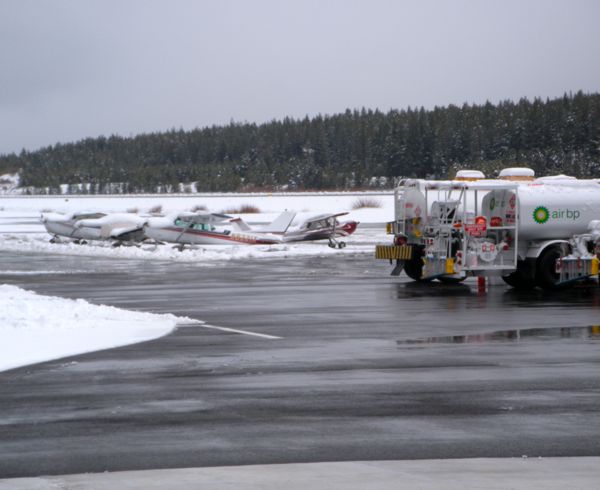
Lake Tahoe Airport is losing money with pilots not paying for fuel. Photo/Kathryn Reed

Lake Tahoe Airport is losing money with pilots not paying for fuel. Photo/Kathryn Reed

At the Airport Commission meeting in April, Golden talked a bit about what is going on with payments. He did not provide Lake Tahoe News a figure for how much his business and the city have lost because of people not paying their bills.

Because the South Lake Tahoe airport is not set up for a pilot to swipe a credit card payment is not immediate for gas. Mountain West Aviation fuel trucks go to the plane and fill it up. Often times a pilot orders the gas the day they arrive, then don’t pay when they leave a couple days later.

“We can’t call the police and have them chase them. They are in the air,” Golden told LTN days after the meeting.

However, the airport could track a pilot down by the tail number and have the FAA get involved as well as put a lien on the plane. The tail number could be used to find out where the plane landed, too. Tracking down the pilot is not the course the city is currently taking.

One pilot told Lake Tahoe News that fuel is the cheapest part of flying.

Even though pilots have to go from the tarmac through the Mountain West building they are walking by without paying and the employees are not able to get them to do so.

The same goes with paying the landing fee – which is about $30 for a turbo prop and can be $200 for a larger multi-million dollar airplane.

Golden’s employees are responsible for collecting the fees and then giving them to the city. In fiscal year 2008-09 the airport collected $39,180.11 in landing fees. For the first seven months of this fiscal year $11,890.31 in landing fees has been paid.

Lake Tahoe Airport is the only airport in the region – including Reno and Sacramento – to charge a landing fee. No general aviation airport in the Bay Area charges a landing fee, Golden said.

Golden said the non-payers represent a cross-section of pilots, though primarily it’s the mid-size, business-oriented flyer not paying.

He said the airport traffic was steady all winter, with numbers of landings increasing. More charter flights came in because the weather was fine for them, but not for smaller planes with different visual regulations.

“If you take the airport out of the equation, you remove a couple hundred thousand visits to the basin,” Golden said.

South Lake Tahoe Finance Director Christine Vuletich discussed nothing about the airport’s situation at the April 27 mid-year budget review with the City Council.

The city’s expenses are exceeding its revenues, which required the council to trim $1.47 million from the general fund budget. To cover expenses, the council tapped into four reserve accounts and deferred payment from the Redevelopment Agency to the city – despite they are all city accounts and taxpayer money. The RDA is still paying the general fund account the $7.2 million it raided unknowingly from taxpayers to complete the Heavenly Village project.

For the second year in a row Vuletich and her well-staffed department have been wrong about how much hotel tax would be collected. This, along with property and sales tax are the three major revenue sources for South Lake Tahoe.

Transient occupancy tax is off by 8 percent from projections or $135,770; sales tax is off by 9 percent or $235,336.

In the redevelopment area, which has a higher TOT, the hotel tax is 10 percent less than budgeted and property tax increment is 1 percent higher than anticipated.

The 911 fee of $540,000 is still at-risk. (Click here to read more about that.) The council has yet to be briefed on the situation by the city attorney.

Another blow came Tuesday when a Sacramento Superior Court judge ruled the state can take $2 billion from local redevelopment agencies. This will be a more than $2 million hit to South Lake Tahoe’s bottom line; something that was not addressed with the city’s mid-year budget revision.

The council approved the revised budget on a 5-0 vote. But it was noted the actions taken are one-time solutions to an ongoing problem. The council did not rule out putting more people on the unemployment lines. The unemployment rate in South Lake Tahoe is 17.7 percent.


Talk of fire prevention fee for water users

By Gary Thomson, Auburn Journal

Could Placer County Water Agency users soon be paying an extra charge on their bills for clearing brush and protecting the upstream watershed against fire and erosion?

It’s a question that the Tahoe National Forest’s top ranger gave an opportunity for leaders of government and private industry to ponder during a workshop on the watershed in Auburn.

Forest Supervisor Tom Quinn told a gathering of about 120 people in Auburn on Thursday that the U.S. Forest Service view of water as a “non-market resource” has shifted.

There’s a new move toward considering non-traditional values that can be attached to watershed – from its role as a wildlife habitat to its impact on climate change to providing water for a plethora of downstream users, Quinn said.

Read the whole story


Melting snowpack causing rivers to rise

By Gus Thomson, Auburn Journal

For 22 years, Bowman’s Bonnie Lightner has been enjoying a front-row seat from her home overlooking the North Fork American River to the ebbs and flows of the Sierra snowmelt.

This past week things turned sensational.

With the spring snow melt and rains continuing, Lightner watched as the water that continually spills over the Lake Clementine-North Fork dam began to flow more heavily. She judges by how many “dividers” at the top of the dam are obscured by the water and by Wednesday morning, the water was all the way across.

That’s a rare occasion, Lightner said, and indicative of the amount of water now pouring downstream from the mountains.

Read the whole story


Most of South Tahoe now deemed a redevelopment area

By Kathryn Reed

In less than an hour and with a split vote, the South Lake Tahoe City Council on Tuesday declared 20 percent of the city blighted in order to create a redevelopment area that encompasses 3,100 acres.

State law requires an area be deemed blighted before creating a redevelopment area. With the latest area encompassing most of the Y to Herbert Street, it means the majority of town is blighted because most of the parcels from Ski Run Boulevard to the state line are in a redevelopment area.

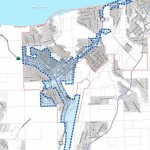
The redevelopment area is in blue.

The redevelopment area is in blue.

It was a 3-1-1 vote, with Councilman Bill Crawford voting no and Councilman Hal Cole recusing himself because he owns property in the area. Even though Councilman Bruce Grego’s law office is in the area, he can vote because he is on a month-to-month lease with his landlord.

Crawford took issue with approving the environmental documents, questioning how a negative declaration can be determined without knowing the projects that might be brought forward. He also has issues with calling the whole town blighted.

Since the April redevelopment meeting, a flurry of letters and emails have been sent back and forth between the city and its two major opponents – South Tahoe Public Utility District and El Dorado County. Those entities believe they will be shortchanged on property tax dollars when the tax increment becomes effective.

The county asked the city to delay the decision. The city believes the county has had ample time to voice its concerns, including at a two-hour meeting where the city presented its position to the Board of Supervisors.

The property tax these entities receive is frozen instead of going up 2 percent each year. The city’s Redevelopment Agency gets that money.

South Lake Tahoe believes it will generate $178 million in tax increment in the 45 years the project will be on the books.

The issue was brought back to the council because in April the panel voted to shrink the area. The Planning Commission put the kibosh on that idea, though the council has the ultimate authority. The council reversed course from last month to include the entire area except for the handful of parcels the county says are theirs.

“This is an important day for our community,” Mayor Kathay Lovell said. “(This is) so we can rebuild our tired little town.”

Councilman Jerry Birdwell asked city staff for the May 18 meeting to come up with ways to show the public how redevelopment can work and to possibly assist areas like the Y and Harrison Avenue with developing business improvement districts like his street — Ski Run Boulevard — has done.

The other item on the agenda Tuesday was to review the annual report for the Ski Run BID and keep it going for another year. Birdwell and Cole recused themselves from the vote. Crawford abstained even though he didn’t make any comments about the issue.

City Attorney Patrick Enright said the vote was sufficient for the matter before the council, but added three votes would be needed for approval of any matter in the future that involves spending money.


El Dorado, Placer ranked high in 2008 income

By Darrell Smith, Sacramento Bee

Median incomes for El Dorado and Placer county residents were among the highest in the state in 2008 and median incomes for that year rose in Sacramento and Yolo counties, according to figures released last week.

But the nation’s economic crisis took its toll statewide as total adjusted gross income fell to $1.13 trillion, according to the state’s Franchise Tax Board, a 7.2 percent decrease from 2007.

“It’s clearly tied to the declines we saw in the stock market,” said H.D. Parker, a deputy director at the state Department of Finance.

Read the whole story