Witness dies before trial of 1989 South Tahoe teen’s killing

By Deborah Circelli, News Journal

DAYTONA BEACH — A former local investigator for the state Department of Children & Families who was a key witness in an ongoing serial-murder case has died.

Cheryl Rose, 52, was found dead in her home in Ocala on Tuesday, according to the Marion County Sheriff’s Office.

She had several medical issues and was prescribed numerous medications, and the Sheriff’s Office is awaiting toxicology results to determine whether she could have died from an overdose, according to Detective Ryan Robbins.

Rose, who was an investigator in Daytona Beach for five years before being fired for poor conduct in April 2009, was the key witness in a trial in California against her ex-husband, Joseph Nissensohn, involving the 1989 murder of a 15-year-old South Lake Tahoe girl. The trial was set for January. He is also charged with murdering two other teens in 1981, before he met Rose, a prosecutor said.

Read the whole story


Trash bin laws to deter bears not uniform in region

By Jeff Delong, Reno Gazette-Journal

Bear season is approaching its peak, and Washoe County will let another summer pass without a law controlling management of the trash responsible for worsening human-bear conflicts.

trash binWhile a showcase ordinance does control how people handle their garbage at Lake Tahoe’s Incline Village — nothing is on the books for many other bear-prone places in Washoe County, including Verdi, Washoe Valley, Sky Tavern, Galena and Caughlin Ranch.

“The lack of an ordinance in Washoe County is an exasperating problem,” said Carl Lackey, a biologist and bear expert with the Nevada Department of Wildlife.

“They’re not helping the situation at all, they’re really not,” Lackey said. “They need to deal with it.”

Read the whole story


Mosquito abatement at Tahoe to start next week

El Dorado County Vector Control will begin its adulticiding control program for mosquitoes next week. This program involves fogging selected areas around South Lake Tahoe and the West Shore to reduce populations of adult mosquitoes.

These areas will be fogged early in the morning or in the evenings when wind conditions are at an optimum. The ground fogging will be done with truck mounted or ATV mounted sprayers.

The Environmental Management Department urges the public to take precautions to prevent West Nile virus.

“Prevention strategies include draining all sources of standing water and reporting dead birds and tree squirrels to the State West Nile Virus hotline,” Virginia Huber, division manager, said in a press release.

Birds are reservoirs for West Nile virus. Mosquitoes transmit the virus by biting an infected bird and then biting a person. Dead bird reports are the most sensitive and earliest indicator of West Nile virus transmission and can be reported to the State hotline at 877.968.2473 or online at www.westnile.ca.gov.

Huber recommends the following tips to prevent West Nile virus:

Drain standing water that may produce mosquitoes.

Dawn and Dusk are times to avoid being outdoors when mosquitoes are most active.

Dress appropriately by wearing long sleeves and pants when outside.

Door and window screens should be in good working condition.

Defend yourself by using an effective insect repellent. Make sure to follow label instructions!

For more information about WNV, visit the following websites: www.edcgov.us/emd or www.westnile.ca.gov. Information is also available on the El Dorado County West Nile Virus Hotline (530) 573.3405.


Killing of wrong bear led to creation of advocacy group

By Jeff Delong, Reno Gazette-Journal

It started with paw prints that didn’t match a guilty party.

It was back in 1998 when a trapper hired by the California Department of Fish and Game shot and killed a mother bear and her cub after a bear tore through a cellar door on Lake Tahoe’s west shore in search of food.

Ann Bryant founded the BEAR League. Photo/BEAR League

Ann Bryant founded the BEAR League. Photo/BEAR League

But the wrong bear was shot, residents of the Homewood area argued, insisting state wildlife officials were far too bloodthirsty when it came to policy concerning Tahoe’s bears.

“It was utter chaos. The local people were completely incensed,” said Ann Bryant, an area resident. “It was a crime against nature and we all took it that way.”

Read the whole story


DUI checkpoint in South Tahoe on July 12

The South Lake Tahoe Police Department will be conducting a DUI/driver’s License checkpoint on July 12 from 8pm to 1:30am along Lake Tahoe Boulevard and Pioneer Trail.

The department is continuing its efforts at lowering the number of people killed and injured in alcohol involved crashes locally and through the county’s Avoid DUI Task Force Campaign with this DUI/driver’s License checkpoint.

Personnel will be checking drivers to identify offenders and get them off the street, as well as heightening awareness to the dangers of impaired driving.

“We have already had an impact on traffic collisions with our extra enforcement efforts over the 4th of July weekend. Crashes were down in the city from seven injury collisions last year during the same tire period to just three this past weekend,” Sgt. Shannon Laney said.

In 2008, law enforcement statewide reported that 7,801 people were injured or killed during the three summer months of June, July and August.

A major component of the checkpoints, beyond taking dangerous drivers off the road, is to increase awareness of the consequences of impaired driving and to encourage using sober designated drivers. A DUI checkpoint is a proven effective method for achieving this goal, according to officers.

By publicizing these enforcement and education efforts, the South Lake Tahoe Police Department believes motorists are deterred from drinking and driving.


Fire summit sizzles with info, fizzles with attendance

By Austin Fay

STATELINE — Every tax paying homeowner in the Lake Tahoe Basin was sent a postcard notifying him or her of Friday’s fire symposium. From the approximately 40,000 postcards that were sent, about 10 homeowners showed up at Harveys.

The symposium of fire chiefs, decision-makers, land managers, and homeowners was part of the larger inaugural weeklong Living With Fire program.

The U.S. Bureau of Land Management, Nevada Association of Counties, Nevada Division of Forestry, Nevada Insurance Council, Nevada Fire Safe Council, Sierra Front Wildfire Cooperators, the University of Nevada Cooperative Extension, and U.S. Forest Service all sponsored the program.

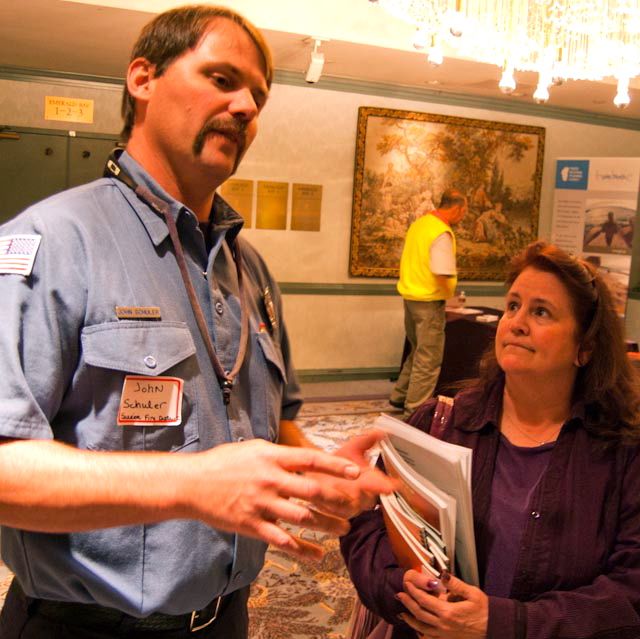
John Schuler, a defensible space inspector at the Sierra Fire Protection District in Washoe County, educates Petra Schuler, a South Shore homeowner. Photo/Austin Fay

John Schuler, a defensible space inspector at the Sierra Fire Protection District in Washoe County, educates Petra Schuler, a South Shore homeowner. Photo/Austin Fay

For a number of years Nevada has had a similar summit in May, but it has never been well attended by people in the basin. Having it this week in July was intended to draw second homeowners who may have been in town for the holiday week.

Speakers came from both sides of the state line. Kit Bailey, fire chief for the local Forest Service office, talked about wildland fires and how they affect homeowners in the Lake Tahoe Basin. Mike Vollmer of the Tahoe Regional Planning Agency gave an informative talk on what qualifies as defensible space as well as how to defend one’s home against fires.

A panel of homeowners — Paula Lambdin, Leona Allen, and Warren Berg — shared stories and told of the precautions they took during the 2007 Angora Fire, all of them emphasizing the effectiveness of having a defensible space. Lambdin and Allen lost their houses along with 252 other homeowners, but Berg’s was spared as he had protected his home by implementing defensible space recommendations.

There were also breakout sessions Friday where the few homeowners in attendance could meet with their division fire chief and learn details of the specific precautions their fire district has taken, as well as what homeowners can do to prepare in the event of a fire. Many fire districts hold smaller community events designed to educate the homeowners in their district, but this is the first time a basin-wide event has taken place.

Some of the measures included: creating a defensible space, replacing wooden roofs, joining a fire chapter, removing juniper bushes below windows, moving firewood stacks from structures, educating oneself and spreading knowledge throughout the community.

Things that homeowners could do were cited along with the reasons why homeowners don’t take steps to protect themselves. According to officials, the top six reasons why homeowners don’t implement defensible space are:

• Liking the trees and vegetation

• Cost

• Time

• Agency rules

• Loss of privacy

• Erosion concerns.

“We have a good fire department, but chances are any fire that comes through there, it will burn every lot,” Marilyn McDonald, a Fallen Leaf Lake resident, said.

The area where McDonald lives is currently being considered in the South Shore Fuel Reduction Project by the Forest Service. The review is expected to be published later this fall as to whether it is a priority for fuel reduction.

There is also a stewardship program for lots in the basin neighboring Forest Service land that allows for homeowners to remove brush, surface fuels and ladder fuels up to 100 feet from the house. The only precautionary measure not directly allowed is cutting trees. To a degree, and with a permit from the Forest Service, homeowners can maintain the tree growth around their homes.

Tahoe Regional Planning Agency changed its parameters for do-it-yourself defensible space preparation after the Angora Fire. Citizens can go in and do much of the defensible space preparation themselves. A tree 14 inches or less in diameter at breast height that is not in a stream area or has other restrictions can be cut by a resident without a permit.

South Lake Tahoe Fire Chief Lorenzo Gigliotti spoke about the Federal Emergency Management Agency grant the city is eligible for. Seven months ago, his department applied for a pre-hazard mitigation grant from FEMA to help pay for replacing the wooden roofs in South Lake Tahoe. After a screening of the nearly 9,500 single-family homes in South Lake Tahoe, 1,308 were found to have wooden roofs. The grant, if the district receives it, would pay for about 75 percent of the total replacement costs to go to a fire-resistant roof.

Tom Rosenberg, a full-time South Shore resident and homeowner, came because he was interested in fuel reduction initiatives.

“The turnout was disappointing to me,” Rosenberg said. “It’s up to us to do it ourselves. And at this point the regulations are very gentle.” Meaning there aren’t a lot of sticks, but there are a lot of carrots to create incentives for homeowners to educate and protect themselves against fire, he added.

Jessica Mencken of the Nevada Fire Safe Council had much to say about the low attendance.

“Getting people informed about events like this is the most frustrating part of my job,” Mencken said. “Nobody cares until, ‘oh no, it’s in my backyard’ and now, three years later, people don’t care. You get 10 people.”

But the publisher of Lake Tahoe News, a tax paying homeowner in the basin, never received one of the postcards that were supposedly sent. So the outreach is questionable.

Chief John Pang of Meeks Bay Fire Department said, “The first year you put on an event like this, you’re going to have a slow turnout, you’re asking people to come indoors for an entire day and for our second homeowners, it’s really difficult.”

In contrast, 1,100 people turned out for the Meeks Bay Fire Department’s 42nd pancake breakfast last weekend, where they had access to much of the information presented at the symposium.

“Unfortunately, if we had a fire last week, this place would be packed,” Pang said.



Dirty air may affect water quality, drought conditions

By Susanne Rust, California Watch

Dirty air may not just affect your lungs.

It could affect your tap, too.

Scientists at the Desert Research Institute, a division of the Nevada System of Higher Education, say polluted air can cut a storm’s snowfall in half.

Randy Borys, co-author of the study and director of the institute’s Storm Peak Laboratory in Steamboat Springs, Colo., said pollutants aren’t creating drought – they are just making it worse.

What’s happening is that pollutants, such as sulfate, nitrate or other compounds, attract tiny droplets of moisture in the atmosphere.

Read the whole story


DCSD ready to hire Whittell principal

By Kathryn Reed

Douglas County School District trustees at their Tuesday meeting are expected to hire a principal for Whittell High School.

Crespin Esquivel, an assistant principal at Hug High in Reno, has been chosen for the job. He has had that position since 2005.

All of Esquivel’s experience is in Washoe County, either as a teacher, dean or Hispanic liaison specialist.

He earned his bachelor’s from UNR and master’s from University of Phoenix.

Esquivel replaces Sue Shannon who retired at end of the school year.

The school board meeting is at Douglas High School in Minden on July 13 at 3:30pm.


Tahoe bear-human encounters on the rise

By Jeff Delong, Reno Gazette-Journal

People and bears have grown a little too close for comfort in the Reno-Tahoe area, a situation increasingly dangerous for both.

Behavior and physical characteristics of bears living near urban areas are altered.

A bear in a South Shore neighborhood in fall 2009. Photo/Janice Eastburn

A bear in a South Shore neighborhood in fall 2009. Photo/Janice Eastburn

They’re bigger — sometimes much bigger. Many skip winter naps.

They reproduce early and often. They die young. And every year, aggressive black bears smash their way into homes and cars in food-hunting burglaries that can put them in dangerous proximity to people.

Some experts question if these are still truly bears.

Read the whole story


Talk of redevelopment suit percolates at STPUD, county

stpudBy Kathryn Reed

“We have filed a letter that reserves the right to file suit.”

That is Dennis Cocking, spokesman for South Tahoe Public Utility District, talking about his agency’s actions regarding South Lake Tahoe’s latest redevelopment area.

Neither the utility district nor El Dorado County is happy with the city’s decision to create a redevelopment area that encompasses most of the town – going from the airport, to the Y, to Herbert Street. It’s 3,100 acres.

For the state to recognize a redevelopment area the parcels must be deemed blighted. The county has taken issue with the massive swath of land the city says falls into blight.

A recent appellate court decision ruled in favor of Los Angeles County in its quest to stop a redevelopment project in Glendora. This county said sufficient physical blight did not exist. The court agreed.

El Dorado County referenced that case in a letter the Board of Supervisors sent Mayor Kathay Lovell and the rest of the council on July 8. The letter reiterates the concerns the county has regarding blight and that the city may leave the county no choice but to litigate.

It is not known when the county or district will decide how it plans to proceed.

STPUD and city staffs have been discussing concerns since the City Council approved the area in May. The city and county are not talking. If a lawsuit is to be filed by either disgruntled entity, it must be done by mid-August.

“It’s not like you can stop redevelopment forever. You invalidate the current redevelopment area,” Cocking said of what a lawsuit could achieve. “It would force the city to go back and either come up with a smaller area or put a cap on it.

“We would have liked to have been involved sooner, but that ship has sailed.”

City-STPUD work on other issues

Since the city and South Tahoe PUD have been talking, several issues have been resolved in the last six weeks; with some being offshoots of the larger redevelopment squabble.

City Manager Dave Jinkens in a June email to STPUD General Manager Richard Solbrig said in theory he agrees, “… the RDA [Redevelopment Agency] would be responsible for the cost of paving the street should the district decide to upgrade sewer and/or water mains in the street at the same time city RDA work is under way.”

Another key issue being discussed is Lukins Brothers Water District on the west side of town. The small water company that goes from the Y down Emerald Bay Road does not have water lines sufficient to satisfy fire suppression needs. It is a private entity governed by the California Public Utilities Commission, with a franchise agreement with South Lake Tahoe for its nearly 1,000 customers.

At issue is who would own the improvements made to the inferior water district that would be paid for with redevelopment dollars and what happens if STPUD one day buys Lukins.

South Tahoe PUD wrote to the city proposing, “For ownership of improvements made to the Lukins system with public funds, the city would support modifying the CPUC agreement to have the improvements pass to the district for ownership. If the agreement could not be modified, the city would agree to sell any improvements paid by redevelopment funds to the district at a nominal cost in the event the district were to purchase the Lukins system in whole or part.”

The city’s response was, “This proposal needs to be examined and explored further.”

The district would also like to enter into a dual service agreement with Lukins, using the city as the conduit to make it happen. The idea is Lukins could provide domestic water and STPUD could provide fire flow.

Sources told Lake Tahoe News one reason nothing is happening with the dilapidated buildings at the Y where Mikasa and Miller’s Outpost used to be is because no commercial enterprise can get insurance because fire flows are not sufficient. Property owners cannot negotiate a deal directly with STPUD for it to supply the necessary water in case of a fire. But the city could broker a deal between Lukins and STPUD to provide dual service.

A similar agreement exists between STPUD and Lakeside Water District, where the larger company would provide fire flow to the would-be convention center.

Other issues the city and South Tahoe PUD are discussing are irrigation issues at Linear Park, water supply to city entities and the cost involved, and encroachment fees for district construction projects in the city right-of way.