Mixed results for LTUSD in statewide test scores

By Kathryn Reed

Tahoe Valley Elementary School’s falling statewide test scores was in stark contrast to how most of the schools in Lake Tahoe Unified School District performed.

The Academic Performance Index is the measure the state uses to determine how students are doing from one year to the next. Results were released Monday. Overall, the state posted a gain of 13 points.

“While we cannot be satisfied until the achievement gap is eliminated and all students are well-prepared for college and careers, this significant progress should be celebrated,” state Superintendent of Education Jack O’Connell said in a statement.
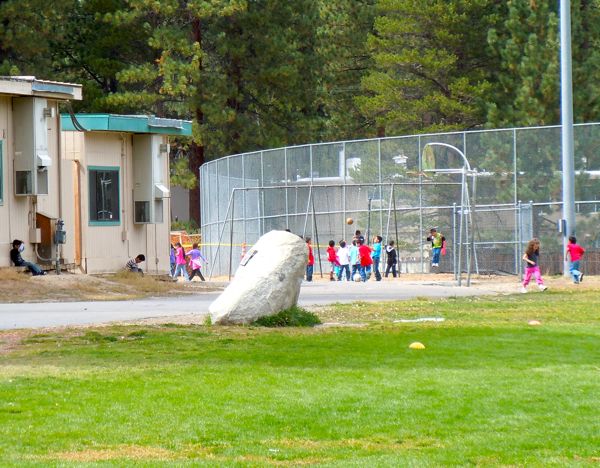
Bijou elementary students exceeded expectation on state test scores.

Bijou elementary students exceeded expectation on state test scores.

The problem with President George W. Bush’s No Child Left Behind policy is that the scores do not compare apples to apples. For example, results for this year’s fourth-graders are compared to the previous year’s fourth-graders, not to how they did as third-graders. President Obama, with his Race to the Top, did not change the accountability factor to make it more relevant.

In LTUSD all but the magnet school is Meyers is considered a performance improvement school. The reason is the subgroups.

The testing treats everyone the same no matter their language ability, primary language or if they are special ed. That is a complaint educators have had with the system since the get-go — it’s not a level playing field.

“We do the same programs across the district,” LTUSD Superintendent Jim Tarwater said.

But the test scores would not indicate this. The environmental school, where Tarwater is also principal, had a score of 919 last year and improved 20 points to 939 with the latest testing.

“It’s not just the wealthy. We have problems like anyone else, though it is pretty homogenous,” Tarwater said of the demographics at the magnet school.

To be PI means year after year not meeting the goal the state sets. The state says 800 points is where all school should be and then sets goals to reach that number.

Tahoe Valley’s scores tumbled from 820 to 788.

“They have to zero-in and find out what the difference was, what happened between classes,” Tarwater said. “The interesting thing is they did exactly what they did last year. They did the monitoring and the intervention.”

LTUSD is not alone in having students in academically challenged schools. Between El Dorado, Placer, Yolo and Sacramento counties there are approximately 94,000 students in PI schools.

A bright spot for LTUSD is Bijou Community School. For the second consecutive year it surpassed the state’s target. It was supposed to improve upon last year’s total of 689 by six points and instead did so by 29 for a score of 718.

“We are excited because that staff for three years has been committed to breaking the 700 mark. So now they are aiming for 800,” Tarwater said.

This fall the district expects to hear from the state if Bijou will continue to be categorized as PI.

Tarwater told Lake Tahoe News the continued improvement at the school has to do with collaboration of teachers, drilling down with students, tracking academic performance on a individual basis to know what students need additional help with, and dedication of staff and administrators.

Sierra House also exceeded expectations. It shot up 14 points to 813 when the goal was a one-point increase.

“Their Latino population made some good growth,” Tarwater said. “One thing I’m excited about at all the school is the numbers in the white population is well in the upper 800s, including Bijou. What you are seeing is language is an issue.”

South Tahoe Middle School’s scores were flat, dropping a point to 792.

South Tahoe High School met its goal – gaining nine points for a score of 759.

Obama’s Race to the Top program, for which states must compete for dollars and California didn’t get any, is going to have the same standards for all students in the academic year 2013-14. Tarwater said the federal standards do not dilute what LTUSD and California are doing.

A complaint often heard from parents, students and educators is the lack of diversity in curriculum. With so much emphasis on language arts and math, other core subjects and a substantive number of electives have been scratched.

The Lake Tahoe Unified board is expected this school year to discuss ways to re-introduce electives, especially at the middle school. The idea is then students will be better prepared for the array of offerings at the high school.

In these economic times and continued state take-aways, LTUSD is unique in California to continue its class-size reduction, music, physical education and sports programs. But the goal is to do even more.


Environmental documents released for SLT General Plan update

The draft environmental impact report for South Lake Tahoe’s General Plan update was released today. People have until Nov. 12 to comment on it.

A public hearing is scheduled for Oct. 14 at 3pm at Lake Tahoe Airport before the Planning Commission. The City Council will take on the issue Nov. 2 at 9am.

Copies of the report are available at 1052 Tata Lane, South Lake Tahoe or call (530) 542.6020.

The existing General Plan was adopted in 1999. The purpose of the document is to act a planning tool for the city for the next 20 years.

— Compiled by Kathryn Reed


Early morning wildland fire near Stateline casinos

Updated: Sept. 13 11:09am.

Firefighters quickly doused a half-acre fire this morning near the Heavenly gondola in South Lake Tahoe.

This area and right behind the Stateline casinos have always been popular illegal camping sites for homeless people. Although fire officials have not determined the exact cause of the blaze, speculation this morning was that the fire could have originated at a homeless camp.

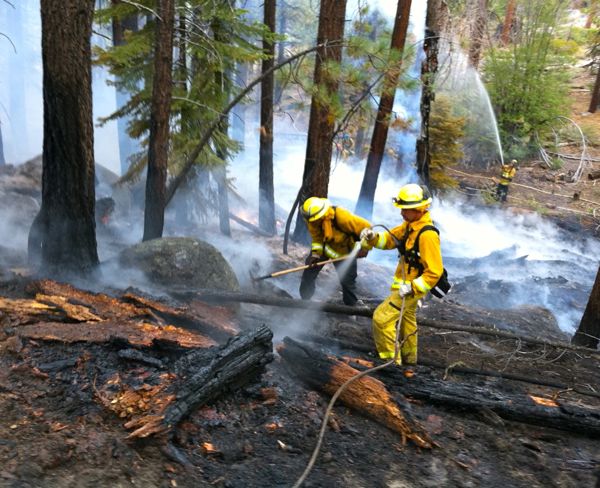
Firefighters extinquish a blaze near the Heavenly gondola Sept. 13. Photo/Taylor Flynn/Tahoe Mountain News

Firefighters extinguish a blaze near the Heavenly gondola Sept. 13. Photo/Taylor Flynn/Tahoe Mountain News

Crews from the U.S. Forest Service, South Lake Tahoe, Lake Valley and CalFire responded to the fire that was reported at 5:47am. It was contained by 7:30am.

“They jumped on it right away. We are fortunate,” said Lisa Herron, Forest Service spokeswoman.

This was the second fire in 12 hours the four agencies responded to.

The first was Sept. 12 at 5:30pm, about a half mile off Al Tahoe Boulevard in the Springmeyer Land Conservancy area. The fire was human caused and burned a 30 foot by 30 foot area of grass and duff.

The Sept. 13 fire was reported by a pilot taking off from Lake Tahoe Airport as being by the gondola tower 6 or 7 at Heavenly Mountain Resort.

“Significant on this fire, was the fire’s activity and the location on the slope. This fire burned with relatively intensity due to the fire’s location adjacent to steep slopes with heavy continuous fuels like trees, dead and alive, as well as, brush,” South Tahoe Division Chief Marty Scheuerman said in a press release. “The primary reasons firefighters were able to contain this fire to just a half acre was the quick aggressive response and the temperatures were in the low 30s and relative humidity was in the 60 percent range.”

Both Fires were human caused and under investigation.

— Compiled by Kathryn Reed


California ranked No. 48, Nevada No. 15 for condition of roads

By David T. Hartgen, Adrian Moore, Ravi K. Karanam and M. Gregory Fields, Reason Foundation

We often hear the nation’s infrastructure is crumbling, but state highway conditions are the best they’ve been in 19 years, according to Reason Foundation’s 19th Annual Highway Report. Unfortunately, the recession is partly responsible for the improvement in road conditions: people are driving less which has helped slow pavement deterioration and reduced traffic congestion and fatalities.

The annual Reason Foundation study measures the condition and cost-effectiveness of state-owned roads in 11 categories, including deficient bridges, urban traffic congestion, fatality rates, pavement condition on urban and rural Interstates and on major rural roads, and the number of unsafe narrow rural lanes. National performance in all of those key areas improved in 2008, the most recent year with complete data available.

Drivers in California, Minnesota, Maryland, Michigan and Connecticut are stuck in the worst traffic. Over 65 percent of all urban Interstates are congested in each of those five states. But nationally, the percentage of urban Interstates that are congested fell below 50 percent for the first time since 2000, when congestion standards were revised.

Motorists in California and Hawaii have to look out for the most potholes on urban Interstates. In those two states, 25 percent of urban interstate pavement is in poor condition. Alaska and Rhode Island have the bumpiest rural pavement, each with about 10 percent in poor condition. However, nationally, pavement conditions on urban Interstates are the best they’ve been since 1993, and rural primary roads are the smoothest they’ve been since 1993 also.

Read the whole story


Horse advocates say BLM sent animals to ‘slaughter buyers’

By Frank X. Mullen Jr., Reno Gazette-Journal

Wild horse advocates are asking the federal government to investigate allegations that the Bureau of Land Management sent 172 Nevada mustangs to an auction attended by “slaughter buyers” in July.

The horses were rounded up by the BLM in the Pilot Creek Valley area near Wendover and auctioned off in Fallon on July 10. By law, federally-protected horses can’t be sold for slaughter, but the agency says the horses sent to the auction were abandoned domestic horses or their offspring, not federally-protected mustangs.

Such “estray” or “feral” horses aren’t covered by the 1971 law that protects established herds of free-roaming mustangs. Federally-protected wild horses can’t be legally sold for food, but estrays can be sold for eventual slaughter in Mexico or Canada, where firms provide horse meat for human and animal consumption.

“I’m disgusted the BLM did what it did with these horses,” said Jill Starr, president of Lifesavers Wild Horse Rescue. Starr bought 169 of the horses at the auction. Six have been adopted and the remainder will be offered for adoption or released in a sanctuary, she said.

Read the whole story


Truck full of ice cream to be hauled from Ebbetts Pass ravine

By Michael Kay, Union Democrat

A towing company will soon remove the wreckage of a semi-trailer truck that fell from a famous curve on Highway 4 into a ravine last month while carrying 40,000 pounds of ice cream and peanut butter chips.

But the rusting Cadillac whose decades-long stay in ravine has given “Cadillac Curve” its name is likely to stay put, as the Stanislaus National Forest does not have the funds to remove it, according to spokesman Jerry Snyder.

The remains of the ice cream may also have to to wait. Leah Knapp, a spokeswoman for Progressive Insurance, which insured the truck, said another company is responsible for cleaning up the ice cream bars and coolers strewn across the wall of the ravine.

Officer Jeff Gartner of the California Highway Patrol’s South Lake Tahoe office estimated hauling out the truck would cost at least $20,000, but possibly much more.

Read the whole story


BlueGo routes changing, audit still not done

By Kathryn Reed

STATELINE — Riders of BlueGo, the South Shore’s bus service that is bankrupt, can expect more route changes as of Oct. 3.

The South Tahoe Area Transit Authority board unanimously agreed to the changes at the Sept. 10 meeting. The South Lake Tahoe City Council will vote on the changes Sept. 14.

Gordon Shaw with LSC consultants once again gave a PowerPoint presentation to the board. The route changes and budget were the focus of his talk.

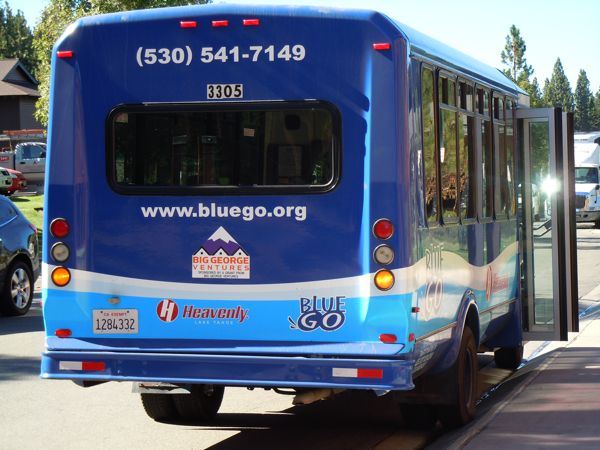
BlueGo routes are being cut to save money.

BlueGo routes are being cut to save money.

Gone is Route 22 – Stateline/Zephyr Cove and Route 40 – Meyers.

Also eliminated are routes 52, 54 and 55. The expansion of routes 50 and 53 are supposed to help lessen the impact on riders who use those three eliminated routes.

“We know we can get to the college at least once an hour,” Shaw told the board.

A survey is going on now to assess what people going to Lake Tahoe Community College would like and to then tweak the route as necessary to accommodate them.

The budget shows $159,893 in surplus for the fiscal year 2010-11. But it also includes $275,000 from El Dorado County even though the county is no longer part of STATA.

Kathay Lovell, mayor of South Lake Tahoe and STATA board member, raised a concern about keeping that money in the budget. Carl Hasty, leader of Tahoe Transportation District which now runs the day-to-day operations for STATA, said he spoke with the county’s counsel Sept. 9 and is confident El Dorado will be a member again.

El Dorado County pulled out in July because of liability issues and lack of confidence regarding financial issues.

STATA still does not have its 2009 audit complete. Even though it was on the agenda Sept. 10, it was not approved. The board gave Dan Garrison, who works for Ridge Tahoe and is treasurer of the board, direction to approve the audit. The board never intends to vote on accepting or rejecting it. Nor does it have to by law.

But a copy of the draft is not being given to anyone. This is not sitting well with at least El Dorado County.

Lake Tahoe News obtained an email between county Auditor-Controller Joe Harn and Russ Nygaard, the county’s deputy director of engineering and facilities, which was cc’d to a number of people, including the whole Board of Supervisors. It’s in response to Hasty telling Nygaard the audit won’t be released until the STATA board gets it.

Harn writes, “Carl Hasty’s position is ridiculous. For a funding agency, like the County of El Dorado not to be able to obtain a copy of STATA’s June 2009 audit is ridiculous. The County and DOT [Department of Transportation] need to consider fully the problems of contracting with agencies located in Nevada. There seems to be great delays in providing the County with basic public records. With the litigation going on with MV Transportation, TTD’s failure to provide us with basic public records is not helpful.”

STATA is a Nevada entity. If it were in California, the draft would be a public document.

Hasty said after the Sept. 10 meeting he expects the final audit to be done next week.

The audit was pulled from an earlier agenda because the Tahoe Regional Planning Agency said it had issues with language in the document. TPRA doesn’t have a voting member on the STATA board.

It was TRPA that brought in John Andoh as the transit administrator. And it was TRPA’s financial ledgers that were used by STATA for a number of years. Without seeing the audit and subsequent revisions, it’s anyone’s guess as to what the numbers show and what changes were made.

The reason this is a big deal is that for the most part this is public money.

The Stateline casinos, Heavenly Mountain Resort, Grace Academy, Ridge Tahoe and Big George Ventures are the private partners.

STATA has filed for bankruptcy. It is also facing a number of lawsuits from MV Transportation, the former operator of BlueGo.

STATA was able to resolve one legal matter at this month’s meeting. In closed session the board voted to accept the settlement with ATM and Andrew Morris, the transit operator before MV took over.

“We were suing them. It mostly had to do with the status of the fleet,” STATA chairwoman Nancy McDermid said after the meeting. She deferred details to STATA attorney Mike McLaughlin. He was not available late Friday.


Sexually transmitted diseases going untreated

By Carrie Peyton Dahlberg, Sacramento Bee

With government budgets pinched, some counties in the Sacramento region are cutting back on finding and treating people with sexually transmitted diseases.

Both Sacramento and El Dorado counties are contacting fewer patients and fewer of their partners than they used to, public health doctors say. That increases the risk that untreated, perhaps unwitting people will infect others.

“The epidemic that’s already pretty rampant is going to get worse,” said Dr. Glennah Trochet, Sacramento County’s public health officer. “These illnesses will become much more widespread.”

Read the whole story


Hot August Nights secrecy baffles N. Nevada officials

By Frank X. Mullen Jr. Reno Gazette-Journal

Dealing with the Hot August Nights organization has been an exercise in frustration after event officials announced in June that the classic car and music festival will be opening in Long Beach, Calif., next year for a six-year run, officials of Reno and Sparks said.

“It’s been a debacle from the start,” said Sparks Mayor Geno Martini. “They haven’t shared any information with us. I understand that the executive director, Bruce Walter, gives direction in these things, but in the end the board has to vote on this stuff.

“This is a strange set of circumstances I don’t understand. The (HAN) board is acting completely differently than any board of directors I’ve ever been involved with. They need to regain credibility and give us the whole scoop about what’s going on in Long Beach.”

Martini, Reno Mayor Bob Cashell and local casino executives are scheduled to meet with Hot August Nights officials Sept. 20 to discuss the event’s future in Northern Nevada. The 24-year-old festival brings $350 million into the area each August, organizers said.

Read the whole story


Gorman pays South Tahoe overdue TOT

Updated: Sept. 13, 2010, 3:45pm.

By Kathryn Reed

Lake Tahoe South Shore Chamber of Commerce Executive Director B Gorman wrote a check to South Lake Tahoe for nearly $1,000 on Sept. 9 for the transient occupancy tax she had not paid since last December.

Gorman did not return a phone call seeking comment.

B Gorman

B Gorman

The city Finance Department allows people to self-report what is due.

Gorman’s payment comes one day after Lake Tahoe News reported she was operating a vacation rental out of her home without permits or paying taxes.

The city assessed $100 in fines on the $633 in back TOT she paid. The room tax is 10 percent, so the Gormans collected more than $6,000 in rent.

The city did not issue her a permit because Gorman told officials she was getting out of the room rental business.

Patrick Atherton, president of the chamber board, said on Sept. 9 that it is an internal matter for the board to decide if any action should be taken regarding Gorman’s behavior.

While that is true, it is not a decision that can be done solely behind closed doors because the chamber is funded with public money. Annually it receives cash from Douglas County. It has received geotourism grant dollars from El Dorado County. The most recent South Lake Tahoe money was for the wayfinding program. Federal money is coming in the chamber’s coffers for the Prosperity Plan.