New breed of horse race betting

By Ari Levi, Bloomberg News

Betfair Group PLC, a British online-gambling company, is wagering that it can revitalize California’s slumping horse-racing industry.

The London company, which has spent a decade bringing legal sports betting to the Web, set its sights on California after the state passed a bill in September allowing horse betting through online exchanges.

Betfair has opened an office in San Francisco, where it’s likely to more than quadruple its workforce next year to about 100, said Stephen Burn, the company’s global director of racing. California’s law, the first in the nation to legalize so-called exchange wagering, takes effect in May 2012.

“There’s potentially massive upside there for us,” said Burn, 48, who moved to the state from England a year ago. “We don’t share the doom and gloom that other people have been coming up with about U.S. horse racing.”

Read the whole story


Reid embraces House version of DREAM Act

By Erin Kelly, Gannett News Service

WASHINGTON — The U.S. Senate on Thursday postponed until next week a vote on the DREAM Act, which would allow young immigrants brought to this country illegally as children to earn legal status if they attend college or serve in the U.S. military.

The Senate had been scheduled to vote on its version of the Development, Relief and Education for Alien Minors Act on Thursday morning. But U.S. Senate Majority Leader Harry Reid, D-Nev., announced that he wanted to scrap the Senate version in favor of a different version passed Wednesday night by the U.S. House.

Wednesday’s vote was the first time the House has approved the DREAM Act in the 10 years since the legislation was first introduced in early 2001.

Now, if Reid manages to wrangle enough votes for the bill, it can go straight to Democratic President Barack Obama for his signature instead of having to go back to the House.

Reid won a 59-40 vote Thursday to table the Senate version of the bill.

Read the whole story


El Dorado County terminates another community service officer

By Carlos Alcalá, Sacramento Bee

Jona Scher, an El Dorado Sheriff’s Office community services officer, was served with a notice of intent to terminate employment on Thursday, tantamount to being fired.

Scher is the third employee of the Sheriff’s Office served with a termination notice in a week. Each of them is a plaintiff in lawsuits against the department filed in summer.

Scher and her attorney were not available for comment, but one of her co-plaintiffs characterized the firing as a “form of harassment,” designed to hurt the women before the holidays.

Read the whole story


LTCC does 180 on policy regarding printing schedule

By Kathryn Reed

Lake Tahoe Community College has reversed its policy regarding mailing quarterly class schedules.

ltcc skedIn what was touted as a green initiative in terms of money and fewer trees being destroyed is no longer the direction the two-year institution is pursuing.

Tom Greene, who became vice president of Academic Affairs and Student Services at the South Lake Tahoe college after the policy was in place for fall quarter, initiated the reversal.

“Ethically speaking it’s important,” Greene said of mailing the schedules. “It doesn’t feel right not to. It’s hard to quantify the access barrier it may have created.”

Part of the mandate of California community colleges is to provide access to all. Greene said a significant segment of the South Shore does not have computer access, and therefore is cut off from knowing course offerings without it being printed.

But if people can get to the college, then they have computer access. Libraries also have computers.

The college printed the fall schedule, but it was only available at the college.

When it was announced in August this would be the new policy, an annual savings of $10,000 was proclaimed. Starting with fall the schedule was half the number of pages as previous ones because course descriptions were eliminated.

The printing cost for the fall schedule was a little more than $2,900. The run for winter quarter was about $4,300 because of printing enough to mail to people living in California. It cost about $1,500 to mail them.

It is not possible to discern if the lack of mailed schedules impacted enrollment for fall quarter. Part-time enrollment is down, but that could be because fewer classes are being offered per state mandates that adult community members would take. Full-time enrollment is up, which has made overall enrollment rates be higher.


Brown may find it hard to be green governor

By Anthony York, Los Angeles Times

SACRAMENTO — Jerry Brown ran for governor promising to revive the economy through an aggressive expansion of California’s green-energy industry — but that agenda could prove costly to consumers.

Brown wants the state to make major new investments in solar and wind power: building large-scale power plants that run on renewable resources and placing solar panels on parking-lot roofs, school buildings and along the banks of state highways. Although advocates of renewable energy tout the long-term savings of going green, billions of dollars would be required to reach the governor-elect’s green-energy goals.

Nobody knows if the program would produce the “more than half a million green jobs” Brown promised during the campaign, but many experts agree that it could lead to sharply higher utility rates.

Read the whole story


NHP looking for help in hit and run accident

The Nevada Highway Patrol is looking for information regarding a hit and run accident on Dec. 7 in Douglas County.

The collision was at 5:35pm at Highway 395 and Buckeye Road.

Two vehicles were stopped in the left northbound travel lane for a red traffic signal light when a silver Chevrolet or Dodge pickup failed to slow and stop safely for the stopped vehicles.

The driver of the pickup, reported by those involved in the collision as a lone female, struck the rear of a green 1996 Chevrolet Geo driven by 53-year-old Cynthia G. Silva of Carson City. The force of that collision forced the Geo into the vehicle ahead of her, a 1991 white BMW sedan driven by 59-year-old Robert K. Peaslee of Gardnerville. Silva received minor injuries from the collision and was treated and released at the scene, while. Peaslee was not injured.

The female hit-and-run driver backed her truck up and immediately fled the scene, officers said. The partial Nevada license plate is: 711 W_ _.

Anyone who may have witnessed the collision, or who can provide additional information, is asked to contact Trooper Brad Smith at (775) 687.7380.


Stateline gaming win down, statewide it’s up

Stateline casino revenue continues to decline year-over-year, according to information released today by the Nevada Gaming Control Board.

statelineWhile the October gaming winnings statewide for Nevada are up 11 percent, they are down 5.4 percent in Stateline. The North Shore casinos come in with an 8.04 percent increase.

The statewide gaming win is up almost 4.4 percent for the first four months of the fiscal year, which started in July. October gambling revenue is up 16 percent on the Las Vegas Strip, and up more than 8 percent in Reno compared with 2009.

— Kathryn Reed


Movement in MV-STATA lawsuit expected later this month

By Kathryn Reed

MV Transportation has offered an extension to all parties named in the lawsuit involving the BlueGo bus system on the South Shore. Responses are expected to start coming in Dec. 10.

bluegoAll responses are due by the end of the month. Once those are on file, discovery will begin.

The Fairfield-based company has sued the individual board members of South Tahoe Area Transit Authority, which is now in bankruptcy court. This was done as a maneuver to recover nearly $3 million the transit agency says it is owed them by STATA. STATA has little money or other assets, but the private and public entities the board members represent are all solvent.

A deal has been reached with El Dorado County for the government agency to pay MV $160,000. The court approved that good faith settlement agreement last week.

South Lake Tahoe is named in the suit. Neither attorney with the city – Patrick Enright nor Nira Feeley – has a license to practice law in Nevada. The suit was filed in Reno. STATA was based in Stateline. Also named are Mayor Kathay Lovell and Assistant City Manager Rick Angelocci.

“At this time no outside counsel has been hired or associated with on the matter,” Enright wrote Lake Tahoe News. “Councilmember (Bruce) Grego is the TTD representative, so they would be representing him or arranging for the insurance carrier to.”

The Tahoe Transportation District has taken over the operation of BlueGo.

The Tahoe Transportation District board meets Dec. 10 at 1pm. BlueGo, waterborne transit, and finances are part of the agenda. The meeting is at the Tahoe Regional Planning Agency office at 128 Market St., Stateline.


South Tahoe ice rink losing money, lacks marketing plan

Publisher’s note: This is the second of a two-part series about the South Lake Tahoe Ice Arena.

By Kathryn Reed

In the 2010-11 South Lake Tahoe budget the “Recreation Summary” calls for projected revenues to be $996,200, expenditures $2,073,558. This equals a deficit of $1,077,358. The majority of expenses are for personnel services — $1,472,855.

Specific ice arena figures can be found in Working Papers B that were supplied to Lake Tahoe News. The revenue estimate is $618,000 from skating fees, class fees, renting equipment, rent of the ice, and sales of product. Expenditures for the rink include: personnel services, $430,662; other expenses at $134,669 which include laundry, communications, printing and binding, merchandise for resale, general supplies, program supplies, clothing-uniform, medical supplies, gas, electricity, fuel.
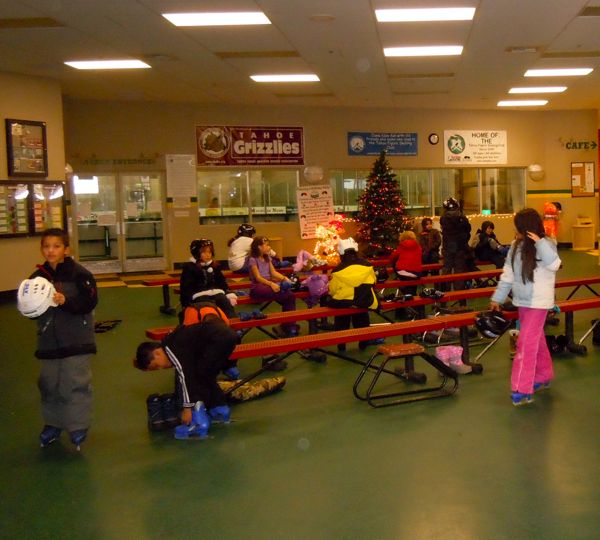
Skating is part of the Lake Tahoe Unified fourth-grade curriculum. Photos/Kathryn Reed

Skating is part of the Lake Tahoe Unified fourth-grade curriculum. Photos/Kathryn Reed

In 2009-10 the top three revenue generators were: public skate 26 percent of the budget, facility-ice rentals 25 percent, and skating programs 11 percent.

Rob Swain, supervisor of the South Lake Tahoe Ice Arena, said the projected deficit for this fiscal year is about $35,000 for the ice rink. The deficit for 2009-10 came in at $78,000.

“I’m not proud of it. It’s horrible in my opinion,” Swain of last year’s numbers.

He could not answer the questions: Why was the deficit so large last fiscal year? And why do you anticipate it being less than half of that this fiscal year?

One budget item that will be cut this year is utilities, which came to more than $60,000 last fiscal year. This is because of the cogeneration plant being installed.

Another expense that has been cut is staff. Swain said 1.7 full-time employees operate the arena. A slew of part time people are part of the staff, as well. Swain remarked that with the furlough days he and others are mandated to take – an average of three a month – he doesn’t consider himself a full-time employee.

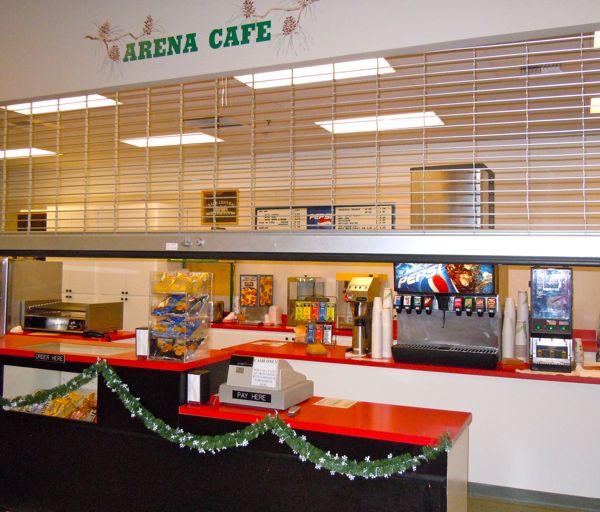
The café is seldom open. Swain said there is not the volume of customers to do so. He also does not want to change the policy that allows outside food and drink. He said at one time he shopped at Costco to stock the cafe, but then ex-City Manager Dave Jinkens said no more shopping off the hill. He has met with local grocery stores to get a deal on food items he would resell, but said the stores were not open to that idea.

At one point the café was losing $900 a month, Swain said.

However, Nancy Kerry envisions a restaurant where people could watch the skaters. She was asked by City Manager Tony O’Rourke to do an assessment on the rink after parks and rec staff said they were too busy to do it themselves.

The cafe at the South Tahoe rink is seldom open.

The cafe at the South Tahoe rink is seldom open.

The retail store once had an outside operator, but no longer. Rink staff run it. It’s full of items for hockey players and figure skaters, as well as T-shirts and fleece vests the general public would wear.

A positive at the rink is the number of skate school participants has been on the upswing the past few years.

The peak was 684 in 2002 – the year the rink opened. And it opened in May. For the next five years participation numbers for skate school decreased; the low point of 150 was in 2007. Swain attributes the drop to when to two elementary schools in Lake Tahoe Unified School District closed and the economic downturn.

Since then the numbers have been increasing, with 349 participants this year as of the end of November.

Money v. customers

Swain sounds like a man more worried about the bottom line more than the quality of service customers are getting.

“If I can rent the facility, it is easy money,” he said. “It brings people to the community, where everyone benefits.” He means heads in beds, meals served, gas in tanks and other residual expenditures involved with people in town for hockey tournaments and camps. (Swain is a hockey player.)

He has rented the rink for winter clothing catalog shoots as well as to the government to test tires.

Swain said the two words that will put the ice rink on solid ground are cooperation and compromise.

But it’s customer service the city manager wants him to focus on.

“We are in the service business,” O’Rourke said. “We are here for our customers, not ourselves. We have to meet their expectations and their needs.”

Swain said after last week’s focus group meeting he immediately implemented three changes people wanted – all in the name of customer service. One was to post the calendar at the facility in a manner people preferred, another was to offer coffee. He couldn’t remember the third.

When it comes to the public using the rink, school schedules are a contributing factor – so are windy days on the slopes.

“We are very weather driven,” Swain said. A public session on a rainy day can bring in five times the amount of money the figure skaters generate, he said.

With the rink being built with Measure S bond money – a measure residents still see on property tax bills – Swain said the philosophy is to provide as much ice time to the public as possible.

Rink is secret to many

One problem with getting the public to use the rink is there is no marketing budget. Interim parks Director Chris Hawken said money for such endeavors is taken from other parts of the budget instead of being a separate line item.

Part of the recent discussions involve getting the word out to the public about the various skating programs – including curling, birthday parties, youth and adult hockey leagues, skills and drills, broomball, and figure skating.

Until meeting with Lake Tahoe News, no one in the media had been told about the free Dec. 18 holiday event that starts at 5:30pm.

Most of the information being distributed about rink activities is directed to current users.

When the weather is nasty, Swain said hotels in the area are sent faxes telling them to suggest to their guests to come to the ice rink.

But Kerry wants a more proactive approach to getting tourists to know about the rink.

Hawken said new this year is having a coupon inserted in card key holders for hotel guests to use.

Going after hockey tournaments and camps are other ways to get people to know about the rink.

The flip side is letting locals know so they could attend the various events on this NHL size sheet of ice.

But the rink is not all that inviting. It’s drab. The holiday tunes on the sound system are not peppy. The 300-seat stands are cold. Heaters above them have to be pointed out they even exist. It is incredibly cold – colder than other rinks. The party room is tucked into a corner in what looks like an after thought. There is no view of the ice from there.

Swain volunteers he likes the outdoor rink at Heavenly Village with its decorative snowflakes and the vibe it puts off. He thinks doing more things like that would be good for the indoor rink. But he quickly points out the continued reduction in staff has him and others wearing many hats which is stretching them thin and causing some things to fall by the wayside and never get done.

One thing that might free up time for Swain and Hawken is the city attorney will be handling the bulk of contracts. This is to ensure consistency and eliminate the multiple contracts for various user groups. It is also designed to create a more even playing field and bring oversight and accountability to what is being offered people.

When Stan Sherer comes on board in January as Parks and Rec director the ice rink will be at the top of his list in terms of making sure it is run correctly and customer satisfaction is in check. Some cities lease their rink to an outside vendor instead of having staff run it. This could be an option in South Lake Tahoe.



More heavy equipment in Washoe State Park alarms residents

By Kathryn Reed

Although citizens concerned about the heavy equipment being used for the thinning project at Washoe Meadow State Park thought it was all over, that was not entirely the case on Wednesday.

The contractor was back at the South Shore site Dec. 8. This time it was to haul out the logs he had cut a year ago.

State Parks officials said all work was to be finished Dec. 8.

“He was on the existing road right at the park boundary and not entering the meadow,” according to Rich Adams, fuels reduction specialist for State Parks. “He is aware of the guidelines to not cause significant rutting.”

Adams is going to the site Monday with Tahoe Regional Planning Agency officials to look at the entire project area.

Concerns were raised last weekend about the over the snow project when the temperatures began to rise and the snow began to melt.