USFS looking for OHV money from State Parks

The Forest Service will be submitting an annual application to the state Department of Parks and Recreation, Off-Highway Motor Vehicle Recreation Division. This application requests funding to provide trail maintenance, restoration, conservation, patrolling, education and law enforcement for over the snow and off-highway vehicle trails and areas.

These grants will be available for public review and comment until April 4 online.

Any comments that are submitted to this site will go to the state and to the individual National Forest.

“These annual grants have provided important funds for the Forest Service to maintain the trails, repair winter storm damage and restore trailside environments as well as enabling more patrolling and monitoring of these sites. The Forest Service is requesting over $1 million this year,” David Michael, Tahoe National Forest Trails and OHV manager, said in a statement.


LTCC mapping out a way to offer community education

By Kathryn Reed

Lake Tahoe Community College hopes to return to its roots a bit this fall by offering community education.

While the state mandates the dollars it doles out to two-year institutions be largely spent on courses geared toward students who will transfer to four-year colleges and for remedial purposes, it hasn’t always been that way.

Tom Greene

Tom Greene

When LTCC opened in 1975 it had a true community education component. This was in large part funded by a 5-cent assessment place on properties statewide. A local 72-cent property tax was in place to fund LTCC.

At that time community colleges also set their own fees.

When voters passed Proposition 13 in 1978 it changed how property taxes to this day are collected in California as well as the funding structure for education and other entities.

One reason LTCC is reintroducing community education is because of how the state reimburses the school for classes. In recent years more elective type courses are not being reimbursed. Many of these, like physical education, are popular in South Lake Tahoe. But the college is losing money without the state reimbursement.

Tom Greene, vice president of Academic Affairs and Student Services, spoke to the LTCC board March 22 about the need to hire a part-time community education coordinator.

After the meeting he told Lake Tahoe News he expects in the next month or so to have more structure to the program. Bringing back community education was a component of the February strategic planning session.

“It will give us a great deal of flexibility,” Greene told the board. “It will be an alternative revenue stream and it meets the unmet needs of the community.”

Although the program per state law is not supposed to make money, instead break even, it’s possible to incorporate into the fee structure the wear and tear of the facility and utility costs. This is where the college may reap a savings of sorts.

“I imagine if it’s not self-supporting, it will not be long lived,” Greene said.

Specific courses that might be offered are far from being finalized. But there was discussion about bringing back Kids College, offering culinary classes, having a mini version of the Spanish institute, or weekend seminars.

Part of the flexibility Greene spoke of was timing of classes – this could be for a day, hours or a weekend. Plus, the requirements for instructors are not the same as regular LTCC classes.

Cynthea Preston, dean of Instruction, said, “We have a lot of vocational classes that would be better in community education.”



State water managers juggle flooding v. storage concerns

By Matt Weiser, Sacramento Bee

In a state often torn between flood and drought, spring is a reprieve. Winter storms are done, and a thirsty summer seems a distant worry.

Not so this year. The calendar may say spring, but the clouds disagree. Stubborn storms promise ample water supplies, but they bring a real threat of flooding to the state for the first time in five years.

For California’s water managers, it is a perilous time.

This spring is especially vexing because the state’s reservoirs are full, the snowpack is mountainous at 146 percent of average, and yet more storms loom, including another expected today.

That means a delicate juggling act, and a little guesswork, to serve two masters: flood control and water storage.

Water managers must let out just enough water at just the right time. The aim is to make room for the next storm without taxing levees downstream, and without wasting water that might be needed for lawns and crops this summer.

Read the whole story


Basic homeowner’s insurance doesn’t cover flooding

By Claudia Buck, Sacramento Bee

The frightening images of Japan’s tsunami wiping out homes, roads and entire cities are vivid reminders that a natural disaster can strike at any time.

And whether it’s an earthquake, a wildfire or flooding, being covered against severe damage to your home or business is essential.

Across the United States, flooding is the No. 1 natural disaster, according to the Federal Emergency Management Agency.

And given the region’s swollen rivers and the promise of heavy runoff this spring from melting snow, now’s a good time to assess how well you’re protected against flooding.

A basic homeowner’s or business insurance policy will cover damage caused by storms, such as a leaky roof, fallen tree limbs or broken pipes.

But a homeowner’s policy typically does not cover damage due to flooding, or what’s known as “rising water.”

Flooding – such as a levee break, a river overflowing its banks or water from springtime snow melt – is generally defined as a temporary inundation of normally dry land. For that type of coverage, you need a separate flood policy, which is provided by the federal government’s National Flood Insurance Program and purchased through a local insurance agent.

“The distinction is that homeowner’s insurance covers water falling from the sky; flood insurance covers water rising from the ground,” said Tully Lehman, spokesman for the nonprofit Insurance Information Network of California.

Read the whole story


Washoe County headed toward regional fire protection

By Susan Voyles, Reno Gazette-Journal

Washoe County commissioners on Tuesday gave its official blessings for its members on the joint fire advisory to work with Reno officials on regionalizing fire services.

Commissioners also want to invite officials for Sparks, the North Lake Tahoe Fire Protection District, the Reno-Tahoe Airport Authority and neighboring fire departments covering north Lyon County and Carson City to participate in the talks.

Reno and Washoe County officials have until June 30 to notify each other of any plans to disband a 11-year-old contract in which Reno staffs the county’s six Truckee Meadows fire district stations. The county also oversees the Sierra fire district.

Sierra Fire Chief Michael Greene has proposed switching to three-man crews to keep its three stations open and avoid paying overtime of upwards of $800,000 this year for a fourth firefighter when one reports sick.

Read the whole story


Schools closed in LTUSD on March 25

ltusdLake Tahoe Unified School District will not be in session March 25 because of the severity of the storm.


LAO report looks at fee to fund public benefits of water investments

By Lisa Lien-Mager, Association of California Water Agencies

A new paper by the Legislative Analyst’s office says assessing a fee on water at the retail level would be the most feasible option for funding the public benefits of water investments.

In a March 22 report prepared for the Senate Natural Resources and Water Committee, the LAO said placing an assessment at the water retailer level makes sense from a practical standpoint.

“We find that an assessment levied on water retailers and administered by the state Board of Equalization is the most feasible funding option for a public-benefit-type charge in California,” the eight-page report says. “It is relatively easy for water retailers to provide the data necessary to impose assessments tied to the use of water.”

The report identifies five broad categories of “public-purpose water activities” currently supported by the state’s General Fund or by general obligation bonds. The categories include: planning and management of the statewide water system; broadening access to necessary water services; ecosystem improvements; management of water-related risks and major public emergencies; and water system changes that improve recreation opportunities.

Read the whole story


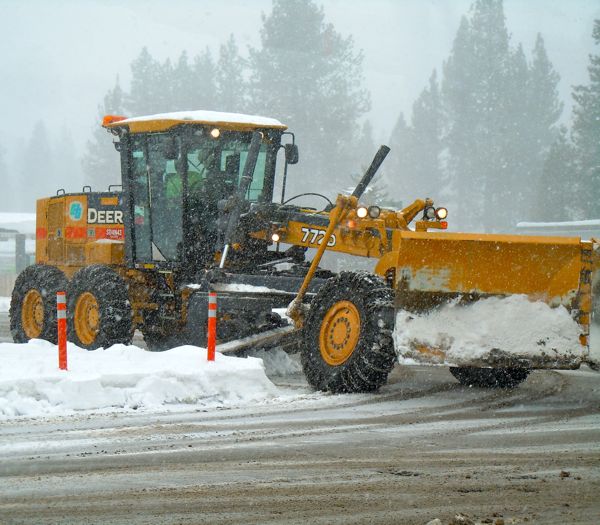
Blizzard conditions closes roads, cancels events

In the interest of safety for presenters and the traveling audience Explore Tahoe has canceled the program for Thursday night.

The Regional Wildland Fire Exercise scheduled for March 25 has been canceled because of the weather.

Caltrans is blasting on Highway 50 at Echo Summit. Highway 89 remains closed around Emerald Bay. Travel restrictions are in effect for most of the roads in, out and around the Lake Tahoe Basin. Interstate 80 was closed at the state line because of a big-rig accident.

Caltrans clears the Y in South Tahoe on March 24. Photo/Kathryn Reed

Caltrans clears the Y in South Tahoe on March 24. Photo/Kathryn Reed

Snow has been coming down in a horizontal pattern since about noon in South Lake Tahoe, with accumulations in a two-hour period of about 3 inches.

Sierra-at-Tahoe has closed for the day. Mt. Rose never opened.

Placer County has activated its Emergency Operations Center.

In Gardnerville Thursday morning sustained winds were clocked at 25 mph, with a gust of 61 mph.

According to the National Weather Service, a winter storm warning is in effect until 11am Friday.

Reporting at noon March 24 the NWS has the following snow totals for the previous 24 hours:

  • Heavenly — 14 inches
  • Alpine Meadows — 19 inches
  • Kirkwood — 24 inches.

— Lake Tahoe News staff report


Tsunami’s effects in California offer clues about future

By Abby Sewell, Los Angeles Times

Although the effect of the tsunami was minuscule in California compared with Japan, the scattered damage is providing a rare opportunity to study how the waves work and to help officials better prepare for what could be a far more destructive seismic event along the state’s coast.

Teams of scientists combed the California coast all last week, comparing damage from port to port and harbor to harbor. The result will be a set of recommendations that could give better indications of which areas are most at risk and how to mitigate damage.

“This will be our best data set of response in California from a far-afield tsunami yet,” said Jose Borrero, a tsunami researcher with the consulting firm ASR Limited who traveled the length of the California coast.

The state has already published inundation maps that show which areas are believed to be at risk of flooding in various tsunami scenarios, but the new data will allow for a more detailed understanding.

The California Emergency Management Agency estimates that surges induced by the earthquake in Japan caused $44 million in damage to coastal California, with Crescent City and Santa Cruz being hardest hit. In Crescent City, one man died when he was swept out to sea while attempting to photograph the waves, and much of the town’s harbor was destroyed, crippling the local fishing industry.

Read the whole story


Wood smoke particulates pose health problems

By Cheryl Katz, Environmental Health News

NORDEN — On a frosty evening in the Sierra Nevada, smoke curling from the chimney of the Clair Tappaan Lodge is a welcome sight for chilly snowshoers and cross-country skiers. Gathering by the massive stone hearth at this landmark Sierra Club mountain hostel, guests relax in the warmth and aroma of the crackling log fire.

Woodsy scents waft across the region, as millions of fireplaces and wood stoves are lit by people seeking environmentally friendly sources of heat and ambience. But new research is raising concerns about the toxic substances in that smoke.

Tiny airborne specks known as particulate matter produced by wood-burning stoves appear to be especially harmful to human health. Small enough to deeply penetrate the lungs, they contain high levels of carcinogenic chemicals. They’re capable of damaging DNA and activating genes much like car exhaust and tobacco smoke, according to a new study in Denmark. Another new study, conducted in Canada, found that infants and toddlers were significantly more likely to get ear infections if they lived in an area with a lot of wood stoves and fireplaces.

Because wood is a natural material and has been an integral part of human existence for so long, many view it as a benign, cheap and renewable energy alternative. But wood smoke can exacerbate asthma symptoms, and is especially harmful to children and older people. The emissions also have been linked to respiratory disease, atherosclerosis and other coronary problems, and early deaths among people with cardiovascular or lung disease.

Read the whole story