Evacuations in Douglas County as fire spreads

By Reno Gazette-Journal

The Ray May Fire near Gardnerville has burned close to 2,000 acres and has necessitated some people be evacuated.

The neighborhood near the wildfire was dark Tuesday night as crews turned off electricity and propane as a precaution.

Douglas County sheriff’s Capt. John Milby said though the fire is primarily threatening Pine View Estates, authorities were also keeping an eye on the Pine Nut No. 2 subdivision about five miles to the north.

At 9:10pm about 75 voluntary evacuations were in place for neighborhood near the Douglas County wildfire.

Read the whole story


Invasive smallmouth bass gain foothold in Lake Tahoe

By Matt Weiser, Sacramento Bee

Invasive smallmouth bass have become established in Lake Tahoe, posing what researchers call a “much more ferocious threat” to native fish than anything that has come before.

“We’ve had reports of smallmouth bass before, but now we’ve 100-percent confirmed its presence in Lake Tahoe,” said Kevin Thomas, environmental scientist at the California Department of Fish and Game. “The population could explode and put more stress on the native fish.”

The finding was announced Monday by the University of Nevada, Reno. It came during a UNR project with Fish and Game and the U.S. Fish and Wildlife Service, which removed 5,000 invasive fish from the near-shore aquatic zone.

Read the whole story


Lack of money not stopping desire, regulations to improve Lake Tahoe’s famous clarity

By Kathryn Reed

HOMEWOOD – Money and cooperation were the overriding themes of the 15th annual Lake Tahoe Environmental Summit on Tuesday at Homewood Mountain Resort.

For the first time since then-President Bill Clinton started these summits, the governors of California and Nevada attended the event. But it was Sen. Dean Heller, R-Nev., who was the only speaker to have his speech interrupted by applause.

His desire to turn a greater amount of the regulatory control in the Lake Tahoe Basin over to the five counties and one city was met with strong approval by the few hundred people in attendance.

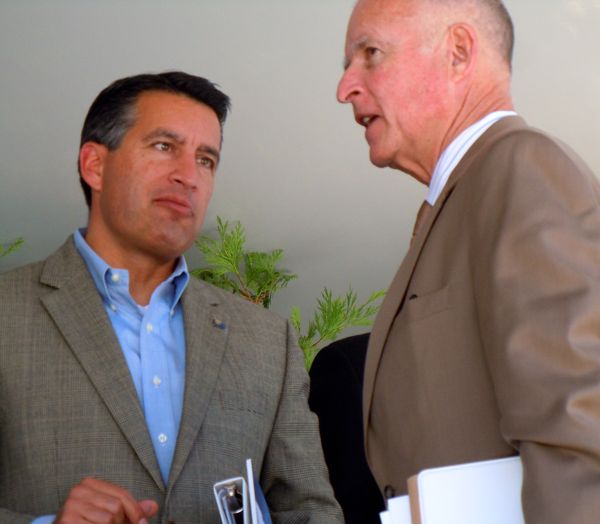
Govs. Brian Sandoval and Jerry Brown pledge to work together on Lake Tahoe issues. Photos/Kathryn Reed

Govs. Brian Sandoval and Jerry Brown pledge to work together on Lake Tahoe issues. Photos/Kathryn Reed

Heller and others spoke of the need for TRPA’s Regional Plan to meet its latest deadline of December 2012 for approval by the Governing Board.

A meeting on Monday between Govs. Jerry Brown and Brian Sandoval sparked a mutual desire to travel to each others respective capitals to further the dialog about Nevada Senate Bill 271 and getting the Tahoe Regional Planning Agency to function better.

(Sandoval and Heller are former TRPA board members.)

“We need a road map and certainty about what is going to happen at this lake,” Sen. Dianne Feinstein, D-Calif., said in reference to the need for the Regional Plan update’s completion.

Eye on sediment

While much was made of the need to reduce fine sediment from reaching the lake, the irony is all those people listening to the politicians on stage were sitting in fine sediment, stirring it up as they walked on the lower ski slope – which is on the other side of Highway 89 directly across from the very waters they are trying to protect.

At the summit, Brown and Sandoval, with Jared Blumenfeld, administrator for the EPA’s Pacific Southwest Region, signed the Total Maximum Daily Load document, which has a goal to substantially improve lake clarity.

The federally mandated and unfunded program says that in 65 years the white dinner plate-looking Secchi disc will be visible to a depth of 100 feet. Right now it can be seen at 64.4 feet.

In this year that saw the lake rise 3 feet from runoff, it declined in clarity by the same amount.

On the California side it’s Lahontan Regional Water Quality Control Board that oversees the TMDL, while it’s the Nevada Division of Environmental Protection on the other side of the lake.

“Ten years ago people thought Lake Tahoe’s loss of blue was because of algae. It’s about 25 percent of the problem,” Blumenfeld said. “The rest of the problem is sediment. Science has given us a road map. I like to call it a diet for Lake Tahoe.”

While Sandoval singled out the Sierra Colina project in Stateline being an example of a private entity working on eliminating 74 tons of sediment from reaching the lake each year via the project in and around Burke Creek, he skirted around the greater problem with that project in that it is held up in litigation.

Brown said, “The lake stands as a microcosm of the larger issues we face.”

He said it’s time builders and environmentalists get together to find a way to sustain the region economically and environmentally.

Where’s the money?

The problem is no one had definitive answers how to pay for that diet of reducing fine sediment reaching Lake Tahoe. Everyone talked about a greater need for cooperation, for there to be less reliance on the federal government, and a greater need for private entities to step forward.

One source of money will be the Tahoe Fund. A Monday night fundraising dinner brought in $200,000. While it’s a start, it’s a drop in the bucket – especially when one considers it costs nearly $2 million to build one mile of bike trail in the basin. And these trails are viewed as a means to reduce sediment by getting cars off the road.

Another $34 million from Southern Nevada Public Lands Management Act money has been allocated for Lake Tahoe. But that source is also drying up.

While $1.5 billion has been spent in the last 10 years on projects designed to improve lake clarity, where the money will come from in the future is an unknown.

The Lake Tahoe Restoration Act has not be reauthorized, though Sen. Harry Reid, D-Nev., is confident is will pass. He was confident last year, too, and Congress didn’t give the green light.

“We need to adapt to a new fiscal reality,” Feinstein said.

While that is true, no one is openly speaking about adapting to a possible new reality if Lake Tahoe’s clarity doesn’t improve and what that means for the eco-system as well as economy via tourists not wanting to see another brown lake.

ngg_shortcode_0_placeholder (Click on photos to enlarge.)


Landmark case could redefine mortgage mediation in Nevada

By Jason Hildago, Reno Gazette-Journal

Is Nevada’s Foreclosure Mediation Program unconstitutional?

That’s the $64,000 question in a brewing legal battle that’s poised to redefine the foreclosure mediation process in the Silver State.

The battleground is the Nevada Supreme Court, where “Wells Fargo Bank vs. Renslow” now is working its way through the system.

The case was kicked up to the state’s high court after Judge Patrick Flanagan of Washoe County’s Second Judicial District Court ruled against Wells Fargo and modified the mortgage of a Reno couple, Duke and Tina Renslow, earlier this year.

Created by the Nevada Legislature in 2009, the Foreclosure Mediation Program allows homeowners who receive a notice of default to seek a one-on-one meeting with their lender in front of a neutral mediator for a potential loan modification. The law requires lenders to negotiate in good faith or face sanctions.

The Renslow case is the first time that a Nevada District Court judge has exercised the provision in the program that allows courts to modify the terms of a mortgage when lenders or servicers negotiate in bad faith.

Flanagan declined to comment because the Renslow case is pending before the Nevada Supreme Court. But according to a court docket acquired by the Reno Gazette-Journal, Flanagan cited Wells Fargo’s egregious conduct in dealing with the Renslows as the prime reason for his ruling.

Now, Wells Fargo is appealing the decision with the Nevada Supreme Court, alleging that Flanagan’s modification of the Renslow mortgage — along with the entire Nevada Foreclosure Mediation Program — is unconstitutional.

Regardless of how the Nevada Supreme Court rules, the case will be a game-changer said legal experts such as Geoffrey Giles, a Reno lawyer with extensive experience in foreclosure cases. It also could mean a potential tipping of the scales for a system that has been criticized as being more favorable toward banks.

Read the whole story


Custody issues at center of father-daughter deaths on West Slope

By Stephen Magagnini and Peter Hecht, Sacramento Bee

Mourad “Moni” Samaan killed himself and his 2-year-old daughter, Madeleine Layla Samaan-Fay following a bitter custody battle that began even before the child was born, Samaan’s father said Monday.

In an exclusive interview with the Bee, Dr. Makram Samaan said his son and granddaughter – found inside his son’s sport-utility vehicle on Saturday evening in El Dorado County – died of carbon monoxide poisoning from the exhaust pipe. (Authorities haven’t confirmed the cause of death.)

The girl’s mother, California Deputy Attorney General Marcia Ann Fay, 46, has declined to comment after several requests by The Bee.

Makram Samaan – a psychologist who helps couples mediate disputes and divorces – held his hands to the heavens and cried: “I’ve helped thousands of people and saved a lot of families, but I failed my son – I did not see it. I did not see it! Why should it not be me?”

Samaan, who wrote his master’s thesis on suicide, said he knew his son Moni was in distress, but had no inkling how much.

He blamed the courts for driving his son over the edge.

“We need to take marriage and divorce out of the courts,” said a sobbing Samaan at his Fair Oaks home overlooking Lake Natoma.

Read the whole story


DA may begin taking harder line on Tahoe pot cases

By Kathryn Reed

More marijuana cases may soon end up in El Dorado County Superior Court.

The combination of South Lake Tahoe being on the verge of finalizing ordinances related to pot dispensaries and deputy district attorneys receiving specialized training in these matters could change the tide when it comes to prosecuting pot-related cases.

Hans Uthe, deputy district attorney in the South Tahoe office, said the new approach his office plans to take involves commercial grows. But he would not give details.

pot“We are also waiting for the city to get two basic sets of ordinances passed so we know the rules and can enforce them,” Uthe told Lake Tahoe News. “We are wary about (prosecuting cases), but it’s not true about not wanting to.”

With Proposition 215 in California allowing the use of marijuana for medical purposes, it conflicts with federal law that prohibits the use even for this purpose. This, at times, makes prosecuting cases difficult.

Uthe said prosecutors around the state have been hesitant to pursue cases. He said analysis coming out of Los Angeles looks good and that his office may adopt some of what his Southern California colleagues are doing.

The feds have said grows on federal property and exporting the product are the two main areas it will crackdown on.

Uthe said in the last year a handful of export cases have been prosecuted by his office. He said suspects are using UPS and FedEx more than the U.S. Postal Service as a means to deliver their goods.

“People ship it to colleagues in other jurisdictions where it’s sold at a high profit,” Uthe said.

With marijuana being cheap and legal to grow in California, it is being sent to states where cultivation is illegal and the end product is more expensive.

Uthe hasn’t noticed an increase in pot cases since the three collectives opened in South Lake Tahoe. He attributes the spike ever since Proposition 215 was passed in 1996.


LTCC launches community ed with classes for athletes

By Kathryn Reed

Don’t be surprised if competitors in next month’s Iron Girl triathlon have better times than they did at the inaugural event in 2010.

This could happen because of three classes designed with the Sept. 18 South Lake Tahoe event in mind. The swim clinic, tri interval speed clinic, and tri circuit workshop are the first three classes offered through the resurrected Community Education program at Lake Tahoe Community College. They are geared toward improving performance.

ltccThey are three of the first four classes the college board of education has approved. It’s likely at most of their meetings going forward they will be asked to OK community ed classes. Ed code requires the board sign off on them.

Megan Waskiewicz, who works 20 hours a week coordinating the program, said having these types of classes to start the program fit with what survey takers said they want. Nearly 80 percent of the 100 respondents said health-fitness-wellness type classes are what they want.

A recent Lake Tahoe News “Question of the Week” also asked people what kinds of classes they would like.

The college also queried the 500 participants in this month’s Spanish Institute what they would take in the future. With many of them from out of town, this taps into the destination visitor.

Waskiewicz envisions weekend classes that could involve part or the whole family. It might involve cooking, hiking or both.

Culinary programs were high the list of desires in the community survey.

Next summer she wants swimming programs to be part of community ed. As a former employee in the local ski industry, she is ready to tap that area – perhaps a women’s ski class or something geared toward kids.

Community partnerships

Cynthea Preston, dean of Instruction at LTCC, told the board last week that Barton Health and Lake Tahoe Visitors Authority approached the college about putting on the three classes related to triathlon training.

“I would have liked it last year,” board member Karen Borges said. “My friends and I were saying if we get a flat, we’re done.”

She did the tri last year and welcomes a lesson in changing a flat tire as part of the Sept. 17 class.

This particular tri is geared toward newbies, with nearly 90 percent of the 600 registrants competing in their first triathlon.

The college’s website will have detailed information about the various classes, while clicking on tri classes brings up the PDF for those particular ones.

Barton has an internal boot camp that LTCC will be part of when it comes to instruction.

That is one of the unique things about community ed compared to the regular college – classes don’t have to be offered to everyone.

Nuts and bolts

Plus, grades are not involved. However, curriculum is written for each class.

This week the website will have an instructor proposal form added so anyone who wants to teach a class may fill that out. Then a committee will decide whether to pursue it.

Cost for classes and instructor pay will depend on what is being offered, the number of students, materials required and other factors.

For instance, the Aug. 20 and Aug. 27 tri classes are each $18, while the Sep. 17 tri circuit workshop is $35.

This compares to the three-day SAT prep class that runs $200, plus $25 for the text. That is the fourth class the community ed program is offering. Right now South Tahoe High doesn’t offer such a class, so the college is hoping the Sept. 11-18-25 sessions are well received. It’s being taught by Frances Lord, an LTCC instructor who has taught the subject elsewhere.

And the requirements to teach have nothing to do with what it takes to be a full-time or adjunct instructor.

“We have a lot of flexibility. Why not try some things that are different?” Waskiewicz said.


Sandoval declines to call off Nevada bear hunt

By David McGrath Schwartz, Las Vegas Sun

It looks like Nevada’s going on a bear hunt Saturday.

Gov. Brian Sandoval has ignored please for him to block Nevada’s first-ever bear hunt, scheduled for Saturday, ending opponents’ hopes for a last-minute intervention.

The issue has captured the attention of Northern Nevadans, with opponents to the bear hunt submitting 15,000 signatures to the governor’s office calling for it to be cancelled.

“He supports the (Nevada Wildlife) Commission on this regulation and expects that the information this hunt will yield can ultimately aid in the conservation of wildlife populations, including bears,” according to a statement from Sandoval’s spokeswoman Mary-Sarah Kinner. She said the commission adopted the regulation based on “scientific standards.”

Earlier Monday, a handful of protesters gathered outside the Capitol Building. “We want a stay of execution,” said Kat Simmons, of Gardnerville. “We want him to intervene and stop the hunt.”

The state Wildlife Commission in February gave final approval for the hunt after its biologists said the state’s bear population could support a hunt.

Read the whole story


Tribal gaming cuts into tour bus traffic at Tahoe-Reno casinos

By Rob Sabo, Northern Nevada Business Weekly

Bus tours to regional casinos remain an important revenue stream for gaming properties, casino executives say, even though the number of visitors to Northern Nevada who arrive via tour bus declined drastically over the past decade.

And some are working hard to boost their bus business.

Tour buses loaded primarily with seniors from California eager to pull the handles of slot machines and collect buckets of nickels once were a common sight at Reno-Sparks casino properties. However, the widespread inception of tribal gaming throughout Northern California has curtailed the once-popular day trips to gamble in The Biggest Little City.

Revenues from bus tours at Grand Sierra Resort declined by 66 percent after the property dropped the Hilton flag, says new General Manager Bill Wright.

“It was a very viable business, but when the property went from the Hilton to the Grand Sierra it appears to have changed its philosophy,” says Wright, who also worked as general manager of the Flamingo Hilton before leaving the area for Las Vegas in 2001.

Michelle Williams, sales manager for the Eldorado for the past six years, formerly worked with a motor coach company specializing in bus tours to Reno. Williams says that market used to make up a substantial revenue stream, and although it has diminished, all customers are vital to the health of Reno casinos.

“The last few years primarily the economy has affected it more that anything,” Williams says. “Indian gaming certainly has affected our business, but people still do want to get out of California and come to Nevada.”

Wright, who joined Grand Sierra Resort in May, says boosting revenues from bus tours is part of several new strategies to be put in place at the 2,000-room hotel property.

“When leisure demand is not enough to fill your rooms, we are looking at each and every avenue we can to drive room nights,” he says. “We have got such big square footage on the casino floor and with the number of rooms, and the challenge is finding customers to fill the capacity we have. That is one segment that has worked in the past, and we feel it is viable again.”

In the past few years revenue generated from bus tours has become minuscule for properties in Carson City and the Carson Valley, says Bill Henderson, longtime director of sales for Carson Valley Inn in Minden. Properties such as the CVI and Ormsby House in Carson City used to benefit from overnight bus tours to Reno that often took patrons on side trips to Carson Valley properties and South Lake Tahoe.

Henderson, who also worked at South Lake Tahoe properties prior to his 27-year stint at Carson Valley Inn, says it wasn’t uncommon to see 60 or 70 buses per day arriving at large South Lake Tahoe casinos.

Read the whole story


2 people arrested in South Tahoe kidnapping of infant

Two people were arrested this weekend on kidnapping charges. The incident started in South Lake Tahoe and ended in Douglas County.

On Aug. 13 at about 3:30pm the Douglas County sheriff’s deputies were contacted by the South Lake Tahoe Police Department and advised that a kidnapping had just occurred in South Lake Tahoe,

A 1-year-old baby was allegedly taken from his mother’s residence by Salvador Miguel Aquino-Villavicencio and his mother, Josefina Villavicencio, both of whom reside in Douglas County at the Holbrook Trailer Park.

The child was located inside the residence unharmed.

Both Salvador and Josefina Villavicencio were taken into custody without incident and booked into the Douglas County Jail on fugitive no-bail arrest warrants for kidnapping and criminal conspiracy, and are now awaiting extradition.

— Lake Tahoe News staff report