Bridgeport fire sends smoke toward Tahoe-Carson-Reno

Smoke from a fire near Bridgeport is filtering into the Lake Tahoe Basin and into Northern Nevada.

The fire along Highway 395 started Sunday about noon.

More than 1,200 acres have burned.

Firefighters had to evacuate the Buckeye Campground Sunday night. Some roads in the area have bee closed.

— Lake Tahoe News staff report


Heavenly taking strides to overhaul Cal Base Lodge

By Kathryn Reed

Heavenly Mountain Resort is in the process of having the soil composition for the California Base Lodge and parking lots be reclassified.

This is because a soil report the resort had done a year ago came back with a different analysis compared to what was recorded in the mid-1970s. Besides the soil difference, the latest study says the stream environmental zone at the resort is smaller than originally indicated.

The South Shore resort has long planned to revamp that area. A new lodge and other changes to the acreage are part of the master plan that was approved in 2007 by the Tahoe Regional Planning Agency and the U.S. Forest Service. Because this lodge and parking are not on Forest Service land that agency is not involved in the current talks.

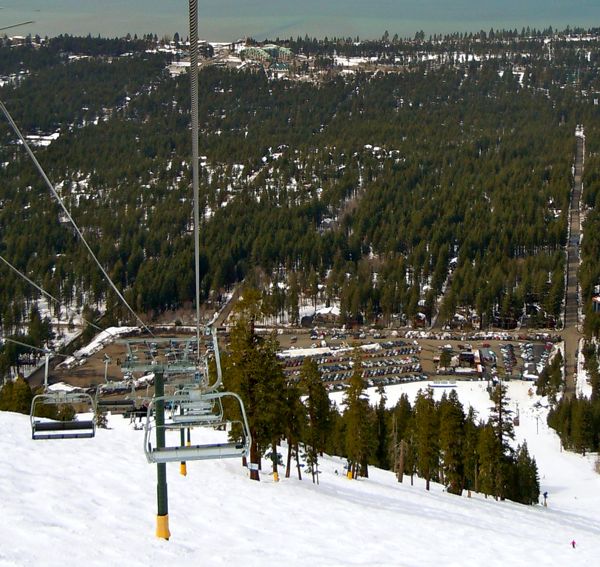
Heavenly is inching forward with plans invovling the lodge at the base of Gunbarrel. Photo/LTN file

Heavenly is inching forward with plans invovling the lodge and land at the base of Gunbarrel. Photo/LTN file

TRPA, though, is the agency tasked with reclassifying land designations. A hearing about Heavenly’s desires to change things is slated for Sept. 29 at 2pm at TRPA’s Stateline headquarters. This is done before a hearings officer.

Mike Cavanaugh, the TRPA planner handling this situation, did not return multiple phone calls.

He is the one who signed the letter dated Sept. 15 that was sent to neighbors alerting them to the hearing about Heavenly’s request.

The staff report, which doesn’t have a name on it, recommends the hearing officer make the changes Heavenly is asking for.

“This is a step in the process, in the TRPA review process so we can move forward with future planning,” Russ Pecoraro, Heavenly’s spokesman, told Lake Tahoe News. “There may be some mitigation we need to plan for. We want to know what we are dealing with.”

He would not say if a time line exists for redeveloping the outdated lodge and making that entrance to the resort visually more appealing.

“Since it is a scientific prediction and not a verification, TRPA requires all land capability classes be verified on a parcel before a project is permitted. A land capability challenge is one of TRPA’s administrative mechanisms for correcting the land capability maps, which are based on the 1972 soil survey,” TRPA spokesman Jeff Cowen said. “Heavenly’s master plan is an approval of long range concepts, but not of the individual projects. Each project contained in Heavenly’s master plan needs to be permitted and fully reviewed as they come forward. Master plan areas don’t necessarily have all their land coverage verified prior to proposing a master plan.

“The California Base Lodge parcel never had its land capability verified and the applicant predicted they would need substantial soil testing and expert review, so they chose to forego the verification step and go directly to a land capability challenge, which includes soil boring, test pits, expert review and a public hearing.”

Since its creation in 1974 by the TRPA and USFS, the Bailey Land-Capability Classification is the system used to determine what can be built where in the Lake Tahoe Basin based on the soil.

The extensive document says, “For purposes of this study, land tolerance is used as the principal measure of capability. Land capability is in turn defined as the level of use an area can tolerate without sustaining permanent damage through erosion and other causes. Although capability classes are expressed as levels of tolerance, they are estimated by the degree to which potential hazards arising from improper use are absent. (The lower erosion hazard a soil has, the higher its capability rating for development.)”

In April 2008, Heavenly put more than 400 filters under the 15-acre California Base Lodge parking lot through manhole covers to reduce sediment from flowing into Bijou Creek. They are rated to handle a peak flow of 1-inch of runoff or rain per hour.


Retiree benefits for the military could face cuts

By James Dao and Mary Williams Walsh, New York Times

As Washington looks to squeeze savings from once-sacrosanct entitlements like Social Security and Medicare, another big social welfare system is growing as rapidly, but with far less scrutiny: the health and pension benefits of military retirees.

Military pensions and health care for active and retired troops now cost the government about $100 billion a year, representing an expanding portion of both the Pentagon budget — about $700 billion a year, including war costs — and the national debt, which together finance the programs.

Making even incremental reductions to military benefits is typically a doomed political venture, given the public’s broad support for helping troops, the political potency of veterans groups and the fact that significant savings take years to appear.

But the intense push in Congress this year to reduce the debt and the possibility that the Pentagon might have to begin trimming core programs like weapons procurement, research, training and construction have suddenly made retiree benefits vulnerable, military officials and experts say.

And if Congress fails to adopt the deficit-reduction recommendations of a bipartisan joint Congressional committee this fall, the Defense Department will be required under debt ceiling legislation passed in August to find about $900 billion in savings over the coming decade. Cuts that deep will almost certainly entail reducing personnel benefits for active and retired troops, Pentagon officials and analysts say.

“We’ve got to put everything on the table,” Defense Secretary Leon E. Panetta said recently on PBS, acknowledging that he was looking at proposals to rein in pension costs.

Read the whole story


Nevada officials make bear hunt permanent event

By Jeff Delong, Reno Gazette-Journal

Nevada’s first black bear hunt can continue in future years under regulations unanimously adopted by wildlife officials Saturday.

The Nevada Wildlife Commission, facing one of its most controversial issues in recent memory, voted to make regulations guiding the hunt permanent.

The vote came after critics urged commissioners not to do so, instead asking for an independent review of science indicating that the state’s bear population will support a limited hunt.

Commissioners said they believe that science to be sound.

“I am confident in the science supplied by (the Nevada Department of Wildlife), and that is why I am supporting making this a permanent regulation,” said commission chairman Mike McBeath.

“Our job is to preserve, protect, manage and restore populations of game animals,” McBeath said. “Making this a permanent regulation helps us do that.”

Read the whole story


LTUSD enrollment starts strong

Enrollment increases are exactly where Lake Tahoe Unified wants them – at the elementary level.

ltusdWhile the official tally for the state is not taken until October, officials are reporting 88 more students than last school year. The bulk of that growth is in kindergarten and first grade.

“That feeds the system,” is how Superintendent Jim Tarwater described it.

For a district that has had declining enrollment for years on end, to start off strong is a good sign. However, it’s what the numbers look like after the winter break that are more telling. That is often when people leave the district — then return for the fall when the weather is nicer.

The middle school is holding steady, with some decline at South Tahoe High. What’s different at the high school is 14 students are from Nevada – the largest contingency to date. Even the student body president – Jack Percival – is from the Silver State.

— Lake Tahoe News staff report


Sparks cancels Street Vibrations because of shootings

By Reno Gazette-Journal

4:42pm update: Street Vibrations events in Sparks tonight are canceled in the wake of Friday’s night’s shooting in John Ascuaga’s Nugget and a retaliatory shooting this morning nearby, Sparks Mayor Geno Martini said.

“We’re canceling it in Sparks,” Martini said. “After the retaliation it’s just too tense of a situation. It’s hard to say what’s going to happen. It’s just not worth the chance.”

Street vendors and live entertainment had been scheduled in Victorian Square tonight.

After the late-night shooting that killed one and wounded two, another shooting occurred about 10:30 a.m. at Victorian and Stanford that left one wounded. Martini could cite no details but called the shooting “definitely a retaliation.”

4:30pm update: The following is an excerpt from a Sparks news release:

In light of a shooting involving rival members of motorcycle clubs at a Spark Casino Friday night, and a subsequent drive-by shooting on Victorian Avenue in Sparks this morning, a state-of-emergency has been declared by the City. It is expected the Governor will also declare a state-of-emergency on behalf of the City of Sparks. Pursuant to the police powers vested in the City of Sparks, the Street Vibrations motorcycle event in Sparks will be canceled for the remainder of the weekend.

“The safety and security of the public is our number one priority,” said Sparks Mayor Geno Martini.

Read the whole story


Poll: Majority of Californians support legal online gambling

By Laurel Rosenhall, Sacramento Bee

A majority of California voters – especially those under age 40 – would like to see the state tax Internet poker and make the game legal, according to a Field Poll released today.

Among all age groups, 53 percent of voters support the idea, the poll says, while 41 percent oppose it. Among voters under age 40, however, support grows to 73 percent.

The Legislature has been discussing proposals to make online gambling legal in California for the past two years. The bills stalled as various gambling interests fought over who would be able to profit from the endeavor.

Parties involved in the debate – owners of Indian casinos, card rooms and race tracks – are supposed to meet this fall to hash out a compromise proposal for the Legislature to consider next year. Lawmakers who support Internet gambling have said it could bring hundreds of millions to state coffers.

The potential for the state to make money by taxing Internet poker is the main reason Irene Woods of Fair Oaks said she wants California to permit Internet gambling.

“It would be another source of revenue for the state, and we’re in dire financial problems,” said Woods, 79, who participated in the survey.

“I don’t see anything immoral about gambling anyway. What’s the difference if you go to Tahoe or Reno, or if you do it online?”

Poll respondent Timothy Dwyer of Stanislaus County saw it another way. He said the potential for the state to make money isn’t worth the risk to players who could wind up gambling too much.

Read the whole story


Reno-Tahoe, Denver try to convince USOC to go after 2022 Games

By Brian Gomez, Gazette

COLORADO SPRINGS — Nearly 40 years ago, Denver gave away the Olympic rings. Now, it wants them back.

The U.S. Olympic Committee has had preliminary talks with Denver about the chance of a bid for the 2022 Winter Games, USOC chief executive officer Scott Blackmun said Friday after his keynote address during the U.S. Olympic Assembly.

It’s still undetermined whether the Colorado Springs-based USOC will enter the fray for 2022 — with Reno/Lake Tahoe, Salt Lake City and Bozeman, Mont., also weighing bids — or throw its weight behind a bid for the 2024 Summer Games, in which possibilities are Chicago, Dallas, Los Angeles, Minneapolis, New York, Philadelphia and Tulsa, Okla.

If the USOC tries for 2022, bid books outlining a city’s plan for the Games, that would detail whether Olympic competition and practice venues are targeted for the Springs, would be due to the USOC in 2013, when the USOC also would offer an applicant city to the International Olympic Committee. The IOC will announce its short list in 2014 and pick the 2022 Olympic host in 2015. At least 15 other nations have shown interest, the strongest contenders including Barcelona, Spain; Berne, Switzerland; Munich; Oslo; and Ostersund, Sweden.

“I think 20 years is long enough,” Blackmun said in reference to the U.S. last hosting the Olympics in 2002 in Salt Lake City. He added: “It’s important that we host the Games in the United States as a way to keep Americans connected to the team. . . . I don’t think there are limitations on our ability to participate in a 2022 bid right now.”

Bid leaders from Denver and Reno/Lake Tahoe are in town for the Olympic Assembly, the USOC’s annual gathering of 400 attendees that ends today with a USOC board meeting.

Read the whole story


Nevada receives DOE grant for energy retrofits

By Nevada News Bureau Staff

CARSON CITY – Nevada has been approved for a U.S. Department of Energy competitive grant to assist in energy retrofits across the state.

The grant will help commercial buildings develop energy efficient retrofit projects, making it easier for businesses, contractors and energy suppliers to undertake these efforts.

The $765,000 grant will be augmented with a $250,000 in-kind match from NV Energy.

“We are one of only five states to be awarded this grant and we should be encouraged about the fact that DOE feels confident that we can carry out the grant program successfully,” Gov. Brian Sandoval said. “Through this grant, we hope to provide a consistent set of resources and policies to develop a sustainable industry for contractors and energy professionals for the long-term, thereby creating jobs as the retrofits are accomplished.”

Nevada Energy Director Stacey Crowley said, “We have assembled a great team anchored by our office, UNR and NV Energy. We will work to address the importance of energy efficiency to add value to our state’s industries and accelerate economic development.”

The team, which also includes the Nevada Association of Associated General Contractors and the Office of Economic Development, plans to address the challenge of increasing commercial building energy retrofits at two levels: by better aligning Nevada’s energy policy – particularly those aspects dealing with energy efficiency – and economic development policy; and addressing the specific financial barriers hindering energy efficiency upgrades in commercial buildings.


TRPA switches leadership on Regional Plan update — again

By Anne Knowles

STATELINE — The Tahoe Regional Planning Agency has someone new shepherding its long overdue Regional Plan update.

Harmon Zuckerman, the former Douglas County principal planner hired by the agency two years ago to oversee the RPU, resigned on Monday, a few days shy of the end of his contract. Arlo Stockham, a planning consultant who previously worked for the city of Reno and the Truckee Meadows Planning Agency, has replaced him as the TRPA’s RPU coordinator.

“I was surprised to hear that Harmon is leaving the agency, that’s unfortunate,” said Shelly Aldean, Carson City supervisor, TRPA Governing Board member and member of a newly formed TRPA committee to expedite the RPU. “But I am sure his successor will be equally capable.”
Harmon Zuckerman was brought in to the save the Regional Plan, but his contract was not renewed.

Harmon Zuckerman was brought in to the save the Regional Plan, but his contract was not renewed.

“Harmon brought the plan up-to-date and created a set of documents for the next phase,” Jeff Cowen, TRPA spokesman, said. “We’re in a new phase and need new leadership.”

But that is also what the agency said when they brought Zuckerman in.

Stockham was involved in the contentious 2002 Truckee Meadows Regional Plan, which ended up in court, as well as the overhaul of Reno’s zoning codes to promote smart growth.

“Reno and Washoe County had different ideas and in the end it was litigated,” Stockham said of the 2002 regional plan. “But we worked through the issues and were able to reach good consensus. I’ve gained a reputation of being pretty good at consensus building around important and controversial issues. I work hard to minimize points of disagreement.”

Stockham said he previously worked with John Hester, TRPA planning manager, who contacted him about the position.

“I’ve worked with John in the past and this seemed like a good fit,” Stockham said.

Calls for comment to Joanne Marchetta, TRPA executive director, and Hester as well as an email to Zuckerman were not returned.

Stockham said he was getting up to speed on the RPU and wasn’t ready to speak to the details of the plan.

“It’s premature to discuss content,” he told Lake Tahoe News this week. “This is all quite new. I had an initial meeting with some of the key planning people (Tuesday).”

Stockman said he also couldn’t comment on exactly how he will coordinate with the new TRPA committee formed last month to ensure adoption of the stalled update.

That six-member committee is chaired by Clem Shute, a California lawyer and a member of the TRPA Governing Board appointed by the governor of California. The other committee members, all Governing Board members, are Robin Reedy, vice chair of the committee and a governor of Nevada appointee; Aldean; Mara Bresnick, a California Assembly Speaker appointee; Steve Robinson, representing the Nevada Department of Conservation and Natural Resources; and Larry Sevison, appointed by the Placer County Board of Supervisors.

Reedy thinks the committee will focus more attention on the RPU than the Governing Board has been able to in the past. The RPU was supposed to be done in 2007, with latest release date set for late 2012.

“We’re a smaller group of people with passionate ideas,” Reedy said. “A lot of us are new to the board.”

Aldean agreed. Aldean said she was involved in an earlier committee to redefine tourist accommodation units, the size of a one-bedroom unit for development and redevelopment purposes, which never reached a consensus.

“At the end of the day we agreed to disagree,” Aldean said. “But we have new players. Clem Shute was not on the board. We have new people with new outlooks.”

The TAU definition is one of several issues confronting the committee. Another is the transfer of land coverage between hydrologic basins.

The TRPA would also like to change land coverage policy. Land coverage – the square footage allowed to be built on a parcel determined by environmental impacts – is required to build in the Lake Tahoe Basin and can be banked and sold, but cannot be moved between water sheds. The TRPA would like to allow land coverage available in one watershed to be used in another.

The inability to relocate land coverage, says Cowen, has hampered redevelopment of outdated sites like the recently approved Boulder Bay project at the Tahoe Biltmore in Crystal Bay.

Many in the conservation community oppose both ideas as allowing excessive and destructive growth in the basin. The League to Save Lake Tahoe, arguably the TRPA’s biggest critic, though, is in flux right now after Rochelle Nason, its executive director of nearly 20 years, resigned last week.

“It remains to be seen whether their overall approach will change,” Cowen said of the League.

The RPU is at the center of complaints about the TRPA, especially from Nevada, which passed a bill during its recent legislative session to withdraw from the bi-state Compact if certain reforms were not made to the agency. During discussion of the bill, the agency’s inability to adopt an RPU, which updates a plan that expired nearly five years ago, was repeatedly cited as an example of the TRPA’s failures.

Nevada Secretary of State Ross Miller, a member of the Governing Board, for example, called out the RPU as the prime reason for changing the board’s voting structure.

The new RPU committee is scheduled to meet monthly until it is expected to deliver a feasible plan to the entire Governing Board for a vote by the end of 2012.