N. Shore man’s BASE jump lands him in a tree, then jail

By Cathy Locke, Sacramento Bee

A parachutist who took a moonlight leap off the Foresthill Bridge on Wednesday night landed in jail after a Placer County sheriff’s helicopter crew had to pluck him from a pine tree.

Scott Liske, supervising ranger for the Auburn State Recreation Area, said Nicholas Frey, 34, of Olympic Valley jumped from the bridge 730 feet above the American River canyon. Frey intended to land near the east side of the north fork of the American River, but his parachute became caught in a gray pine.

Liske said Frey dangled there for about an hour – possibly while companions tried to figure out how to get him down – before calling 911 shortly after midnight.

Frey was hanging about 60 feet above a roadway, on the end of a branch that extended about 45 feet out from the trunk of the tree.

“It was not an easy rescue,” Liske said.

Read the whole story


Enrollment flattening in Douglas County

ZEPHYR COVE — Enrollment has done something at Douglas County School District’s lake schools that it hasn’t done in years – it’s gone up.

The increase from last year is 1.9 percent – which is eight students – but it is a sign things may be starting to level off.

Enrollment was on such a dramatic decline that Kingsbury Middle School closed a couple years ago, making Zephyr Cove Elementary a K-6 and Whittell High a 7-12.

Overall, enrollment in DCSD is down 1.1 percent from 2010 or 68 students. Valley schools are down 76 students or 1.9 percent.

The peak enrollment at the Lake Tahoe schools since 1990-91 was in 1997-98 with 942 students. This year there are 439 students at the lake.

Holly Luna, CFO for the district, at Tuesday’s meeting said, “Overall, grade levels are getting smaller.”

However, Luna cautioned, “One year does not make a trend.”

— Kathryn Reed


Washoe Meadows golf course drives wedge between users

By Kathryn Reed

A river runs through it – and that’s one of the problems as well as one of the things that make this area on the outskirts of South Lake Tahoe so beautiful.

Washoe Meadows State Park and Lake Valley Recreation Area are places even residents of the South Shore can’t locate on a map. This is one of the few state parks that is undeveloped – no signs, no trail markers – definitely no camping or concessionaire. The recreation area is better known as home of Lake Tahoe Golf Course in Meyers.
Part of Washoe Meadows State Park may be turned into a golf course. Photos/Kathryn Reed

Part of Washoe Meadows State Park may be turned into a golf course. Photos/Kathryn Reed

The areas are side-by-side, with no true indication of any property line. They share the Upper Truckee River running through the landscape. Therein lies the problem.

Various sections of the river have been or are slated to be reconfigured to restore the Upper Truckee to its natural meander. The goal is to reduce sediment reaching Lake Tahoe and to create a natural flowing river that floods its bank, which in turns restores meadows and provides appropriate habitat.

It’s the 1.5 miles of river belonging to the State Parks system that is taking center stage this month.

State Parks commissioners are slated to vote on the final environmental impact report Oct. 21. Alternative 2 is the preferred course of action. This would likely mean moving nine of the existing holes of the 18-hole course onto what is now State Parks property from the Recreation Area.

The original 1984 statute that came out of the lawsuit that resulted in State Parks owning the land says 777 acres were acquired by the state – which includes the state park and recreation area. The final EIR says the existing acreage in Lake Valley Recreation Area is 173 acres and would go to 211 if alternative 2 were approved; and Washoe Meadows has 608 acres and would become 570 in alternative 2. That’s from Volume V Page 5-3. However, Appendix K contradicts those numbers, saying what exists in the recreation area are 155 acres and it would go to 195; while the state park acreage is 628 and would go to 588.

An economic study indicates keeping the golf course a full 18-holes is preferable than reducing it to nine holes or making it an 18-hole executive course like Tahoe Paradise, which is on the other side of Highway 50.

It would be the concessionaire who would pay to essentially rebuild the golf course, but in turn it would be less income for State Parks at the get-go because the contract would be for less per year. State Parks contends in the long run it would be a financial gain for the state agency.

(A year-to-year lease is in place now until a decision about the river and golf course’s futures are decided.)

There are disagreements about whether river restoration is needed. There is no argument the river has been changed by man – mostly to accommodate logging and grazing needs from decades ago. But with the runoff from urban areas being the primary cause of the decline of lake clarity, some question why millions of dollars in taxpayer money is continuing to be spent on restoring Upper Truckee River.

Cyndie Walck, State Parks hydrologist, said that no one is mandating her agency restore the river, but at some point her agency must comply with Lahontan Regional Water Quality Control Board’s total maximum daily load standards. That unfunded mandate is being passed from the federal EPA to the state board to landowners in the Lake Tahoe Basin to reduce fine sediment from their respective properties that reach Lake Tahoe.

Walck told Lake Tahoe News that without funding to restore the river and to rebuild the golf course, neither would happen. Money does not exist at this point, but often becomes available once environmental documents are in place.

“The EIR lays out what we think the conceptual design of the river and golf course would be,” Walck said. “If approved, then we [get a] design contract to get grades right and river meander right.”

But there is a vocal group that believes the conceptual aspects of the preferred alternative are all out of whack.

Two members of the Washoe Meadows Community, a group dedicated to not altering the state park, this month gave this reporter a tour of what would be changed if alternative 2 were approved. On their website is a map that may printed to walk the route where changes are likely to occur.

This was a much different tour compared to what Walck led reporters on a year ago. That tour is the one parks commissioners will be given next week.

A notable difference is the State Parks tour enters from the golf course, shows the deteriorating banks of the river, goes into what looks like disturbed area and convincingly makes the point – why not make this area look better with a golf course?

The private tour that starts from a trail off Grizzly Mountain Road is equally convincing of their point-of-view – that this land should remain untouched.

“Where is the holistic view of the ecosystem?” asked Krissi Russell, who lives near the park.

“This provides a wildlife corridor,” Russell said as she walked near a fen.

The EPA defines a fen as, “… peat-forming wetlands that receive nutrients from sources other than precipitation: usually from upslope sources through drainage from surrounding mineral soils and from groundwater movement. Fens differ from bogs because they are less acidic and have higher nutrient levels. They are therefore able to support a much more diverse plant and animal community. These systems are often covered by grasses, sedges, rushes, and wildflowers. Some fens are characterized by parallel ridges of vegetation separated by less productive hollows.”

Walck says two studies have been done that say the fen will not be disturbed.

Lynne Paulson with the Washoe Meadows Community is enlisting the aid of a UNR professor to dispute the State Parks view.

Paulson’s group says the proposed changes will reduce public access to the Upper Truckee River in this area, while Walck says the opposite.

“It’s not fair for them to say we are trying to keep it for ourselves when they keep (the park) a secret,” Paulson said. “It is unusual to downgrade a state park.”

She believes if State Parks had put money into Washoe Meadows in the last 27 years then maybe it would be better known, used more and others would not want it to go from a natural environment to pristine grass for golfers.

They are not against the river restoration, but against a golf course on what is now State Parks land. Their preference is alternative 3 – making the course a nine-hole or executive course.

Moving the course will bring it to within 200-feet of some homes which now boarder a state park.

It would not go into the meadow where the Celio barn is, but it would bring it closer to that icon.

The Washoe Meadows Community is concerned other relics of Tahoe’s past will be disturbed as well, like the grinding rocks used by the Washoe Indians (which are part of their tour) and the old spring house (outside the tour) area.

Walck points to the two projects restoring Angora Creek on State Parks land as evidence of improvements to the property and her agency’s ability to do successful waterway upgrades.

In a week the State Parks commissioners will be asked to:

• Adjust the classification of certain land areas at Washoe Meadows State Park and Lake Valley State Recreation Area by modifying the boundary of the two units.

• Amend the General Plan for Lake Valley SRA.

• Certify the Upper Truckee River Restoration and Golf Course Reconfiguration Project environmental impact report.

The final EIR is in volumes four and five, which are downloadable, and are each about 1½ inches thick.

Dates to know:

• Oct. 20 at 1:30pm at the clubhouse of the Lake Tahoe Golf Course state parks commissioners will tour the proposed changes. Members of the public are requested to contact Louis Nastro at lnastro@parks.ca.gov prior to Oct. 17 if planning to attend.

• Oct. 21 9am at the clubhouse of the Lake Tahoe Golf Course state parks commissioners will vote on the environmental documents regarding swapping Washoe Meadows State Park and Lake Valley Recreation Area land. Here is the meeting agenda.

• Dec. 7 9:30am, Tahoe Regional Planning Agency APC votes on the EIR at the Stateline office.

• Dec. 15 9am TRPA Governing Board vote on certification of final EIR at Stateline office.

ngg_shortcode_0_placeholder (Click on photos to enlarge.)


Caltrans ready to cease work in South Lake Tahoe

Caltrans this weekend expects to wrap up year one of its three-year Highway 50 project in South Lake Tahoe.

Crews will be paving conforms – or entries to the side streets – on Friday and Saturday. The support work for the operation is part of the stormwater and water quality improvement project.

Motorists can expect east and westbound No. 2 lane closures at various locations from Fremont Avenue to Edgewood Circle between 7am and 7pm on Friday and Saturday.

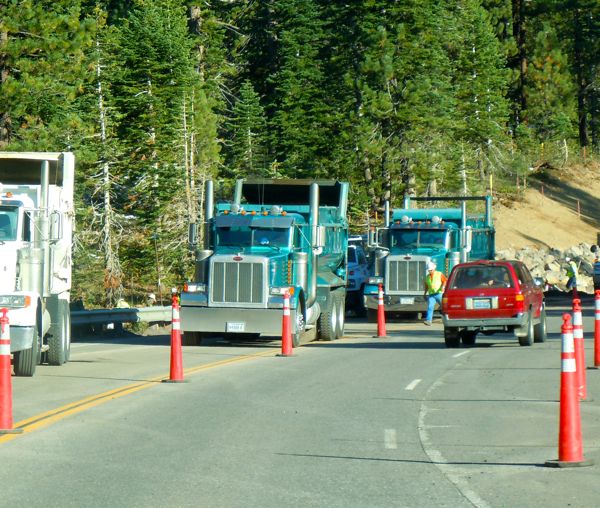
Lanes on Highway 267 between Northstar and Kings Beach are reconfigured. Photo/LTN

Lanes on Highway 267 between Northstar and Kings Beach are reconfigured. Photo/LTN

Caltrans says 15-minute delays are likely on Highway 267 on Oct. 14 between 7am-3pm and on Oct. 15 from 7am-6pm.

Crews are grinding and paving from shoulder to shoulder as part of a maintenance project.

The one-way traffic controls are from one-quarter mile south of Upper Horse Coral to the Brockway Summit.

The state transportation department is also in the middle of its every seven-year review of whether the 35mph speed on Highway 50 on the South Shore is appropriate. A conclusion is expected in the spring.

— Lake Tahoe News staff report


Gummy bears soaked in alcohol latest way teens get drunk

By CBS-13

WEST SACRAMENTO — Vodka-soaked gummy bears. That’s the newest way teenagers are getting drunk, and police warn it’s nearly undetectable.

It’s dangerous because the booze-soaked candy is pretty much odorless and the person eating them has no idea how much alcohol they’re putting into their system.

In less than a month, a “how-to” YouTube video has more than 17,000 views. The candy-soaked session goes over in detail how to make vodka-soaked gummy bears. Police warn the squishy multi-colored candy could have you seeing all sorts of colors if you pop and chew without a care in the world.

Police in Hollister have posted a warning on their Facebook page telling parents — especially this close to Halloween — to be on the alert for the booze-soaked bears.

Read the whole story


Gift reporting rules for Calif. lawmakers may change

By Torey Van Oot, Sacramento Bee

The state political watchdog agency is set to consider next month adopting substantial changes to rules governing gifts to public officials and staff, including exemptions from disclosure for presents received from former spouses, dating partners and longtime friends.

The proposed regulations drafted by Fair Political Practices Commission staffers affect what must be disclosed and count toward the $420 annual cap on gifts from an individual source. Registered lobbyists, who are prohibited from giving gifts worth more than $10, and firms or interests that hire lobbyists would not qualify for the exemptions.

In addition to establishing relationship categories to exempt, the proposed amendments would let lawmakers receive without public scrutiny gifts considered “acts of neighborliness” and “acts of human compassion” and update language related to bereavement, birthdays and weddings.

Tickets or event admission received in connection with a “ceremonial role,” such as throwing out the first pitch at a baseball game, would not be considered a gift.

FPPC Chair Ann Ravel said the changes are simply meant to clarify the rules and put into regulation current enforcement practices, saying most of the language comes from advice letters generated by the agency.

Read the whole story


STPUD candidates try to distinguish themselves

By Kathryn Reed

Not much separated the six South Tahoe Public Utility District board candidates in terms of their responses to questions posed to them Wednesday night. They politely sparred for 2½ hours before more than 40 people – mostly employees.

All will hire qualified disabled employees, all would prefer local contractors be hired if that were possible and is in the district’s best interest, all wish the water meter issue were more equitable, all want to make sure the district’s capital improvement projects are prioritized, and none wants to raise rates.

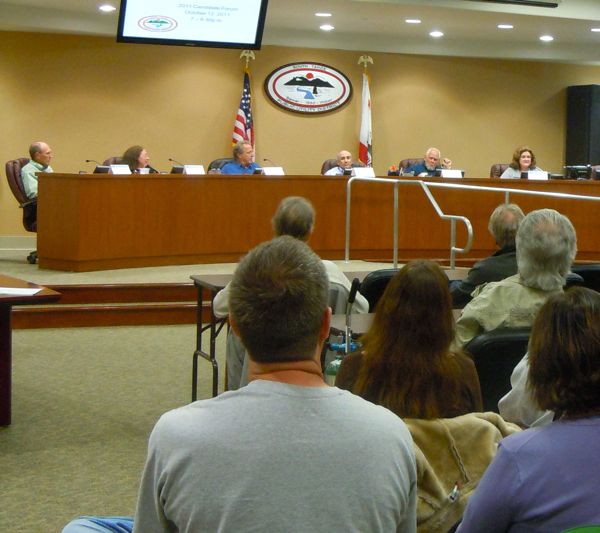
STPUD candidates answer a dozen questions Oct. 12. Photo/LTN

STPUD candidates answer a dozen questions Oct. 12. Photo/LTN

While the six were seated where the board normally sits, only two will be there in December when they are sworn in. They were positioned based on how their names will appear on the Nov. 8 ballot: Claude Gunsch, Mary Kortge, John Runnels, Randy Vogelgesang (all vying for the seat being vacated by Marylou Mosbacher); and Dale Rise and Kelly Sheehan.

Jimmy Hoggatt, engineering department manager, asked the six with all the prioritizing they want to do, where fire flow fits into their plans. The consensus was the district is not mandated to provide fire flow, what fire departments require is more than what’s really needed, the areas closest to the forest have the larger water lines and the district will do what it can to make upgrades when it can.

What set them apart Oct. 12 based on answers to questions from the audience:

• Gunsch: As a former employee, he would hit the road running – is a nuts and bolts guy, not a politician.

• Kortge: The district should look into a possible class-action lawsuit against the state because she believes the equal protection law has been violated when it comes to how water meters are being installed and billed.

• Runnels: Salaries of district employees should to be more on par with what the average ratepayer living in Lake Tahoe is making.

• Vogelgesang: Supports the 10 percent cut department heads have been asked to make, but added staff cuts may be needed.

• Rise: Postpone the $7.1 million project in Alpine County. Change the district’s health care plan.

• Sheehan: Does not advocate for a rate freeze.

The Employee Communication Committee at South Tahoe Public Utility District sponsored the forum. Soroptimist International of South Lake Tahoe is having a noon lunch forum Oct. 19. Reservations are required. For more information, call 866.801.8652.


Carbon monoxide alarms are the law in California

By Teri Mizuhara

Carbon Monoxide, aka CO, is widely known as the “silent killer” because you can not see it, taste it, or smell it.

Annually, more than 400 people die and another 20,000 are hospitalized due to CO poisoning.

So what exactly is carbon monoxide? CO is the result of combustion (burning) of a fuel such as wood burning fireplaces, gas furnace, gas water heaters, gas stoves and ovens, portable generators, barbecue grills and even your running car or truck.

The fumes from the combustion contain CO gas and when a person breaths this gas in they are subject to CO poisoning.

CalFire Amador-El Dorado Unit Chief Kelly Keenan said, “If you are exposed to high levels of CO, you may feel flu-like symptoms such as a headache, nausea, shortness of breath, dizziness/light headedness because the CO replaces the oxygen in the red blood cell and won’t allow oxygen to reach your organs. A person’s red blood cells actually bond with CO easier than it bonds with oxygen. High levels of CO can kill a person in minutes and it is the No. 1 cause of unintentional death by poison in the U.S.”

If you suspect CO poisoning, get the person or persons to fresh air immediately, then call 911. In some cases CO poisoning can cause permanent brain and heart damage.

As of July 1, carbon monoxide alarms in single family dwellings are required by state law. Minimally, you should have CO alarms outside each sleeping area and on each level of your home including the basement.

If you can afford it, put a CO alarm in each sleeping bedroom. Check the batteries monthly and change the battery twice a year. If they are plug-ins, test them once a month and if they have a battery backup, change that battery twice a year.

Don’t forget to vacuum the alarms often to keep them in proper working order.

Key points:

Never use a barbecue or outdoor space heater in your home or garage.

Do not leave your vehicle running in your garage, even for a few minutes.

Never heat your room or home with your kitchen oven.

Have your home heating system checked by a professional annually.

Have your wood burning stove or fire place professionally cleaned annually.

“If your CO alarm sounds: Get everyone out of the house and call 911. If you can’t physically leave the house, move to an open doorway or open a window and stay there. Call 911. Do not close the window or door,” Keenan said. “Never reenter the structure until the fire department has said it is OK, that is our job and we are more than happy to do it.”

Teri Mizuhara works for CalFire in the Camino office.


Public-private deal stops tons of silt from clouding Tahoe

By Anne Knowles

Installation of a stormwater treatment system at the Sierra Colina Village development site this week marks the completion of the first private-public partnership project many say is the kind of work that is key to Lake Tahoe’s future.

The system will filter, treat and store runoff from the development and from Echo Drive. It is part of a larger, Burke Creek watershed facility being built by Douglas County to treat stormwater runoff from Lake Village Drive.

According to Douglas County, the entire project will reduce sediment loads into the lake by 74 tons annually.

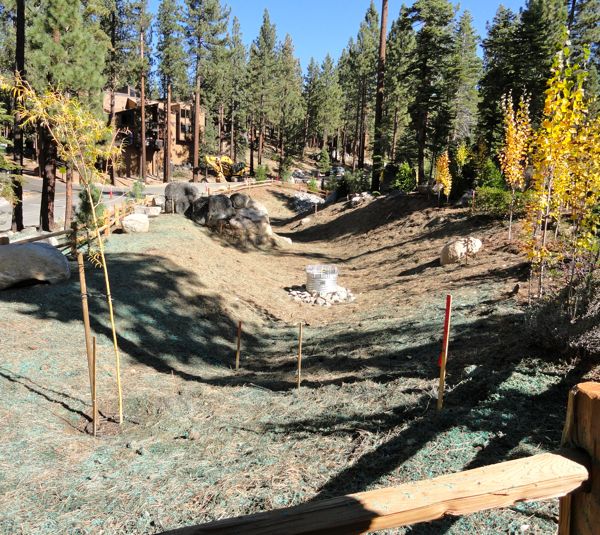
Environmental improvements are being made to Sierra Colina before construction begins. Photo/Steve Kenninger

Environmental improvements are being made to the Sierra Colina site before construction begins. Photo/Steve Kenninger

The Sierra Colina portion of the water quality improvement project (WQIP) is being paid for by the developers of the 18-acre site, Steve Kenninger and Gail Jaquish, who plan to build 41 market-rate and nine moderate-income, deed-restricted dwellings that will be Leadership in Energy and Environmental Design certified.

The private developers funded the initial $25,000 study conducted by Northwest Hydraulic Consultants of South Lake Tahoe and used by Douglas County to plan the system, and spent $250,000 for the construction of the Sierra Colina portion and will likely spend another $250,000 to maintain it. (Per agreement, the county will maintain the entire system and invoice Sierra Colina for its portion.)

The county, through an $878,600 grant from the Nevada Department of State Lands and an $876,600 grant from the U.S. Forest Service, is spending $1.76 million to design and build the rest of the WQIP. The WQIP was designed by Nichols Consulting Engineers in Stateline and built by Peek Construction, which has an office in Stateline.

“The entire project would not be as efficient or as effective if the Sierra Colina group had not decided to partner on it,” said Mahmood Azad, principal engineer/fisheries biologist for the Nevada Tahoe Conservation District and the former Douglas County engineer who is managing the project for the county. “If we’d both done separate projects, we would have spent more money and it would not be as efficient.”

With the cost of restoring Lake Tahoe clarity to 80 feet by 2025 estimated at $1.5 billion, while public funds continue to dry up, everyone from Nevada Gov. Brian Sandoval to Tahoe Regional Planning Agency Director Joanne Marchetta has been saying that the only way to achieve the clarity goal is through private-public partnerships like the WQIP project.

One obstacle, though, may be convincing private parties that the cost of such endeavors is in their best interest. The Sierra Colina project price tag, for example, was $525,000 — or more than three times the $160,000 coverage mitigation fee the developers could have paid instead.

“The TRPA code gives us two options,” Kenninger told Lake Tahoe News. “We could pay the coverage mitigation fee or create a new public water quality project if you can show you completely mitigate the runoff from the private project’s coverage.”

Kenninger said they studied the issue and found that the land, even undeveloped, was creating problems.

“The status quo was hurting water quality,” said Kenninger, and the development as planned would create an additional load.

Kenninger said he wanted to completely mitigate the load caused by the new project rather than pay the mitigation fee.

“Public-private partnerships haven’t happened before because of the cost,” Kenninger said. “We wanted to show everybody we can work together. This project is a model because future federal and state EIP funds are going away. In return, they’ll allow redevelopment to happen. And the revenue from that pays for the private contribution to treat public stormwater.”

Kenninger and Jaquish went forward with environmental improvements even though the development is tied up in court.

Azad said the county is now looking for potential other projects to work on with private parties, but that nothing has been indentified yet.

“The lesson I’ve learned from all this is it takes longer and requires more manpower upfront,” Azad said. “But it ends up being more efficient and cheaper in the end.”


Nev. bear season half over, 10 killed — none in Tahoe

By Jeff Delong, Reno Gazette-Journal

Ten bears have been killed in Nevada’s first black bear hunt, bringing the number of animals than can be taken to the halfway point.

A female bear was killed Sunday and a male bear on Monday, the first since Sept. 18. The other seven bears were all killed during the first eight days of a hunting season that commenced Aug. 20, according to officials with the Nevada Department of Wildlife.

No more than 20 bears can be taken during a season ending in late December. The season will end earlier if six females are killed, and four of the bears killed thus far have been females.

Hunting activity appears to be picking up with cooler fall weather, said Chris Healy, spokesman for the Nevada Department of Wildlife.

Read the whole story