TRPA inching toward a workable Regional Plan

By Kathryn Reed

KINGS BEACH – More time was spent discussing who should be on the Regional Plan Update Committee than where the plan is.

Considering the Tahoe Regional Planning Agency’s document dictates what the five counties and one city, along with other landowners can do in the Lake Tahoe Basin and the fact the document was due in 2007, the sense of priorities seemed skewed at Wednesday’s meeting.

What was resolved after everyone seemed to have his or her turn to talk (Governing Board member Nancy McDermid was absent) is the committee would grow by one. South Lake Tahoe’s rep Claire Fortier is now on the Regional Plan Update Committee.
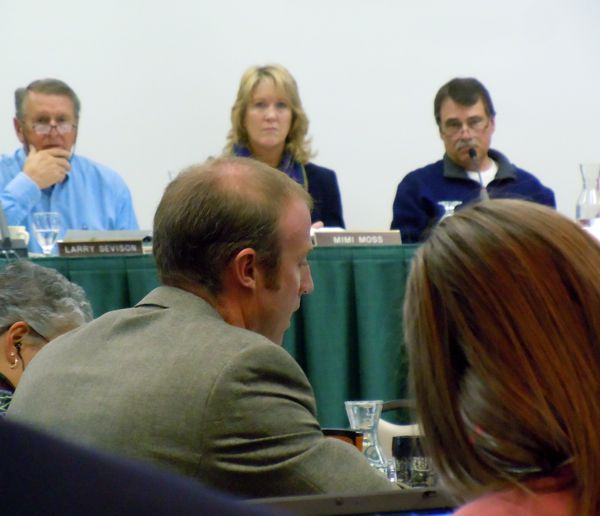
Arlo Stockham on Oct. 26 gives the TRPA Governing Board an update on the Regional Plan. Photo/Kathryn Reed

Arlo Stockham on Oct. 26 gives the TRPA Governing Board an update on the Regional Plan. Photo/Kathryn Reed

While the staff report listed when the twice monthly committee meetings will be, committee Chairman Clem Shute made it clear they are likely to change so to not put them down in ink. The meetings will be on TRPA’s website and they are open to the public.  The next one is Nov. 2 when the committee will likely take action on what staff brought to the board Wednesday – which was for discussion purposes only.

Arlo Stockham, who was brought in last month to breath life into the Regional Plan Update that everyone says will be ready for a vote in December 2012, went over the basics of where things are.

“We need to get out of detailed design issues. We need to spend our limited resources on environmental gain,” Stockham said.

Board member Byron Sher called the removal of all reference to transect zoning “a bombshell”. His colleague Tim Cashman was a bit miffed as well, saying, “I’m a fan of transect.”

To this Stockham said, “It’s a term no one understands. We don’t plan to mandate transect.”

Jennifer Merchant, who works in Placer County’s Tahoe office, voiced her frustration with transect going away because she said her staff has jumped through hoops to accommodate TRPA for years, with about $700,000 spent on developing a plan and transect is the path they were told to pursue.

Shute is concerned about the county going through the process without a Regional Plan Update. Stockham said it would not be a problem.

It turned out to be a big problem for South Lake Tahoe. The League to Save Lake Tahoe is suing the city because its General Plan does not conform to the current TRPA Regional Plan.

Although the word transect is out, it isn’t gone in theory. The plan is to promote smart growth, mixed use vibrant centers. Essentially it’s transect without calling it that. It also allows for more flexibility.

Flexible – that’s the word TRPA is trying to embrace and be associated with.

The talk is local jurisdictions will have a greater say in what is built or rebuilt in their communities. Of course, it still must fit into whatever big picture the Governing Board approves so it won’t ever be a free for all.

Local plans would be adopted to conform to the TPRA Regional Plan.

While the goals are to remove redundancy, increase delegation to local government and create one-stop shops, the details are far from in place. Enforcement is an issue that needs to be addressed.

Already on the books are more than 175 descriptions of land use for each plan area. Ideally, much of that will go away.

Land use classifications will go from five to seven, with wilderness and backcountry being added. Commercial/public service will be called mixed-use. The other existing categories are conservation, recreation, residential and tourist.

While everyone seems to have a hand in the Regional Plan Update, simultaneously the environmental documents are being prepared. The goal is the draft EIS will be out in March.

Executive Director Joanne Marchetta said it is possible to study the five alternatives while the update is under way because it’s been set up to look at the “broadest range of possibilities so we analyze the full range of impacts.”

Also on Wednesday was a workshop with the Governing Board and Advisory Planning Commission to go over the Code of Ordinances. It will be before the Governing Board for adoption in November.

The goal is to make it less cumbersome – so someone might understand it without hiring an attorney. With people understanding what to do, it might mean the consulting business in the basin will be less robust.

But it is not designed to eliminate the need for each property to have a $1,000 site analysis done to document coverage and other TRPA-isms. It’s the requirement of those types of regulations that make deck extensions so expensive and why there are so many illegal ones.

Then there are board members like Sher, who has never lived in the basin, who wants to force homeowners to do their BMPs before they can sell their property. That is a possibility in one of the alternatives being studied.

In other action:

• The board accepted the $35,000 settlement agreement with Tamara Fritz who extended her West Shore pier without a permit and installed a boat lift on the property. She will also have to clean up the vacant lot next door.

• The board resumes its meeting Thursday at 9:30am at Stateline, with the South Tahoe Greenway bike trail on the agenda along with tourist accommodation units at the Nugget.


Nevada public records policy under review

By Sean Whaley, Nevada News Bureau

CARSON CITY – A panel of lawmakers agreed today to review its new policy on responding to public records requests after concerns were raised by the ACLU of Nevada.

Rebecca Gasca, legislative and policy director for the organization, told the Legislative Commission on Oct. 26 that the new policy says those seeking public records from the Legislative Counsel Bureau need to explain why they want the information when making requests.

The policy, adopted in August, improperly shifts the burden to the person requesting the public records to show that the need for the information is stronger than any public policy interest in keeping the information confidential, she said.

Gasca had already sent a letter to the commission from ACLU General Counsel Allen Lichtenstein explaining the concerns with the policy in detail.

Assemblyman Ira Hansen, R-Sparks, a member of the commission, asked that the new policy be reviewed at its next meeting.

“We did kind of, as I recall, went through it kind of quickly,” he said. “And there is some verbiage in it that I think we probably ought to review to see if it is a little too vague and a little too open ended.”

Gasca said the new policy would incorrectly apply a Nevada Supreme Court ruling in Donrey of Nevada v. Bradshaw and impose a “balancing test” to determine if the public interest in disclosing the information outweighs the public interest served by not releasing the information.

The balancing test referenced in the court case applied to requests for criminal information, not general public records requests, she said.

“The policy of LCB that you passed at the last commission meeting actually broadly expands upon that and specifically states that requestors need to put in why they are requesting something so the LCB can balance those interests,” Gasca said.

While there was a comment from LCB Director Lorne Malkiewich that the requirement will not be used as a basis for denying requests, this statement of intent was not included in the new policy, she said.

Concerns about the policy have also previously been expressed by Barry Smith, executive director of the Nevada Press Association.

In response to the ACLU letter, Malkiewich said the new policy, “was not proposed in an effort to restrict public access, but rather to reflect the state of the law and allow us to continue our practice of prompt, complete response to requests for public records.”

“In summary, the policy that I proposed and the Legislative Commission adopted does not conflict with state law; it reflects what the Nevada Supreme Court has recognized to be the state of the law,” he said. “We will not reject a request for failure to include such a statement, but a clear explanation of a particular public interest may tip the balance in favor of disclosure of a document that might not otherwise be disclosed.”


Carson City IHOP rampage sparks call for changes to gun laws

By Martha Bellisle, Reno Gazette-Journal

Law enforcement leaders, a shooting victim and some lawmakers are calling for a review of Nevada’s gun laws after a mentally ill man shot 11 people with an assault weapon at a Carson City restaurant last month, leaving five dead.

Some states have responded to mass killings by banning assault weapons, outlawing high-capacity magazines or requiring gun owners to get licenses and release their mental health records.

And now, after the IHOP shooting, some in Nevada have called for similar state-level restrictions and bans on some firearms. But others oppose new firearm restrictions based on what they say is a knee-jerk reaction to a tragedy, and say the call for tougher laws is simply an effort to curtail the right to bear arms.

Nevada National Guard Sgt. Caitlin Kelley, one of the victims in the IHOP attack, responded to the shooting by calling for a ban on assault weapons, which can be purchased without a background check at many gun shows or through private sellers.

“I can’t imagine why we are even selling assault weapons to civilians,” said Kelley, who was shot in the foot and still uses a wheelchair. “There’s no reason for an AK-47 or an M-16 or an M-4 to be in a civilian’s home.”

Washoe County Sheriff Mike Haley agreed, saying: “I don’t see any logic to having assault weapons available to the public.” But he said banning such weapons would spark a sharp response by gun-rights advocates.

Robert Smith, president of the Nevada State Rifle and Pistol Association, said guns are not the problem — the problem lies with the people using them.

“It isn’t the weapon that’s bad, it’s the person” who commits crimes with the weapons, he said. “If you keep them away from private citizens, you’re making the private citizens unarmed targets.”

Semi-automatic assault weapons can easily be converted into automatic weapons — which are the same thing as machine guns — with a simple kit available online or at gun shows, officials said.

What happened at the IHOP “was as close to a war as most people will ever come, and they were helpless to defend against it,” Haley said. “But because of our love affair with weapons, we are subjecting the public to this type of violence. If this is going to change, the public has to stand up and demand change.”

Read the whole story


Empty fields fill farmers’ pockets

By Felicity Barringer, New York Times

BRAWLEY — Three generations of Al Kalin’s family have worked their 2,000 acres of carrots and sugar beets, wheat and alfalfa for almost a century in the Imperial Valley, a scorching swath of Southern California desert that was unfit for farming until water from the Colorado River was diverted here in 1901.

But now Mr. Kalin and his brother enjoy a choice that their parents and grandparents never had. They can continue to farm all their land, or they can stop farming some of it and earn more than $500 an acre — more than the market value of a crop like alfalfa in a given year — simply by not using the water required to nourish those crops. Water saved is sent on to thirsty cities and suburbs to the west: San Diego, Los Angeles and Palm Springs.

With water increasingly scarce in the West, some other communities are allowing farmers to sell their allotment of it for whatever price they can find, in some cases thousands of dollars for the amount it takes to grow an acre of a crop. But this comes with a hitch. Working farms provide jobs and income to their many suppliers. There are 450 farmers in the Imperial Valley, but half the jobs held by the 174,000 residents are tied to agriculture.

When land is idled, the communities around the farms can wither. Residents here point to the neighboring Palo Verde Valley, where farmers can sell more than a quarter of their water supply at much higher prices in a process they control. As a result, nearly a third of the agricultural land was not farmed this year; over time, businesses and workers have suffered.

Imperial’s fear is that a century after Colorado River water allowed this land to be a cornucopia, unfettered urban water transfers could turn it back into a desert. So the deal that Imperial water managers struck limits how much water can be sold and for what price, and it controls how much acreage is enrolled in the program and for how long.

Many farmers, including the Kalins, have resisted the temptation to sell. “There is something about that fallowing, it just doesn’t sit well with my brother and I,” Mr. Kalin said.

The Imperial Irrigation District, where they farm, controls more water than any other place in the West — about 20 percent of the annual flow of the Colorado. “It’s built into the DNA here that water is a birthright,” said Kevin Kelley, the irrigation district’s general manager.

Read the whole story


Momentum to eliminate social promotion in LTUSD

By Kathryn Reed

It’s going to get tougher to be passed from one grade to the next in Lake Tahoe Unified School District without knowing the material.

ltusdThe board on Tuesday night agreed to direct staff to begin the legwork to revise the promotion-acceleration-retention policy.

Today’s policy allows parents to have the final say if their child is held back. What is proposed is the district – through teachers and other staff – would have the ultimate say.

Early intervention is the key so students will progress with their classmates. The idea is by October educators have a good idea who is falling so far behind that it may be impossible to make up the work. South Tahoe Middle School Principal Beth Delacour at the Oct. 25 meeting relayed the story of a boy who had more than a dozen math assignments outstanding. He found out if he doesn’t pass, he probably would be a year behind his buddies. He’s turning in the work.

Superintendent Jim Tarwater said the threat of being retained is often enough to get some kids to apply themselves.

Two age groups often are most likely to be held back – at kindergarten because of emotional issues more than learning issues. This is one reason Preppy K has been successful; it eases youngsters into the rigors of school. The other level is middle school where youths start to make choices for themselves, pull away from parents and sometimes end up making the wrong decisions.

Board members agreed consequences need to be in place if kids decide to slack off. A consequence could be repeating the grade. But they also want to make sure a safety net is there to catch them and spur them along, including providing academic help.

“You don’t want them to go through middle school and be three grades behind,” Tarwater said. “There has got to be some work ethics in this world.”

Delacour echoed that sentiment – saying school is a student’s job.

Four students at STMS were held back this year; all are doing well now.

Then there are the kids who for reasons that go beyond their control need support that doesn’t involve academic tutoring. Tarwater spoke about being at the middle school earlier in the day when a sixth-grader told him her friend was suicidal and needed help. The student told him the only place she feels safe is at school.

Those are the students who need to be reached so not only do they understand the importance of an education, but also that they are important.

Another issue that keeps coming up when standardized test results come out is those students classified as English learners at the elementary level are the same EL students at high school.

“Long-term English learners is a national problem,” Ivone Larson, South Tahoe High School principal, said. “Part of it is cultural. It’s such a complex issue.”

She equated it to anyone in that room moving to China and eight years later only being at a conversational level with Mandarin instead of at an academic level. It depends on what language is spoken at home, the education level in the home and the individual’s desire to learn.

The next step is for Tarwater to meet with the leadership team and staff to come up with a plan that essentially wipes out social promotion in LTUSD. Then the board will vote on the policy.


STATA’s bumblings seeping out in court documents

By Kathryn Reed

Who owns the name BlueGo?

The trustee appointed to oversee the lawsuit involving MV Transportation and the bankrupt STATA is asking that and many other questions.

Based on David J. Thompson’s 15-page report submitted this month to the bankruptcy court in Reno, the tide is turning in MV’s favor.

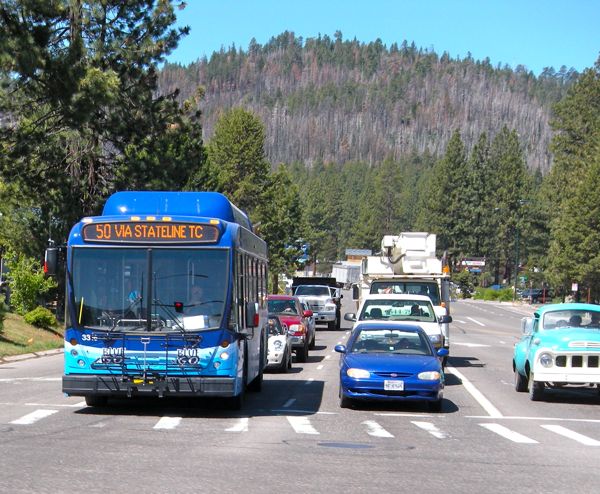
It's not known who owns the BlueGo brand. Photo/LTN file

It's not known who owns the BlueGo brand. Photo/LTN file

South Tahoe Area Transit Authority’s board voted to file for bankruptcy in August 2010. MV filed a lawsuit a couple months before that after the STATA board severed the transit operator’s agreement for it to run the South Shore bus system known as BlueGo.

“I have reconciled MV’s claimed damages for unpaid invoices of $1,979,227.52 to STATA’s records. I preliminarily find it to be accurate,” Thompson wrote in the report.

Also in the report, Thompson says, “For the two years ended June 30, 2010, STATA received approximately $2 million in operating grants. In spite of this, operating expenses consistently exceeded revenues including these grants.”

Thompson admits he still has a number of documents to review. There are 20 boxes of accounting records. What he isn’t able to discern is how STATA ended up with all the liability and Tahoe Transportation District with all the assets. TTD is now the umbrella entity – the STATA so to speak – to coordinate transit on the South Shore.

Jessica Woelfel, who represents Fairfield-based MV, would not comment on pending litigation.

South Lake Tahoe Assistant City Attorney Nira Feeley refused multiple requests for comment.

South Lake Tahoe was part of STATA, so it is part of all of the hearings. El Dorado County settled its portion of the case months ago. STATA was made up of public and private entities – from local governments to the casinos to Heavenly Mountain Resort to Ridge Tahoe.

While the lawsuit naming board members of STATA has been dropped, they are not without blame for running the agency into the ground, according to court records.

“According to the Participation Agreement, a certain level of funding based on an operating budget was to be paid quarterly in advance by the participants. It also provided that in the event of any operating shortfalls the participants would make additional contributions or suffer reduced services. The board of directors, who were also the representatives of the participants/customers, was obligated by the agreement to execute on this provision. It appears that they neither cut the services nor secured additional contributions for the shortfall,” Thompson wrote.

The report outlines how the STATA board ignored warnings of financial weaknesses in the system, as well as not having an adequate amount of staff.

At the hearing this month the adversary part of the lawsuit was stayed, with motions needing to be filed in November. Ultimately what needs to be decided is if MV’s case against STATA will remain part of the bankruptcy hearing or if it will be decided separately.

And a twist not before made public is that it’s not clear who owns the rights to BlueGo.

“Not listed on the petition is the BlueGo brand name which has some worth if it can be determined who owns it,” Thompson wrote.


Ex-Placerville mayor faces more criminal charges

By Cathy Locke, Sacramento Bee

Former Placerville Mayor David Machado’s legal woes increased Monday.

A grand jury indictment unsealed in El Dorado County Superior Court adds a new felony conspiracy charge and two misdemeanor charges to allegations filed against Machado in a criminal complaint in August.

He now faces a total of three felony counts and two misdemeanor counts in an alleged cover-up of his property dealings in Placerville.

Machado, 53, was arrested Aug. 18 for investigation of felony perjury and conspiracy after the El Dorado County District Attorney’s Office filed a criminal complaint accusing him of 30 “overt acts” of misconduct.

He did not enter a plea at an arraignment Monday, which was continued to Nov. 28. Machado’s attorney, James S. Clark of Placerville, asked for the continuance, saying he has not received documents he had requested from the District Attorney’s Office in August.

“I’m punching in the dark right now,” Clark said following the brief court appearance.

Read the whole story


Douglas County looking beyond traditional TMDL solutions

By Kathryn Reed

STATELINE – Connectivity. That is the word being used on the Nevada side of the Lake Tahoe Basin when it comes to total maximum daily load.

“The big water year really helped educate us about what is connected,” Mahmood Azad, Douglas County TMDL representative, told county commissioners. “If it is not directly connected (to Lake Tahoe), it does not need a water quality project.”

Some water that never connected to another source did last winter, while others stayed to themselves.

This is significant because the theory behind the federally unfunded TMDL mandate is all bodies of water need to be part of the treatment program. It’s the Environmental Protection Agency pushing down the policy to reduce fine sediment. In the Silver State, it’s the Nevada Department of Environmental Protection that is the overseer.

What Azad and other are discovering is not every puddle of water ends up in Lake Tahoe and therefore it probably should not have an expensive filtration system associated with it.

“With the issue of connectivity, it is disconcerting we don’t know what makes it into the lake,” Commissioner Greg Lynn said at the Oct. 20 meeting. “The state of water quality at the lake after 40 years of TRPA is still very primitive.”

Azad said, “Neither TRPA nor NDEP are leaders in connectivity.”

A major concern of the five counties and city in the basin is how to pay for the projects and then where does the maintenance money come from.

Grants secured by the Nevada Tahoe Conservation District will fund the public portion of the Nevada TMDL projects, but maintenance is an unknown.

“It’s an open ended budget and that’s scary,” Azad said of the maintenance component.

Azad said he is looking at getting grants to study ways to reduce fine sediment form reaching Lake Tahoe. One idea is use rock chips on roads because they don’t breakdown. The problem is they can’t be used on roads where the speed limit is more than 35mph because of the damage that can be done to vehicles.

Another possible study is looking at how iron naturally occurs in some waterways and how those bodies of water don’t deliver sediment to the lake.

With fine sediment from roads said to be a major contributor to diminished lake clarity, that is an area entities are focused on.

Warrior Way improvements are expected to happen next year. Bids should go out in November.

The remainder of Lake Village will also be bid next month, with work commencing in 2012.

Azad told commissioners the stormwater infrastructure mapping is continuing, with two people in the field every day.

“We will translate this into a maintenance management system,” Azad said.


Tahoe City crews moving out of 50-year-old fire station

By Katherine E. Hill

TAHOE CITY – Chief Duane Whitelaw’s eyes light up as he talks about the new, modern fire station being built on a hill above Tahoe City. The 22,000-square-foot facility spread over three levels is in stark contrast to the antiquated fire station that was built in 1961 for an all-volunteer fire department.

“Most facilities during that era were designed for people to drive in to the station” to respond to calls, says Whitelaw, who heads the North Tahoe Fire Protection District. “With growth and development in the district, we needed to take a more permanent approach to providing emergency services.”

North Tahoe Fire Chief Duane Whitelaw will move his crew into the new station by the end of the year. Photos/Katherine E. Hill

North Tahoe Fire Chief Duane Whitelaw will move his crew into the new station by the end of the year. Photos/Katherine E. Hill

The new Station 51, being called a public safety center rather than a fire station due to its multi-use design, has been designed to meet the growing demands of the district, which stretches from Tahoe City to Alpine Meadows, Homewood and Kings Beach.

The center will not only house the fire department, it also will serve as the region’s emergency command center in case of disasters.

One of the most important things about the new facility is its location – on Fairway Drive off Highway 89. The current station was built in the heart of Tahoe City. In the 50 years since it was built, Tahoe City has become a popular tourist destination, drawing a steady stream of pedestrian and automobile traffic through the small town year-round. In the summer, traffic is often at a crawl through Tahoe City, making for potentially dangerous conditions for firefighters to leave the station to respond to calls.

“We’ve outgrown the current building and it’s a real safety problem,” Whitelaw says.

Work has been progressing quickly on the station since construction began in May 2010, and it will be completed by the end of the year. The NTFPD financed the $10 million cost for the project, which includes $6 million for construction. The station has been designed to be a silver LEED building, which is an international system for green building. The station is being built using a mix of cement fiber board, metal, wood and plaster, and will use solar panels for hot water and to offset its energy use.

The new station features five bays, including room for a $1.4 million aerial ladder truck that will be needed to respond to calls at taller structures in the works in the district including the proposed village at Homewood Mountain Resort, the affordable housing project under construction in Kings Beach, as well as the Kings Beach Town Center. There also are expanded administrative offices, conference rooms that will be open for use by the public, and sleeping quarters, a fitness area, living room, dining room and kitchen for the fire crews that will be living at the station during their shifts. The new station also will be ADA accessible; the current station is not.

Station 51 crews average four to seven people per shift and respond to fire and medical emergencies, with 80 percent of their work devoted to medical calls, Whitelaw says. Firefighters, however, are cross trained to respond to fires, water rescues, forest fuel reductions such as the chipping program, and hazardous materials, as well.

Future of the old fire station

While work continues to complete the new facility by the end of the year, local officials are trying to decide what to do with the site of the current fire station. The station is part of the West Commons Beach area, which sits on a

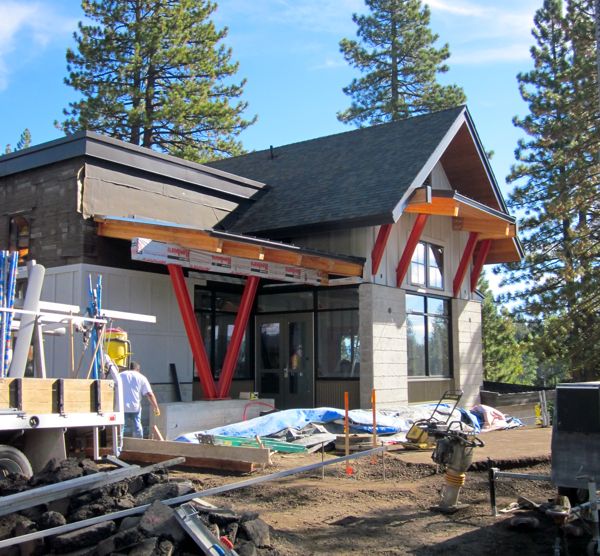
The entrance to the new station.

The entrance to the new station.

bluff overlooking Commons Beach. The site includes the visitors’ center and the Tahoe City Community Center, which is home to the North Tahoe Arts Center. Last week, officials unveiled four proposed alternatives for public use of the site that ranged from using the fire station’s footprint for a park to razing all of the structures to build an interpretive center that would become a regional attraction.

“Our concerns were using the building for community uses,” TCPUD General Manager Cindy Gustafson said. “There are a wide range of opportunities that are nowhere near reality.”

The proposals presented raised concerns from many in the community who attended the meeting. People raised questions about the lack of on-site parking and concerns over the removal of the Community Center, which houses the only public art center in the North Tahoe-Truckee region.

Bill Briner, who has served in countless public offices through his decades residing in the region and was on the Placer County Board of Supervisors when the fire station was built, was most vocal in his opposition to any plan other than razing the fire station.

“We committed to tearing down the firehouse when they were done, and I don’t want to spoil it by building multi-story buildings,” Briner said. “That’s the whole idea of tearing the fire station down … opening up the view.”

More than a dozen people in the audience applauded Briner’s call to open the view to Lake Tahoe. Since the fire station was built in 1961, however, landscaping with tall trees and brush on Commons Beach obscure a clear view of Lake Tahoe from the fire station site.

Briner also said he was opposed to any plans that would conflict with existing businesses in Tahoe City, citing three of the proposals that call for food and rental concessions.

The site on which the three structures were built was given to the “people of Tahoe City” by President Ulysses S Grant in 1872 and eventually became the responsibility of the Tahoe City Public Utility District. The Community Center was built in 1938 and the fire station in 1961.

When the new station was built, the fire district committed to tearing down the station once it no longer needed the building, which spurred the need for local officials to address the future of the site. As well, neither the station nor the Community Center is ADA accessible. The Community Center also operates at a $50,000 deficit each year and is in need of more than $100,000 in repairs to the roof, siding and heating system.

A steering committee has been tasked to work with consultants to come up with proposals for the site and the project is being spearheaded by the TCPUD and the North Lake Tahoe Resort Association. The committee is made up of representatives from local government agencies, the fire district, the North Lake Tahoe Historical Society, U.S. Forest Service, California Tahoe Conservancy, California State Park and others.

The consultants presented four proposals for the site. All of the proposals call for razing the fire station and adding an elevator for ADA accessibility. None of the proposals calls for adding any additional parking to the site, but rather call for shuttle drop-off locations.

Plaza least costly

The first, and least costly, would be to demolish the station and visitors’ center and to build a plaza on the fire station site, dubbed the Lake Welcome Plaza. The Community Center would be renovated and a new two-story addition built to house the visitors’ center and expand exhibit space for the Arts Center. There also would be an ADA accessible path leading down to Commons Beach. It would cost between $4 million and $6 million.

Theater would serve community

A Community Center Plus option at $7 million to $8 million calls for renovating and expanding the Community Center into a multi-use facility that could house exhibit space and an interpretive center, as well as food and kayak and paddleboard concessions to offset operation costs. A basement level would be added to provide space for the concessions. The fire station and visitors’ center would be torn down and a 165-seat theater would be build to be used for performances, conferences and other uses.

The last two proposals take a different approach to the site, with options that would develop a destination attraction in Tahoe City to draw in tourists.

Tahoe Experience at pavilions

The third proposal calls for four enclosed pavilions connected by a center corridor to be built on the site dubbed as Tahoe Experience Pavilions at a cost of $11 million to $13 million. All of the existing buildings would be torn down and the Community Center could be relocated to another, unspecified location. The pavilions are inspired by the Tahoe City waterfront in 1900 and would provide space over three levels for exhibits, administrative offices, a store, multi-use facility, and food and rental concessions, with outdoor courtyards between each pavilion. The bottom floor would be situated at lakeside with Commons Beach.

Hydrarium most radical proposal

The fourth proposal, The Hydrarium, is the most costly and the calls for the most radical change for the site. At a price tag of $23 million to $25 million The Hydrarium concept calls for a four-story interpretive, state-of-the-art center that could attract hundreds of thousands of visitors each year to Tahoe City and be a revenue source, said Barry Howard, one of the project’s consultants. The Hydrarium stands one story taller than the current structures on the site; the bottom level would be below street level at lakeside.

The modern, circular design of the build would provide exhibit space with interactive exhibits and a multi-use theater with Lake Tahoe as the central theme of the facility. There also would be space for food and rental concessions, and could provide jobs in the community.

The steering committee passed out a community survey at the meeting, which also is available online, to get public feedback on the proposed alternatives before moving forward. The committee will likely meet within the next month to evaluate public input before deciding how to proceed, said Kelli Twomey, TCPUD spokesperson. The committee will also have to evaluate construction costs and potential funding sources before making any decisions, she said.

A video of the meeting, along with the community survey, will be available online this week, or call (530) 583.3796 for more information.


Dogs bite people on both sides of El Dorado County

By Cathy Locke, Sacramento Bee

El Dorado County Animal Services officials are searching for dogs that bit people in two separate incidents, one in South Lake Tahoe and the other in Grizzly Flat.

On Oct. 16, a 17-year-old boy was bitten about 6:30 p.m. on the South Tahoe Middle School soccer field on Al Tahoe Boulevard in South Lake Tahoe. The teenager and his brother began playing soccer with the dog’s owner and another man, and the dog suddenly bit the youth, according to an El Dorado County Public Health Department news release. The dog owner left the area and no information was exchanged.

The dog is described as a larger size dog, possibly a golden retriever-boxer mix. The dog’s owner is described as white, in his late 20s with light-colored hair.

Read the whole story