Vail Resorts’ mountain division does well, but company posts quarterly net loss

By Ed Sealover, Denver Business Journal

Vail Resorts Inc. had a net loss of $55.7 million, or $1.54 per diluted share, during the first quarter of its 2012 fiscal year, but officials are optimistic about a good ski season and believe reorganization of its lodging division will yield increased revenue in future years, CEO Rob Katz said Wednesday.

The Broomfield-based company typically suffers losses during the first quarter of each year, when its resorts aren’t open for skiing or snowboarding.

But the loss for the three months ending Oct. 31 was 29.5 percent larger than the loss for the same period in 2010, which was $43 million, or $1.20 per diluted share. That was due largely to costs associated with the acquisition of the Northstar resort in Truckee in October 2010 and a legal settlement, co-president/CFO Jeff Jones said in an earnings call Wednesday.

Vail officials reported revenue increases in some segments, such as a 21.8 percent jump in mountain division revenue driven primarily by increases in dining, retail and summer activities at its four Colorado resorts — Vail, Beaver Creek, Breckenridge and Keystone — and Heavenly and Northstar in California.

Read the whole story


Lahontan: Lake clarity at any cost, no matter what

By Kathryn Reed

More than one billion dollars — $1,000,000,000 – is what has been spent on the environmental improvement program in the Lake Tahoe Basin. The goal is to increase lake clarity.

Clarity is not declining as rapidly as it once was, but it’s still declining each year. That makes the programs winners, according to Lahontan Regional Water Quality Control board members and staff.

And Executive Director Harold Singer readily admitted at the Dec. 6 Lahontan board meeting that nothing his agency has made entities do can definitively be said to have improved that clarity.

El Dorado County Supervisor Norma Santiago, center, addresses the Lahontan board Dec. 6 while her board stands next to her. Photo/Kathryn Reed

He said he’s often asked by money suppliers – the federal government in particular – what they are getting for their money. He points to projects.

“We’ve never been able to quantify those actions as they relate to water quality,” Singer said.

The EIP program started after then-President Bill Clinton’s visit to Lake Tahoe in 1997 – hardly the Dark Ages when it comes to scientific know-how.

It is just now that Lahontan believes it has developed the tools to quantify how projects impact lake clarity.

On Tuesday, the Lahontan board on a 5-0 vote (Keith Dyas was absent and three board positions remain vacant) agreed to approve the stormwater-urban runoff permit system for South Lake Tahoe, El Dorado County and Placer County.

The board didn’t see any point in extending the process — despite the passionate pleas of the three jurisdictions. While in some ways the process has been lengthy and years in the making, the comment period closed Nov. 30 — less than a week before the board voted.

It’s through the permitting process that Lahontan will monitor projects on the California side of the basin.

But it was also said by board member Amy Horne to the three jurisdictions, “If in 2016 we don’t see the level of improvement we expect, it’s not your problem.” (That is the year the five-year permit expires, though the program continues, and permits will need to keep being acquired.) In other words, if that occurs, fine sediment won’t be the culprit after all.

Sediment reduction is what the city and two counties are tasked with. Regulators in the basin all say the majority of fine sediment clouding Lake Tahoe is from urban runoff.

But there is more than just particles reaching the lake.

Horne said weather is an uncontrollable factor in all of this. The more snow, the more runoff, thus the cloudier the lake gets. Droughts provide for the best clarity readings.

Midway through the 4½-hour meeting at Embassy Suites, Brendan Ferry, senior planner with El Dorado County, explained how his jurisdiction believes its measuring tools are superior to Lahontan’s.

While the permit allows the jurisdictions to use other tools, Lahontan must approve those tools. But no one could give the multiple speakers for the county an answer as to how it will be determined if their tools are legit, and if a decision will be made so the first deadline of March 15 to provide Lahontan with mandated information can be met.

The county is so incensed with what is going on that the Board of Supervisors recessed their regular meeting for all to attend the Lahontan meeting. As Supervisor Norma Santiago read the prepared statement, her colleagues flanked her in a show of support not usually seen.

“What has been created in the TMDL Management System are tools that lack scientific backing, that are not integrated, are duplicative and/or inefficient and will require tremendous administrative staff time to analyze and implement,” Santiago said.

She went to say, “If you go through with the draft permit today, the predictable result for the county, because of these unnecessary administrative costs, will be layoffs in the transportation department, roads will not be fixed in compliance with the requirements and we may be forced to do very little toward our common goals.”

Money is a big issue for the jurisdictions. It could cost up to $2 million a year to do what Lahontan is asking. Federal money is evaporating. No one knows how the requirements will be implemented without cash to do so.

Lahontan staff has told Lake Tahoe News the Total Maximum Daily Load and now the stormwater permit are not unfunded mandates. But when someone or an agency is told they must do something and no money is provided to do the mandate – that makes it an unfunded mandate.

Ken Grehm, director of Placer County Public Works Department, said he’s been disappointed how Lahontan staff repeatedly say money can’t be an issue. He added that if any useful discussions are going to happen in the future, there must be the realization money is important.

“Water quality is just one of the services we provide,” Grehm said. This sentiment is shared by all jurisdictions.

Lahontan board member Don Jardine, who is also on the Alpine County Board of Supervisors, understands shrinking budgets. He didn’t use the phrase “unfunded mandate” but at the end of his remarks he ultimately said, “things have been put on us that we have to do.”

It’s the federal Environmental Protection Agency that is responsible for the TMDL program throughout the country.

Jacques Landy, who works for the EPA out of an office in the TRPA building, told the board his agency is satisfied with the permit as written and voiced support of its approval.

Sarah Hussong-Johnson, South Lake Tahoe director of engineering, echoed her colleagues in questioning Lahontan’s tools and the money needed to satisfy the permit.

(Hefty fines that could not be articulated well at the meeting will be levied against the jurisdictions if they don’t satisfy the permit requirements.)

Hussong-Johnson also said the city is frustrated with the “lack of a concerted effort with the near shore.”

This is where the growing muck and marked lack of clarity is visible standing on the beach. This isn’t the clarity that is measured. If it were, the numbers would be worse. Instead, a disc that looks like a white dinner plate is lowered into the water from the middle of the lake. That’s how the experts determine lake clarity.

————–

The Lahontan board resumes its meeting this morning at 8:30 at Embassy Suites. The main topic is pesticide use.


Financial cracks emerge in South Tahoe ice rink deal

By Kathryn Reed

Even though the South Lake City Council in August voted to change the recreation bonds from non-taxable to taxable to allow the private ice rink operators to legally make a profit, the board with the ultimate power to ensure that happens didn’t have its first meeting about the issue until Monday.

And now it’s a race to get the legal, financial and political agreements in order so the bonds are sold before March 1. Changes can only take place March 1 and Sept. 1 – the debt payment dates.

Discussion was delayed by Measure R proponents (aka the JPA board) because they did not want voters last month to confuse rewriting the original Measure S to allow a different disbursement of funds with changing the actual bonds. The two are completely separate issues.

The recreation JPA board (Hal Cole-Norma Santiago-Debbie Henderson) listen to county Auditor Joe Harn. Photo/LTN

But not trusting the voters to understand the difference has created this accelerated pace to not only refinance the bonds, but to make them taxable.

Even though Dec. 5 was the first time the JPA board officially heard the proposal, the financial advisor who was officially hired that same day is already on the Dec. 13 agendas for the South Lake Tahoe City Council and El Dorado County Board of Supervisors.

While there is no proving meetings occurred between John Upton, the lone paid employee of the South Lake Tahoe Recreation Facilities Joint Powers Authority, and the three board members, Hal Cole (South Lake Tahoe rep), Norma Santiago (El Dorado County), and Debbie Henderson (Tahoe Paradise Resort Improvement District) seemed well versed about the issue. Had Upton spoken to each member individually, it would be considered a serial meeting and thus a violation of California’s opening meeting law. The public’s business is supposed to be conducted in public.

With Cole showing up 35 minutes late – saying he didn’t know about the meeting until someone called him when he was a no-show at 1pm Dec. 5 and that he hadn’t seen the agenda – he was the most adamant the financial advisor be paid a fixed price over the discounted hourly rate that was proposed at the meeting.

Mark Northcross with Northcross-Hill-Ach in Marin County was the financial advisor in 2001 when bonds for the South Shore recreation measure were first sold. He’s the guy being used this time, too.

Northcross told Lake Tahoe News he was first contacted by Upton this summer. Northcross said he is the one who brought up the issue of the IRS having a problem with a private entity making a profit off tax-exempt bonds and that they would need to be changed.

The board on Monday agreed to hire Northcross on a $37,500 contingency fee. This means he only gets paid if the bond sale goes through. Stradling, Yocca was hired as bond counsel at $50,000 under the same contingency agreement.

However, County Auditor Joe Harn told the board the county shies away from these types of agreements, and instead opts for time and materials contracts.

“The fewer people who have a financial interest in the bond closing, the better,” Harn said. Harn is also the JPA’s treasurer.

Cole said he prefers knowing what the cost will be upfront; believing the financial advisor will operate within set parameters (that will be decided at the Jan. 20 JPA meeting) and therefore the JPA has no risk involved.

However, Northcross at the meeting said his excitement for being back in South Tahoe made him want to reduce his hourly fee. Normally it’s $300/hour. He said he’d charge $275/hour, with a cap of $15,000. The cap, he later told Lake Tahoe News, could then be negotiated if more work were needed.

Despite this offer of a reduced price, the JPA board didn’t even discuss it, nor did the members do any math to figure out how many hours might be needed to do the job and what the better deal would be. The JPA was more concerned with knowing the price than getting the best price.

South Lake Tahoe’s city attorney, Patrick Enright, and finance director, Christine Vuletich, were in the audience. They didn’t offer any advice.

Northcross and Harn had a brief conversation while waiting for Cole to arrive – knowing they were within earshot of this reporter. Northcross said to Harn that while refinancing may save 3 to 4 percent, or $15,000 annually, many in his field say not to go forward until the benefit is 5 percent. He didn’t share that with the JPA board.

The current interest rate on the bonds is a bit more than 5 percent.

All of this work could save property owners about 75 cents a year on their $18 bill for Measure S/R.

But City Manager Tony O’Rourke followed Harn at the podium, saying it’s not just about the JPA taxpayers to consider.

“We want to enable private investment at the ice rink – that benefits the taxpayer,” O’Rourke said. With the city losing $100,000 on the rink in some years, it wanted to unload it, even though taxpayers paid for it through Measure S property fees.

The JPA board also agreed to allocate up to $15,000 to have a current bond rating secured – a necessary requirement to go forward. The last rating was AA-minus. That money comes out of the JPA’s administrative budget – though it’s still taxpayer money.

Another big question mark is what entity will sell the bonds. Northcross said going with BBVA Compass bank might be the best option instead of the traditional bond market.

Northcross pointed out that depending on what deal is struck, it’s possible the city will have to come up with $400,000 to pay down the debt in order to make it all work. There are certain legal requirements with reissuing the bonds and the taxpayers not incurring a financial burden.

O’Rourke said if it came down to that, “We’ll have discussions with the operator (of the rink).”

If there is a buy down cost, that wouldn’t be known until February – which would leave only a matter of days for the city to come to a deal with the ice rink operators.

And if the city is left footing the bill, that would be those same taxpayers incurring the costs that O’Rourke said are saving money with the ice rink not being controlled by the city.

“We wouldn’t be here if the ice rink contract weren’t a problem,” Cole said early in the meeting.

——————–

Dates to know:

• Dec. 13: South Lake Tahoe City Council and El Dorado County Board of Supervisors at their respective meetings hear presentation from Mark Northcross

• Jan. 17: South Lake Tahoe and El Dorado County discuss and vote on legal documents and official financing

• Jan. 19: Tahoe Paradise board votes on legal documents and official financing

• Jan. 20: JPA board votes on legal documents and official financing

• Feb. 28: Bond sale expected to close.


Nevada improves data collection to measure student achievement

By Sean Whaley, Nevada News Bureau

CARSON CITY – Nevada has made significant progress in the collection of the data needed to measure and help improve student achievement, but still has work to do in putting the information to work for parents, educators and policy makers, a national report says.

The Data Quality Campaign’s (DQC) seventh annual state analysis, Data for Action 2011, shows that states have made major progress building their student data systems. More states than ever – 36, up from zero in 2005, including Nevada – have implemented all of DQC’s 10 Essential Elements of Statewide Longitudinal Data Systems.

The report shows however, that states continue struggle with the 10 State Actions to Ensure Effective Data Use, which are intended to ensure that stakeholders can effectively use the data to increase student success. The report shows that Nevada has implemented five of the 10 actions.

The report shows, for example, that 41 states do not link workforce data with K-12 data and 38 states do not link workforce data with post-secondary data.

Aimee Guidera, executive director of the Data Quality Campaign, said in a telephone conference call today that there has been substantial progress since the first report was released in 2005 in collecting the date needed to improve student achievement.

“Not only have states made progress, but for the first time, the campaign is thrilled to announce that we believe that every single state in this country now has the capacity to empower education stakeholders,” she said. “And that means everyone from parents to policy makers, with quality data to inform decision making. And that is an amazing, gaming changing opportunity for us in the education sector.

“People have complained they didn’t have access to information, they didn’t know where to get the information, we didn’t have the quality information, and we think that we are now at a turning point in the conversation to say there are no more excuses, we now have this data that is collected at the state level,” Guidera said.

But states need to do more to provide access to the data to teachers, parents and policy makers, and to make sure they know how to use the information, she said. Only eight states are now providing individual student information to parents, and only five are providing information to students themselves, Guidera said.

States particularly need to ensure the date can be effectively used by teachers, she said.

Gov. Brian Sandoval has made quality data collection a priority of his administration because of its importance in measuring education reform efforts.

He issued an executive order Oct. 7 asking a state education panel to take the necessary steps to create a system to track students through their school years, following in the steps of other states as part of an overarching effort to reform education and improve student performance in Nevada.

That group, the P-16 Council, met Nov. 9 to begin the process of creating a usable data system to track student performance from early childhood education through college.

In remarks at the meeting, Sandoval said: “This is a historical moment, this is really a crossroads in the state of Nevada and we have some great opportunities to really improve the delivery of education in this state.”

Guidera said Nevada is in the middle of the states with five actions met. The average nationwide is 4.6.

Nevada has a lot of momentum in the data collection effort, having this year put the 10 elements in place, she said. The challenge now is to ensure the state data system is meeting the needs of the local school districts as well as other users, Guidera said.

Keith Rheault, Nevada’s superintendent of public instruction, said the state was able to meet the data quality elements through a federal grant received in 2008. The funds ran out this year but the agency is pursing another federal grant to continue the process.

“Our next step will be to link the data systems of K-12 education to the (Nevada System of Higher Education) NSHE data as well as the workforce database (managed by the Department of Employment, Training and Rehabilitation),” he said.

Rheault said the new grant would be used to meet several of the missing action items cited in the report, including the linkage of the systems as well as building a statewide data repository.

“Quality educational data that is readily available to school districts and the public is a key element in improving schools and the achievement and success of our students,” he said.


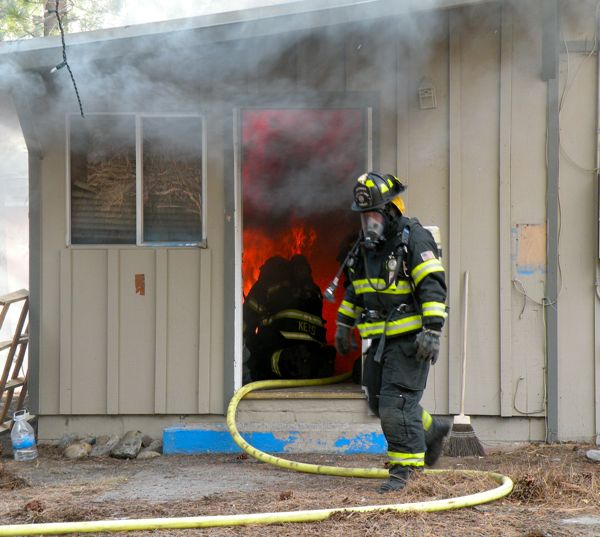
House engulfed in flames — all to train firefighters

By Kathryn Reed

Smoke fills the air. It’s hard to see. Flames all around. It doesn’t matter. No time to think; just time to instinctively react. Someone up the narrow stairs is injured. It’s going to take careful maneuvering to get them out of the engulfed house on a gurney.

Situations like this happen all the time throughout the world. In South Lake Tahoe it happened twice last week and is expected to again later this week.

It’s all about training.

A house on Third Street near the corner of South Avenue is being used by South Lake Tahoe and Lake Valley firefighters as live fire training. Barton Health recently acquired the tiny structure with the intention of demolishing it. (It’s a short walk to Barton Hospital from the property.) The South Lake Tahoe Fire Department negotiated a deal to use it for training, with the end result being less debris for Barton to be responsible for hauling away and area firefighters more ready for a real structure fire.

South Tahoe firefighters use a house on Third Street for training. Photos/Sallie Ross-Filgo

“There are some dangers associated with this sort of training, but it’s important to do it in a controlled way so they can gain some experience, feel some heat, so to speak, and overcome whatever challenges are associated with it so when they encounter the real deal they will be able to think more clearly and operate at maximum capacity,” Fire Chief Brian Uhler told Lake Tahoe News.

Firefighters are required to always be training, but the high-risk, low frequency emergency situations like fires, and water and rope rescues are more difficult for a small department to train for. This is because with only three shifts it’s not possible to take one off duty for training and have the others cover. That scenario works in metropolitan locations.

And until recently the command structure within the city’s department did not put an emphasis and priority on real-world training.

When Uhler took over in August he met one-on-one with firefighters as well as in group settings.

Firefighters discuss how best to approach the live fire.

“One question I asked was, ‘When was the last time you deployed from the station and went to and actually put a fire out during a training session?’ I got some blank looks and answers like ‘never’. I asked how long they’d been here and some said five years,” Uhler said.

Thus began a new era within the South Lake Tahoe Fire Department.

But part of the sparse real fire training had to do with logistics as much as higher ups. Plus, lack of a training facility and no overtime are other hindrances to getting ample time in.

While Lake Valley has an extremely old burn tower at its station on Highway 89 in Meyers, it’s not the same as a house. Carson City has a training site that uses propone, so the flames can be turned on and off. But that does not give firefighters the same feel as being in a room to watch and feel how fire behaves, builds and refuels.

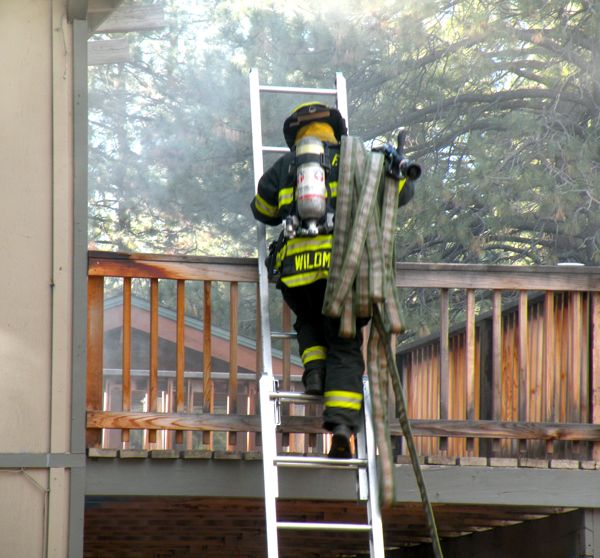
A firefighter drags a hose to the second floor balcony.

Jim Drennan, who was is one of three South Tahoe fire captains to be promoted to shift commander, is now in charge of training for the city’s troops.

“The formula in my perfect world is to have the resources and funding to have a true training facility nearby and take one engine company out at a time and send them to the training tower,” Drennan said.

While he recognizes that perfect world is not going to exist anytime soon, he plans to actively seek more structures to burn for training purposes. Plus, it’s cheaper for owners to have firefighters burn it to the ground compared to having a demolition team haul away the debris.

Of course there are a ton of hoops to jump through to do something like this – permits from the Tahoe Regional Planning Agency, Air Resources Board and others. The Barton house had to be certified not to contain asbestos before it was ignited.

In the past, South Tahoe has coordinated with Tahoe Douglas firefighters to train to extinguish a high-rise fire. Wildland training has been done in conjunction with Tahoe Douglas, Lake Valley, U.S. Forest Service, CalFire and CalStar.

With the house on Third Street, firefighters are cutting holes and doing ventilation work before the fire is set. Then, as flames roar, the men and women sling hoses over their shoulders, dragging them to the second floor – all to get used to what that’s like fully suited up, oxygen masks on and heat intensifying.

“There have been some learning opportunities, some corrections were made in how things were done,” Uhler said.

To that end he says the training has been a success.

Next up is for the third shift to get its turn at training – that will be Dec. 7 or Dec. 8.


Obama quietly organizing in Nevada while GOP contenders ignore Silver State

By Anjeanette Damon, Las Vegas Sun

As most of the political world’s attention is captured by the circus of the Republican presidential primary, Barack Obama’s campaign has been assiduously reactivating the formidable infrastructure that helped drive him to victory four years ago.

Obama and the Democratic Party have been pouring organizing resources into battleground states such as Nevada, recruiting volunteers, building social networks, holding outreach events and registering voters.

That same machine will be used to identify and turn out supporters next November.

And the bad news for Republicans, who have largely skipped Nevada in their primary contest, is Obama doesn’t have much work to do to rejuvenate an organization he has been maintaining since he won the state by 12 points four years ago.

“The organizing efforts actually have been pretty good and pretty consistent for a couple of years in Nevada,” said Chip Evans, former chairman of the Washoe County Democratic Party, a key swing county in Nevada. “To some extent, they’ve expanded the Democratic base of activists beyond the typical folks we’ve usually seen.”

Ronni Council, a Democratic strategist in Las Vegas, said the same has been occurring in Southern Nevada.

Read the whole story


Nevada tax revenues better than projected

By Sean Whaley, Nevada News Bureau

CARSON CITY – Despite ongoing volatility in Nevada’s gaming industry, strong consumer buying is helping to keep the state’s tax revenues on an even keel four months into the new two-year budget, state officials say.

Nevada’s taxable sales increased by more than 10 percent in September, the first double-digit gain seen in the report since December 2010, which was helped by a large natural gas pipeline project in Northern Nevada. Before that, the last double-digit gain came in February 2006.

Car sales were up 9.4 percent in the September report, while business at bars and restaurants was up 14.5 percent and the accommodations category was up 21.6 percent.

Compared to the May 2011 Economic Forum projections, the general fund portion of the sales and use taxes is about 1.45 percent or $2.9 million above their forecast for fiscal year 2012 through September, according to the Nevada Department of Taxation.

Gaming revenues have been a disappointment, however, due largely to the influence the card game baccarat, played by high rollers on the Las Vegas Strip, has had on the monthly casino win.

The September gaming win was down 5.9 percent compared to September 2010 due in large part to baccarat.

Michael Lawton, senior research analyst for the Gaming Control Board, said gaming percentage fee tax collections so far this fiscal year are 7.4 percent, or nearly $16 million, below the forum projections made in May.

The live entertainment tax collected on major casino shows is about $6 million above projections, however, which reflects the increase in visitor volume seen in the casino industry, he said.

“Every indication we get from the operators is that the business models are good,” Lawton said. “Everyone knows visitation is up, hotel revenues are up, air traffic is up. It’s just the volatility of baccarat tends to rear its ugly head. We’re expecting it to come back in, like I said, October and November, to have a couple of strong months to finish off the calendar year.

“We’re only four months in so I don’t think we need to push the panic button yet,” he said.

Nevada state Budget Director Jeff Mohlenkamp said in a statement that overall tax revenues are tracking above projections. The budget office will continue to closely monitor the collections, he said.

“We are very pleased with the increases in sales tax revenues,” Mohlenkamp said. “For fiscal year 2011 we experienced increases of 5.3 percent over fiscal year 2010. Further, sales tax has increased on (a) year-over-year basis for 15 consecutive months and is on track to outpace projections during fiscal year 2012.”

The 2012 fiscal year began July 1. Nevada’s legislatively approved budget runs for two years, through June 30, 2013. Sales and gaming taxes together make up about 58 percent of the revenue needed to support Nevada’s $6.2 billion, two-year general fund budget.

Nevada’s fiscal position appears to mirror that of many other states, according to a new report from the National Association of State Legislatures.

The organization’s “State Budget Update: Fall 2011” analysis shows that only four states, California, Missouri, New York and Washington, are reporting a new budget gap since the fiscal year began. Fifteen states had reported budget gaps at this time in 2010.

“Better revenue performance is driving the improvement in state finances,” the report said. “Collections in most states have stabilized or are growing, and the general revenue outlook for the remainder of the fiscal year reflects confidence in continued modest growth.”

The report said of Nevada: “Nevada continues to experience economic challenges related to high unemployment and a weak housing market. Although these conditions have been considered in the state’s revenue forecast for the current biennium, continued weakness in employment could affect sales tax and payroll tax revenues.”

The Nevada Economic Forum, a panel of five financial experts who set the tax projections that must be used to balance the state budget, will meet Dec. 13 to hear an update on the state’s tax collections. It cannot change the projects made in May that were used to finalize the current budget, however.


Vail Resorts changing its focus of lodging division

By Mark Harden, Denver Business Journal

Vail Resorts Inc. this week announced a “strategic shift” for its lodging division, saying it plans to focus on adding properties at its ski resorts and Grand Teton National Park rather than elsewhere, and anticipates staff cuts in the division.

“The current economic and real estate environments make it difficult to realize the benefits of growing our lodging division outside of our mountain resorts and the national parks,” Rob Katz, chairman and CEO of the Broomfield-based company, said in a news release. “We believe that by narrowing the focus of our lodging segment, we will provide an enhanced experience for our guests and better long-term profitability.”

The new policy appears to have the greatest impact on RockResorts, a company luxury lodging unit that operates hotels at Vail Resorts’ ski areas as well as across the Caribbean.

The company statement said Vail Resorts will “no longer seek to add new RockResorts-managed properties which are located outside of the company’s six mountain resorts.”

Read the whole story


Medi-Cal cuts could affect skilled nursing centers, including Barton

Publisher’s note: In regards to the following article, Barton Health Vice President of Finance Dick Derby said, “The affects of Medi-Cal cuts to Barton Health’s Skilled Nursing Facility is currently under review. Currently, the estimated annual negative impact to Barton is $1.5 million. The Skilled Nursing Facility at Barton Memorial Hospital is always at capacity and generally has an average of 47 out of 48 ‘residents’ funded by MediCal. We understand the great benefit this facility has on our community and are researching options to assist us in continuing to provide this vital service to our residents. In addition, the California Hospital Association has filed an injunction against the reduction and the case is to be heard on Dec. 19.”

By Darrell Smith, Sacramento Bee

Hospital officials in California’s rural counties say the latest round of cuts to Medi-Cal could leave thousands of the state’s neediest people without access to medical care.

At particular risk, they say, are elderly and long-term patients who need skilled-nursing care.

“This is a real crisis,” said Anthony Wright, executive director of Health Access California, a patient advocacy group. “We have been skeptical of providers’ claims in other areas, but not with Medi-Cal cuts.”

The cuts are intended to save the budget-strapped state up to $623 million. Reimbursement rates will be trimmed as much as 10 percent, but earlier cuts blocked by legal action could also take effect, making the effective reductions 20 percent or more.

“This is a difficult decision,” said Norman Williams, a state Department of Health Care Services spokesman. “California is facing a tremendous shortfall. There is pain.”

Medi-Cal is the name for the state’s federal Medicaid program. It serves more than 7 million low-income Californians – approximately 20 percent of residents – and costs the state more than $41 billion a year, about 13 percent of the budget.

Read the whole story


Romney faces tough decision regarding online gambling

By Karoun Demirjian, Las Vegas Sun

When it comes to reviving the economy in Nevada, politicians of different stripes hawk different solutions.

Democrats say the future is in green energy. Republicans advocate loosening regulations on mining permits. But both parties in this state agree that one of the biggest potential employment engines is legalizing online poker: Do that and, as Sen. Harry Reid once put it, you’ll create “jobs, and lots of jobs.”

Nevada’s front-runner in the Republican race for the presidential nomination, however, isn’t yet sure.

“I haven’t come down on online poker,” Romney said in an interview with the Sun last month, explaining he had yet to take a serious look at the issue.

But then he did something most politicians don’t: He voluntarily offered a promise, and a timeline, to deliver a more specific answer.

“I will, and I’ll give you an answer,” he continued. “Before the caucuses come along, I’ll give you an answer on that.”

The pledge sets up a potentially thorny decision for Romney: Say you’re against legalizing and regulating the online poker industry, and you risk upsetting some Nevadans; say you’re for it, and you risk upsetting the Church of Jesus Christ of Latter-day Saints.

Romney’s Mormon faith has stirred headlines elsewhere in the country, but in Nevada, there’s never really been any fault lines between Romney’s politics and his personal faith.

“Romney does not talk about it … and I don’t think Nevadans cared. Being a Mormon isn’t that much of an issue in Nevada or anywhere in the West, for that matter,” said Eric Herzik, professor of political science at UNR. “Mormonism is a longtime part of Western society.”

Read the whole story