Pier installation signals start of Tahoe Beach Club

By Kathryn Reed

STATELINE – Not wanting their permit to become invalid, Tahoe Beach Club developers decided to create even more phases for the multimillion dollar project at the end of Kahle Drive in Stateline.

Putting in about 60 feet of what will be a 159.6-foot pier this fall and adding the remainder next year satisfies the Tahoe Regional Planning Agency’s stipulations that movement on a project must begin within three years of the permit being issued. Had the developers – Tom Castaneda and Bob Mecay – not put in the floating pier this fall, it would have meant starting at the very beginning with the permitting process.

That would have been a costly endeavor – time-wise and financially.
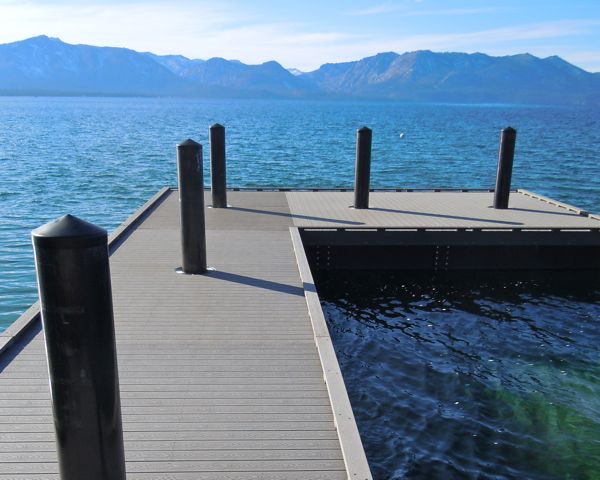
The floating section of the Tahoe Beach Club pier was installed this fall. Photos/Kathryn Reed

After all, five agencies were involved in the pier – TRPA, Douglas County, Nevada Division of Environmental Protection, Nevada Division of State Lands, and the Coast Guard.

Three engineering firms had to witness the pylons being put in to make sure the soil wasn’t disturbed in a manner that would stir up the sand and be bad for Lake Tahoe. Some who witnessed the installation said a person walking in the water would have kicked up more sand.

The pier, when complete, will have a price tag of about $400,000 – with a substantial portion of that figure involving the permitting process.

Castaneda and Mecay wanted the entire pier to be floating, but said TRPA rules no longer allow that to happen because with the dock abutting the shore it could present erosion concerns.

The Tahoe Beach Club pier brings the number of floating docks on Lake Tahoe to 19. The 275-foot one at the Hyatt in Incline comes all the way to the shore.

“New engineering designs will allow us to lower and raise the entire 100-foot second section,” Castaneda said. “We will do that two to three times a year so that it is at the same level of the floating pier. Then there will be an adjustable ramp between them.”

Walking on the Trex platform it’s hard to know it’s floating because of the stability. Steel sits on top of the floats.

With waves several feet high a couple weeks ago, the dock’s stability passed Mother Nature’s test.

The end of the floating section is 36-feet-long – twice what the walkway is. This is so larger boats could dock to pick up residents for excursions.

The main project

While the economy has stalled Castaneda and Mecay’s plans to remove the mobile home park and replace it with 143 high-end housing units, they see a ray of light in the financial world.

“The financial investment atmosphere is a lot better than a year and two years ago,” Castaneda told Lake Tahoe News. “We would like to lock up some construction financing. I would safely say next year and then begin the project.”

This would be the first multifamily residential property built on the shores of Lake Tahoe in nearly 30 years.

Tom Castaneda and Bob Mecay are eager to build Tahoe Beach Club.

Castaneda and Mecay bought the 19-acre parcel in 2002 for about $12.6 million. At that time 155 mobile homes occupied most of the land that sits between Rabe Meadow and the University of Nevada 4-H Camp. Now at Tahoe Shores Mobile Home Park there are 18 vacant lots, about 30 people leasing spots from the property owners, and another 110 mobile homes the two men own and lease out. It has been a mobile home park since the 1960s.

While 39 units were supposed to be real phase 1, that will now be phase 3. One hundred and fifty people are on a waiting list to buy into the development. They want one of the units that range from 1,250- to 4,000-square-feet.

The luxury villas will have 19 to 30 units in a building, while the estate homes have four to eight units. The lower level will be one story, while second floor units will have a loft.

The later will be designed to have the feel of a brownstone.

The architecture, though, is old-style Tahoe, with influences of the Tahoe Tavern running throughout.

In all, there will be 14 buildings along one mile.

A private 40,000-square-foot beach club on the water is part of the plans. It will include a restaurant, full spa, workout area and facilities for banquets-parties-weddings. The club will offer memberships to the public.

Club members will have access to the 270-foot stretch of private beach.

Before the market crashed it was estimated the project would cost $260 million, with units selling for between $1.5 million and $4 million. Those numbers could change depending on when construction and sales begin.

Environmental benefits

Environmental improvements are part of the development’s goals as well. The project ties into the Rabe Meadow restoration work being done by Sierra Colina, Douglas County and the U.S. Forest Service.

Today about 11,384 pounds of sediment reach Lake Tahoe from the acreage owned by Tahoe Beach Club. When the project is built out that will be reduced to 632 pounds of sediment a year.

Two acres of stream environment will be restored. Currently it’s paved.

Greenhouse gas emissions will be cut by 63 percent. Much of that will be accomplished by getting rid of the woodstoves that are now in use.

The goal is to treat the water onsite through an intricate filtration process.

Native vegetation will be used in the landscaping.

Power lines will be put underground. Part of the deal is the developers will also bury the line on the 4-H site.

The whole project is going after silver LEED certification.

ngg_shortcode_0_placeholder (Click on renderings for full picture.)


Nevada business leaders want clear plan for economic diversity

By Sean Whaley, Nevada News Bureau

CARSON CITY – A member of the panel charged with helping diversify Nevada’s economy and create jobs said he wants to make sure the state plan developed to achieve these goals is a practical working document.

“I hope we have concrete definitions that go beyond buzzwords,” said Sam Routson, a member of the state Board of Economic Development.

The plan needs to be a working tool that the public can easily understand, he said. Routson is the chief administrative officer for the agricultural company Winnemucca Farms.

Routson’s comments were in response to a report prepared by the Brookings Institution and SRI International that was delivered to the panel in early November. The report, intended to help the state with its economic diversification efforts, identifies seven economic sectors, some already in existence such as gaming and tourism, and some emerging, such as clean energy, where Nevada should focus its efforts.

The report has come in for some criticism for failing to offer clear definitions of the economic sectors the state should be focusing on to diversify the state economy.

Ray Bacon, executive director of the Nevada Manufacturers Association who testified in the public comment section of the meeting of the panel, which includes Gov. Brian Sandoval and several private sector appointees, said he would have sent the report back because of a lack of clear definitions.

The report discusses advanced manufacturing, which used to be called high tech, but it lacks specifics, Bacon said. Other sectors, such as clean energy, are not defined either, he said.

“We can’t get there until we know what the definitions are,” Bacon said.

Steve Hill, executive director of the Governor’s Office on Economic Development, said the intent is to produce a state plan that is a working document and one that is “direct and to the point.”

The plan is being developed now and is expected to be released in January.

Board member Kathleen Drakulich asked Hill if the Brookings/SRI report provided enough detail to prepare the state’s plan.

Hill said the report has provided a great deal of depth, but that the state’s plan won’t be prepared based solely on the information. Hill said he is reaching out across the state to get comment for the plan.

Because it is being generated so quickly, Hill said the first draft of the plan will not be a complete answer to Nevada’s economic diversification efforts. As the board and state officials learn more about what works, the plan will be updated to reflect that knowledge, he said.

After the meeting Thursday, Sandoval said the criticisms are welcome.

“Now Mr. Hill, who is writing that plan as we speak, has heard some of the concerns of folks with regard to the Brookings report,” Sandoval said. “That report was never supposed to be the end-all, be-all with regard to economic development in the state of Nevada. It was going to identify our strengths, our weaknesses, which clusters we should be focusing on and essentially provide the foundation for our state economic development plan. And I think it accomplished just that.”

The state’s plan of action will be a business plan with the measurements needed to ensure accountability, he said.


Casino owners rank high with LGBT community

By Steve Green, Las Vegas Sun

Casino operators Caesars Entertainment Corp., MGM Resorts International and Wynn Resorts Ltd. scored high Thursday in a ranking of companies for their support of lesbian, gay, bisexual and transgender (LGBT) equality.

The Human Rights Campaign Foundation in Washington, D.C., issued its annual Corporate Equality Index assessing how corporations treat LGBT employees and how supportive they are of the LGBT community.

The scores are based on returned surveys and cover factors such as whether a company has an inclusive work environment and commitments to the LGBT community through philanthropy and supplier diversity.

The rankings also consider whether equal health care coverage is provided for LGBT employees and their families including domestic partner benefits.

Numerous Fortune 500 companies such as 3M Co., Apple Inc. and UnitedHealthGroup Inc. received perfect 100 percent scores.

Among the nation’s casino operators, three participated in the survey and were ranked: Caesars received a perfect 100 and MGM Resorts International and Wynn Resorts each received a 90. (Harrah’s and Harveys in Stateline are owned by Caesars Entertainment.)

Read the whole story


No burning allowed today in Washoe County

A burn ban is in effect for Washoe County because of air pollution.

The Washoe District Health Department issued the code red at 8:25am Sunday.

People with respiratory problems and children are advised to stay indoors.

The health department cited a high level of fine particles in pollution in air, or particulate matter smaller than 2.5 micrometers in diameter.

— Reno Gazette-Journal


Why medical marijuana reduces traffic fatalities

By Maia Szalavitz, Time

States that legalize medical marijuana see fewer fatal car accidents, according to a new study, in part because people may be substituting marijuana smoking for drinking alcohol.

Sixteen states and the District of Columbia, have legalized medical marijuana since the mid-1990s. For the new study, economists looked at 1990-2009 government data on marijuana use and traffic deaths in the 13 states that had passed legalization laws during that time period. The data were from the National Household Survey on Drug Use and Health and the National Highway Traffic Safety Administration.

Comparing traffic deaths over time in states with and without medical marijuana law changes, the researchers found that fatal car wrecks dropped by 9 percent in states that legalized medical use — which was largely attributable to a decline in drunken driving. The researchers controlled for other factors like changes in driving laws and the number of miles driven that could affect the results.

Medical marijuana laws were not significantly linked with changes in daytime crash rates or those that didn’t involve alcohol. But the rate of fatal crashes in which a driver had consumed any alcohol dropped 12 percent after medical marijuana was legalized, and crashes involving high levels of alcohol consumption fell 14 percent.

Read the whole story


Control of invasive species in Lake Tahoe remains a struggle

By Geoff Schladow, Heather Segale, Allison Gamble and Andrea Wilkins

Research efforts to control invasive aquatic species from around the world continue to threaten the Lake Tahoe Basin. Work to identify the most effective mechanisms for controlling the populations of Asian clams continues. Current projects are focused on controlling the spread of the Asian clam population in Emerald Bay. Researchers are working collaboratively to experiment with different methods of eradication.

Research is also being done in the southern part of the lake on Curlyleaf pondweed. Curlyleaf pondweed is an invasive aquatic weed that is increasing in density in Lake Tahoe. It reproduces via vegetative shoots called turions, which are extremely resilient and hard to kill. Researchers are working on identifying possible means for controlling the spread and reproduction of this invasive species using bottom barriers of several materials (jute, rubber, and polyethylene). Three sets of these barriers are currently out in Lake Tahoe.

Scientists continue to discover new things about Lake Tahoe. Photo/LTN

Post-doctoral researcher Allison Gamble is also studying the effects of Mysis shrimp on Tahoe’s food web. Mysis were deliberately introduced into Lake Tahoe in the 1960s. Mysis are a big predator on smaller zooplankton, and also an important food source for fish. They undertake a diel (within 24-hours) vertical migration every night, where they migrate from the bottom of the lake to close to the surface, one of the longest vertical migrations in nature. If we scaled the Mysis to the size of a human, it would be equivalent to moving 50 miles (or 1,700 laps of a pool) vertically up and back down in a single night.

Gamble is comparing the historical densities of Mysis shrimp to current densities in Lake Tahoe, Emerald Bay, Fallen Leaf Lake, and Donner Lake, and addressing how ecosystem characteristics influence food web dynamics. Her research will provide new insights into the evolving Tahoe food web.

PARASOL

The lake was buzzing with scientists from around the world at Tahoe for a weeklong research project called “PARASOL” (PARticulates And SOlutes in Lakes). Scientists and students from TERC, the EPA National Health and Environmental Effects Research Laboratory in Duluth, and the University of Kyoto completed a circumnavigation of the lake, taking measurements of all the physical properties and the suspended particles and organisms that comprise the lake’s ecosystems. These measurements will allow us to know how the near shore water quality changes around the lake.

In addition, the team devoted extra effort to studying conditions in Marla Bay and Emerald Bay. The work was exhausting, often starting before 6am, and usually ending well after dark. TERC supporters allowed research vessels to be moored at their private docks around the lake, saving valuable time and gas.

Hundreds of samples went from lake to the lab all week.

The data from this project is still being analyzed at Tahoe, Davis, DRI, Duluth and Kyoto.

Microbial plankton survey

Three weeks following PARASOL, a new group of collaborators filled TERC’s laboratories to conduct a preliminary survey of the microbial plankton of Lake Tahoe. This time the visitors were from Laval University in Quebec, and UC Santa Cruz. Most of what lives in Lake Tahoe is invisible, and it has only been in the last few years that tools such as flow cytometry and DNA sequencing have allowed us to see this hidden world and learn about how it is impacting the features of the lake that we do see. The results of this experiment are being used as the basis of new proposals to the National Science Foundation.

Input of sediment

TERC post-doctoral researcher Alexander Forrest and graduate student Paul Stumpner deployed a current-measuring instrument in Lake Ohau in New Zealand in November 2011. This collaborative project with Richard Levy of GNS Science will provide information on the input of sediment to this glacial lake. What we have learned at Lake Tahoe is being applied in many parts of the world. Conversely, what we learn in New Zealand will help us to better understand Lake Tahoe.

Geoff Schladow, Heather Segale, Allison Gamble and Andrea Wilkins are with the UC Davis Tahoe Environmental Research Center.


Analysts: Nevada casinos will do better in 2012

By Steve Green, Las Vegas Sun

Analysts at accounting firm PwC have boosted their growth projection for Nevada’s casino industry.

In the PwC (PricewaterhouseCoopers LLP) annual gaming forecast distributed this week, the firm projected Nevada gaming win of $10.4 billion in 2010 to reach $10.7 billion this year and then expand to just shy of $13 billion by 2015.

Predictions are for more traffic to Nevada casinos in 2012. Photo/LTN file

The 2015 projection would about equal the level reached in 2007 — the high-water mark for Nevada casinos before the recession.

That figure represents an annual growth rate of 4.9 percent. By comparison, PwC a year ago projected an annual growth of 4.1 percent over five years.

“The momentum generated in 2010 (a 0.1 percent increase) is carrying over in 2011 and we project that the market will increase by 2.8 percent for 2011 as a whole,” PwC said in its report.

The PwC forecast for Nevada gaming revenue in the next few years is aggressive, with its analysts expecting growth of 4.1 percent in 2012 and 4.6 percent in 2013. Projections for gaming taxes in the state budget, in comparison, are for growth of 2.5 percent in fiscal year 2012 and 2.7 percent in fiscal year 2013.

Despite the higher projected growth rate in Nevada casino revenue, PwC expects Nevada’s share of the $57.5 billion U.S. gaming market to decline slightly through 2015 because of competition from Asia and as regional casinos pop up in populous U.S. markets such as Massachusetts and potentially Florida.

Read the whole story


California, Nevada join forces to fight mortgage fraud

By Alejandro Lazo, Los Angeles Times

An alliance by California and Nevada to jointly investigate misconduct and fraud in the mortgage business further divides efforts by the nation’s attorneys general to bring the home-lending industry to account for improper foreclosure practices.

The two states, which are at ground zero of the nation’s housing bust, will join forces to probe allegations of foreclosure fraud and other wrongdoing in the mortgage markets, including the packaging and selling of mortgage-backed securities by Wall Street players and scams by smaller players offering to help troubled borrowers.

The agreement to work together, announced in Los Angeles on Tuesday by California Atty. Gen. Kamala D. Harris and Nevada Atty Gen. Catherine Cortez Masto, comes a week after Massachusetts said it was suing the nation’s five largest mortgage servicers over alleged foreclosure illegalities. The moves escalate pressure on the nation’s biggest financial institutions already in high-level negotiations with a coalition of state attorneys general over their alleged abuses.

“This potential partnership with the Nevada AG may cover a fairly broad array of issues,” said Paul Leonard, California director for the Center for Responsible Lending. “Having the prospect of investigations and litigation could very well raise the stakes for — and put added pressure on — the financial institutions to come up with a settlement.”

California bowed out of the multistate talks this summer, saying the banks were being let off the hook too easily, and has opened a number of probes into the mortgage business. Harris characterized her pact with Masto as an intensification of her efforts. The offices will share litigation strategies, evidence in ongoing investigations and link both the civil and criminal teams of each office.

Read the whole story


North Shore man arrested in BASE jumping incident

By Ed Fletcher, Sacramento Bee

A second Olympic Valley BASE jumper has found himself behind bars after a nighttime attempt off Placer County’s Foresthill Bridge.

Authorities, responding to a reported suicide attempt Wednesday evening, spotted a man parachuting off the span.

“We got a call saying that she was at the bridge and was going to jump. That is what led us out there,” said Sgt. Dave Johnson of the Sheriff’s Department.

It turns out the woman was not at the bridge and did not make an attempt on her life, authorities said.

Wednesday evening, authorities say, the Placer County sheriff’s helicopter crew spotted Aaron McGovern, 39, of Olympic Valley just as he was about to jump from the span.

Read the whole story


Stateline casino win up in October

People parted with their money up and down Nevada in October. Casinos reported an 8.1 percent increase – or $961 million – compared to a year ago.

Even Stateline clubs posted a gain. They were up 4 percent from 2010; taking in $15.7 million. When the weather is nice in Lake Tahoe in the fall, the tourists keep coming.

Stateline casinos do well in October. Photo/LTN file

The Las Vegas Strip was up 13.3 percent, downtown Vegas up 8.1 percent, and Reno down 12.3 percent, according to the Nevada Gaming Control Board on Friday.

— Lake Tahoe News staff report