Homewood to enter 21st century with mega-upgrades

By Kathryn Reed

TAHOE CITY – What’s another 10 hours when five years had already been spent on the revitalization plan of Homewood Mountain Resort? For Art Chapman, sitting in a room all day Wednesday listening to people praise and rip apart his plan was worth it.

Chapman is president of JMA Ventures, the San Francisco-based development company that bought Homewood in summer 2006.

The Tahoe Regional Planning Agency Governing Board on Dec. 14 did not cast a dissenting vote on the multiple motions needed to adopt the final environmental impact statement, Regional Plan amendments and phase 1 of the Homewood Mountain Ski Area Master Plan.

Homewood will be getting a mid-mountain lodge with a public swimming pool.

Despite the approval after the marathon meeting at Granlibakken resort, a lawsuit was filed Dec. 8 to stop the project based on California Environmental Quality Act violations. The California Clean Energy Committee filed the suit against Placer County and JMA.

“The committee’s supporters on the West Shore will be directly and adversely impacted by the implementation of the project and by the failure of the Homewood Mountain Resort Ski Area Master Plan EIR/EIS to adequately evaluate the impacts of the project and to propose mitigation as required pursuant to CEQA,” according to the Homewood CEQA writ.

People who would be on the defendants’ side at the meeting told Lake Tahoe News they believe the final EIS addresses the concerns brought forward in the lawsuit and are not concerned.

Chapman after the meeting spoke one-on-one with Lake Tahoe News.

“If this thing were to work, it had to be embraced by the locals. And that’s why we will be successful when we build it,” Chapman said of the Homewood project.

Of the 22 people who spoke against it, most were in favor of doing something, but on a much-reduced scale.

Fifty people spoke for the project, while two others fell in the neutral category.

Of the people who spoke, more full-time residents want the project, while part-time/second homeowners don’t want things to change. It was obvious the economic situation in the Lake Tahoe Basin – loss of jobs, little or no public-private investment, and declining school enrollment – has taken its toll on locals. They are the ones welcoming JMA – its money, jobs and goal of revitalizing the West Shore.

Much was said of how this project will be good for the economy and good for the environment. It will create 500 construction jobs and 180 year-round positions.

Chapman expects to add nearly $7 million to the tax rolls, and between $16 million and $20 million to the West and North shore economies on an annual basis.

“I hope it rejuvenates the local economy,” Chapman said.

He and his wife have lived in Placer County for the last eight years. When the residences are built at Homewood he intends to move there.

As a skier, Chapman told Lake Tahoe News one day he hopes to be able to ski between Homewood, Alpine Meadows and Squaw Valley. As it is, with JMA entering a partnership with KSL Capital Partners to create Squaw Valley Holdings so the two entities jointly operate Alpine and Squaw, putting Homewood into the mix could be easy.

“It’s not that far from the top of Homewood to the backside of Alpine,” Chapman said. He likes the idea of making Tahoe be like European ski resorts with linking terrain.

The environment

Environmental gains beyond what is required are part of the plan. At the meeting Chapman agreed to monitor for 10 years how well the impervious materials are working.

By the time it’s built Chapman expects to have secured an LEED gold certificate for construction.

Improvements have begun, with 88,000 fewer pounds of sediment reaching the lake. By build out that number will rise to 154,000 pounds a year.

TRPA standards are that filtration systems must sustain a 20-year event, or 1 inch of rain in an hour.

Homewood’s plans call for twice that standard.

Generators will be able to be used on the snowmaking equipment if there were ever a wildfire, so firefighters have an added mechanism to put out the flames.

Coverage – a concept unique to the basin that stipulates how much land can literally be covered – will be reduced by 235,000 square feet. The TRPA regulation has to do with erosion.

Project concerns

Issues brought up at the TRPA meeting included how much traffic the development will create. The lawsuit also takes issue with the numbers Placer County approved which are the numbers JMA cites.

JMA says winter vehicle miles traveled will decrease based on providing free dial-a-ride service to local residents and the idea guests will be staying longer than a weekend visit. The bus will run from the Y in Tahoe City to Emerald Bay. Ten will run in the winter, three in summer. Beaver Creek is the model being used.

“Upon completion, traffic will be less than five years ago,” Chapman told the board. He also said state statistics show traffic along that stretch of Highway 89 has decreased by 30 percent in the last 10 years.

Board member Mara Bresnick liked the League to Save Lake Tahoe’s idea to have rigorous monitoring of traffic. That was agreed to. The number of vehicles coming to Homewood will be tracked. Tracking use alternative transportation and surveys of guests about how they got to the resort are also part of the conditions.

Concerns are traffic on busy weekends will be even worse going through Tahoe City at the Y. While plans are in the works to reroute Highway 89 so it no longer goes over Fanny Bridge, construction of a bypass is years away and at this rate is likely to occur after Homewood breaks ground. (The TRPA Advisory Planning Commission is scheduled to discuss Fanny Bridge on Jan. 11, 9:30am at the Stateline office. JMA is required to pay for part of the bridge bypass.)

Added on Wednesday was the agreement to monitor traffic for 20 years.

Board members Clem Shute and Bresnick insisted if vehicle numbers are higher than what’s expected, there must be some sort of mitigation requirements and that phase 2 doesn’t get approved without addressing vehicle issues.

Everyone agrees summer vehicle trips will increase because the resort as it is today is used for one season.

A water taxi will be operated by Homewood in summer. Free bikes will be available. Completion of the West Shore bike trail is being paid for by JMA. Access to hiking will be allowed — whereas now people would be trespassing. The pool at mid-mountain will be open to the public. And the mid-mountain lodge will be open year-round.

The goal is Homewood will be a year-round destination.

But not everyone is thrilled with that. One of the 74 speakers talked about how it’s ridiculous to build a five-star resort at a three-star mountain.

Chapman, on Wednesday and at the multitude of meetings he’s spoken at, said if the project he wants to develop wasn’t approved, he would have to shutdown the ski resort which will be 50 years old in 2012.

The tiny West Shore town with its population of 744 residents could grow if and when the project is developed. A late revise by JMA was to eliminate the fractional ownership units and make them whole ownership.

The development

Chapman expects to break ground on the $500 million project in summer 2014. Final designs and permits need to be secured between now and then.

The plan calls for 56 residential condominiums, 47 multi-family condominiums, 48 ski-in/ski-out chalets, 13 workforce-housing apartments and a 75-room hotel.

Chapman made no bones about the real estate portion being the financial driver for everything else. He said with Homewood having about 100,000 skier visits a year, the average skier spending $6.48 on food and beverage, and no profit in ski school, it will take the real estate to drive on-mountain improvements. Even with an estimated increase of 18,400 skiers a year upon build out, Chapman said it wouldn’t substantially move the bottom line.

“Before we can borrow money for real estate, we need to prove the ski area is viable. This little ski operation can’t afford to spend $12 million on lifts or $10 million on a mid-mountain lodge or $13 million on (a base) lodge,” Chapman said. “Real estate is the golden goose.”

The EIS/EIR and amendments that were voted on can be found on the TRPA’s website.


Change in leadership in South Lake Tahoe government

By Kathryn Reed

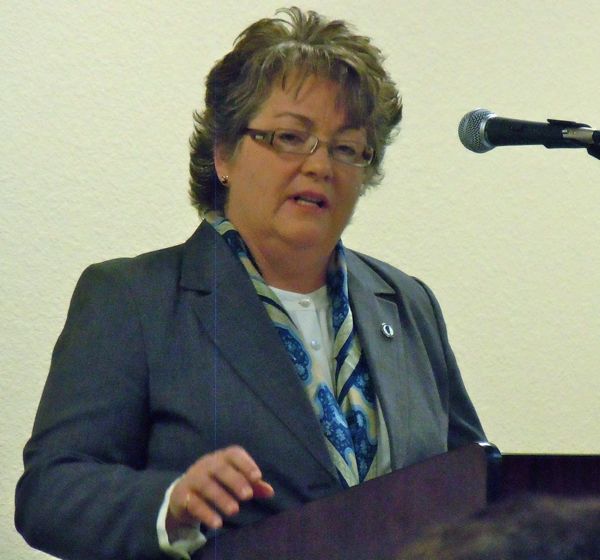
In a bit of a power play, Claire Fortier was voted by her colleagues on the South Lake Tahoe City Council to be mayor for the next year, but moments later stripped her of two committee appointments she coveted.

It’s fairly routine for the mayor pro tem to become mayor the following year. This is what happened this year. And now Tom Davis is the mayor pro tem.

In South Lake Tahoe much of what the mayor does is ceremonial. A big part of her job is to help set the agenda and run the meetings.

But as the city keeps raising its collective voice to be heard in Sacramento and Washington, D.C., the role of the mayor is becoming a bit more important than years past. In large part this has to do with how others view the words “mayor” and “councilmember” – the former carries a bit more clout.

Claire Fortier is mayor of South Lake Tahoe for the next year. Photo/Kathryn Reed

Fortier said she is ready to lead South Lake Tahoe by building an innovative team, helping reshape the region, and making Tahoe an affordable and fun place to live.

But one person cannot do it alone.

Along with the reorganization of council leadership came changes to committee assignments. This past year Fortier and Councilwoman Angela Swanson were on the Legislative Committee. Now it will be Swanson and Davis.

The Strike Force Committee, something that evolved out of the CEO club, will now have Councilman Hal Cole instead of Fortier. Swanson and Councilman Bruce Grego each lobbied for the appointment, too.

Fortier retains her seat on the Tahoe Regional Planning Agency Governing Board. But she wanted the other committee appointments.

Her colleagues said she couldn’t do it all and the responsibilities of the city needed to be shared.

While clearly a bit of politics was being played during the committee appointments, the five practically had a group hug at the end of meeting – saying how wonderful it is to work together.

Later that night they all took time to celebrate Fortier’s ascension to the post of mayor at a reception at the Black Bear Inn.


LTUSD, LTCC brace for their share of $1 bil. in midyear cuts

By Kathryn Reed

Money for teachers, textbooks and lights for the classrooms remain – for the most part – but there may be no students sitting at the desks. That’s because school bus funding has been cut throughout California.

Gov. Jerry Brown on Tuesday pulled the trigger to slice millions of dollars from K-14 education.

When the state budget was passed last summer a number of assumptions came with it – like how much revenue would flow to Sacramento. Those predictions are so far off — $4 billion short – they forced the governor to implement midyear cuts.

State budget cuts could force LTUSD buses to sit idle in the garage. Photo/LTN file

For Lake Tahoe Unified School District it means losing $382,000 in transportation dollars.

“Our fear is what do the cuts look like next year,” Superintendent Jim Tarwater told Lake Tahoe News after the Dec. 13 school board meeting adjourned at 10:30pm. “We have to bus people.”

The state isn’t saying if these are one-time cuts or ongoing for 2012-13.

And that bus money is  just what is used to get students to and from school. Athletic and special education busing expenses are separate categories.

Students can’t drive their friends to school until they’ve had a driver’s license for at least a year. The price of a gallon of gasoline is also filling up bus seats instead of the student parking lot. LTUSD buses 1,800 students, while about another 2,000 get to school some other way.

CFO Deb Yates was slated to give her first interim budget report to the board Tuesday night before it was known Brown would be dropping the hammer on education.

Throughout the state K-12 is about to lose $79.6 million in general funding, plus another $248 million in transportation. Community colleges will lose $102 million.

“It could have been worse,” Yates said.

Education officials knew when the state budget was passed that midyear cuts could occur. K-12 could have been hit with a $1.5 billion loss.

In addition to the bus dollars being whacked, the governor is taking about $14 per pupil, or roughly $56,000 from LTUSD.

To bridge the gap, reserves will be used. This was anticipated when the board approved its budget. But it will bring the reserves below the desired 3 percent minimum.

If the cuts are ongoing, this will drastically affect future budgets. As it stands, LTUSD is forecasting a shortfall of more than $416,000 for 2012-13.

But there is enough in reserves to survive the next two years with the known cuts.

Earlier Tuesday night the Lake Tahoe Community College board met.

LTCC President Kindred Murillo anticipates the college will face a $50,000 loss for this academic year. More than four times that amount was set aside for anticipated midyear cuts.

The big change will be the increase statewide of semester units going from $36 to $46 (which would be adjusted for LTCC’s quarter system). This fall semester fees went from $26 to $36.

All told, the governor came up with $1 billion in cuts. But that barely touches the projected 2012-13 deficit of $13 billion.

Other entities taking a hit include:

• $100 million each to the UC and CSU systems. (They each were cut by $650 million in the state’s current budget.)

• $100 million to In-Home Supportive Services.

• $15.9 million to county libraries.

• $100 million to services for people with developmental disabilities.

• $102 million to public safety services, including prisons.

• $8.6 million to Medi-Cal.

Most of the reductions announced Tuesday will be implemented Jan. 1, with more cuts likely to be declared by Brown after the first of the year.

One way to generate revenue is raising $6.8 billion through increasing the sales tax and raising rates on wealthier Californians. The governor wants voters to approve those taxes next November.

———–

In other action:

• Molly Blann is president of the LTCC board and Karen Borges the clerk.

• At LTUSD, Wendy David will serve as president of the board another year, with Sue Novasel the clerk.


South Shore law enforcement not tolerating impaired drivers

South Lake Tahoe police, Placerville police, El Dorado County sheriff and the CHP will be out in force during the holiday season from Dec. 16-Jan. 2 to arrest anyone caught driving drunk behind the wheel.

“‘RUOK?’ is the text message version of the often heard question, ‘Are you OK to drive?’ If you have to ask someone the question, you already know the answer,” SLTPD Sgt. Shannon Laney said in a press release. “You know they have had too much to drink or are showing signs of being “buzzed.” You know that they are not OK to drive. Asking the question doesn’t relieve you of the responsibility. Call them a cab, take them home yourself, offer your couch.”

DUI/ driver’s license checkpoints, multi-agency DUI task force deployments and roving DUI patrols are scheduled locally in partnership with law enforcement statewide and around the county during the Winter Holiday Anti-DUI Campaign. DUI checkpoints are placed in locations that have the greatest opportunity for achieving drunk and drugged driving deterrence. Officers will be contacting drivers passing through the checkpoint for signs of alcohol and/or drug impairment. Grant funded drug recognition experts will be staffing most of the checkpoints.

DUI Checkpoints, along with regularly scheduled high visibility DUI enforcement, are proven strategies with the goal of removing impaired drivers from the road and heightening awareness of the dangers of driving under the influence of drugs and alcohol. According to the National Highway Traffic Safety Administration, sobriety checkpoint programs can yield considerable cost savings: $6 for every $1 spent.

Laney recommends these tips for a safe holiday season:

• Plan a safe way home before the festivities begin;

• Before drinking, designate a sober driver and leave your car keys at home;

• If you’re impaired, use a taxi, call a sober friend or family member, or use public transportation;

• If you happen to see a drunk driver on the road, don’t hesitate to contact your local law enforcement, Call 911; and

• And remember, “RUOK?” is a ridiculous question. If you think they’ve had too much, they probably have. Help him or her make other arrangements to get home safely.


Incline startup helps gaming firms attract mobile audience

By Yun Long, Reno Gazette-Journal

Almost everyone seems to have a mobile app. And if not, they’re working on one.

JoinGo, an Incline Village startup established in 2008, offers gaming properties a mobile product that puts them on the ground floor of the smartphone trend — without the substantial investment in technology or workforce that application development typically demands.

“We have “» a one-stop shop solution for the gaming industry in taking care of their mobile needs,” said Alex Kanwetz, JoinGo cofounder and vice president of business development.

The company’s mobile application menu allows casinos to customize smartphone apps, and to target and interact with customers in loyalty programs.

Tamarack Junction in south Reno is one of the first clients to launch an app developed from the JoinGo program.

“We wanted to get involved with the upcoming technology to talk to our customers,” said Casey Sullivan, general manager of Tamarack Junction. “JoinGo seems to be one of the better technologies out there.”

JoinGo’s program is applicable for any-sized operation, especially for smaller casinos.

“If (the smaller operations) were to go out and build these applications on their own, it would be economically infeasible to do that,” JoinGo CEO Steve Boyle said. “They just wouldn’t do it.”

Read the whole story


Kings Beach beautification: roads, sidewalks, lights

By Katherine E. Hill

KINGS BEACH – Kings Beach will be undergoing a face-lift over the next three years, with sidewalks, lighting, landscaping and a reconfigured three-lane highway through the small hamlet. With these improvements, known as the Kings Beach Commercial Core Improvement Project, come long-term maintenance and repair costs from snow removal in the winter to replacing pavers and making repairs through the years.

A proposed benefit assessment district is being considered to pay for these long-term costs that would encompass property owners along Highway 28 from Highway 267 to east of Chipmunk Street and about one block back from Highway 28 into the area known as The Grid. Property owners learned about the proposed assessment district last week during a series of presentations by Placer County officials and consultants hired for the project.

Kings Beach will be transformed in the coming years. Photo/Katherine E. Hill

NBS consultants recommend property owners form the benefit assessment district to fund the ongoing maintenance of the $35 million capital improvement project. The consultants presented three alternatives for the district that ranged from $378,878 per year to maintain a snowmelt system to $266,246 annually to remove all snow by hand.

Greg Davidson, director of NBS, recommended against a snowmelt system in the sidewalks, noting that it would add an additional $3 million in initial costs to install the system, with annual maintenance costs at more than $378,000. Instead, NBS is recommending property owners consider a district that would cost about $186,761 annually to maintain, with a wide portion of the sidewalks cleared during snowstorms by hand with some snow storage along the walkways.

“It seems to be the most popular,” Davidson told members of the North Tahoe Business Association during a lunch presentation Dec. 6. Consultants had presented the proposal to property owners during a morning meeting that day and noted that those in attendance preferred the alternative with the most snow cleared by hand and to eliminate the snowmelt system. A third presentation was that night.

This proposal would mean an average annual assessment of about $600 per property owner, which could change as plans for the district are finalized.

“Landscape maintenance may be something to be considered to add to the district,” added Stephanie Parson, NBS senior consultant. Property owners at the morning meeting expressed interest in landscape maintenance being included in the assessment district, which was not part of the initial plan. NTBA members at the lunch meeting were also in favor of adding landscape maintenance to the plan, which will add about $12,000 to the annual costs, Davidson said.

The assessments for each parcel are based on a variety of factors, including street and sidewalk frontage, lot size, building size, and land use (residential, commercial, vacant land, recreational use, and more). Property values are not used for assessments within the district.

Assessments would be done annually to reevaluate each parcel, with a public hearing conducted yearly by the Placer County Board of Supervisors. Property owners also could dissolve the district in the future should they vote to do so.

Consultants are expected to have the final property assessments for each parcel completed by February, with property owners within the proposed district voting in February or March. The district would then have to approve by the Board of Supervisors, with assessments added to 2012-13 property tax bills.

Kings Beach project on track

While property owners consider the assessment district to pay for long-term maintenance of improvements, Placer County Associate Engineer Dan LaPlante says the project is on schedule to be finished by fall 2014.

During the summer, traffic-calming measures such as speed bumps and traffic circles were installed within The Grid. These traffic-calming measures will continue to be installed next summer, along with off-highway improvements such as sidewalks, drainage and five parking lots. As well, utilities will be moved and put underground along Highway 28 in summer 2012.

The bulk of the work, which will realign Highway 28 through Kings Beach from four lanes to two lanes with a center turn lane, will be done in the summers of 2013 and 2014, said LaPlante, who also is serving as project manager.

LaPlante said the county is still working to fully fund the project, but is optimistic that funding will be ready before the major project work begins in 2013. The $35 million project is being funded through federal and state agencies, transit occupancy tax, impact fees and other sources. There is currently a $10 million funding shortfall, he said.

“If we can salvage the middle two lanes, we can save $5 million,” he told NTBA members, bringing the shortfall down to $5 million.

For more information on the Kings Beach Commercial Core Improvement Project, go online.

——-

Note: Katherine E. Hill is a member of the North Tahoe Business Association, but does not own property within the proposed assessment district, and therefore, will have no vote in its formation.

ngg_shortcode_0_placeholder (Click on artist’s rendering for full image.)


Advocacy group’s extreme weather map brings climate change home

By Dean Kuipers, Los Angeles Times

Climate change much? A new map published today by the Natural Resources Defense Council makes it plain that extreme weather attributable to climate change isn’t something that only happens in other parts of the world. Chances are you’ve had your own Hurricane Irene, or drought, or something like it in your own backyard.

The interactive map lays out 2,941 monthly weather records broken in communities throughout the U.S. from January thru October of this year, and traces an onslaught of severe storms, drought, flooding and calamity. The point is to show how climate change is affecting your community every day.

“We did this analysis because we wanted to aggregate state-by-state what had happened for people, so they could see it on the map,” said Kim Knowlton, senior scientist in the Health and Environment program at the NRDC. “I think it’s pretty stunning: One can see in the Northeast how much record-breaking rainfall; in the South, in particular, how much record-breaking heat. We have icons, too, for drought and wildfire. For snowfall, all over the Midwest and the Northeast.”

An interesting interactive element plays the entire year like a video, showing rain, flood and storms surging across the country.

Read the whole story


Part-time Legislature in California?

By Jim Sanders, Sacramento Bee

California’s Legislature would become part-time under a constitutional amendment proposed Friday by a Republican lawmaker and the head of a political watchdog group.

The measure calls for the nation’s most populous state to meet three months per year – and for lawmakers’ pay to be cut from $7,940 per month to $1,500 per month – or $18,000 annually.

Republican Assemblywoman Shannon Grove of Bakersfield is teaming with Ted Costa of People’s Advocate in hopes of gathering 807,615 voter signatures to qualify the measure for the November ballot.

The proposal was filed Friday with the state attorney general’s office, a first step toward launching a campaign.

California has had a full-time Legislature since voter passage of a constitutional amendment in 1966.

Costa said the Legislature is dominated by advocates for organized labor and “if that’s the game you want to play, we’ll just send you home.”

“We’ll see if you can make it on $1,500 a month. … I imagine there will be an awful lot of crying in the Legislature when they realize this will be on the ballot,” Costa said.

John Vigna, spokesman for Assembly Speaker John A. Pérez, said California has one of the world’s largest economies and deserves full-time leadership. He also took a jab at Grove’s job performance.

“This is an irresponsible proposal coming from someone who hasn’t put forward any real solutions to our long-term challenges,” Vigna said.

Read the whole story


El Dorado County rape suspect arrested in N.J.

By Melody Gutierrez, Sacramento Bee

An El Dorado County man who fled while being investigated for allegedly raping a 14-year-old in 1998 was arrested today in New Jersey.

Pasquale Patrick Senatore, 45, has been on the run since 2002, when investigators attempted to question him about allegations he forcibly raped a girl repeatedly over a three-month period.

Read the whole story


Smart phones, Internet create smart energy revolution

By Fiona Grahma, BBC News

Alan Woodham is enjoying an enviable retirement.

Aged 60 he and his wife like to travel as much as possible. In the mean time their home is left empty – which in the winter could mean burst pipes, and an insurance nightmare to return home to.

Not exactly the après ski experience they look forward to.

All this changed, says Woodham, when he joined a field trial for a new smart home energy system called PassivEnergy.

“The benefit to us is that I can control it remotely.

“While we’re travelling in Australia or something like we were last winter when the winter was very hard, then clearly being able to check occasionally that the house is OK, the heating system is functioning and checking what the temperature is inside the house is pretty good.”

Andy Woodham Andy Woodham on PassivEnergy: “You just touch the icon, it loads the application, and it just automatically links through.”

The system lets you to control your heating and hot water from a touchscreen interface at home, online or from an app on your smartphone.

First you set a few basic rules. Then the system will learn how long your home takes to heat up and cool down, when you are most likely to need hot water, and act accordingly.

Passiv Systems founder Colin Calder says the platform has been designed with a simple interface, on top of a back end that can be adapted to manage all energy needs including air-conditioning, solar installations, and heat pumps.

He started the company in 2008 while building a zero carbon home.

“I stood back and thought, this is completely unmanageable.

“If we’ve got the Kyoto treaty driving us towards a zero carbon house, how can we possibly expect consumers to manage those homes efficiently if we’ve got all these different systems and they’re not integrated.

“If you can’t find the solution on the market, go and create it.”

Company research found 47 percent of people have no idea how their heating works. Calder decided making his system accessible from ordinary consumer devices could help.

“Almost everyone has a mobile device. People like to be able to control things with that mobile device.

“So if you’re going to be home late because you’re going to be out for a meal then you can control your energy consumption on the phone.”

Data is sent to company servers – the cloud – every 10 minutes, for analysis and to help with grid and supply balancing.

The intelligence behind the system stays behind.

“To do proper control in the home then the intelligence needs to be in the home.

“We firmly believe that the home can go offline, there are all sorts of security issues, it would be dangerous for people to be in the home when the temperature goes below a certain level.”

Critics point to the fact that data held on systems like this could potentially allow hackers to work out when your are most likely to be away from home, leaving it vulnerable to thieves.

But Calder says data is fully encrypted, and as inaccessible to prying eyes as possible. He also says the system can slice up to 23% off your energy bills.

“It’s the sort of – why wouldn’t I want that? I’m better off, I’m more comfortable and I’ve got control.”

He’s not alone in harnessing consumer devices, cloud computing and the internet to create smart energy products.

Across the Atlantic iPod designer Tony Fadell found himself having a similar moment of clarity while designing a green home in Lake Tahoe.

Read the whole story