California nonprofit looking to turn plastic pollution into fuel

By Amy E. West, Santa Cruz Sentinel

Plying through the infamous “Garbage Patch” in the North Pacific, a solar-powered catamaran gobbles up fishing nets, plastic bags and Styrofoam blocks, and then shoves them into a high-temperature cooker to convert the litter to fuel. This fuel propels the boat farther to devour more plastic – until every large piece has been scooped up.

It sounds like an environmentalist’s dream. But it’s the ambitious mission of the Santa Cruz nonprofit Clean Oceans Project, which six months ago teamed up with a Japanese manufacturer and a San Jose distributor, E-N-ergy, to bring plastic-to-fuel technology to the Monterey Bay.

The project was founded three years ago by ocean conservationists Nick Drobac and Jim “Homer” Holm, who hope to convince investors and donors of the feasibility of cleaning up plastic pollution and creating fuel at the same time. The proposed solution addresses one of the world’s biggest environmental problems: A non-biodegradable material that clogs landfills and waterways, strangles wildlife and contaminates food sources.

“This problem is enormous,” Drobac said, “and it grows every single day.”

Drobac and Holm say they are sold on technology from Blest Co. Ltd. that uses a process called pyrolysis. Using a 110-pound Blest demonstration model, the oceans project recently illustrated how a few pounds of roadside plastic litter can be fed into the pressurized oxygen-free oven and heated to 800 degrees Fahrenheit. This liquefies the plastic, converts it to a gas, which then condenses to form a crude oil mixture of gasoline, diesel, kerosene and heavy oil.

The components can be further refined to road fuels or used directly in boilers as heating oil, in generators, or some diesel vehicles that already use biodiesel, said E-N-ergy’s Jackie Ayzenberg. The end products consist of water vapor, inert char – which can be reused as fuel – and negligible amounts of carbon dioxide. On the smaller models, “the amount of carbon dioxide is less than one adult breathing,” said Kiyoshi Nakajima, creator of the Blest machine.

Various plastic resin types produce differing amounts of fuel. For instance, a plastic water bottle is not a good fuel source, but Styrofoam packaging is. Plastic weighing as much as a gallon of milk – roughly seven to 10 pounds – generates a gallon of fuel.

Read the whole story


Arrest made in Douglas County sexual assault case

A Gardnerville man wanted in connection with the sexual assault on a 6-year-old girl was arrested Jan. 4.

Victor Mora Jr. was located at the Carson City Inn Motel in Carson City Wednesday night after Douglas County sheriff’s deputies received an anonymous tip regarding his whereabouts.

Mora was booked into the Minden jail on an arrest warrant for lewdness with a minor.

Bail was set at $50,000.

— Lake Tahoe News staff report


STPUD part of pool that owes $915 million to CalPERS

By Kathryn Reed

South Tahoe Public Utility District says it has no unfunded liability other than the $3 million for sick days employees could claim. But it is part of pool that pays into the state retirement system that is behind more than $900 million in payments.

While the district is current on its payments to PERS, it has not taken steps to cutback what is must pay – something entities throughout El Dorado County have already done.

Because STPUD has fewer than 100 active members in the California Public Employees Retirement System it must participate in a risk pool. The more than 150 cities and special districts in this risk group share the responsibility of the unfunded retirement account.

There are two ways to calculate the unfunded amount. One is to use the market value of the fund and the other is the actuarial number. The latter is what STPUD uses in its financial statement. In doing so, it skews the numbers dramatically to paint a much less bleak picture.

The district’s most recent annual financial report for fiscal year ended June 30, 2011, says the collective unfunded liability for PERS as of June 30, 2009, was $466,178,582. Another way of looking at it is the pot is missing 21.8 percent of what it should have. This compares to the prior year when the unfunded liability was $293,817,678 – or missing 16.1 percent.

However, using the market rate assessment the unfunded liability for the pool is $915,908,782 for the same time period, or 42.8 percent deficient.

This means these groups have promised their workers a certain amount of money when they retire, but the money is not there. If everyone comes collecting, it could affect STPUD retirees because their money is part of the pool.

CalPERS essentially has two sets of books. The market value is the true value of the account. But when the stock market crashed and the losses of 2008-09 depleted the fund value, this private entity (CalPERS is not a government agency) said that loss would be amortized over 30 years. That in essence is the lower, actuarial rate STPUD and other government bodies use because it is smaller.

When it comes to retirement benefits there are three basic choices: 1. nothing, 2. defined contribution upfront, like what most 401(k)s are in the private sector, so employees know what amount the employer is giving toward their retirement, or 3. defined benefit, which is what most public employees have, so then they know the dollar amount they will get when they retire.

The problem for the public agency paying the defined benefit if that at least through PERS there is no control by the member agencies in how the money is invested. When there are losses, the public agencies must make up the difference. When raises are given, that affects what people get in retirement, but is seldom part of the public discourse in terms of what taxpayers are liable for.

Someone may be hired as a public servant. But it’s the taxpayers who are doing the lifetime of serving by paying for that employee until they die.

STPUD has been part of PERS since 2003.

“STPUD does not have an ‘unfunded liability’ as defined by CalPERS. The CalPERS Pool itself is required to account for the unfunded liability,” Paul Hughes, South Tahoe PUD’s chief financial officer, told Lake Tahoe News. “This liability is 100 percent CalPERS’ and not the district’s.”

But the pool is funded by those 150-plus entities, which includes STPUD.

Other entities in the risk pool with STPUD include Diamond Springs/El Dorado Fire Protection District, Lake Valley Fire Protection District, South Placer Municipal Utility District, Squaw Valley Public Service District, Tahoe City Public Utility District, Tahoe-Truckee Sanitation Agency, Town of Mammoth Lakes, Town of Truckee, Truckee Donner Public Utility District, Truckee Fire Protection District, Truckee Sanitary District, and Truckee-Tahoe Airport District.

For the last fiscal year STPUD’s CalPERS contribution was $1,316,604; for fiscal year ending June 30, 2010, it was $1,313,791; and for year ending June 30, 2009, it was $1,204,423.

For the current year, the district pays 16.59 percent of an employee’s salary into PERS, while the employee’s share is 6.59 percent. Those figures change July 1 to having the district pay 16.804 percent and employees 6.804 percent.

Full member contribution is 8 percent. So, the district is paying a portion of the employees’ share in addition to the employer’s share.

It’s items like these that the STPUD management and board have not even tried to negotiate with staff. The next round of negotiations is expected to start this spring because the current contract expires June 30.

Getting employees to pay their share of PERS is what the city of South Lake Tahoe finally accomplished with its bargaining units. The final agreement was ratified by the City Council Jan. 3, with the last group upping its contribution for this fiscal year and going to pay the full amount starting next fiscal year.

“I like to think No. 1 we have been as conservative as we can. If there are things that can be done to make the plan better relative to the long-term financial stability of the district, that will be looked at,” STPUD board President Eric Schafer said.

He said changes to PERS have not occurred because the current contract was signed in 2007 when fiscal matters were more robust. That was for four years, then extended a year to expire this June.

This fiscal year, which ends June 30, 2012, the district has a $49,733,789 budget. Salaries account for $9,434,757 or 18.97 percent; PERS $1,416,237 or 2.85 percent; and health care $2,749,200 or 5.53 percent.

STPUD’s main sources of income are people paying for water and/or sewer operations, property taxes (which were down 6.6 percent last fiscal year and are expected to drop another 1.8 percent this fiscal year), investments, and connection fees.

Service charges accounted for 69 percent of revenue in fiscal year 2010-11 – that is the money people are paying each quarter.

South Tahoe PUD employees have the best PERS retirement plan available. At age 55 they may retire with 2.7 percent of the highest year’s salary for every year of service.

Schafer says it’s not the absolute best because employees have to pay into it.

The least expensive available is 2 percent at 60.

“The Board of Directors is currently considering a tiered system that would affect new hires. Bear in mind, while that is certainly a possibility, it is a long-range solution that only bears fruit many years from now,” Dennis Cocking, STPUD spokesman, said.

A tiered approach is something South Lake Tahoe went to several years ago. El Dorado County went to a tiered structure years ago, too. Some employees are at 2 percent at age 55, while new employees are at 2 percent at age 60. Eldorado Irrigation District, the county’s largest water provider, is also tiered.

As it stands now, someone hired today at South Tahoe Public Utility district would have retirement benefits that are 35 percent higher than someone hired today by South Lake Tahoe.



End of bear hunting season does not make controversy go away

By Jeff Delong, Reno Gazette-Journal

The new year ended Nevada’s first black bear hunt with 14 bears killed and no sign that controversy over the hunt is near an end.

Nine male and five female bears were killed since the hunt’s Aug. 20 start, six bears shy of the maximum that could have been taken by Dec. 31.

The hunt was approved by the Nevada Wildlife Commission after a series of crowded public hearings and protests and vigils conducted by organized critics. A lawsuit was filed to block the hunt but was rejected by a district court judge in Carson City shortly before the hunt began.

“I think it was very successful,” Carl Lackey, a biologist and bear expert with the Nevada Department of Wildlife, said of the state’s inaugural bear hunting season.

Lackey said a few more bears were killed than he expected and that he was somewhat surprised only two of them were taken in the Carson Range. None was killed in the Lake Tahoe Basin.

Of the 14 bears killed, half were taken in the Pine Nut Mountains east of Minden. Two were taken in the Stillwater Mountains near Wellington and three in the Pine Grove Hills in Lyon County.

Read the whole story


Gardnerville man wanted in connection with assault on 6 year old

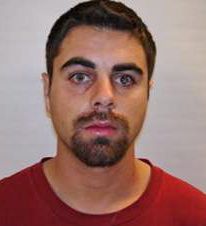
Douglas County sheriff’s deputies are looking for 28-year-old Victor Manuel Mora Jr.

A felony arrest warrant was issued for Mora in December as a result of an investigation into a sexual assault of a 6-year-old girl. Mora is a fugitive from justice.

Secret Witness is offering a reward of $250 for information leading to the arrest and conviction of Mora in this incident.

He is described as male, Caucasian, 28, 5-foot-9, approximately 170 pounds, medium build, green eyes, medium length brown hair, and possible facial hair or goatee.

Two photographs of Mora are to the left.

Although a resident of Gardnerville, Mora is known to frequent the Carson City and Reno-Sparks areas.

Anyone with any information regarding the possible whereabouts of Mora is urged to call Douglas County Secret Witness at (775) 782.7463, or DCSO Investigator Nadine Chrzanowski at (775) 782.9907.


Undercover agents seize $20,000 in drugs at SnowGlobe

South Lake El Dorado Narcotics Enforcement Team agents were at the SnowGlobe Music Festival for two nights during the Dec. 29-31 event at Lake Tahoe Community College.

At the entrance people who had drugs or other items not allowed at the venue could dump them in “amnesty containers” — meaning they would not be cited or arrested for whatever they left behind. Some of the totals below reflect the goods that were seized in this manner.

The following are the number arrests-seizures agents made:

  • 8 arrests
  • 3.5 pounds marijuana (approximate value $10,500)
  • 76 grams powdered MDMA (approximate value $6,000)
  • 13 ecstasy pills ($195)
  • 4 vials of LSD ($2,500)
  • 64 miscellaneous pills ($1,000)
  • 15 weapons (mostly edged weapons like knives).

— Lake Tahoe News staff report


Body of Truckee man pulled from Donner Lake

This morning divers at Donner Lake recovered the body of William Kiser.

The 24-year-old Truckee resident had been with a friend Jan. 2 when their canoe capsized. She was able to swim to shore and alert authorities that Kiser was missing.

Kiser’s body was found about 150 yards from shore in 15 feet of water at 11am Jan. 4.

An autopsy is scheduled to confirm exact cause of death.

It is not known if either person in the canoe had been wearing a life jacket.

 — Lake Tahoe News staff report


Study: Parents are the biggest obstacle to letting kids play

By Janice D’Arcy, Washington Post

A report on why children in day care are sedentary suggests that it’s not the care providers, but the parents, who are mostly to blame.

The study, “Societal Values and Policies May Curtail Preschool Children’s Physical Activity in Child Care Centers,” will be published in the February issue of Pediatrics and was published online today.

It focused on childcare centers where, according to previous research, close to three-fourths of pre-school-aged America children are enrolled and where they spend only 2 to 3 percent of their time playing vigorously.

Researchers set out to find out why so little time was spent playing. They studied 34 racially and demographically diverse Cincinnati-area child-care centers and found three consistent obstacles to exercise.

Providers told researchers that they felt pressure from parents to keep children from vigorous play that might lead to injury and also pressure to focus instead on academics.

Read the whole story


Businesses count SnowGlobe cash; concert divides locals

By Kathryn Reed

While the South Lake Tahoe City Council was prepared to get an earful from residents Tuesday about the three-day SnowGlobe Music Festival, only 10 people spoke during the public comment session about the concert.

The consensus from those folks is something has to be done about the sound level – the bass and subwoofer in particular. It shook walls and physically agitated people.

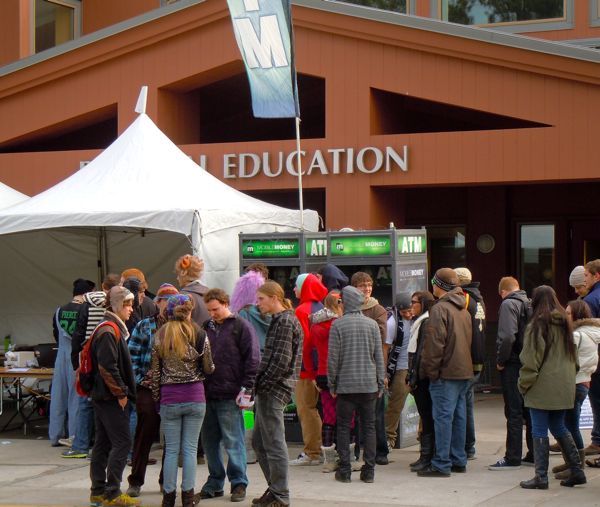
SnowGlobers -- about 10,000 strong each night -- line up at Lake Tahoe Community College to get in. Photo/LTN

Others said this town needs to bring in tourists and that events like SnowGlobe are good for the economy.

Some talked about moving the event off the campus of Lake Tahoe Community College. City officials and promoters considered all open spaces – including Lake Tahoe Airport. With talks about SnowGlobe starting early last spring, that did not allow enough time to work with the FAA to stage the event at the airport.

City officials recognize that area, too, could impact a neighborhood.

The college’s perspective is the event was successful, but that they would work on better trash containment in future years. Trails that locals use had litter on them. The college also wants to ensure the promoters end the event at the time specified.

The South Lake Tahoe Police Department cited the promoters after the second night when the concert ran long.

Representatives from both South Shore chambers of commerce were at the Jan. 3 meeting, saying they will be taking surveys of members and anyone who wants to participate.

South Tahoe Chamber of Commerce is asking people eight questions related to SnowGlobe’s impact on businesses. Anyone may take survey.

The Nevada-based chamber is still putting its survey together.

Here are comments the city has received from area businesses:

• Richard Bennett, manager of Rite Aid, “SnowGlobe saved jobs. Sales were up 15 to 20 percent.”

• Jim Warlow, owner Cork and More, “Very positive impact.”

• Rude Brothers Bagels, “Best sales in 15 years.”

• Tyler Cannon, owner of Sprouts, “Sales hit historic highs for the time period.”

• Ross Stores manager, “Sales were huge.”

• Sno-Flake Drive In, “SnowGlobe brought in a lot of business.”

• Jazz Kat Cafe owner said she stayed open late once she saw SnowGlobers walked right by her door. She saw business at “completely unexpected volumes,” “slammed” and “sold out of items each day.”

• Freshies said sales were “huge.”

• Mike Donavan, MontBleu general manager, reported huge increases in business after 11pm when the after-parties began.

The city has a survey on its website, too. The majority, to date, want to bring the event back.

As for exact numbers, transient occupancy and sales taxes figures for December won’t be available for a while. Those will be the two biggest indicators of how the area did financially. However, extrapolating the direct impact on the economy compared to a year ago when record snowfall brought people to the area will be more difficult.


Water content in Sierra dismal, record low set for January

By Kathryn Reed

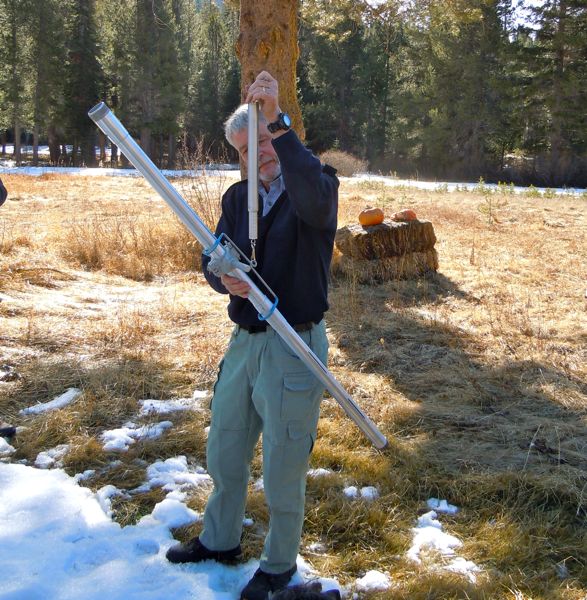
PHILLIPS STATION – Scanning the field at the base of Sierra-at-Tahoe, Frank Gehrke wonders if he needs to bring his equipment out of the vehicle.

It turns out he does need the tools. But he didn’t need them to tell the story. The dry, not even muddy field spoke volumes. The Sierra has no snow.

Frank Gehrke barely found any snow to measure Jan. 3 near Echo Summit. Photo/Kathryn Reed

No snow has many ramifications for a state that depends on its mountains to fill its reservoirs, irrigate its fields, provide winter recreation that translates into tax dollars and keeps people out of the unemployment line, and lowers the threat of fire.

The one measurement Gehrke took Jan. 3 showed a snow depth of 4 inches. But it’s the water content that matters. It came in at 0.14 inches – a record low.

Gehrke has been taking snow samples near the top of Echo Summit for the California Department of Water Resources since 1987. That was the year the previous low water content record was set at 0.9 inches.

1987 was also the start of a five-year drought.

While no one wants to use the “D” word this early in the season, the lack of precipitation throughout California and Nevada last month had it going down as one of the driest Decembers on record. What Northern California has been experiencing is typical in a La Nina year.

Liquid Precipitation

Location         Dec. 2011    Dec. 2010  

S. Lake Tahoe  trace            6.43 inches

Tahoe City       trace          11.40 inches

    Reno                 zero             1.39 inches

Carson City      zero             3.39 inches

Bridgeport       zero             4.52 inches

Mammoth        zero           13.17 inches

Driest Decembers on record

Location           Precip Total/Years

S. Lake Tahoe               trace (2011)

Reno     zero (2011,1883,1882,

1877, 1876,1874)

Carson City      zero (2011,2000,1989)

Mammoth        zero (2011)

2011 Oct.-Dec. Precipitation Totals and Rank

Location           Precip Total/Rank

Tahoe City         3.72 inches (8th driest)

Reno                   0.30 inches (5th driest)

Carson City        0.45 inches (3rd driest)

Source: National Weather Service

The irony is arid Southern California has received more moisture. Some areas are having an above average rainy season.

The smell of dry grass lingers in the air where the snowpack is being measured. No snowcapped peaks are evident. Mountain bikes on cars go by on Highway 50, while a few die-hard skiers turn in to take some runs at Sierra.

“We just don’t know what the future weather will be,” Gehrke said. “Last year was unexpected. It was supposed to be relatively dry.”

Instead, the winter of 2010-11 set records for snowfall in the Sierra. That’s a good thing because it filled California’s reservoirs to the point that they are higher than they were this time last year.

But Gehrke is realistic. He doesn’t believe the water content can catch up if things remain dry through February.

The National Weather Service in Reno does not see any storms on the horizon for at least the next 10 days. That means going into the next holiday weekend – Martin Luther King Jr. – it will be more manmade snow for skiers to schuss on. While resorts keep making snow, bike rental places are getting back into the business, too, in Tahoe.

After all, it’s been darn right hot out – at least for January. South Lake Tahoe hit record highs on Jan. 2 and Jan. 3. On Monday it was 59 degrees in South Tahoe, breaking the 1997 record of 50 degrees. On Tuesday the mercury crept to 58 degrees, one degree higher than the record from 1996.

The entire region is warm. Reno also hit records for the past two days. On Tuesday the high was 66, breaking the 1927 record of 57 degrees. While on Monday the high in Reno was 69, smashing the 58-degree record set in 1939.

While the moisture is nowhere in sight, the cold is returning. Expect highs to be in the 40s in the Lake Tahoe Basin by the end of the weekend with overnight lows in the teens for the weekend.

Phillips Station:

Dec. 30, 2009

  • Snow Depth: 38.5 inches
  • Water Content: 9 inches
  • Percent of Long Term Average: 75 percent

Dec. 27, 2010

  • Snow Depth: 55. 9 inches
  • Water Content: 19 inches
  • Percent of Long Term Average: 158

Jan. 3, 2012

  • Snow Depth: 4 inches
  • Water Content: 0.14 inches
  • Percent of Long Term Average: 1

Source: Department of Water Resources