Judge gives ‘convention center’ creditors 1 more month

By Kathryn Reed

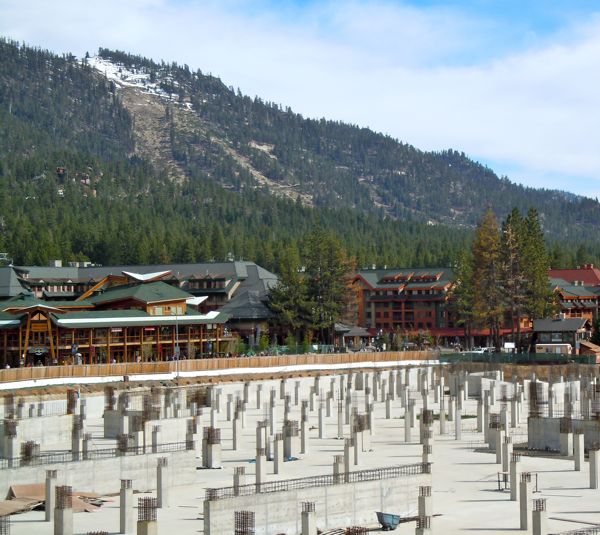
How much is the more than 11-acre site on the east end of South Lake Tahoe worth with its rebar and concrete?

That is one issue still to be decided in the ongoing saga known as the failed convention center project. Lake Tahoe Development Company, the Zephyr Cove company that was supposed to build two hotels and convention center on the Stateline area property, owes El Dorado County $2.45 million in property taxes.

The end of bankruptcy court for the would-be convention center site appears to be nearing. Photo/LTN

Randy Lane, principal for the company that has been languishing in bankruptcy court since October 2009, is challenging the amount owed.

“We are appealing the assessment,” Lane told Lake Tahoe News. “We are saying the assessed value of the property far exceeds the actual property value.”

A hearing on that is slated for March.

One of the bugaboos about the bankruptcy is the parcels were never consolidated into one map. Lane still owns nine of the 29 parcels.

Owens Financial, which stands to lose the most at $25 million, if the slate were wiped clean, agreed this week to pay about $400,000 of the back property taxes that are due.

Also at this week’s session before the bankruptcy judge in Sacramento, a Feb. 29 date was set for an evidentiary hearing. All parties will have a chance to present evidence for a plan of action and bring any witnesses they want.

The judge could make a decision that day or shortly thereafter.

Lane wants more time to find someone to develop the site. Others want out.

Once the project is no longer tied up in bankruptcy court, the clock starts ticking on the permit issued by the Tahoe Regional Planning Agency. Those permits have value, though no true dollar amount. If they expire, it would mean whoever takes over the rights to the land would have to start from scratch with permitting. That does mean time and money.

But it also would give someone the opportunity to start from scratch and not work within the parameters of what has been approved.


Tahoe tourism agencies back Olympic effort with cash

By Kathryn Reed

STATELINE – Lake Tahoe tourism agencies are doing their financial part to help bring the 2022 Winter Olympics to the region.

On Jan. 12 the Lake Tahoe Visitors Authority allocated $25,000 to the bid effort, with the North Lake Tahoe Resort Association having already committed the same amount. Each will be asked to put in another $25,000 next year. (Board member Tom Davis was absent.)

Blaise Carrig, co-president of Vail Resorts mountain division, made a pitch to the LTVA board at the Thursday board meeting. Carrig, who the day before officially became a board member of the Reno-Tahoe Winter Games Coalition, first worked with the team when he worked at Heavenly Mountain Resort.

Blaise Carrig

“It would be a really good legacy project for Reno-Tahoe,” Carrig told the LTVA. “It would bring national and international recognition to the marketplace that Reno-Tahoe could use.”

It will take more than $1 million to put the bid together, so the tourism agencies’ checks are just a start. Nevada has pledged money. Private and public entities are being asked to be part of the process.

The bid would have to be ready to be presented to the U.S. Olympic Committee by March 2013, summer at the latest. The International Olympic Committee picks the host city in 2015. That gives the city and/or region seven years to get everything together.

“When Salt Lake City was awarded the bid, in those seven years it went from 25th to No. 1 for getting funding for infrastructure,” LTVA board member Nancy McDermid said. “This would be one way in seven years to get infrastructure we haven’t had.”

Roads, transit and venues are all things that would come to the region.

Carrig said venues have been scoped out, but nothing is solidified. Earlier he told Lake Tahoe News it is possible Heavenly could create a new run to accommodate the men’s downhill.

Without being able to accommodate that event, sources have told Lake Tahoe News, no area can host a Winter Games.

Carrig assured the LTVA board the South Shore would be part of the Olympics.

He said the international committee looks for bids that are compact. In large part this has to with the media and how they cover the Games.

While Sacramento was brought up, Carrig sees it more as a gateway to Tahoe-Reno, than a venue site. But with a large arena, having ice events there has not been ruled out. Reno doesn’t have a single sheet of ice. The South Lake Tahoe Ice Arena in the past has been talked about as a training area. It has no seating to accommodate anything close to an Olympic event. The next nearest ice is in San Jose where the Sharks play. But the Cow Palace in San Francisco and Oakland arena have had skating events before.

McDermid also questioned Carrig about whether environmental groups had been approached. He said Nevada Lt. Gov. Brian Krolicki, who is heading up the Tahoe-Reno coalition, has started those talks.

“Part of the bid is what is the environmental legacy,” Carrig said.

“Legacy projects” is a phrase often heard when discussing Olympic bids. It’s what a community is left with after the two weeks. It could be roads, a stadium or less sediment reaching Lake Tahoe. The theory is those legacies would be viewed as a positive by and for the community.


Report: Officials stay one step ahead of aquatic invasives

By Kathryn Reed

STATELINE – Sixty-three percent of the vessels inspected in 2011 had to be decontaminated before being allowed to enter Lake Tahoe.

Of the 30,400 boats that were launched, 7,600 had to be checked for aquatic invasive species, with 4,800 of those needing to be decontaminated. While most of the boats originated in California or Nevada, Utah, Oregon and Arizona were the states with the next highest number of boaters.

Small mouth bass are a threat to mackinaw in Lake Tahoe.

Overall, that was 9,000 more than in 2010. Ted Thayer, aquatic invasive species program coordinator for the Tahoe Regional Planning Agency, said how data is collected changed between 2010 and 2011, so while marinas reported business was up, it may not have been as significant as the AIS program numbers indicate.

Thayer on Jan. 11 updated the Advisory Planning Commission about how the AIS program worked last year. The TRPA Governing Board will hear the presentation at its Jan. 25 meeting in Stateline.

“This was a very successful year for the program,” Thayer said.

The program since its inception in 2007 keeps evolving. Prevention, monitoring and controlling are the mantras. Weeds, Asian clams and warm water fish are the predominate invasives that partners in the program are trying to eradicate, control or prevent from reaching Lake Tahoe. Fallen Leaf and Echo lakes also come under the purview of this program.

But what makes Fallen Leaf Lake different than Tahoe is no aquatic invasive species have been found in that body of water off Highway 89. Motor boats are inspected at the marina, with a roving inspector checking non-motorized watercraft that are mostly launched from the U.S. Forest Service-owned campground at the other end.

The Fallen Leaf Lake report shows of the 428 inspections, 24 vessels came from lakes known to have quagga or zebra mussels, or New Zealand mud snails.

Other regional bodies of water like Donner Lake and Lahontan Reservoir are outside TRPA’s control. However, as funding these programs becomes more difficult with the disappearance of federal dollars, a broader regional approach to aquatic invasive species is likely to occur.

Thayer said this could mean one day the decontamination station on the North Shore being outside the basin and closer to Truckee, and possibly having a station in Carson City instead of at the top of Spooner Summit. Those are just ideas now. Eventually permanent stations are the goal.

TRPA is not alone in the AIS program. A number of agencies and groups are involved, including, but not limited to, Tahoe RCD, UC Davis, California Department of Fish & Game, and Nevada Department of Wildlife.

In 2011, 6.51 acres of Emerald Bay were treated for invasive weeds. This compares to the 1.1 acres treated in 2010. Commercial divers helped with the removal of the plants.

Milfoil is one of the biggest problems throughout Lake Tahoe, especially in the lagoons of Tahoe Keys on the South Shore.

“This project was designed to test multiple methods,” Thayer said. “Tahoe Keys is a very different environment. There is a lot denser growth of weeds, with a lot of boat docks.”

A dye that is invisible to the human eye was used in this area. Thayer praised Lahontan Regional Water Quality Control Board’s decision late last year to allow herbicide use in Lake Tahoe on occasion. He said this may be needed for the Keys.

Using a barrier to suffocate Asian clams was most effective in summer, but worked in the winter as well – it just takes longer when the water is colder. Marla Bay is where the winter tests were done.

Knowing this works means the material could be used in areas with a ton of boat activity – like Ski Run Marina area – that during the summer make it dangerous for divers to work.

A pilot program to rid the mouth of Emerald Bay was less successful because of the topography and water exchange.

A warm water fish eradication program encompassed about 14 acres, mostly in the Tahoe Keys. An electrical charge was sent into the water that stunned the fish. They were then scooped out of the water – all 12,000, which weighed 2,157 pounds.

The small mouth bass, according to Thayer, is what concerns officials the most. They can threaten the mackinaw. Even though the mackinaw is not native — it was introduced as a sport fish — it is not considered an invasive species.

A change going forward is creating a lakewide permit for AIS treatments. Thayer said that should be in place this year.

In the past, engines were flushed for one minute to decontaminate them. That will decrease to 10 seconds this year. Thayer said this is to conform with industry standards. For boaters it will speed up the process and decrease potential propeller damage from the decontamination process.

Monitoring the water at 60 locations throughout Tahoe, Fallen Leaf and Echo is how scientists determine if invasives have reached those bodies of water. The most threatening are quagga and zebra mussels. They have not reached any of these waters.

To keep the program going, an increase in watercraft inspection fees is being proposed. The Governing Board will make that decision. The document linked here is what was presented to the APC and is likely to change before it reaches the Governing Board in 12 days.


Fire officials on heightened alert because of dry conditions

Due to the lack of measurable precipitation and drying north and east winds, all burning in El Dorado and Amador counties have been banned on state responsibility lands until further notice.

“Since this is one of the driest winters on record, we have decided to take this action in order to protect life and property. We have put into place a staffing pattern that maintains one fire engine in each of our divisions and one conservation camp crew in each of our camps 24/7,” Chief Kelly Keenan of the Amador-El Dorado Unit of CalFire said in a release.

The public is being asked to not burn debris piles and check on old debris piles to make sure they are completely out.

“We are seeing escape control burns almost daily due to these extreme weather conditions,” Keenan said.

The U.S. Forest Service has put the fire danger level at moderate — an occurrence almost unheard of in January.

“The overwhelming majority of our wildland fires are human-caused. As usual, the No. 1 cause was illegal or abandoned campfires,” Forest Service spokeswoman Cheva Heck said in a release. “We ask that that people remember that campfires and warming fires generally are not allowed on the Lake Tahoe Basin Management Unit.”

The chart shows fire stats for the LTBMU for 2011.

The Forest Service this winter has responded to two wildland fires caused by residents dumping woodstove ashes in the forest near their homes.

A couple lost their rental house near Meyers from putting hot ashes on a deck.

Fire agencies recommend placing ashes in a metal container, which should be stored on a non-flammable surface like a concrete walk. They should cool for four days before final disposal

Nevada officials are also worried about fire as precipitation this winter is still non-existent.

Fire agencies usually spend winter months training, maintaining equipment and preparing for the next wildfire season, but so far this winter, wildfires have occurred weekly throughout Nevada.

In 2011, Nevada experienced 814 wildfires and lost approximately 423,768 acres, just shy of the five-year average of 428,084 acres burned.

Conditions are similar to late summer or early fall, and the potential for a rapidly spreading wildfire during daylight hours is high. In several cases, fire behavior has been extreme because of the lack of precipitation, high winds, low humidity and extremely low fuel moisture.

 — Lake Tahoe News staff report


Bomb squad takes care of ordnance left at gun shop

Ordnance left at a Gardnerville gun store was disposed of Monday by the Douglas County bomb squad.

Deputies took it to the Douglas County Shooting Range where it was disposed of via controlled detonation.

The owner of the store discovered the ordnance sitting outside the rear of his shop when he opened for business Jan. 9.

The ordnance consisted of unexploded gas canisters, grenade simulators, and an 81mm smoke mortar round.

Authorities say dropping ordnance off in this manner is not safe. To dispose of items properly, call (775) 782.5126.

— Lake Tahoe News staff report


Couple found dead in Carson River

By Reno Gazette-Journal

The Carson City Sheriff’s Office identified the two people found dead in the Carson River on Tuesday as Darrell Crossman, 54, and his wife Kelley Crossman, 43, both of Carson City.

Their bodies were discovered Tuesday afternoon by a hiker about a half-mile south of Carson River Road. Both were in shallow, frigid water. A campsite, vehicle and two small dogs were located nearby.

According to the Sheriff’s Office, the two were unemployed and living with other family members in Carson City.

Autopsies performed Wednesday at the Washoe County Medical Examiners Office showed no significant injury or trauma to either victim. Toxicology reports are pending.

Read the whole story


Tahoe ski resort heavyweights to advance Olympic chances

By Susan Wood

Experience counts. The Reno-based coalition tasked with bringing Olympic gold to the California-Nevada region in winter 2022 threw some big guns behind the effort Wednesday by appointing to the board Lake Tahoe ski giants Blaise Carrig of Vail and Andy Wirth of Squaw Valley.

The two men have shared the Olympic experience when they worked in Utah. They would like to share it again in 10 years.

If organizers get their way, the Olympics will return to Lake Tahoe 62 years after they were in Squaw. Photo/LTN file

Carrig, co-president of Vail’s mountain division, brings to the Tahoe table his experience at The Canyons resort in Park City during the 2002 Winter Games at Salt Lake City and a steadfast investment as the head of Heavenly Mountain Resort before moving up Vail’s corporate ladder.

Wirth would like to see the Games return to Tahoe and pledged to work closely with his old pal and resort competitor Carrig to accomplish that goal.

The board may even enlist some high-level help from the East Coast – as in presidential candidate Mitt Romney, who salvaged the Winter Games to Utah a decade ago and turned it into a profitable endeavor. Romney visited the coalition in 2008.

It could also be a boon that Nevada Lt. Gov. Brian Krolicki is co-chair of Romney’s presidential campaign in Nevada.

“(Romney) did a phenomenal and remarkable job. He took a group from utter disaster to an extreme success,” Wirth said.

The Squaw chief noted that even if the Reno-Tahoe group loses to a city like Denver, it would be a lesson learned.

“It’s difficult to handicap (one city versus another). I’m just encouraged by the initiative of the resorts,” he said.

Reno and Denver want to be the U.S. city chosen for 2022. Reno has Tahoe, with resorts from Squaw Valley to Heavenly providing world-class views from one side of the lake to another. Denver has Vail, with seven back bowls stretching seven miles across at its namesake and a not-for-the-faint-of-heart World Cup downhill run (Birds of Prey) at the customer-oriented Beaver Creek resort that would make Tahoe’s Olympic downhill legend Daron Rahlves look twice.

On the North Shore, Squaw has a reputation. Let’s face it. If one doesn’t get enough of a poignant chill seeing that Olympic flame burning on Highway 89, then maneuvering with the elite down runs off KT-22 may provide bone-chilling humility.

On the south side, Heavenly has the entertainment to support the bed base and snow caches some don’t want to share. The bi-state resort even brings its own entertainment to the slopes, with Gunbarrel 25 each spring. Just once, one may want to imagine skiing wild man Glen Plake and freestyle Olympian Jonny Moseley bumping knees side-by-side.

Both resorts have a history with the Winter Games.

The guts and vision of Alex Cushing brought the games to Tahoe in a surprise move away from Innsbruck, Austria, 42 years ago. A decade ago this month, the Olympic torch graced Lake Tahoe on its way to Utah with one of the torchbearers, Martin Hollay, skiing it down Heavenly’s Olympic run. (This reporter ran a leg of it down Sierra Boulevard.) The South Shore community showed up in great numbers for both.

In an area divisive on many fronts, the North and South shores were unified in being a part of something big.

Organizers hope for this dream again.

But either way, the revenue-sharing agreement between the U.S. Olympic Committee and International Olympic Committee will need to be worked out before any U.S. city is considered. The two entities are in meetings this week to hash out their differences.

Carrig insists the Olympic-seeking group remains in the early phases of planning – with no cost analysis or set venues in mind.

The Denver committee recently released a cost estimate to host the Games — $1.5 billion. They used the 2010 Games at Vancouver as a benchmark, the Denver Post reported.

Everything remains on the table as a possibility in Tahoe. Carrig did mention Heavenly could see a new run – perhaps one carved on the front ridge of South Lake Tahoe leading to the Olympic run. It’s all just a possibility. It all could be for the men’s downhill.

“We’re going to evaluate it. A new venue could start over that way,” Carrig told Lake Tahoe News, while peering out his Colorado window at snow falling last weekend.

“A larger issue is all the beds being filled by the spectators, media and athletes,” he said.

Carrig admits Tahoe and Colorado are attractive for the Winter Games, with their history, ski terrain, scenery and environmental cultures.

He believes the stigma has disappeared regarding Denver turning down the Games in 1976 after winning the bid. Nonetheless, Carrig said his loyalty lies with working with Reno-Tahoe Winter Games Coalition Chairman Krolicki.

Squaw Valley CEO Wirth has a massive background at Vancouver with Intrawest. His home resort’s host-city status in 1960 and his company’s purchase of neighboring Alpine Meadows bring elements of nostalgia and terrain to the Olympic bidding table.

The goal is for Tahoe-Reno to edge out Chile and China on the international front after bumping Denver out of the picture.

What Denver’s coalition of public officials and business leaders doesn’t have is a representative from Vail Resorts, the largest U.S. ski company.

“I’m not sure how (our efforts) all stack against others, but their not having something has no bearing on what we do. The truth is, we have the properties in both regions. We did look at who they have on their committee and noted what representation they did have but didn’t focus on what they didn’t have,” Reno-Tahoe coalition CEO Jon Killoran told Lake Tahoe News on Jan. 11. Instead, Killoran focused on the board’s level of depth. The efforts began in 2001 with Reno sports commissioner Jim Vanden Heuvel, who died three years ago.

Since then, California Lt. Gov. Gavin Newsom – the former San Francisco mayor — threw his support behind the venture, along with a Bay Area sporting event group which tried to bring the 2012 Summer Games to the area. State Sen. Ted Gaines, R-Roseville, is one of the California Winter Games Committee members. Gaines started skiing at a young age at Tahoe resorts and has a second home on the North Shore. And Newsom has business interests at Squaw.

To Killoran, a vision like forming an Olympic bid requires cooperation from a collective group of people.

“You don’t always do that every day,” Killoran emphasized.

Wirth seconded the sentiment.

Other members of the Reno Tahoe Winter Games Coalition board include:

• Dan Allen – ITS Logistics

• Krys Bart – Reno Tahoe International Airport

• Larry Bernard – attorney

• Bruce Breslow – Nevada Department of Motor Vehicles

• Nicholas Butler – Umpqua Bank

• Brad Chamberlain – attorney

• Nancy Cushing – Squaw Valley

• Carolyn Wallace Dee – Squaw Valley

• Susan Fisher – Fisher Consulting

• Jeff Hamilton – Olympian

• Toni Harsh – Valley Building Company

• Glenn Hibl – CFO Group

• Chris Kassity – Kassity Management Group

• John Krmpotic – KLS Design

• Limin Liu – Olympian

• Tamara McKinney – Olympian

• Gregory Peek – ERGS Inc.

• Michael Pennington – Community Services Agency & Development Corp.

• Daron Rahlves – Truckee Olympian

• Rossi Ralenkotter – Las Vegas Convention & Visitors Authority

• Tony Sanchez – NV Energy

• Jim Simon – Porter-Simon Attorneys at Law

• Steve Trounday – Navegante Group

• Steve Woodbury – Nevada Commission on Tourism

• Larry Young – Ward Young Architects

• David Youngberg – Youngberg Group.


South Tahoe woman dies in Montana car accident

By John Grant Emeigh, Montana Standard

A South Lake Tahoe woman killed in a roll-over crash Tuesday afternoon in Montana has been identified as 32-year-old Rachael Platt.

Madison County Sheriff Dave Schenk on Wednesday confirmed her identity.

The Montana Highway Patrol reported that Platt died after her vehicle went off the road on Montana 359 about 12:20pm and rolled multiple times. She was alone in vehicle, and was wearing a seat belt, according to the patrol.

Read the whole story


Bickering ties up renewable energy projects in California

By Julie Cart, Los Angeles Times

Millions of dollars in renewable energy projects intended to provide power to facilities in California’s national parks and forests are sitting idle because of a years-long squabble with Southern California Edison.

A new $800,000 solar project at Death Valley National Park, photovoltaic panels at the state-of-the art visitors center at Santa Monica Mountains National Recreation Area and a solar power system at the U.S. Forest Service’s new facility at Mono Lake are among dozens of taxpayer-funded projects in Southern California on hold as the federal agencies try to hash out an agreement with SCE to tie the projects to the state’s electrical grid.

The apparent stumbling block involves contract restrictions imposed by federal law, but utilities elsewhere in California have signed similar agreements with the agencies with few problems or delays.

“There’s 24-plus systems in the Southern California Edison area that have been installed in the last three years that we have not been able to negotiate an interconnection agreement on,” said Jack Williams, who retired this month as the National Park Service’s Oakland-based regional facilities manager. “We think we are close at times, but then nothing. We were successful with PG&E, but with Southern California Edison…. They have been a bit more difficult. We’ve raised the flag many times. It’s an issue for all federal agencies.”

An Edison spokesman declined to discuss the projects, citing ongoing negotiations.

Read the whole story


Gaming win up in Nevada, down at Stateline

Despite a drop in Stateline casino gaming revenue in November, the state posted gains.

Throughout Nevada revenues jumped 7 percent from November 2010 to November 2011. Casinos brought in $880 million.

On the South Shore, the Gaming Control Board on Wednesday, said the win dropped 7 percent to $14 million.

 — Lake Tahoe News staff report