Carson City man charged in 2 Lake Tahoe bank robberies

A Carson City man has been charged with seven counts of armed robbery, with two of the bank robberies occurring in Lake Tahoe.

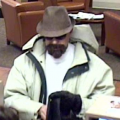
Authorities say the fedora-wearing bank robber who struck Bank of the West in South Lake Tahoe on Feb. 18, 2010, is David Griffith Osborne.

Authorities say fedora-wearing bank robber is David Griffith Osborne.

The U.S. Attorney’s Office in Sacramento on Feb. 25 released the complaint against Osborne. He is already in federal custody on unrelated charges.

If convicted, Osborne faces up to 25 years in federal prison for each armed bank robbery.

According to the complaint, Osborne robbed the following California banks:

1. Dec. 22, 2009, Bank of the West, 736 Taylorville Road, Grass Valley;

2. Feb. 18, 2010, Bank of the West, 2160 Lake Tahoe Blvd., South Lake Tahoe;

3. March 9, 2010, Bank of the West, 200 Bear St., Kings Beach;

4. March 31, 2010, Bank of the West, 736 Taylorville Road, Grass Valley;

5. April 26, 2010, Bank of the West, 34 East Gridley Road, Gridley;

6. June 3, 2010, American River Bank, 9750 Business Park Drive, Rancho Cordova;

7. June 29, 2010, Chase Bank, 6669 Clark Road, Paradise.

Osborne also committed the April 12, 2010, armed robbery of the Bank of the West’s Carson City branch, according to authorities.

 — Lake Tahoe News staff report


State transportation dollars coming to South Tahoe

The California Transportation Commission on Wednesday allocated $347 million in new funding to 47 projects designed to provide congestion relief for motorists statewide, with one of them being in South Lake Tahoe.

The state Highway Operation and Protection Program will allocate $3.7 million to construct water quality collection and treatment facilities west of Ski Run Boulevard to Wildwood on Highway 50.

In Placer County, $1 million from the locally-administered State-Local Partnership Program will go to Roseville to widen from two to five lanes a one-mile stretch of Fiddyment Road from Baseline Road to Pleasant Grove Boulevard.

The allocations include $281 million from Proposition 1B, a transportation bond approved by voters in 2006. In total, nearly $12 billion in Proposition 1B funds have been allocated by administrative agencies for statewide transportation needs.

The remaining $66 million in allocations came from assorted transportation accounts funded by state and federal dollars.

Here is the projects list.


Nevada panel wants money before looking at education funding plan

By Sean Whaley, Nevada News Bureau

CARSON CITY — A panel of lawmakers on Tuesday began a review of the state’s 45-year-old formula for funding public education with an eye toward addressing the needs of the state’s urban districts as they work to educate special education students, English-language learners and children in poverty.

The panel is still searching for funding for a study to help in the review, however. The failure to find private funding for a study could jeopardize any meaningful review in this interim, lawmakers were told.

The panel decided to give the Clark County School District, which advocated for the review in the 2011 legislative session, until Feb. 21 to identify a minimum of $125,000 in private funding to perform the necessary study. The panel would then meet again on Feb. 28 if the funding is secured.

The New Method for Funding Public Schools interim study was authorized by the 2011 Legislature to look at the “Nevada Plan” the current funding formula adopted in 1967.

“As we know over the past several decades since the Nevada Plan was developed and adopted, our state has grown and changed significantly,” Assemblyman Marcus Conklin, D-Las Vegas, the chairman of the panel, said. “A periodic review of the state’s funding methodology for public schools is necessary to ensure that the funding methodology accomplishes what it was originally designed to do – which was to ensure an adequate educational opportunity for all Nevada students regardless of individual school district wealth.”

Following a review of the Nevada Plan, the panel can then determine if inadequacies or inequities exist, he said.

“Then we can develop any recommendations for improvement, if necessary, to ensure that the state’s public school funding methodology equitably considers the individual needs and characteristics of Nevada’s public school student population,” Conklin said.

Joyce Haldeman, associate superintendent of community and government relations with the Clark County School District, said there is no intention with the review to take away funding from other school districts.

Instead, the state’s largest school district would like to see additional factors given weight in the formula, including English language learners, special education students, gifted and talented and students receiving free- and reduced lunches, she said.

The study is the result of Senate Bill 11 sought by the Clark County School District to consider a weighted enrollment formula to take into account the different educational needs of children in the larger districts.

Craig Stevens, director of government relations for the Nevada State Education Association, spoke in support of the study.

“Our state is simply too diverse and the needs are too specialized to have a flat rate just for every single child,” he said. “It really not only hurts those that need the specialization but those that do not as well. We fully support making sure that funds are differentiated so that the student gets the services that they need in order to be fully successful.”

Several parents from Clark County also expressed support for the study, saying the funding formula needs revision because it shortchanges the district.

But Assemblyman Ira Hansen, R-Sparks, a member of the panel, asked for justification for the review, noting a 2007 study by lawmakers identified no inequities in the Nevada Plan.

After spending nearly $250,000, the conclusion was that the Nevada Plan was highly equitable, he said.

“Now what’s changed between 2007 and today?” Hansen asked.

The committee debated how overarching any funding formula review should be, given that no money was allocated for a study. The consensus was that a narrow review, focusing on several key student populations, would be the most practical approach if funding is secured.

The Clark County School District had anticipated $125,000 in funding from a foundation to pay for a study, but the district learned the money will not be forthcoming, Haldeman told the panel. The district is looking for other funding sources, she said.

The Nevada Policy Research Institute, a conservative think tank, weighed in on the Nevada Plan in September 2011, noting that many people, including policy makers, are either confused or deliberately misleading on the issue of per pupil funding in the public schools.

The analysis suggested that when all sources of funding are included in per pupil expenditures, the dollars spent are much higher than are reported by the districts.


Government gridlock compels Nevadans to pursue progress via initiatives

By David McGrath Schwartz and Michael Squires, Las Vegas Sun

Labor is preparing a business-tax ballot initiative.

A conservative businessman is threatening initiatives to raise taxes on mining and gaming.

A maverick attorney is proposing an initiative calling for sweeping changes to the state tax structure, creating what would be, in effect, a parallel government to that run by lawmakers and the governor.

These initiatives, pushed by groups and individuals of varying ideologies, from very liberal to very conservative, suggest a state that has lost faith in the ability of its political leaders and institutions to get things done, or at least big things.

Nevada is a wounded state, with a busted housing market and highest-in-the-nation unemployment. One pillar of its economy, construction, is gone and won’t be back anytime soon. Another, gambling, has come back, but is seeing competition spread across the country and world.

Who will do something about it?

Read the whole story


State take-aways could deplete LTUSD’s reserves

By Kathryn Reed

Cutting the school year by 15 days. Bigger class sizes. High school teachers moving to the elementary level. Using all of the reserves. Bus drivers looking for work; students without a ride. Early retirements.

Some or all of those statements are likely to be a reality for Lake Tahoe Unified School District. Depending on the state budget and what the local board decides to do, all of the statements could come to fruition.

The school board on Tuesday night adopted the proposed budget reductions affecting this school year and for next as presented by CFO Deb Yates. More specifics will be forthcoming in future meetings.

“We’ve pledged to STEA and CSEA not to do a (reduction in force),” Superintendent Jim Tarwater said at the beginning of the discussion that brought out an unusually large crowd for an LTUSD meeting.

The teacher and classified unions are working with the district to keep jobs, which keeps programs, which provides students a broader education. But with the busing situation, at least today, it looks near impossible to keep that department at the current staffing level.

LTUSD must fill a $424,000 hole the state just created by eliminating busing for special education and home to school transportation. Yates doesn’t know how the state can legally eliminate the spec ed busing when it’s a mandate. But state agencies (think Lahontan Water board) are known for unfunded mandates (think TMDL) to local jurisdictions (think South Lake Tahoe, El Dorado and Placer counties).

Reserves will be used to fill this year’s transportation take-away. With the state doling out those dollars on a monthly basis, it’s easy for the state controller to not write that check.

The transportation hit for 2012-13 is expected to be $834,000. To pay for the combined loss of more than $1.2 million it would cost each student $347. Students already pay to ride. But many on those yellow machines get a free ride – the same ones (about 60 percent) who qualify for a reduced or free lunch.

Not being touched is money to pay for athletic teams to travel.

The irony, as Yates pointed out Jan. 24, is if 200 students were not to go to school because the bus is the only way they could get there, that would be about a $700,000 loss in average daily attendance dollars.

“So it doesn’t behoove us to lose transportation,” Yates told the board. “First and foremost we are here to educate kids. We need to get them there to participate in their classes.”

Egregious, irresponsible and heartless are among the words she used to describe what the governor has brought forward.

A projected $9.2 billion shortfall in Sacramento is being foisted upon local jurisdictions to bear. Gov. Jerry Brown has two proposals on the table to deal with the deficit. The better of the two for K-14 education is for voters in November to agree to raise the sales tax by one-half cent and raising personal income tax for those who make more than $250,000 a year.

Because the outcome of that ballot measure won’t be known until late on the night of Nov. 6 – if not for days after the election – school districts are planning their 2012-13 budgets for the worst case scenario.

“While we feel that there is a sense of urgency, we, as a district, cannot make hasty decisions that could affect education in the years to come,” Jodi Dayberry, South Tahoe Educators Association president, told Lake Tahoe News after the board meeting.

She said a collaborative approach is what the two unions in LTUSD want from district staff. Tarwater at the start of the night said it was going to take everyone working together to get through the financial crisis.

Dayberry went on to say, “STEA and CTA encourage voters to become informed and show and vote for tax fairness and restore the sales tax one-half percent in November. Californians have to prioritize and put education first.”

LTUSD is looking at a $1.836 million shortfall for 2012-13. Three furlough days, early retirements, moving three teachers each from the middle school and high school to the elementary level, cutting the athletic director’s hours in half, and increasing class size would help close that gap. That’s what the board on a 5-0 voted OK’d Tuesday.

With a March 15 contractual deadline to let certificated employees know if they have a job for 2012-13, specifics need to be worked out before then, even though the state’s numbers won’t be solidified.


Vail Resorts spending big bucks to reassure skiers there is snow

By Denver Business Journal

On the heels of a Colorado Tourism Office advertisement in the New York Times seeking to lure skiers to the state, Vail Resorts — operator of four Colorado and two Lake Tahoe ski mountains — ran its own full-page ad Tuesday in the Wall Street Journal.

Both ads aim to reassure skiers that, despite skimpy snow earlier in the season, Colorado and California’s slopes now are blanketed — and the Vail Resorts ad even gives snow depth figures.

“The world’s greatest playground is now open,” the ad says. “Come ski fresh powder in Vail’s legendary back bowls.”

Vail Resorts also operates Colorado’s Breckenridge, Beaver Creek and Keystone as well as Northstar and Heavenly at Lake Tahoe, which straddles the California-Nevada line.

“We’ve been blessed with a series of powerful storms at our resorts in Colorado and Lake Tahoe that have resulted in large snow totals and allowed us to open more terrain and to provide an even better experience,” Kirsten Lynch, chief marketing officer of Broomfield-based Vail Resorts, said in an email.

Read the whole story


Obama spends bulk of State of the Union address on economy

By Scott Wilson and David Nakamura, Washington Post

President Obama warned the nation Tuesday that the decades-old promise of a secure and rising middle class is under threat because of growing disparities between the rich and everyone else in America.

In an election-year State of the Union message that will likely serve as the template for the months of campaigning ahead, Obama outlined a series of steps that he believes will reinforce the tentative economic recovery, including proposals to eliminate tax incentives for companies to move jobs overseas, to make college more affordable and to expand help for credit-worthy homeowners looking to refinance mortgages at historically low interest rates.

None of the proposals constitutes a single bold stroke to revive the economy, but the heart of Obama’s message — one he has underscored in appearances around the country in recent months — was that America’s wealthiest citizens must do more to cement the economic recovery and pull the country from its dire fiscal condition.

The approach was typified by his call for those who make more than $1 million a year to pay a tax rate of at least 30 percent and to forgo a host of deductions he said they do not need.

In detailing what he called a “blueprint for an economy built to last,” Obama struck the populist chords that his Republican presidential rivals have criticized as “class warfare.” But he has seen his approval ratings rise on the strength of that message, particularly among the independent voters who helped elect him in 2008 but had grown disappointed by his leadership in office.

“We can either settle for a country where a shrinking number of people do really well, while a growing number of Americans barely get by,” Obama told a boisterous House chamber and a prime-time television audience, “or we can restore an economy where everyone gets a fair shot, everyone does their fair share and everyone plays by the same set of rules.

“What’s at stake are not Democratic values or Republican values, but American values,” he continued. “We have to reclaim them.”

Obama spoke from a stronger position politically than he has been in for months. His approval rating, according to a new Washington Post-ABC News poll, stands at about 50 percent, and a majority of independent voters now look favorably on his performance in office.

But his advisers are well aware that his pursuit of a second term is imperiled by a still-staggering economy and a perception, even among those in his own party, that he has not effectively challenged Republicans to pass his economic plans.

Nearly all of the roughly hour-long speech Tuesday was devoted to the economy. Obama spent only a brief time on foreign policy.

Read the whole story


Warning for fire survivors about bogus contractors

In response to the Washoe Drive Fire that destroyed dozens of homes and caused damage to many more, the Nevada State Contractors Board is warning affected homeowners to be cautious of unlicensed contractors who will likely begin frequenting neighborhoods soliciting repair/rebuild work.

Any person who comes into contact with an unlicensed contractor is encouraged to obtain as much information on the individual as possible and contact the Reno Unlicensed Contractor Hotline at (775) 850.7838.

Common red flags:

· Door-to-Door Solicitations – Contractors may come to the door immediately surveying damage and selling their services on-the-spot at a reduced price.

· Verbal Agreements – Contractors may say that a written contract is unnecessary.

· High Pressure Sales – Contractors may push for an immediate decision about work and does not allow the homeowner time to verify their contractor’s license, obtain multiple bids, or check contractor references.

· Demands for Cash Payment – Contractors may insist on cash payments, even offering to drive/follow the homeowner to the bank to obtain the funds.

· Demands for Large Down Payment – Contractors may say that they need the majority of the funds to purchase supplies and pay workers prior to any work being performed. As a general rule of thumb, it is best not to pay more than 10 percent down and not let payments get ahead of the work.

Tips for hiring licensed contractors:

1. Ask for the contractor’s license number and verify it on NSCB’s website or call (775) 688.1141.

2. Obtain at least three bids prior to making your decision.

3. Ask for references from each contractor and follow up with them to verify the quality and timeliness of the work previously performed for those customers.

4. Make sure your contract is as detailed as possible, including type/color of materials, payment schedules, etc.

5. Never sign a contract until you understand all the terms and agreements.

6. Always obtain a receipt when payment is made. It is advised never to pay in cash – only check or credit card.

7. Request lien releases after each phase of the project is complete.

8. Don’t let the payments get ahead of the work.

9. Report any suspicious activities to the Contractors Board at (775) 688.1141.

It is a criminal offense to contract without a license in Nevada. The first offense is a misdemeanor, second offense is a gross misdemeanor, and the third offense is a Class E felony.


Nevada charter schools improving

By Sean Whaley, Nevada News Bureau

CARSON CITY — Nevada’s charter school law was strengthened in 2011, seeing its ranking among the states moving to 20 from 23 as a result, a national group reported last week.

Nevada’s overall score improved from 97 points to 111 out of a potential of 208 points in the report issued by the National Alliance for Public Charter Schools.

Keith Rheault, state superintendent of public instruction, said the primary reason for the improved ranking was the 2011 Legislature’s adoption of Senate Bill 212, which created an entity to focus exclusively on reviewing and approving charter schools in Nevada.

The State Charter School Authority makes Nevada one of eight states to have a statewide authorizing agency focused on building high quality charter schools, said Gov. Brian Sandoval in August when he appointed Steve Canavero of Reno as director of the organization.

The bill eliminated the previous approval process using a subcommittee of the state Board of Education.

The improvement is good news for those who support increased school choice, and comes as National School Choice Week is set to get under way on Sunday.

Nevada has 31 charter schools serving about 8,000 students. Nevada passed its first charter school law in 1997.

Potential areas for improvement in Nevada’s law include increasing operational autonomy and ensuring equitable operational funding and equitable access to capital funding and facilities, the assessment said.

The organization said that following one of the most positive years for state charter school legislation in recent memory, there were numerous changes in the rankings. Sixteen states saw their charter school law scores increase, 22 states’ overall scores remained the same, and four states fell in their overall score.

Maine’s law, which passed last year, vaulted to the top of the rankings. Of the states that allow charter schools, Mississippi’s law remains at the bottom of the list.

In its third year, “Measuring Up to the Model: A Ranking of State Public Charter School Laws” ranks each of the country’s 42 state charter school laws. Each state received a score on its law’s strength based on the 20 essential components from the NAPCS model law, which include measuring quality and accountability, equitable access to funding and facilities and limited caps on charter school growth.

“What’s most encouraging about the charter school movement’s legislative efforts is that they are more frequently marrying growth with quality and accountability,” said lead author of the report and NAPCS Vice President for State Advocacy and Support, Todd Ziebarth. “The long-term viability of the charter school movement is primarily dependent on the quality of the schools that open. It’s critical that state lawmakers recognize the importance of charter school quality and accountability – and the impact that their laws have on it. We are glad to see that they are increasingly doing so.”

In the 2011 rankings, the average score of all states with a charter school law was 100 (out of a maximum possible 208), and in this year’s rankings the average state score rose to 107, demonstrating that state charter laws are increasingly improving. The top 10 states with laws best positioned to support the growth of high-quality charter schools are Maine, Minnesota, Florida, New Mexico, Massachusetts, Indiana, Colorado, New York, California and Michigan.

The National Alliance for Public Charter Schools describes itself as the leading national nonprofit organization committed to advancing the charter school movement.


Harrah’s bus crashes on Spooner Summit; 3 minor injuries

By Kathryn Reed

Harrah’s guests are used to taking a gamble – it just usually doesn’t involve getting to or from the casino.

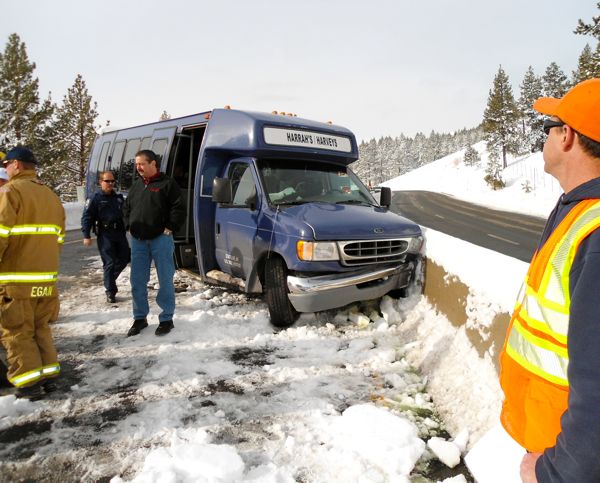
Eighteen passengers in one of the casino company’s shuttle buses were involved in an accident Tuesday morning that left them standing on the side of Spooner Summit. Three people sustained minor injuries, with one being transported to Carson Tahoe Hospital, according to the NHP.

Nevada Highway Patrol Trooper Eric Gallagher told Lake Tahoe News there was a mechanical malfunction in the steering system. The bus was headed toward Carson City on the east side of the summit in the left lane. The loss of steering capability along this windy section caused the bus to strike the center rail.

A Harrah's bus malfunctioned Jan. 24, hitting the median on Highway 50. Photo/Provided

A commuter going over the summit about 9:30am told Lake Tahoe News the bus was sideways, partially in the right lane, which meant having to “gingerly go around it.”

At that time NHP was not on the scene, but three units were driving with lights and sirens on from the Carson direction.

Harrah’s sent another vehicle to take the group to the Reno-Tahoe Airport.

A spokesperson for Harrah’s was not immediately available for comment.