Ma Nature, lack of publicity hurt El Dorado wineries

By Kathryn Reed

FAIR PLAY – Not a cloud in the sky, not many people in the wineries. From a consumer standpoint the first day of the El Dorado County barrel tasting event was great. From the viewpoint of some of the 27 wineries that are part of the event, Saturday was disappointing.

Coming off a harvest that was bizarre by most definitions, having a special event that is less than successful is not welcome. The event continues today. But at $35 for the weekend, it is more money than 2011.
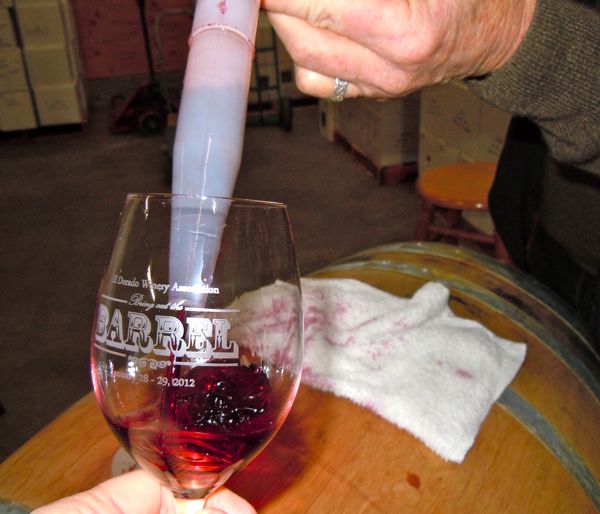
Barrel tasting continues today at designated El Dorado County wineries. Photos/Kathryn Reed

Some industry officials who spoke to Lake Tahoe News off the record on Jan. 28 attributed the less than stellar turn out to the public relations-marketing firm that is in its first year for El Dorado Winery Association.

The latest stats on the website are from March 2011. The latest press release is from February 2009.

Twenty-seven wineries were on the list this year as participants in the barrel tasting event – one more than 2011. In 2010, 1,200 tickets were sold, while 2,000 were sold in 2011. Ticket sales for this year have not been released.

An increase in price during a recession could be a contributing factor to the decline of participants in this event that started in 2007. This year the weekend pass is $35 (tickets still available for today), compared to $20 or $25 for the two days in 2011. No Sunday-only tickets were for sale, as was the case last year for a price less than the weekend rate.

A Fair Play winery said the barrel tasting event in 2011 attracted about 1,400 visitors. About 10 were at this particular winery midday Saturday. Usually people are flowing out of the tasting area – even when the weather has been less than ideal.

Lake Tahoe News reporters are used to having to struggle to get to the counter to get a pour. Of the five wineries visited Saturday, the opposite was the case.
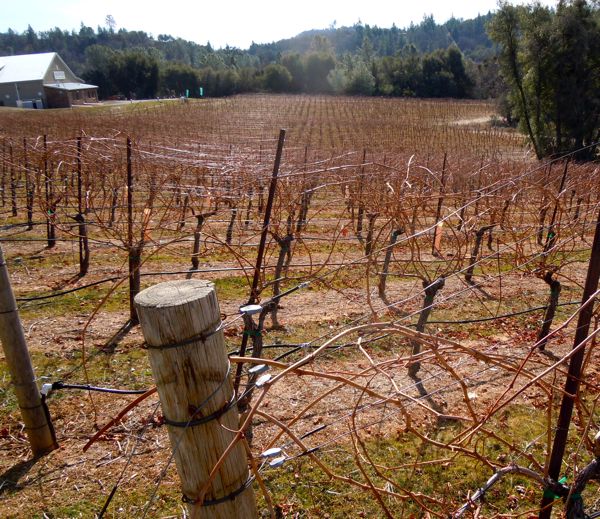
Vines are dormant -- but it's still dry, as evidenced by the brown at Skinner vineyard.

Besides the lack of people, the lack of rain is everywhere. Brown terrain proves moisture has been scarce. Cows are munching on grass in fields that are normally green and several inches tall.

John Latcham, who manages the vineyards for Latcham Winery, says he knows of people who have already started to irrigate.

“If this continues, we’ll be irrigating soon,” Latcham said. “The water table is way down.”

The irony about this dry winter is last year was extraordinarily wet – setting records for moisture totals in so many parts of Northern California.

But growing grapes is farming. And farmers and Mother Nature have a love-hate relationship. The love seems to be lukewarm based on the inconsistencies.

Last year at this time Single Leaf Vineyards had 70 inches if rain. This year 10 inches have been recorded. Pam Miller, who owns the winery with her husband, said someplace in between would be ideal.

“Don’t tell me there is not climate change,” Miller told Lake Tahoe News. “There is no doubt Northern California is changing.”

With the abundance of moisture a year ago, which kept coming during the fall harvest of grapes, it meant Latcham lost 40 percent of its harvest. The white grapes were off the vine before the problems arose, but the reds – especially the tender Zinfandel grapes – were hit hard.
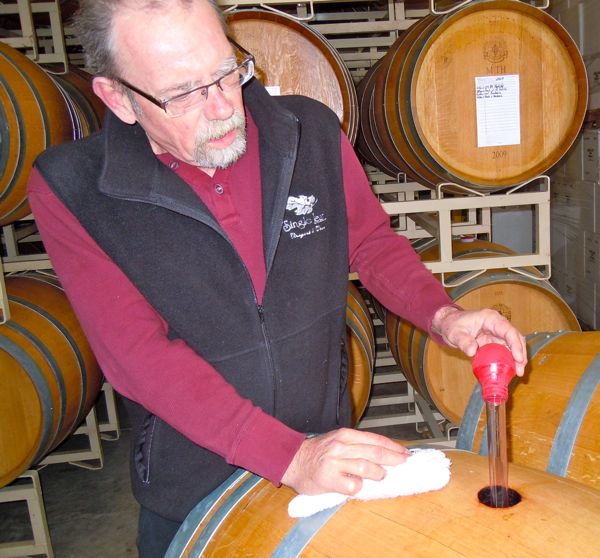
Scott Miller is about to pour from the barrel Jan. 28 at Single Leaf.

The rain drops the sugar content of the grapes.

“Not only was it a difficult harvest, it was expensive,” Latcham said.

Bunch rot was a problem for some wineries.

Still, winemakers believe the 2011 vintage will be good.

“We’re optimistic about 2011,” said Greg Baiocchi, winemaker at Miraflores.

What will come of 2012 remains to be seen. This is the normal dormant season for the vines. Every place is below normal for rainfall, but there is still time for that to be made up.


Nevada GOP to use social media on caucus day

By Sean Whaley, Nevada News Bureau

CARSON CITY — Nevada state Republican Party officials expect all the major GOP candidates to visit the state ahead of the Feb. 4 first in the West caucus.

The Nevada GOP is also introducing social media into the process, using Google and Twitter to report the caucus results beginning about 5pm that day from 16 of the state’s 17 counties.

Final results won’t be known until sometime after 7pm because of the Clark County GOP decision to have one at-large caucus to accommodate religious concerns by some in the Jewish and Seventh-Day Adventist faiths who cannot participate until after sundown.

Clark County results won’t be complete until that late caucus concludes.

“I’m so excited about Feb. 4,” said Nevada GOP Chairwoman Amy Tarkanian in a telephone conference announcing details of the event. “We are first in the West, which is vital, and as we’re watching everything take off across the country it looks like we may be the tipping point.”

The Republican presidential contest is expected to remain undecided through the Florida primary on Tuesday. Nevada is the next state in the process with its caucus. As many as 60,000 Republicans could participate.

Tarkanian said Mitt Romney, Ron Paul, Newt Gingrich and Rick Santorum are all expected to campaign in Nevada in coming days. Romney won the caucus in 2008.

The caucus events for most participants will occur in each county between 9am and 3pm. Clark County is the only county to have the evening at-large caucus.

Jim Anderson with CAP Public Affairs, hired by the Nevada GOP to help win Nevada for Republicans in November, said the use of Twitter and Google is a new wrinkle in presidential politics.

“One of the really cool things that we’re doing with this caucus that I believe has never been done before is utilizing both Twitter and Google to get the results out in what we think is the most efficient way to date,” he said.

The Nevada GOP Titter account, NVGOP, will be used to Tweet the results, Anderson said. The Google election results map will be used as well and be available on the state GOP website, he said.

It should be the fastest results coming out of a caucus in history, Anderson said.


CalFire needs managers, but firefighters prefer overtime pay

By Jon Ortiz, Sacramento Bee

Some of California’s rank-and-file firefighters earn so much money in overtime that the state has revived pay bonuses worth thousands of dollars to lure them into management.

The problem at the Department of Forestry and Fire Protection has grown over the last decade, as the state negotiated firefighter contracts that boosted overtime pay without consistently raising supervisors’ wages.

Along with the department’s graying ranks and early-retirement incentives, the developments have depleted CalFire’s leadership ranks.

Persuading line firefighters to take those management positions and give up the overtime money has proved difficult.

“Basically, when you’re an assistant chief, you make less money, have more responsibility and work longer hours,” said Dale Hutchinson, who as southern region chief hires CalFire managers for half the state. “It’s been a standing issue for years.”

The state is again upping pay for some managers as a result.

Most of new “recruitment and retention differential” money will go to 34 assistant chiefs in the Department of Forestry and Fire Protection. It adds $1,851 per month, about $22,000 per year, to their base pay.

Read the whole story


State upholds decision to reclassify Washoe Meadows park, alter river-golf course

By Kathryn Reed

BRENTWOOD – It was almost like the California State Park and Recreation commissioners had split personalities at the Jan. 27 meeting. The morning was jovial and jocular when it came to approving the general plan and EIR for a new state park in the Bay Area, as well as the naming of it. The afternoon was rushed and seemed like commissioners would rather go to lunch than hear what people had to say about Washoe Meadows State Park.

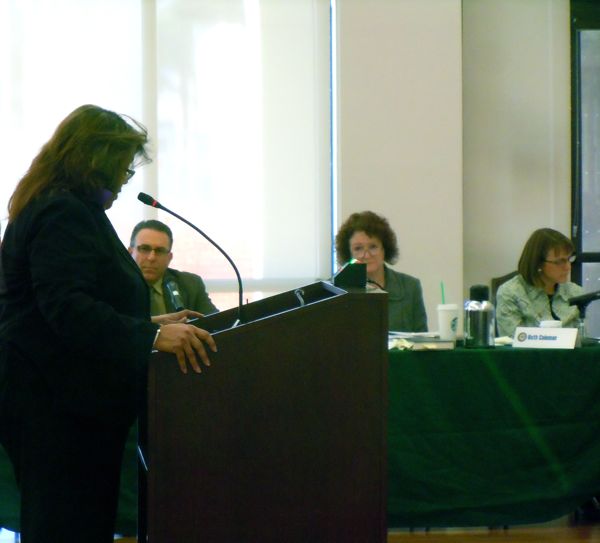
Norma Santiago addresses the State Parks commission Jan. 27 as staff listens. Photo/Kathryn Reed

In fact, the Lake Tahoe state park’s name wasn’t even listed on the agenda.

The board, after seven people spoke, voted 5-0 to maintain the decision made Oct. 20 to accept the final EIR for the Upper Truckee River restoration project, and to swap land between the park and Lake Valley Recreation Area to allow Lake Tahoe Golf Course be reconfigured.

Kathryn Tobias, legal counsel for State Parks, before comments and the vote were taken said the matter before the commission was procedural. State Parks employees had earlier said the rehearing was necessary to make sure everything was in order now that the project is tied up in a lawsuit.

It would be hard to know what the commissioners truly thought beyond their body language because they voted without discussion. Commission Chairwoman Caryl Hart cut people off and only gave people representing an organization three minutes to speak instead of the customary five minutes. She also said the commission had heard everything they needed to hear.

El Dorado County Supervisor Norma Santiago was the first of the seven to speak. All believed the commission should either overturn its original vote or delay Friday’s vote. Santiago asked for three months to prove the information she provided is correct.

“Page 5 of your Draft Resolution 3-2012 states: ‘Resolved: That the legal, social, economic, technological and other benefits of the Project described herein outweigh the unavoidable short-term environmental risks, as described in the Statement of Overriding Considerations adopted by the director of State Parks at the time of project approval, and so the unavoidable significant environmental impacts are overridden by these factors and are, therefore, acceptable’,” Santiago read to the commission.

“I submit to you that there is significant scientific documentation that does not support this statement. Andrew Simon, who did most of the analysis on stream channel erosion for the [Lake] Tahoe Basin TMDL, clearly documents that 90 percent of the problem resultant from this type of erosion can be resolved by addressing 14percent of the toe slope issues. Additionally, in this case, the channeling of parts of this river that currently show no evidence of erosion now and in the future will take 10 to15 years to recover. At the time of recovery, the benefit generated from this channeling is incremental at best. In the meantime, the return on the economic, social, technological, legal and environmental investment are disastrous.”

Besides being the elected official for the area of the South Shore where the project is located, Santiago is also chairwoman of the Tahoe Regional Planning Agency. The TRPA must still approve the project.

Brian Judge, a principal planner with TRPA, was at the meeting, but did not speak on the record. After the meeting he told Lake Tahoe News how important it is to fix this reach of the river and that it’s a critical piece of the environmental improvement program.

Bob Anderson with the Sierra Club’s Lake Tahoe chapter was one of the speakers. After the meeting he told Lake Tahoe News he believes the issue will be “dead in the water” when it reaches the TRPA Governing Board.

The Sierra Club wants the river to be restored, but believes the alternative chosen to do so is not achievable and therefore the status quo will remain, Anderson told the commission.

“Financially, it does not pencil out,” Anderson said.

Restoring the river is not the issue that has people up in arms. It’s how it will be done and the impacts to Washoe Meadows State Park that concerns people. It’s biased tours of the area that don’t show pristine locations that will be disturbed, it’s a precedent-setting ruling that allows a state park to be reclassified to a lower status, it’s putting golf before other recreation, it’s putting money before the environment that have people upset.

And as was stated at the meeting at the Brentwood Community Center in the East Bay, they are tired of the condescending reference to being a neighborhood group when members of the Friends of Washoe Meadow reach well beyond the perimeter of the park and basin.

“It was hard to listen to the meeting, especially at the end when so many false statements were made. But the meeting process doesn’t allow us to make any more comments. The word of parks staff is accepted,” Lynne Paulson told Lake Tahoe News after the meeting. “For example, it was completely incorrect that the findings were available at the last commission meeting. Our attorney was there, as was I and others. We picked up all information available in the back of the room and our attorney specifically asked about the findings, but was told they were not available. “

Paulson is part of the group that is suing to stop the project. The suit in large part is based on perceived inadequacies with the California Environmental Quality Act.

“Also, when they said that they had already considered everything public speakers said, it wasn’t true. For example, we were proposing that they use several different methods of river restoration, not just one type,” Paulson said.

Cyndie Walck, hydrologist with State Parks, told Lake Tahoe News after the meeting she is confident the commissioners made the correct decision and that it will benefit the South Shore environmentally and economically.

“It will open up a public park to the public,” she said. More than a mile along the Upper Truckee River that is now only accessible by golfers will be developed into a hiking trail.

Keeping the golf course 18-holes by moving up to nine holes into what today is the state park, but when the project is done will be recreation area, is more economically viable, according to Walck.

The TCW economic analysis that was done after the October decision challenges the state’s assertions. However, the commissioners made no comment on this fact despite being presented with information Friday.

For now, the project is tied up in court, with the next hearing date set for March.

Walck is waiting to be told she can move forward.

“I have the funding to go to the design level of the river restoration,” Walck said.

———

The new state park that was OK’d is near the town of Brentwood, where the meeting was. The name will be Marsh Creek State Park and will be operated as a historic park.


Nevada missing an opportunity with exports

By Steve Green, Las Vegas Sun

For many Nevadans, “international trade” might mean heading to Walmart in their import cars to buy Chinese-made computers as well as imported desks and chairs to outfit their offices.

But trade is a two-way street, and economic development officials say Nevada companies sell billions of dollars of goods and services each year to customers in foreign nations.

Nevada exports of goods are dominated by gold sales, which in 2010 amounted to $2.4 billion — 40 percent of the value of all state exports. Other big export categories for Nevada are copper (12 percent) and video game consoles, parts and accessories, including casino equipment (7.3 percent).

Through the first 11 months of 2011, total sales of the state’s exports of goods were about $7 billion.

That’s a big number, no doubt, but there’s plenty of room for improvement. Utah, whose population of about 2.7 million people is comparable to Nevada’s, posted $17.3 billion in sales in the same period.

Utah’s manufacturing base is far larger than Nevada’s, but insiders say Utah also has benefited from larger and more focused economic development efforts, including measures to boost overseas sales.

Utah’s commitment to promoting exports includes having not only just a state export director, but also global regional directors. Nevada, for its part, has just two international trade officials.

Read the whole story


South Shore chamber making strides after 5-plus years

By Kathryn Reed

Five years. It’s been that long since the Lake Tahoe South Shore Chamber of Commerce came into being. While the beginning was rocky – as most mergers are – solid ground has been found.

B Gorman has been at the helm since Day 1 when this chamber, which is the culmination of merging Tahoe Douglas Chamber of Commerce and South Lake Tahoe Chamber of Commerce, came to be.

B Gorman on Jan. 26 talks about what Lake Tahoe South Shore Chamber of Commerce is doing. Photo/Kathryn Reed

At the beginning it was Gorman doing almost everything, along with the board. Staff and board members have come and gone. Today there are three full-time employees reporting directly to Gorman and another who is shared with the Lake Tahoe Visitors Authority.

Gorman in a 90-minute presentation gave a recap Thursday of how things are and what the chamber is doing. About 50 people attended the Jan. 26 breakfast meeting at Inn by the Lake. The past and the future, though, were not topics of the meeting.

Afterward, Gorman spoke with Lake Tahoe News about where the nearly 650-member strong chamber is going. (About 70 percent of members are located in California and 30 percent in Nevada, with a mix of sizes.)

Growing membership is always a goal. The CEO-president also envisions the chamber taking on more environmental causes, or at least having a seat at the table when those issues are being discussed.

Chambers and politics have historically been bed partners. But this chamber has not been as politically minded as the former South Lake Tahoe chamber was or others are. That could change, according to Gorman. It’s a direction she would like to take the organization, but said ultimately that will be a decision of the 21-member board.

Relationship building, promoting the community, growing the local economy and representing businesses with government are the main goals of the chamber.

With South Lake Tahoe presumably done with moving people out of and within the government organization, Gorman is forming relationships with those left behind to better serve the business community.

History:                                                                    • 2005 – Serious talks are under way about merging the Tahoe Douglas Chamber of Commerce with the South Lake Tahoe Chamber of Commerce. • March 2006 — In a 13-0 vote, the Tahoe Douglas Chamber of Commerce agrees to merge with the South Lake Tahoe Chamber of Commerce. Three board members were absent and one abstained. The South Lake chamber board voted 18-6 to combine resources. At that time the South Lake chamber had 950 members, and Tahoe Douglas 640, with 350 belonging to both chambers. • Fall 2006 – B Gorman hired to run merged chamber. • November 2006 – merger takes place. Eighteen-year lease signed on Stateline building owned by Primm Ventures. • January 2007 – Public disharmony is evident; members of former South Lake chamber begin forming South Tahoe Chamber of Commerce. Issues with the lease, finances and offices being in Nevada contributed to the problems. • Today – Bitterness is gone for some, remains for others. Another merger is not in the works.

The chamber through a formal bid process was awarded the contract with the city that uses grant funds to provide a business-coaching program called the Tahoe Tactical Team. Forty-five small businesses have gone or are going through the program.

Putting on workshops and forums are a big part of the chamber. Some are open to just chamber members or might cost more for non-chamber members.

Key events the chamber puts on are the Business Expo (March 30 at Harrah’s Lake Tahoe) and Sample the Sierra (Sept. 2 on Ski Run Boulevard).

One member asked why the food and wine event is Labor Day weekend and not at a time when the area is less crowded. Gorman said the harvest of food and wine help dictate when it can be, as do room nights.

“Labor Day weekend is soft. Visitors drop off in mid-August,” Gorman said. “Our hope is to build Labor Day weekend.”

When schools started after Labor Day, Lake Tahoe was busy through that weekend. Not so anymore. Gorman said hotel occupancy has been between 50 percent and 60 percent for nearly a decade on Labor Day weekend.

Another member asked about SnowGlobe, the three-day music festival over New Year’s Eve weekend.

“It’s safe to say if it were not for SnowGlobe, it would have been weaker over New Year’s,” Gorman said. That was based on a survey the chamber sent out to members asking how the event affected business.

But she also said if the city intends to bring the event back, the chamber wants more info that could be shared with members – like suggesting to a coffeehouse it stay open until 2am to warm up the concert-goers on their way back to their lodging establishments.

More information about the chamber may be found online.


Steinberg: Redevelopment agencies won’t be resurrected

By Torey Van Oot, Sacramento Bee

Senate President Pro Tem Darrell Steinberg said today that he believes an effort to extend the life of local redevelopment agencies through April 15 is “not going to happen.”

Legislation to that effect, Senate Bill 659 by Democratic Sen. Alex Padilla, faces a Tuesday deadline for winning passage in the state Assembly, in addition to the planned Feb. 1 date of closure for the agencies

“I’m skeptical,” Steinberg said. “I think the speaker is skeptical, and the governor is dead set against the bill. The focus needs to be on recreating a new set of economic development tools for cities and not on trying to keep alive the current form.”

The Legislature axed the agencies, which subsidize local projects in blighted areas, and created a new redevelopment entity as part of last year’s budget package. But the state Supreme Court ruled in December in response to a legal challenge to the move that while the Legislature had the power to dissolve the agencies, the replacement organizations could not stand.

Read the whole story


Attorney who made tribes rich comes under fire

By Dale Kasler and Peter Hecht, Sacramento Bee

He started out in a tent at the reservation at Wounded Knee, S.D., an idealistic young lawyer defending Indians’ rights. He evolved into a champion for Indian casinos – a towering political figure who cut deals with California governors and helped give birth to a $7 billion-a-year industry.

Sacramento attorney Howard Dickstein has made his tribal clients rich. He’s largely responsible for creating three of the region’s top casinos: Jackson Rancheria, Cache Creek and the stunningly successful Thunder Valley resort near Lincoln.

After nearly 40 years representing tribes, however, Dickstein is a polarizing figure. His negotiating tactics have angered some tribes, and he is often depicted as a controlling presence who meddles in tribal affairs.

For the second time in four years, he is facing bitter accusations of gaining vast personal wealth at the expense of unsophisticated clients.

Two banned members of the United Auburn Indian Community, which owns Thunder Valley, have accused Dickstein of duping the tribe into paying his firm $26 million in fees over six years.

Most of the money – about $23 million – came through a fee arrangement that, until 2009, gave Dickstein’s firm 2 percent of the tribe’s share of Thunder Valley’s profits. Legal experts and rival tribal lawyers say they have never heard of such an arrangement.

Dickstein said there was nothing wrong with it – and that he’s worth every penny.

“A tribe’s financial relationship with me is a phenomenal net benefit to the tribe,” he said.

Read the whole story


Maids at 2 Stateline casinos let go; offered jobs with Fla. firm

By Kathryn Reed

Caesars Entertainment will be outsourcing its housekeeping departments at its Lake Tahoe and Reno properties starting Feb. 1.

The Service Companies will take over the operation, having already done so at other properties owned by the world’s largest gaming company and having plans to do so at others later this year.

The same people will be cleaning rooms at Harveys; they just won't be Harveys' employees. Photo/LTN file

A handful of housekeeping employees contacted by Lake Tahoe News on Jan. 25 were not aware of the changes, even though it was announced to staff last week.

The nearly 200 housekeeping employees at Harrah’s Lake Tahoe and Harveys and 84 in Reno all have been offered jobs with The Services Company, a Florida-based firm that specializes in all things cleaning.

John Packer, spokesman for the Northern Nevada properties, said 40 employees would be getting a raise because TSC has a higher minimum wage than the casino company.

He said the head of housekeeping has signed on with TSC, as have many of the team leaders, so the rank and file will likely have the same boss.

TSC did not return a phone call. It’s not known if benefits are better or worse, or if employees will get the same number of hours they are used to.

Caesars Entertainment and TSC have a long relationship. About 10 years ago they began doing the cleaning at the Stateline properties. TSC also has contracts with MGM, Ritz Carlton and Hyatt properties.

Packer said hotel guests should not notice any changes.

“It’s extremely important to us that guests still have a great experience,” Packer said. He said of the 40-plus properties Caesars Entertainment owns, Harveys, Harrah’s Lake Tahoe and Laughlin consistently receive the top marks for guest services. He expects to keep that ranking when the new housekeeping company takes over.

Gary Thompson, spokesman for the Las Vegas-based company, would not say if more employment changes are in the works within other departments. Nor would he say exactly how many have been laid off in the last few years.

“Over the course of the past 3½ years we have reduced our overall employment across the company,” Thompson told Lake Tahoe News.

In 2008, private equity firms Apollo Management Group and Texas Pacific Group bought Caesars Entertainment for $30.7 billion. An IPO was planned for December 2010, but company executives stopped that from going forward because of market conditions.

An IPO is expected sometime this year.


N. Nevada developing plan to promote sports-recreation

By Anne Knowles

CARSON CITY – Northern Nevada is looking at sports and recreation from every angle to boost its economy.

The bid for the 2022 Winter Olympics, the Reno Bighorns minor league basketball team, the UNR Wolf Pack athletic program, even makers of outdoor gear, all figure into plans to capitalize on sports.

Nevada Lt. Gov. Brian Krolicki and Jon Killoran, the chairman and CEO, respectively, of the Reno Tahoe Winter Games Coalition, and others talked about the various efforts during a breakfast meeting at the governor’s mansion Wednesday hosted by the Northern Nevada Development Authority.

Northern Nevada officials want people to think of the area for sports that go way beyond betting on games at a casino.

“We’re here to talk about sports and the passion of athleticism, but also about business,” Krolicki said.

Krolicki said the coalition of California and Nevada interests are in “hot pursuit” of the 2022 Winter Olympics. He said bids to bring the games to Lake Tahoe are due next summer to the International Olympic Committee, which will decide on the location in 2015, giving the winner seven years to build up the needed infrastructure to host the two-week event.

Killoran said the 2002 Winter Games had a $100 million economic impact on Salt Lake City, which expanded its airport and overhauled Interstate 80 in preparation, and raised the city’s profile internationally.

In the Lake Tahoe Basin, he said, public transportation would be expanded to include high-speed water ferries and to reduce personal vehicle traffic. Krolicki promised the Olympics would be a boon, not a burden, to the basin environment. Money generated by the event, for example, could help fund efforts to improve lake clarity.

Lisa Granahan, Douglas County’s economic vitality manager, said the county has identified suppliers of outdoor gear, particularly soft goods like tents and backpacks, as an industry to attract to the region.

She said the county is already home to four such businesses: North Sails, Aviso Surfboards, Sierra 4×4 Trailers and TechSpec.

“Our goal is to have 700 new jobs by 2022 in new businesses and to develop the services to attract them,” she said.

To that end, the county is planning a cut-and-sew center to make soft goods. Granahan said suppliers are interested in relocating manufacturing to the United States from China, where costs are now rising. A $70,000 grant from the U.S. Department of Agriculture funded start up of the center, which is being housed in space at the Carson Valley Business Park donated for a year rent-free by its owner, Bill Miles, owner of Miles Construction.

Granahan said she would be presenting an update on the county’s economic vitality plan, which comprises 12 areas, including Tahoe revitalization and the South Shore Vision Plan, and trails development, to the Douglas County Board of Commissioners at the commission’s Feb. 10 meeting.

Mike Samuels, assistant athletic director of Nevada Wolf Pack Athletics, described the economic impact of the Wolf Pack moving from the Western Athletic Conference to the Mountain West Conference, which is expected to happen this summer. He said the UNR program, which now receives $500,000 annually from the WAC, will get $2.1 million from the Mountain West. He said the program is working with the Reno Sparks Convention and Visitors Authority to develop tourism packages around the program’s football and basketball schedules.

John Kinkella, director of the Reno Bighorns, talked about the team’s place in the D League, which acts as a minor league to the National Basketball Association, and the money it brings to the region, including 1,200 room nights during this month’s weeklong D League Showcase at the Reno Events Center. The team is now locally owned after being purchased in August 2011 by Reno attorney Herb Santos, and Stephen and Jeffrey Adams.

While no one from the Reno Aces was at the Jan. 25 event, the minor league baseball team will bring money to the area when it hosts the Triple-A All-Star Game in 2013.