Raley’s breaks from grocers to negotiate its own labor contract

By Dale Kasler, Sacramento Bee

Raley’s says the lack of progress on a new labor contract is costing the West Sacramento grocer millions — and contributed to the recent closure of two of its stores.

In an effort to jump start negotiations with the the United Food and Commercial workers, Raley’s has separated itself from its fellow union grocers, Safeway Inc. and Save Mart Stores, and will now bargain on its own.

“There is more urgency on our end than on the other retailers to reach an agreement,” Raley’s spokesman John Segale said today.

The company is seeking about $18 million worth of annual savings, mostly through cutbacks in health expenses, according to a memo sent to employees late Wednesday by Chief Executive Michael Teel. The lack of a new contract since the old pact expired four months ago has cost Raley’s about $6 million, he said.

Read the whole story


California’s government payroll in 2011 increases by $500 mil.

By Phillip Reese, Sacramento Bee

State government payroll increased by half a billion dollars last year, even as California cut thousands of state worker jobs, according to a Bee analysis of new data from the Controller’s Office.

The payroll increase added about $140 million in wages to the Sacramento economy in 2011, contributing to a budding recovery.

The trend is largely due to a shift away from worker furloughs and toward layoffs and hiring freezes. Absent furloughs, most state workers got a full paycheck for the first time in years during 2011, plus some step raises and other union-negotiated bumps.

“Payroll would have grown a lot faster if those (job) reductions hadn’t taken place,” said Michael Shires, a professor of public policy at Pepperdine University.

State payroll eats a large chunk of the state’s budget – almost $18 billion in 2011. During recent lean times, former Gov. Arnold Schwarzenegger and current Gov. Jerry Brown have tried to keep payroll in check, but have taken different approaches.

Through much of 2009 and 2010, the Schwarzenegger administration required workers to take three unpaid furlough days a month, dubbed “Furlough Fridays.” That program ended in late 2010, though many workers still had to take one unpaid furlough day a month last year.

The furloughs cut state worker pay by more than $1 billion from 2008 to 2010. But, despite threats of layoffs and hiring freezes, Schwarzenegger never substantially reduced the number of full-time state workers.

Read the whole story


Dismal snowpack melting away fast with all the sun

By Kathryn Reed

PHILLIPS STATION – While there was snow to survey, there wasn’t much. The water content measured near Sierra-at-Tahoe on Wednesday came in at 19 percent of normal.

Statewide, the snowpack water content for Feb. 1 is 37 percent of normal.

The water content as measured by the Department of Water Resources was 3.8 inches near Echo Summit. This compares to 24.8 inches a year ago.

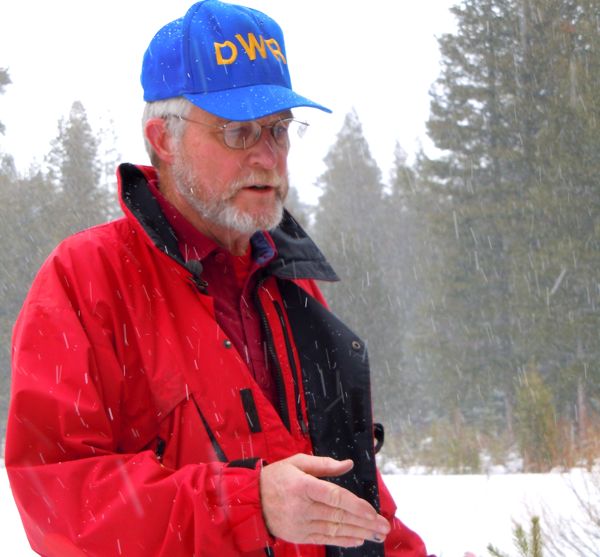
Frank Gehrke with the Department of Water Resources talks water content Feb. 1 near Echo Summit. Photo/Kathryn Reed

It was deceiving to have Frank Gehrke take the samples along a 500-foot open area just off Highway 50 while snow was coming down because it gave the perception winter is alive and well in the Sierra.

That just isn’t the truth.

South Lake Tahoe recorded 3.88 inches of precipitation for all of January, according to the National Weather Service. Weather gurus are not seeing any love on their models in terms of winter-like weather. And the blips that may produce moisture this month aren’t enough to make up for the precip deficit all of Northern California and Northern Nevada are dealing with.

While the National Weather Service said this total was not a record low, the water content comes close.

According to the Department of Water Resources, the Feb. 1 water content was the second lowest on record, with those books starting in 1946. In February 1963 at Phillips Station it was all dirt — nothing to record but zeroes.

Gehrke pointed out that besides the abysmal amount of snow (15.6 inches where he measured Feb. 1) and the low water content, the storm patterns are likely going to create a problem for reservoir managers. This is because the snow is melting faster than usual with day after day of sun.

And he said if the winter progresses with these same storm patterns, the white stuff will disappear even faster.

Reservoirs in California that supply municipalities and farmers are still holding their own after the records set in 2010-11, but if this dry pattern lasts all winter, restrictions could be put in place.

Lake Oroville in Butte County, the State Water Project’s principal storage reservoir, is at 107 percent of average for the date and Lake Shasta, the federal Central Valley Project’s largest reservoir with a capacity of 4.5 million acre-feet, is at 99 percent of its normal storage level for the date.

Besides the lack of snow likely to affect the whole state in terms of water supply in the coming months, it is impacting the Lake Tahoe economy today.

It wasn’t until last weekend that snowmobiling operations started at Tahoe businesses. Kirkwood is the only Tahoe area resort to have its whole mountain open, but with no snow in the forecast for the next two weeks, that status could change. Ski shops are starting to have clearance sales to move merchandise. Snow removal operators may be turning to lawn service soon.

With businesses unable to operate at full throttle it means less operating cash for them, but also fewer employees. South Lake Tahoe’s unemployment rate is at 15 percent, while Douglas County’s is at 13.8 percent.

Feb. 1 DWR readings:

Location

Elevation

Snow Depth

Water Content

% of Long Term Average

Alpha

7,600 feet

14.8  inches

 3.6 inches

17

Phillips Station

6,800 feet

 15.6 inches

3.8  inches

19

Lyons Creek

6,700 feet

21.8  inches

5.8  inches

30

Tamarack Flat

6,500 feet

  15.2 inches

4.8  inches

25


Censured Placer County judge not seeking re-election

By Ed Fletcher, Sacramento Bee

Embattled Placer County Superior Court Judge Joseph O’Flaherty announced today that he will not seek a new six-year term in the upcoming June election.

In September, the state commission overseeing judicial conduct issued a public censure of O’Flaherty — the stiffest punishment available, short of removal from office.

It was the second time the state Commission on Judicial Performance has publicly disciplined O’Flaherty.

O’Flaherty said that ruling didn’t cause him to not seek to return to the bench. He said it would have given an opponent some ammunition but he remained confident.

“It wasn’t the key factor,” O’Flaherty said of the ruling. “I don’t think anybody could have beat me.”

Read the whole story


Teachers’ pension system returns lag behind projections

By Dale Kasler, Sacramento Bee

CalSTRS is thinking of cutting its investment forecast for the second time in barely a year, a move that will reflect the increase strain on the pension fund.

The teachers’ pension system on Thursday will consider a recommendation from its actuarial consultant to cut the forecast by a quarter point, to 7.5 percent. The consultant, Milliman Inc., said the current rate of 7.75 percent “is greater than the expected long-term return.”

Lowering the forecast means could intensify the pressure on the Legislature and Gov. Jerry Brown to come up with a funding solution for CalSTRS. The retirement system is underfunded by tens of billions of dollars; lowering the forecast will increase the gap by another $5.9 billion, according to Milliman’s memo to the CalSTRS board.

Read the whole story


State Parks struggling to deal with money woes

By Kathryn Reed

BRENTWOOD – When Jerry Brown was governor the first time, 90 percent of the State Parks’ budget was from the general fund. As of July 1, Brown proposes the general fund will be responsible for 28 percent of that department’s budget.

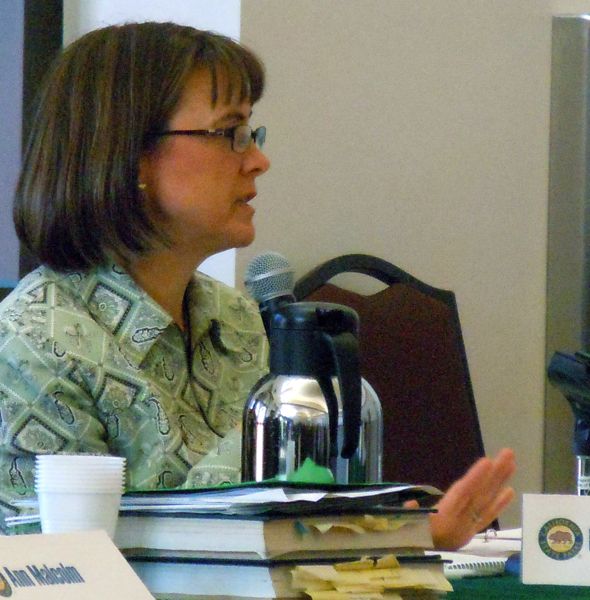
“Now we have to fund our mission,” is how Ruth Coleman, director of the Department of Parks and Recreation, put it at a meeting last week. Parks will be cut by $22 million in fiscal year 2012-13 as the proposals are written today.

Parks Director Ruth Coleman addresses the commission Jan. 27. Photo/Kathryn Reed

She said while the mission of the department has not changed, how it is funded has. Still on the table is the closure of 70 of the 278 state parks beginning July1 – the start of the next fiscal year.

“We don’t know if the 70 closures are permanent,” Coleman told the California State Park and Recreation commissioners.

Coleman told the seven-member board she is creating a business plan for every park, which is more like a strategic plan, for how to manage the parks. This includes developing public-private partnerships, having staff develop a more entrepreneurial mindset, being flexible, and possibly combining state parks.

Workshops will be conducted at five locations on Feb. 22 to gather input from the public and possible partners about how they want the parks to function going forward. The nearest meeting location to Lake Tahoe will be in West Sacramento. Time and exact locations are on the department’s website.

Coleman said she is working on ways to allow parks to keep more of the money they generate. However, this could be subject to approval by higher ups.

Lake Tahoe comes under the High Sierra region, which has 11 units in it.


Grand jury out of money, takes county to court for more

By Kathryn Reed

El Dorado County’s civil grand jury has spent all of the money allocated to it – $40,442 – and now wants a judge to tell the Board of Supervisors to keep paying any bill that comes in through June 30 – the end of the fiscal year.

The county doesn’t want to give any entity a blank check.

The money issue is now tied up in court. Interpretation of the Penal Code is one of the controversies.

Penal Code Section 890.1 states: The per diem and mileage of grand jurors where allowed by law shall be paid by the treasurer of the county out of the general fund of the county upon warrants drawn by the county auditor upon the written order of the judge of the superior court of the county.

Penal Code Section 914.5 states: The grand jury shall not spend money or incur obligations in excess of the amount budgeted for its investigative activities pursuant to this chapter by the county board of supervisors unless the proposed expenditure is approved in advance by the presiding judge of the superior court after the board of supervisors has been advised of the request.

El Dorado County Superior Court Judge Steve Bailey is expected to make a ruling Feb. 15 based on the testimony that was given in January.

But Bailey in a July 2011 court order outlined how payments should be structured for this grand jury. It’s possible the ruling later this month will change that protocol.

Foreman Ted Long is allowed to sign all paperwork for members to get paid without anyone double checking his numbers or validating the work was done. Long is a former South Lake Tahoe city councilman who ran into controversy regarding finances while he served as president of the Clean Tahoe board. A nearly year-long police investigation that started in 2006 resulted in no criminal charges being filed against anyone. (Clean Tahoe was part of the 2007-08 grand jury report.)

The 19-member grand jury is entitled to $15 per day worked and the IRS mileage rate, which is currently 55.5 cents per mile, according to the Penal Code. But the county also gives it a fixed budget – like any body whose budget it oversees.

With six members residing in the Lake Tahoe Basin, it means more miles driven than most years because weekly meetings are in Placerville, as are other points of business for this oversight body. In previous years there have been one or two Tahoe residents on the grand jury, so mileage was less of an issue.

“The El Dorado civil grand jury is an investigatory body created for the protection of society and the enforcement of the law. It is an arm of the court and a representative of the public. Although it is an arm of the court, it operates independently of direct court supervision. It is a check against governmental authority. It is not a branch of the county, nor is it answerable to the district attorney,” the county’s website says in explaining what the grand jury is.

Still, it is the county that pays the grand jury’s bills, it is the District Attorney’s Office representing it in court, and it is Judge Bailey who is overseeing everything.

“The question is what to do when the grand jury thinks it needs more money,” Ed Knapp, county counsel, told Lake Tahoe News. “The board can augment the budget or it can express to the court why it doesn’t want to do it.”

All county department budgets keep being slashed. The grand jury’s was cut in half for this fiscal year.

Knapp said with the county looking at an $8.5 million gap to close by July 1, all entities in the county would keep being pinched.

But Long, who is on his third stint on the grand jury – having served last year and eight years ago, says the grand jury should not sustain across-the -board cuts like other departments because members need the latitude to do their job and shouldn’t have to ask the people they may be investigating to fund the operation.

Last week he sent a settlement proposal to Knapp and others about how to resolve the situation.

He told Lake Tahoe News fixed costs like the copy machine and phone are a known quantity, but sometimes there are outside expenses like eight years ago when an auditor was hired by the grand jury to look at South Lake Tahoe’s Redevelopment Agency. Long would like a reserve of $10,000 set aside each year for those surprise expenses. He’d also like an average of the last few years’ worth of budgets to help determine what should be allocated going forward for mileage.

The meeting room in Placerville is not set up for teleconferencing, but that could change.

Supervisor Norma Santiago said, “This would save the grand jury on their traveling expenses, which is one of the primary causes for the increase in expenses.”

She said other departments could also use the technology.

What’s being investigated?

While the grand jury investigations are somewhat secretive in that the members may not talk about what they are working on, but those being investigated may.

In fact, the Feb. 2 South Tahoe Public Utility District meeting has an agenda item that is for the board to be brought up to speed about what staff has been telling the grand jury.

Water meters are a big part of what the grand jury is asking about, according Dennis Cocking, spokesman for the district.

South Lake Tahoe is also under scrutiny. City Manager Tony O’Rourke said he has been questioned about refinancing the city-owned ice rink and “whether the city should be swallowed by the county.”

While O’Rourke believes in the function of the grand jury, he told Lake Tahoe News he would hope it would investigate corruption and more valid complaints.

Long said this year about one-third of the 12 active investigations are centered in the basin.

The report will come out in late June or early July.


Reward offered in shooting of cat

The Humane Society of the United States offering a $2,500 reward for information leading to the arrest and conviction of the individual or individuals responsible for shooting a bolt (arrow) into the head of a cat on the evening of Dec. 20 in the 500 block of Sunlight Drive in Diamond Springs.

The Humane Society of the Sierra Foothills has also added $3,000 to the reward.

“Our officers have been investigating the case, but we have not come up with any solid leads yet,” Henry Brzezinski, chief of El Dorado County Animal Services, said in a press release.. “At this point, we believe this was an intentional act and we want to find out who is responsible. Studies show that people who commit acts of animal cruelty are more likely to also commit violent crimes against people.”

The cat that was shot with the crossbow, a 4-year-old male Tabby named Taz, received emergency veterinary treatment following the incident and is doing well, according to Brzezinski.

Animal Services is asking for assistance from the community to help in the investigation by calling (530) 621.5795.


Redevelopment’s demise a mixed bag in South Tahoe

Updated Jan. 31, 2012, 3:45pm: The bill allowing cities to use redevelopment funds for affordable housing projects passed the state Senate today, however, it won’t be implemented immediately. This is causing further confusion for cities throughout the state.

By Kathryn Reed

It’s over. Redevelopment is dead.

With six 4-0 votes Monday night (Angela Swanson was absent), the South Lake Tahoe City Council dissolved the Redevelopment Agency, re-created the South Lake Tahoe Housing Authority, and as the successor agency put in the necessary parameters for it to function.

All cities with redevelopment agencies must dismantle them by the end of the day Jan. 31 per state regulations. After all, it was the state that created redevelopment in the mid-1900s.

The Jan. 30 meeting was a continuation of the Jan. 17 council meeting.

The one unknown remains the vote in the Legislature that would allow cities to transfer their housing money from redevelopment to newly created housing authorities, like the one South Tahoe created Monday. The state Senate on Tuesday is expected to vote on SB654. Indicators are it will pass both houses.

Creating the housing entity in South Tahoe means keeping $1.5 million that is in that pot for housing. It was revealed Monday night that the city will be able to keep all of its lead paint grant funding from the feds and not have to come up with the match as was the requirement when the money came to it via the Redevelopment Agency.

If the Legislature votes not to create housing agencies, that money cannot be used for housing and would instead be used to pay down the redevelopment debt.

It was agreed Councilman Hal Cole will be the city’s rep on the oversight agency board, with Councilman Bruce Grego the alternate. (More about redevelopment and what happens is detailed in this Jan. 18 Lake Tahoe News story.)

One thing that bothered Councilman Tom Davis (who was participating via telephone) was the remainder of the $7 million that the Redevelopment Agency owes the general fund will technically not be repaid. This is because the state says it is not an enforceable obligation. The state wiped out all loans between agencies and cities.

This is because in many ways it was all a shell game – taking money from one pot, to fill another, to eventually fill the first one. It’s really all the same money being shuffled from one account to another. While legal, the ethics of it are certainly questionable.

The $7 million in question was taken from the general fund to pay off the bills from the Heavenly Village project. But how those bills were presented to councils at the time was not transparent. The reality of the situation did not come to light until the checks had long been cashed. And then it was a couple years before a repayment plan was put in place.

But really, it was always the city just paying itself. It was never the Redevelopment Agency paying the city. This is because the only money exclusive to the agency was tax increment – which is property tax dollars. That had to go to bond debt.

The $7 million loan – of which half has been “repaid” on paper – is really transient occupancy dollars. That money has always gone directly into the general fund. From there some would go to the Redevelopment Agency. And then it would go back to the general fund as the loan payment.

With redevelopment agencies abolished, it should make for cleaner books, at least in South Lake Tahoe.


Casinos ordered to pay sales tax on comped meals

By Cy Ryan, Las Vegas Sun

CARSON CITY — In a decision with far-reaching impact on the state budget and casino balance sheets, the Nevada Tax Commission ruled that casinos must pay sales tax on comped meals given to players and their employees.

The commission, in this single case, rejected an appeal by Boyd Gaming Corp. and its 12 casinos in Clark County, which were seeking a refund of the taxes they have paid.

The 6-1 decision will mean hundreds of millions of dollars in refunds being sought by casinos statewide will stay with the state. Every casino in the state has a similar appeal before the tax commission. Next up is Caesars Entertainment.

The commission decided that sales tax would be based on the retail price of the meal.

John Bartlett, attorney for Boyd, argued that complimentary meals were not taxable because no money changes hands. There is no sale and therefore there can’t be a tax.

Read the whole story