Caesars Entertainment becomes publicly traded company again

By Lee Spears, Bloomberg

Caesars Entertainment Corp., the U.S. casino chain with more than $22 billion in debt, jumped 71 percent in its trading debut after completing an initial public offering a fraction of the size of its failed 2010 effort.

The stock rose to $15.39 as of 4pm New York time Wednesday, valuing Caesars at $1.92 billion. The price almost doubled earlier in the day, tripping circuit breakers, while the volume was more than six times the number of shares sold in the offering. Caesars raised $16.3 million selling less than 2 percent of its shares at $9 each.

That compares with the $531 million IPO scrapped in November 2010. The new offering paves the way for the sale of additional shares by investors in Caesars’ 2008 buyout, led by Apollo Global Management LLC and TPG Capital, and the biggest in history for a U.S. casino. Owners may seek to sell stock valued at more than $500 million based on today’s closing price.

“The float is small, so not too much surprises me” about the stock gain, David Bain, a Newport Beach, California-based senior analyst at Sterne Agee & Leach Inc., said in an email. “Where shares trade today is likely not a good benchmark for future Caesars valuation.”

Caesars, trading on the Nasdaq Stock Market under the symbol CZR, originally offered the shares for $8 to $10 apiece. The Las Vegas-based company priced in the middle of the range, selling 1.81 million shares, according to a statement.

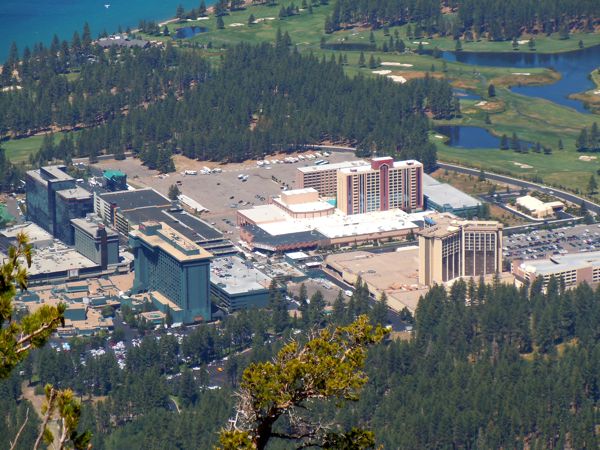
Caesars operates Harveys and Harrah’s in Stateline.

Read the whole story


N. Nevada gaming win increases in December

By Bill O’Driscoll, Reno Gazette-Journal

Gaming revenues in Washoe County jumped 10.2 percent in December from a year earlier, marking just the fourth monthly rise for all of 2011, the state reported today.

The Stateline casino win was up 6 percent in December. Photo/LTN file

Within the county, casinos in Reno saw an 11.8 percent boost over December 2010 while properties in Sparks saw a 7.7 percent rise, according to the report by the Nevada Gaming Control Board. On the North Shore of Lake Tahoe, revenues rose 4.4 percent.

For 2011, Washoe’s gaming revenues showed a 3.2 percent decline from 2010.

Read the whole story


Select California lawmakers had more money to spend in 2011

By Jim Sanders and Phillip Reese, Sacramento Bee

With California billions behind on its budget and public services shrinking, the Assembly collectively tightened its belt last year – but not all of its members did.

Records released under court order show that Assembly Speaker John A. Pérez boosted the budgets of six members by tens of thousands of dollars apiece despite the fiscal emergency.

Member-by-member records lift the curtain, for the first time, on how often Pérez used his authority to add to lawmakers’ budgets, who benefited, and by what amounts.

Most Assembly members stayed within dollar limits set by Pérez; in fact, five legislators returned more than $150,000 apiece that they were authorized to spend, records show. But Assembly Republican Nathan Fletcher and Democrats Wilmer Amina Carter, Julia Brownley, Jim Beall, Sandré Swanson and Anthony Portantino saw their discretionary funding boosted by Pérez in a year when most state agencies were slashing costs.

Nearly every recipient of an augmentation from Pérez was a Democrat. The party’s members control the 80-person house and receive the most coveted posts and largest budgets. Republicans typically receive some aid from their caucus to fund staff.

Any extra money from Pérez went to the members’ committee or leadership coffers, not to their personal office budget of $263,000, making it difficult for the public to track how much was spent on personal aides.

Overall, the newly released records shed light on the extent to which legislators use committee funds for their own purposes: Of more than $17.5 million in committee funding last year, roughly $8.8 million was spent for committee staff and $8.7 million for office or district aides of their chairmen.

Totals are from Assembly data through mid-October and the house’s own projections of its spending through the Nov. 30 end of the legislative year.

Robin Swanson, Pérez’s spokeswoman, said that the Los Angeles Democrat “offsets any necessary augmentations by reducing Assembly spending overall.”

Read the whole story


Future of planning in Tahoe basin coming into focus

By Kathryn Reed

Artists’ renderings of what Tahoe could look like are on easels. Talk is about not having a cookie cutter approach to planning. What might be allowed in one area won’t necessarily be permitted in another. Incentives to rid sensitive land of development and instead concentrate redevelopment in central locations are goals.

For those who were around during the placed-based planning sessions of 2005 and 2006, the message of Wednesday’s meeting sounded like something that should have happened six months, maybe a year after those meetings came to a close.

Those gatherings six and seven years ago were to give input into the Tahoe Regional Planning Agency’s update of the Regional Plan. That was supposed to be finalized in 2007. Now the target date is December 2012, with the draft of the environmental documents slated for release March 28.

TRPA Executive Director Joanne Marchetta on Feb. 8 oulines proposed changes to the Regional Plan. Photo/Kathryn Reed

While some point to the Angora Fire of June 2007 and then the attention being turned to all-things fire, as well as the shorezone plan as reasons the Regional Plan update got derailed, the overriding reasons are people couldn’t even decide what should be studied in the environmental impact statement or the process to get there. Despite scoping sessions being under way in fall 2007 regarding the EIS, the process got hijacked by special interest groups.

Fast forward to Feb. 8, 2012, to a room at Lake Tahoe Community College filled with more than 70 people. TRPA Executive Director Joanne Marchetta is talking about how what is coming down the pike is part philosophical, part practical change.

Keeping the lake in the forefront

Lake clarity remains the driving force for what will be allowed to occur. But with the basin nearly built out, the emphasis isn’t on stopping growth – that has been achieved – but on smart redevelopment.

“We got so good at stopping things in the 1980s that we locked the status quo in place,” Marchetta said.

She talks about the need to balance the environment, economy and community interests. The triple bottom line is what her predecessor called it.

Doing nothing will keep Lake Tahoe’s clarity on the downhill path, she said.

But spending a billion dollars in the last 10 years hasn’t helped it either.

“The emphasis in the Regional Plan, unlike the last one, is fixing the built environment,” Marchetta said.

The mantra from all regulatory agencies is the built environment needs to be improved. Fifteen percent of the Lake Tahoe Basin is privately owned. Of that, Marchetta said, 1 percent is the main contributor to Tahoe’s decrease in clarity.

Walk near the shoreline and so much is brown instead of “blue”.

Seventy-two percent of the fine sediment reaching the lake is from the built environment, including roads. Marchetta gave the example of people needing to sweep their garages. That is fine sediment picked up from area roads that eventually reaches the lake.

Local control

While none of the information above is new, what could be new if the Governing Board approves the Regional Plan update and no one files a lawsuit to stop it, is creating an arena where doing small or large scale projects are not time- or cost-prohibitive because of the permitting process.

What the committee putting together the Regional Plan wants to do is allow the five counties and one city in the basin to develop local plans, have the TRPA approve them, and then most individual projects would never need a TRPA permit. Bigger items, like Homewood, would still undergo TRPA scrutiny.

Julie Regan with the TRPA told Lake Tahoe News after the meeting that these community plans would differ from the current community plans and/or plan area statements because the bi-state regulatory agency would approve them based on what winds up in the Regional Plan update. Then individual projects only need permitting by the local entity – not TRPA.

The six jurisdictions will have about a year to file a letter of intent with TRPA to create the plans. If that isn’t done, then the TRPA will be the permit issuer. Time lines are not finalized as to when the plans would need to be completed.

To avoid the one-size fits all approach like the current Regional Plan, the committee is looking at allowing height and density variances from one area of the basin to another. For instance, a 96-foot high building might be allowed on the South Shore, but not in Tahoe City.

Local entities have been clamoring for more say in what their communities look like.

But some local politicians want more say in what goes on. (Only one elected official was at the Feb. 8 meeting – an LTCC board member.)

At the Feb. 7 South Lake Tahoe City Council meeting, Bruce Grego said there would be no way he would vote for the Regional Plan if the issue of drive-through windows is not addressed.

Supposedly that topic is being put on a “to-do list”, but won’t be an item in the update. As it stands now, no new drive-throughs are allowed. The longtime theory is idling cars are problem.

Arlo Stockham, TRPA regional planning coordinator, told the council on Tuesday, “In the area plan you will be developing, you can have drive-up windows. The EIS is not analyzing regionwide impacts of that change. It would require delaying the process or supplemental review.”

“This year people in the basin get justice or it’s the end of TRPA,” Grego said.

That statement is in reference to Nevada Senate Bill 271 that would have the Silver State pull out of the bi-state Compact if changes are not made.

What’s next

On Feb. 15 the TRPA goes to the Tahoe City Yacht Club at 6pm for a similar meeting to the one at LTCC. A week later, there will be a meeting in Incline Village about the Regional Plan update. Time and location are still being worked out.

March 28 the draft of the environmental documents for the Regional Plan will be released at the Governing Board meeting. People will have 60 days to comment.

In December, the Regional Plan is expected to be voted on by the Governing Board. Any litigation that might be filed must be done so within 60 days.


Placerville airplane broker accused of laundering money for drug runners

By Rick Daysog, Sacramento Bee

Federal prosecutors have filed criminal charges against a Placerville aircraft broker in a novel case involving the alleged sale of six planes to Mexican drug traffickers.

Joe Stancil, former owner of a Placerville Toyota dealership, and his company Stancil Enterprises Inc. were charged last week with helping buyers from Sinaloa, Baja California and Sonora, Mexico, evade federal reporting requirements for large cash transactions.

“The principal object of the conspiracy was to … increase sales of planes at Stancil Enterprises Inc. by obtaining business from apparently criminal elements who wished to purchase planes with currency while evading all cash transaction reporting requirements,” the complaint said.

Donald Heller, an attorney for Stancil, said his client didn’t know the buyers and was not aware that the customers were involved in criminal activities.

Heller said he’s working out a plea deal with the U.S. attorney’s office that likely will include a deferred prosecution agreement.

Prosecutors also are seeking the forfeiture of more than $423,000 allegedly received from the airplane sales.

Read the whole story


Reno teen shows anti-terrorism device to president

By Erin Kelly, Gannett

WASHINGTON — At the White House Science Fair on Tuesday, President Barack Obama joked that 17-year-old Taylor Wilson of Reno must have one of the most radioactive garages in the nation.

Taylor, a senior at the prestigious Davidson Academy of Reno, has been studying nuclear science since he was 10 years old and got a chance to show Obama his patented invention to help detect highly enriched uranium and weapons grade plutonium.

“He asked what my parents thought about the nuclear material in my garage,” Taylor said after meeting the president.

But, all joking aside, Obama also told Taylor that his invention could help protect the United States from terrorists. In a roomful with a marshmallow-shooting air cannon and robots, Taylor’s invention stood out for its seriousness.

The teenager said his detection system could be used as a monitor at U.S. ports to scan cargo containers for dangerous radioactive materials that terrorists may try to smuggle into the country. He said his device would cost less than $100.

Read the whole story


Sandoval’s economic plan calls for 50,000 jobs in 3 years

By Sean Whaley, Nevada News Bureau

RENO – Gov. Brian Sandoval used UNR on Tuesday as a backdrop to unveil his economic development plan, and he challenged the business community and all partners to work to create 50,000 new jobs by the end of 2014.

The 63-page report, “Moving Nevada Forward: A Plan for Excellence in Economic Development 2012 – 2014” calls for creating a cohesive system to move forward with economic development, expand “global engagement” and increase opportunity thorough education and workforce development, among other objectives.

“This (report) is a blueprint for building a vibrant, sustainable economy for all Nevadans,” Sandoval said. “It puts us in a better position to succeed in the hyper-competitive push to champion a strong economy that creates good jobs.

“State government will play a role by advocating for business, providing the infrastructure that helps business thrive, and helping to educate our future workforce,” he said. “The plan spells out our efforts.”

A key component of achieving job growth is a $10 million Catalyst Fund created in cooperation with the Legislature to help existing Nevada businesses expand and to encourage other businesses to relocate to the state.

“So I’m issuing a challenge today, to all of our partners in building this economy,” Sandoval said. “We must create 50,000 jobs by the end of 2014, the 150th anniversary of Nevada becoming a state.”

The plan was developed by Steve Hill, executive director of the governor’s Office of Economic Development, after consultation with business leaders and policy-makers from around the state. The report piggybacked on a report prepared by the Brookings Institution and SRI International that was delivered to the state Board of Economic Development in November outlining how Nevada could move forward with economic diversification and job growth.

The Brookings report identified seven economic sectors, some already in existence such as gaming and tourism, and some emerging, such as clean energy, where Nevada should focus its efforts.

That report received some criticism for lacking specifics of how to achieve job growth in Nevada, which has the highest unemployment rate in the country.

Hill was directed to prepare a plan that would be a working document that the public can easily understand.

The report says that Nevada’s assets for economic development include more than 40 million visitors annually, the largest gold producer in the country, and its national defense opportunities at Nellis Air Force Base and the other military installations around the state.

The state has serious liabilities as well, however, including a disjointed economic strategy, an under-performing education system and a workforce that is not trained for new job opportunities.

Hill said an economic development plan is critical given the current state of the economy.

“We don’t have to worry going forward whether Nevada will be connected to the globe, it will be,” he said. “And we need to learn how to capitalize on that better. So, globalizing, both in terms of exporting, in terms of foreign investment in Nevada, bring good jobs, it brings additional financing and investment in the state and is an area that we need to focus on.”

The plan also focuses on the need for education reform, Hill said.

“We all know that we need a higher level of education achievement in order to drive this economy forward,” he said.

The plan also has benchmarks to assess whether Nevada is achieving its ambitious job-creation goals, Hill said.

Following the release of the plan, Sandoval and Hill toured a Reno business, the Pacific Cheese Company, where president Steve Gaddis said he expects continued expansion of the company with more jobs added in the coming months. The company has a plant in California as well.

The company had 33 employees early last year and has 99 employees now. Gaddis said he expects to expand to 120 to 130 workers by February 2013. Almost all of the workers have been hired locally, Gaddis said.

Gaddis said the first plus for Nevada as a place to do business is the fact that it is not California.

“For us it’s the combination of regional supply logistics, a good labor force, the tax factor attracts us a lot because most of what we will save in Nevada will clearly go back in this business to create jobs and growth,” he said.

The plan generated some immediate criticism from the Nevada Policy Research Institute, a conservative think tank.

Geoffrey Lawrence, deputy policy director at NPRI, said the intent of the plan is to substitute the government for private businesses and politically connected bureaucrats for entrepreneurs. He questioned whether it is constitutional.

“It is a roadmap for crony capitalism and would lead to less productivity and less growth,” he said. “It is clearly unconstitutional. In short, this plan would take Nevada 180 degrees in the wrong direction.”

Lawrence said the state constitution declares that the state shall not donate or loan money, or its credit, subscribe to or be, interested in the stock of any company, association, or corporation, except corporations formed for educational or charitable purposes.

Giving subsidies to private businesses, as this plan calls for, is unconstitutional, he said.


South Tahoe grappling with $44.9 million health care bill

By Kathryn Reed

It would cost South Lake Tahoe close to an additional $2 million a year for the next 20 years to fully fund its retiree health care plan. That’s because as of Sept. 30, 2011, that account had an unfunded liability of $44.9 million.

The city currently pays its share plus $400,000 a year. It’s still not enough because for years the full amount was not paid. The more that is paid each year means the projected 6.5 percent return on investment will help defray the deficit.

“We have a moral and legal obligation to make sure the retiree health plan is solvent. This is a time bomb that will go off,” City Manager Tony O’Rourke said.

But the city doesn’t know what it is going to do to fix the problem.

On Feb. 7 the City Council heard the dire news from John Bartel, president of Bartel Associates out of San Mateo.

He called the retiree health benefits “generous”. An expensive component, Bartel said, is also the average age of city retirees. For those in public safety, the average age at retirement is 53.9 years, while for everyone else it is 56.3 years.

“That exacerbates the problem,” Bartel told the council.

With Medicare not being available until one turns 65, it means the city – via the taxpayers – are footing the entire bill. For city employees hired before Jan. 1, 2008, many receive all of their medical care for the rest of their lives, plus for their spouse and dependents.

Fifty-eight percent of the retirees pay nothing for health benefits.

Councilman Hal Cole asked why the premiums don’t significantly drop when retirees start on Medicare.

Bartel said the city’s insurance broker needs to answer that question. But he also said the city needs to make sure retirees are signing up for Medicare so the city’s plan then becomes the secondary policy.

“If you continue this policy, you will pay more in retiree health care than you do in employee payroll for these employees,” Bartel said of the overall retiree health plan.

The staff report written by O’Rourke says, “The city’s retiree health plan liability has grown due to higher than expected claims ($4.3 million), more retirees than expected ($2.4 million), insufficient invest principal and earnings ($3.7 million) projected higher health care costs trends ($8.4 million) and updated CalPERS demographic assumptions ($2.4 million).”

The city pays $1,700 month for active employees and $1,100 for retirees.

The health plan was changed four years ago to be less generous. But it didn’t solve the burden of paying for those in the system before that date. And with stats from the consultant saying the last 90 days of a person’s life are the most expensive in terms of health care, the bills are going to keep accruing.

A higher deductible was put into place for this fiscal year that has an immediate savings of $4.7 million and an ongoing operational savings of $500,000 per year.

While it’s the 134 retirees who are at issue, they receive the same health benefits as the current 139 employees. So, any changes to employee health benefits affects retirees.

This problem did not pop up overnight. It has, though, essentially been ignored by previous councils and administrations. This council on Tuesday agreed something needs to be done. (Councilwoman Angela Swanson was absent.)

“We need to increase the cost-efficiency of the plan,” O’Rourke said.

That will take the six employee groups to come to the table.

Jerry Copeland, who represents the admin-confidential group, said one problem is the isolated location of South Lake Tahoe limiting health care options. But he also said, “It does need to be discussed as an entire budget issue. It needs to be transparent and open.”

In recent years, the whole unfunded liability of retiree health care has not been discussed in the open.

Retirees have not been asked to the table. Nor is the city contractually obligated to invite them. But it is possible some of them might opt for a cash payment instead of being on the health plan.

Mayor Claire Fortier asked what paying down the debt would equate to in layoffs. O’Rourke said the loss of 17 to 20 people. But he also said with departments so thin and employees being tasked with doing the jobs of multiple people, he doesn’t see how cutting jobs is a possibility. Plus, it would mean the reduction in services to the public.

Tuesday’s meeting was a workshop, with no action plan. More definitive ideas are expected to be brought to the council at the March 6 meeting, with the five likely to be asked to take action. However, they will be limited in what they can do based on contractual agreements. But they can direct staff to negotiate for certain things.

Employees can accrue 500 hours of sick time and be paid out when they leave. That could be negotiated.

Councilman Tom Davis would like to work on increasing revenues via special events that would put heads in beds and therefore up the city’s hotel and sales tax collections.

“Revenue is not a real solution. We need to look at the expense side,” O’Rourke said. “The burden doesn’t rest with the retirees; it’s with the current employees.”


South Tahoe to ask voters to raise business license tax

By Dan Tirabasso

In a 4-0 decision Tuesday, the South Lake Tahoe City Council decided to give residents another opportunity to vote on a tax revision aimed at increasing revenue for the city. (Councilwoman Angela Swanson was absent.)

The June 5 ballot measure would increase the tax on the city’s largest companies by increasing the maximum business license tax from $3,448 to $20,000, while at the same time lowering the overall business license tax rate by 5 percent. It would mean a business would need gross revenues of $20 million to hit the $20,000 fee.

“… the business license tax will be decreased for approximately 99 percent of the businesses in the city, and increased for 1 percent of businesses,” the staff report says.

Finance Director Christine Vuletich on Feb. 7 told the council the tax increase could generate between $200,000 and $270,000 a year. The money would go into the city’s general fund, to be used as the city sees fit.

With the tax increase, it would mean just more than $1 million for the city coffers.

At the meeting, Vuletich said the $20,000 would be paid by three to five businesses, but not everyone agrees with that assessment.

According JoAnn Conner, president of the South Tahoe Chamber of Commerce, under this proposal five to 10 of the largest businesses will feel the pinch of this nearly 600 percent increase.

“We do communicate with these businesses, and we do know some of them are incurring increased costs because of new mandates from the feds and the state. So they’re experiencing higher costs and lower profit margins, in some cases,” Conner, who was at the meeting, told Lake Tahoe News. “So, we are concerned that if you implement new taxes and licensing fees at this point, some of those businesses will end up either downsizing more or cutting employee hours.”

But the majority of the council believes the tax increase makes things more equitable. Councilman Tom Davis is not in favor of raising taxes, but does agree the voters should decide.

Vuletich said overall about 47 of the approximately 3,000 businesses in South Lake Tahoe will see their business license fee go up if the measure passes.

Voters narrowly shot down a similar proposal, Measure E, on Nov. 2, 2010. It would have increased the maximum business license tax to $10,000, while reducing the overall business licensing tax rate by 10 percent.

Opponents of Measure E stated it was too tough on large businesses with low profit margins. They also said that by not eliminating the up to 3 percent annual increase that is tied to the Consumer Price Index, which is designed to keep pace with inflation, the 10 percent tax reduction would eventually be right back where it started, if not beyond.

The CPI adjustment would be eliminated under the new proposal.

This raises the concern that the already financially hobbled city may eventually have to endure a further reduction in revenue as inflation increases.

“It’s a concern, but not at this moment. We could always put it back on the ballot at a future time or just adjust the rates,” City Attorney Patrick Enright said.

If the measure passes with a simple majority, fees would go up July 1 – the annual date businesses must renew their licenses.

Current Rate                Proposed Rate

Schedule A: $1.10            $1.05

Schedule B: $1.65            $1.57

Schedule C: $2.20           $2.09

Schedule D: $2.75           $2.61

Schedule E: $3.30           $3.14

This is per $1,000 of gross receipts.


Washoe Meadow controversy may be resolved with mediation

Washoe Meadows Community, which filed a lawsuit in November against the State Parks Commission and Department of State Parks for environmental studies inadequacies and statutory violations related to the unprecedented reclassification of a state park, has submitted a request for mediation.

This was done after the state filed its CEQA notice of decision following the Jan. 27 rehearing of Washoe Meadow State Park issues.

“Washoe Meadows Community is willing to proceed in good faith efforts to find a mutually agreeable solution. It would be a shame if this situation replicates the duration of the campaign that originally saved the parkland from development, a 12-year process that ended in 1984 with a state emergency statute and purchase of the area recognized as containing ‘unique and irreplaceable resources’,” the group said in a press release.