McClintock behind secretive California water deal

By Michael Doyle, Sacramento Bee

Controlling California water can seem like a covert affair on Capitol Hill. If you’re not in the club, you’re left in the dark.

Republican lawmakers, led by Rep. Tom McClintock, R-Elk Grove, have been quietly overseeing the rewrite of a huge California water bill since last summer. The bill could shape everything from the San Joaquin River to Sacramento Valley water deliveries. Despite the broad-based impact, Democrats feel shut out.

Tom McClintock

“I don’t think they have any interest in talking to us,” said Democratic Rep. Mike Thompson of St. Helena, adding that he has had “no contact” from Republicans writing the water bill.

Equally frustrated at what he described as his aides being “blown off,” Rep. John Garamendi, D-Walnut Grove, confronted McClintock at a recent committee hearing.

“He said, when the bill is ready, he’ll let us know,” Garamendi said. “I think it’s a very bad way to do legislation, especially legislation that’s so sensitive.”

McClintock, who represents Lake Tahoe in Congress, declined repeated requests to discuss the bill over the course of a week. His communications director, Jennifer Cressy, said in an email Thursday that “when proponents have a draft ready to propose, the bill will be ready for public discussion.”

The original bill introduced last May covers a lot of turf. It stops a San Joaquin River restoration program, restores longer irrigation contracts and limits environmental protections in the Sacramento-San Joaquin Delta. Skeptics fear the bill as originally written could also steer more water south of the Delta, away from users north of the Delta.

The bill’s chief author, Rep. Devin Nunes, R-Visalia, said Thursday that the bill is now “in good shape” and needs only scheduling with the committee.

“We’re trying to fix 30 years of malfeasance by the left,” Nunes said, “and it takes a lot of time to get it right.”

Read the whole story


Doctors in the habit of hiding truth from patients

By Karen Kaplan, Los Angeles Times

Some things are better left unsaid – and that includes certain aspects of your medical condition, doctors say.

In a nationwide survey of roughly 1,800 physicians, 17 percent had some level of disagreement with the notion that they should “never tell a patient something that is not true.” Not only that, but 11 percent of those surveyed acknowledged that they had told a patient “something that was not true” in the past year.

The survey, led by Lisa Iezzoni, director of the Mongan Institute for Health Policy at Massachusetts General Hospital in Boston, didn’t ask doctors for specifics about the type of untruths they told. But at least some of them were probably more than just spin – in another question, 55% of doctors admitted they had “described a patient’s prognosis in a more positive manner than warranted.”

One motivation for shading – or flat-out hiding – the truth appears to be the fear of being sued. The survey found that 34 percent did not completely agree that “all significant medical errors” should be disclosed to patients, with 20 percent saying they had withheld information about medical mistakes in the past year.

Read the whole story


Needy business owners may get help sprucing up exteriors

By Kathryn Reed

A state grant may allow South Lake Tahoe businesses to improve their facades as long as they meet strict income requirements.

The money will come from the Community Development Block Grants the city receives from the state. The bulk of the first grant has been spent, with another $300,000 being awarded to the city to be used through June 2013.

Through a formal bidding process the Lake Tahoe South Shore Chamber of Commerce had been awarded the contract for the business coaching services. An amendment to the agreement approved last week by the City Council would allocate $153,125 for façade improvements to businesses the chamber is working with. The state must still say this is an allowable use of the funds.

Hilary Roverud, director of Development Services, told the council she does not anticipate many business owners falling into the income criteria. It’s possible three to five structures could be aided with the money available.

All of the money must be spent on South Lake Tahoe businesses.

During the presentation the council heard from chamber CEO B Gorman, coaches in the program and recipients of the help about the effectiveness of the program. In the past 15 months, 47 businesses have received coaching, with 25 of them being new businesses.

“Twenty-two existing businesses have benefited from the program by improving their skills, expanding products and services offered, thereby creating approximately 15 new [full time] jobs as well as a second location being opened by one of the businesses,” the staff report says.

Before the chamber took over running the program, a group off the hill had the contract. Gorman said the chamber in turn has local experts be the coaches so even more money is staying in the area.


League done challenging South Tahoe’s General Plan

By Kathryn Reed

The League to Save Lake Tahoe has agreed not to appeal the January federal court decision that was in favor of the city of South Lake Tahoe in regards to the lawsuit the League had filed to stop implementation of the city’s General Plan.

Carl Young told Lake Tahoe News that through collaboration, cooperation and negotiations with the city that objectives the conservation groups seeks will be obtained.

“It’s the first time I understand that we have ever successfully defeated the League to Save Lake Tahoe in a lawsuit,” City Attorney Patrick Enright told Lake Tahoe News. “We are going to fight back and we are not just going to roll over. We will defend the city.”

The city is so ecstatic that Mayor Claire Fortier wrote an entire column about how wonderful this is.

“What ties up the rebuilding is the opinion of those who support the League’s 3-decade-old myth that Tahoe is on the verge of becoming overbuilt. It’s the League’s fear-mongering and knowingly false hyperbole that helps the League raise money for costly lawsuits that ultimately destroy projects offering extensive environmental good,” Fortier wrote. “Litigation at Lake Tahoe has become a costly, extremist and antagonistic way of blocking the improvements that would actually stall and reverse lake clarity degradation. Even the most environmentally sound and economically feasible ideas or plans are challenged, sued and ultimately delayed for years, making the costs for such projects prohibitive and the benefits unobtainable.”

In the settlement agreement that was announced Feb. 13, both sides will pay their own legal costs. It was handled in-house by the city, with Assistant City Attorney Nira Feeley being the lead litigator, so no external costs were incurred by South Lake Tahoe. The city’s attorneys office put in about 120 hours on this case.


Douglas County officials tout goals to reinvigorate economy

By Anne Knowles

MINDEN – Douglas County’s multifaceted strategy to boost its economy is working, according to proponents who presented an update on the economic vitality plan to the county’s Board of Commissioners.

“It’s a feel-good meeting I am happy to report,” said Mike Bradford, CEO of the Lakeside Inn and Casino in Stateline, who led the meeting at the Carson Valley Inn here and leads the Tahoe Revitalization team for the county.

Tahoe Revitalization is one of a dozen components of the roadmap adopted 17 months ago by the county. Each piece is overseen by a team of local businesspeople, and county and city government representatives who are responsible for turning talk into action and delivering measureable results.

Construction of a bike path connecting Round Hill Pines Beach to Stateline is part of Douglas County's economic revitalization plans. Photo/LTN file

“The goal is to transform the South Shore into a true mountain recreation spot,” Mitchell Mize, director of real estate for Edgewood Companies and a member of the Tahoe Revitalization team, said at the Feb. 10 meeting.

“We need to resurrect the entertainment that used to be there,” he said. “And we need to influence the TRPA’s (Tahoe Regional Planning Agency) Regional Plan update to allow the kind development we need there.”

Rize said the “grand plan” – the South Shore Vision Plan – is complete. That plan, developed with $50,000 supplied by the South Tahoe Alliance of Resorts, will complement the combined $25 million Embassy Suites and MontBleu resorts on the South Shore have invested in hotel renovations. Another $35,000 to conduct an economic impact study was provided by STAR, the Lake Tahoe Visitors Authority, Douglas County and South Lake Tahoe. And $2.5 million from the Federal Highway Administration is funding the South Shore bikeway demonstration project featuring 3.2 miles of bike paths connecting Stateline to Round Hill Pines, which will break ground this summer.

Next up, said Rize, is completion by year-end of an environmental impact statement for the Highway 50 revitalization plan, which would turn the highway into a three-lane local roadway in through the Stateline casino corridor while realigning the highway through a neighborhood to the east, as well as securing funding from both private and government sources for construction of the project.

Rize said, in the end, the success of the teams’ efforts will be measured in room nights, transient occupancy tax collected, commercial vacancy rates, gaming revenues and investment in commercial property.

“We’re looking to compete with Vail and Aspen,” concluded Rize.

Melissa Shaw Granat, team leader for the Tremendous Trails element of the plan, said 16 miles of trails above Genoa with connections to the Tahoe Rim Trail would open this spring. The 100-mile loop of trails planned for the county was recently christened the Carson Valley Discovery Trail after an August survey and workshop helped pick the name and the Flagship Trail map is almost complete, which should help draw visitors to the area. Also to help promote tourism, the team is working with the California Tahoe Conservancy on a smart phone application that would map area trails and on creating signage for the paths.

Granat said they are working with area visitors’ authorities to find ways to measure the economic impact of trails.

Gardnerville and Genoa, the focus of two of the plan’s components, have already been able to gauge progress in terms of new businesses. Genoa, which is trying to capitalize on its historic downtown, has recently added seven businesses, including three restaurants, a consignment shop and a clothing boutique, said Dan Aynesworth, team leader for Genoa Destination. That’s a 46 percent jump in new businesses when the target was 10 percent, said Aynesworth. Room nights have increased 6 percent, he said, with a goal of 7 percent.

Redesign plans for Genoa’s downtown are half completed, said Aynesworth. The Genoa Trail, funded with $100,000 from The Nature Conservancy, is 60 percent designed and construction should begin in June, with completion planned by the Candy Dance in September. A covered wagon that will be turned into a road sign for the town located on Highway 395 East has been acquired with $6,800 from the town. Casino owner and local rancher John Ascuaga has donated $1,500 for the cemetery beautification project.

Gardnerville added 16 businesses last year, a 9.5 percent increase, said Paula Lochridge, leader of the Main Street Gardnerville team. She said they have a 10-year goal of getting the commercial vacancy rate down to 5 percent, recruiting 10 new businesses and creating 50 new jobs.

Other presentations were made on Ascent Douglas, the work to attract sporting goods manufacturers to the county; Sports Aviation Foundation, work to bring more aviation, including gliding, tourism to the area; the county’s K-12 education and transportation needs; and the long-awaited Carson Valley Community and Senior Center, which is scheduled to open in 2014.

Three components of the plan – Maximize WNC Facility, Minden Momentum and Energy Science Park – have teams but have yet to find a so-called champion, or leader to move them forward, said Lisa Granahan, economic vitality manager for the county.




Sandoval does away with 654 Nevada regulations

By Sean Whaley, Nevada News Bureau

RENO — Gov. Brian Sandoval said his plan to repeal 654 unnecessary regulations will assist in the state’s efforts at economic diversification and job creation by making Nevada more business friendly.

In addition to the repeal of more than 600 rules, another 1,100 will be updated as a result of an executive order he issued in January 2011 imposing a one-year freeze and calling for his cabinet to thoroughly review the entire regulatory framework of the state.

Most regulations that will be repealed come from agencies that impact businesses and individuals directly – 137 regulations in the Department of Business and Industry, 120 in the Department of Motor Vehicles and 95 in the Department of Taxation.

This week Sandoval said a less burdensome regulatory system will help Nevada attract jobs.

“My goal is to make Nevada the most business-friendly state in the country,” he said. “I think that sent an incredible message that we’re in Nevada are going to have important regulations that are business friendly, and we think that it’s going to have a large impact and compliments what this plan does today.

“Overregulation in other states has suffocated business and we think that that is going to be a very attractive component of our ability to attract those businesses to come to our state,” Sandoval said.

At the Department of Motor Vehicles, the regulation which requires schools for training drivers to establish a place of business located in Nevada is being repealed. Repeal was recommended because requiring Internet-based schools to establish a place of business in the state constitutes an unnecessary burden with little to no increased consumer protection (NAC 483.766(1)(a)).

In the Manufactured Housing Divisio, NAC 461.125 is being repealed. The regulation requires that every manufactured building in the state equipped with a toilet have a label affixed to it indicating the maximum amount of water the toilet uses for each flush. The MHD states that this regulation is duplicative and unnecessary.

During the freeze, all regulations were reviewed to determine if they were still necessary, to identify any adverse impact on business, to clarify language and address duplication or inconsistencies, and to determine if the public value outweighed the cost of the regulation itself.

“With my executive order, I established a set of regulatory priorities for this administration – namely, to protect the health and welfare of the people of Nevada without discouraging economic growth,” Sandoval said.

Additionally, Sandoval has given his cabinet specific directions to refocus their approach to rule-making. Regulations will not be frozen, but every regulatory body will be required to notify the governor’s office of proposed actions and include notice of how the proposed regulation is consistent with Sandoval’s priority to keep Nevada’s economy moving.

“My office will provide a thorough review of the rule-making process to ensure government doesn’t get in the way of job growth,” Sandoval said.


Storm could upgrade already decent ski conditions

By Kathryn Reed

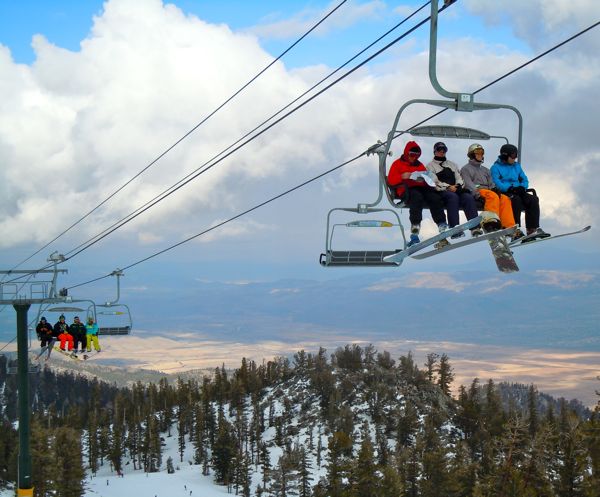
It’s Saturday afternoon and the slopes of Heavenly Mountain Resort are noticeably lacking people – at least for this time of day in mid-February.

For those who are taking advantage of the groomers, coverage and conditions are good considering this has been the winter that Mother Nature forgot. Obstacles for the most part are adequately marked.

Chairlifts are full, but lift lines minimal at Heavenly on Feb. 11. Photos/Kathryn Reed

With people in the Bay Area being scared off by the lack of snow and not understanding the concept of snowmaking and the mechanics of grooming, it means people can be distributed throughout the mountain even though less than half of Heavenly’s terrain is open.

But Monday all of this could change if forecasters are correct.

The National Weather Service in Reno is calling for light to moderate snow tonight and into Monday. A winter weather advisory has been issued from midnight through 4 pm Monday.

Four to 8 inches of snow could drop at lake level, with up to a foot above 7,000 feet.

It might mean tree skiing will open up. This weekend it has a bit of a different meaning by the looks of Dipper Bowl off the Comet chairlift. Tiny trees are visible on what is normally a fun run.

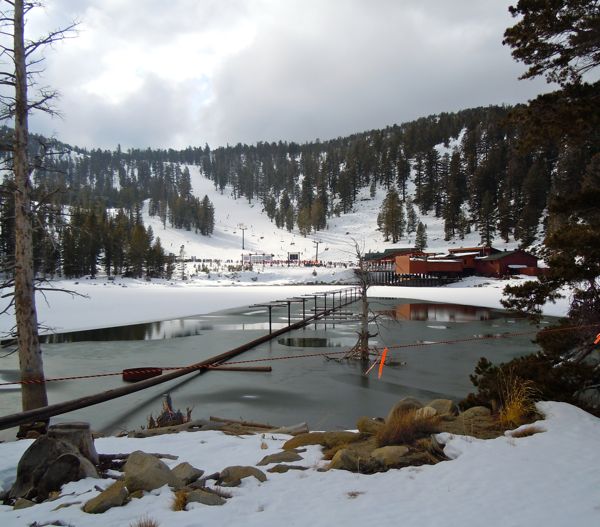
More snow would keep the reservoir by East Peak full.

The Monday morning commute over Sierra passes is expected to be unpleasant with slick conditions, blowing snow and chain requirements.

Forecasters say there is a chance the white stuff will stick around into Wednesday. Temperatures are expected to be in the mid-30s in the Lake Tahoe Basin for the first half of the week, with overnight lows dropping to the teens on Monday and Tuesday.


Nevada hires audit team to track cigarette taxes

By Sean Whaley, Nevada News Bureau

CARSON CITY — The Nevada Legislature’s Interim Finance Committee approved a request from the Department of Taxation for $260,000 to hire a team of auditors to track cigarette sales to protect a $40 million a year payment to Nevada from the nation’s major tobacco companies.

“The reason for the request is that Nevada is involved in a nationwide arbitration with a group of tobacco companies over the Master Settlement Agreement,” said William Chisel, director of the Tax Department. “The stakes of the arbitration are high. Nevada’s potential liability is up to $40 million for calendar year 2003. Nevada is also potentially liable for each subsequent year to the current totaling about $360 million.”

Chisel said it is important for the state to monitor the sales of cigarettes by the smaller tobacco companies that are not part of the MSA. The MSA has resulted in payments to Nevada and most other states since the agreement was finalized in 1998.

As part of the MSA, there is a requirement that these smaller companies set aside a portion of their tobacco sales in an escrow account in an amount proportionate to the payments made to the state by the major tobacco companies. The MSA provides for a reduction of the required annual payments by the major tobacco companies to any state which fails to adequately enforce these laws in a particular calendar year.

Chisel said the team will work to protect the payments that have already been made to the state.

The tobacco payments help fund the Gov. Kenny Guinn Millennium Scholarship for eligible Nevada high school graduates, among other programs.


Pop titan Whitney Houston found dead at age 48

Publisher’s note: While Whitney Houston was never on a stage in Northern Nevada, she did have a connection to Lake Tahoe. The 1992 film “The Bodyguard” was partly filmed at Fallen Leaf Lake.

In the film, Houston and co-star Kevin Costner were holed up at his father’s cabin at Fallen Leaf.

Leah Halsten, who was in “Carnival Cabaret” from 2002-08 at the Horizon casino in Stateline, impersonated Whitney Houston.

By Geoff Boucher, Los Angeles Times

Whitney Houston, a willowy church singer with a towering voice who became a titan of the pop charts in the 1980s and 1990s but then saw much of her success crumble away amid the fumes of addiction and reckless ego, has died. She was 48.

Kristen Foster, a publicist, announced Saturday that the singer had died, and police sources later confirmed that she was found unresponsive in her room at the Beverly Hilton Hotel about 3:30pm. Paramedics performed CPR on her, but she was pronounced dead about 4 p.m., Beverly Hills Police Lt. Mark Rosen told KTLA News. An investigation into the cause of death is pending.

Whitney Houston

On Thursday afternoon at the hotel, Houston drew the attention of reporters and security staff with her erratic behavior, dripping sweat and disheveled clothes. The singer was disruptive at that day’s rehearsals for music mogul Clive Davis’ annual Grammy industry party and showcase; that party at the Hilton on Saturday night was supposed to include a performance by Houston.

Late Saturday, Davis told those assembled at the party that he had a “heavy heart” and was “personally devastated” by Houston’s death, but “simply put, Whitney would have wanted the music to go on, and her family has asked for us to carry on.”

The star’s professional decline had become a familiar part of her public saga. Her haggard appearance at times shocked fans who had once been drawn to the singer’s world-class smile and approachable glamour in music videos, album covers, concerts and, later, hit films. Songs like “I Will Always Love You” and “Saving All My Love for You” had women around the world singing along with the star, but by the end of the 1990s they barely recognized her.

Read the whole story


Disabled ski champion Jill Kinmont Boothe dies at 75

By Bettina Boxall, Los Angeles Times

Jill Kinmont Boothe was the national women’s slalom champion and on the cover of Sports Illustrated when she set out to win a 1955 race that would help put her on the U.S. Olympic ski team. As she sped down a Utah mountain slope, she lost control on an icy bump, struck a spectator, crashed and tumbled into a tree.

When she finally came to a stop, she couldn’t feel anything. This must be death, she later recalled thinking. Her neck broken, she was paralyzed below her shoulders, her promising career as a skier over at 18.

But Kinmont Boothe became a role model of a different sort, the subject of a book and two Hollywood films, a teacher and a painter who refused to let her crippling injuries turn her into a different person.

She died Thursday at a hospital in Carson City, said Ruth Rhines of the local coroner’s office. Rhines could not confirm reports that Kinmont Boothe died of complications related to surgery. She was 75.

A Los Angeles native, she was born Feb. 16, 1936, and in her early teens moved with her family to the Owens Valley, where her father ran a dude ranch in Bishop in the shadow of the Eastern Sierra. She learned to ski at nearby Mammoth Mountain and in 1954 won both the national junior and senior slalom championships

Adding to her appeal, she was, in the words of 1950s press accounts, a “plucky, pretty” blue-eyed blond — the mid-century ideal of young womanhood.

“Everybody that I knew at that age thought Jill was about the cutest thing around; she really was a beautiful young lady and a phenomenal skier,” said Alan Engen, a former U.S. ski competitor and ski historian who met Kinmont Boothe as a young racer. “At the time that she had her accident, she was probably the premier up-and-comer women’s U.S. skier.”

Read the whole story