Hwy. 50 speed limit changes anger South Shore residents

By Kathryn Reed

“Fifty on 50” has long been the joke about the speed locals drive on the main thoroughfare through the South Shore. Only it’s not a joke anymore. And the actual speed limit from Meyers to Stateline is 55 mph where it’s one lane in each direction and 65 mph where it’s two lanes in each direction.

This is because Caltrans conducted traffic and engineering studies that found people are already safely driving faster than the posted limit. Until the new limit signs are in place, the current speed limit signs are not enforceable per state law. Instead, the law becomes what is normal for state highways based on the number of lanes – thus the 55 and 65 mile per hour limits.

When the signs go in – which is expected within two months – the speed limit on this nearly 10-mile stretch of highway will be 5 mph higher than what it is now posted. So, it will be 45 mph in Meyers, 55 from Country Club Drive to just past Lake Tahoe Airport where it will switch to 45 at Kyburz Road, then a quarter mile farther east it will switch to 40 mph and will remain that limit through South Lake Tahoe.
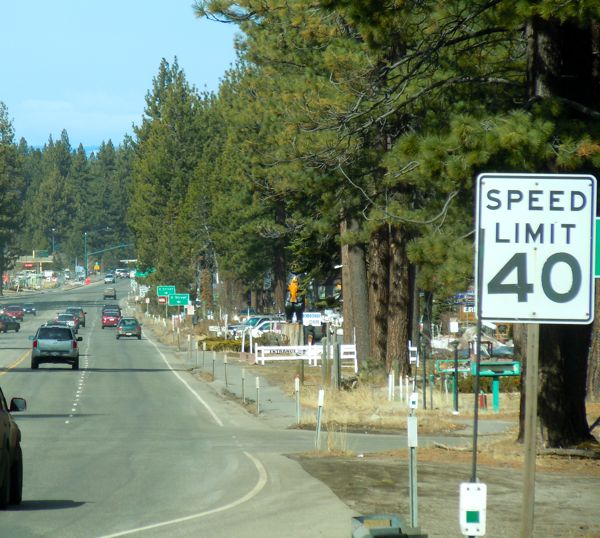
Speed limit signs don't mean a thing right now on the California side of the South Shore. Photo/LTN

Anyone who has gotten a ticket since December for speeding should be able to successfully win in court.

CHP officers have not been enforcing the posted limit signs since December when they were notified by Caltrans officials of the survey results.

“We haven’t noticed any changes yet,” California Highway Patrol Officer Jeff Gartner told Lake Tahoe News in regard to drivers altering their speed through the South Shore. This means they are going the posted limit.

State transportation officials were in town Feb. 21 for two meetings to discuss the issue with officials and residents. The first session was before the South Lake Tahoe City Council; the evening session was at Lake Valley fire station in Meyers.

Pat Kelley, an engineer with Caltrans, told those at both meetings, “There must be a legal reason not to raise the speed limit.”

But she could never cite a legal reason despite being asked to do so at both meetings. People at both meetings were clearly frustrated in wondering what the point of the gatherings were when Caltrans was going to raise the speed limit despite all of the objections from those in attendance.

People in Meyers questioned whether the Tahoe Regional Planning Agency could launch a legal fight by saying the increase in speed increases emissions and increases sediment reaching the lake.

Later in the meeting, TRPA spokeswoman Kristi Boosman said, “The major focus of the Regional Plan update is livable, walkable town centers. This flies in the face of that.”

She also mentioned air quality concerns.

Of the seven people who spoke at the council meeting, all were against raising the speed limit. Of the more than 50 people at the Meyers meeting, no one spoke in favor of upping the limit.

When El Dorado County Supervisor Norma Santiago said she thought the speed through Meyers should be reduced to 35 mph, it was met with applause.

What the council wants to do is change the state Vehicle Code that uses a one-size-fits-all approach to setting speed limits on California highways. Mayor Claire Fortier will write a letter to Caltrans as well as to state lawmakers to work on changing the law.

State law was changed in 2009 to parallel federal law that in the end stripped Caltrans of its ability to lower speed limits based on criteria that would consider specific needs of a community.

Today the law does not take into consideration that the state highway goes through a town, the number of stoplights, the number of driveways, that people are walking in the highway (especially in winter) because this area is so deficient on sidewalks, or the fluctuations in traffic based on Tahoe being a tourist community.

Santiago at the night meeting also expressed how the law doesn’t consider the character of a community, the fact that schoolchildren are crossing a state highway with no marked crosswalk, and that cyclists share the road in so many areas where no path is available – just the lane of traffic.

For locals, Highway 50 is more like a city street and not a state highway. After all, much of it is called Lake Tahoe Boulevard or Emerald Bay Road. But for Caltrans, it only sees the highway designation.

Kelley said the surveys were taken in dry conditions, in the middle of the week, and during the off-season (for the city).

The council wants Caltrans to count cars and their speed midweek during peak summer season.

As Councilman Hal Cole put it, he believes the statistics are skewed in favor of raising the speed limit, and that a compromise of the varying conditions needs to be considered.

Pete Fink, an avid cyclist, said, “We are trying to increase the recreation aspect of this town. Increasing the speed limit is diametrically opposite of that.”

Many said how the South Shore is trying to be more pedestrian and bicycle friendly, and that making it a more scary endeavor to walk or bike through town because of vehicles racing by even faster will thwart any progress that has been achieved and unhinge future improvements.

In the end, Kelley said she would take the council’s concerns back to her legal department to see if the current limits could remain. She also said Caltrans could conduct another survey one day this summer.

The Meyers area also wants another survey because people don’t believe the three April 2009 dates and July 2 that year reflect a true representation of traffic. They want more locals and fewer tourists to be counted. Caltrans did not agree to do this.

What Caltrans studies are prevailing speeds, accident data and conditions not readily apparent to a driver. The minimum number of vehicles counted is 100 at each location. These studies are supposed to be done every seven years. But it’s been 10 years since the South Shore was last studied. Why the delay? Kelley deferred the question to a spokeswoman for the agency who could not answer the question.

In South Tahoe, 13.3 million vehicles traveled through town in a three-year period. Four collisions involving eight vehicles occurred in that time, according to Caltrans.

In Meyers, 8.3 million vehicles went through the area in three years, with 37 accidents involving 74 vehicles. Twenty-seven of those accidents occurred between Friday and Sunday, according to Caltrans.

Highway officials say the accident rate on the South Shore is extremely low for the number of vehicles using the state highway.

Stats, according to Caltrans, show the accident rate does not rise as the speed limit increases.

Another trigger for Caltrans to reconsider speed limits is if changes have been made to the area that would affect how people drive. For South Lake Tahoe, the curb-gutter-sidewalk project that should be completed this summer should necessitate another traffic study in spring 2013.

For Meyers, nothing is on the books today that would necessitate another study.

While some time was spent on how best to cross the highway in Meyers, residents scoffed when told a striped crosswalk is more dangerous than not having one. Caltrans said it gives people a false sense of security. Residents are looking for security and believe no designated area to cross is more dangerous.

A roundabout was talked about, but the discussion was lost among the speed limit dialog.

For today, the speed limits from Meyers to Stateline on Highway 50 are either 55 or 65 mph.

Because of that, South Lake Tahoe Police Chief Brian Uhler wants the new limit signs – even though they increase the current posted limits – put up ASAP so the speed laws are more reasonable. He said those signs could always revert back to the lower speeds if Caltrans can be convinced raising the speed limit is not logical.



Barton to take pulse of community as a whole

Barton Health and other community organizations and businesses are joining forces to give South Lake Tahoe and its surrounding areas a “complete physical”.

The process, known as a Community Health Needs Assessment, consists of gathering information about the health status of residents on three levels: in-depth discussion groups; an area-wide telephone survey; and collection of state, county and national health data.

Lake Tahoe News in October 2011 first wrote about the assessment, which is now about to start. This month, the project will identify major health risks, disease incidence and service needs of residents of South Lake Tahoe and its surrounding communities.

Beginning in March, 400 20-minute phone interviews will take place with adults ages 18 and older in English and Spanish.

Barton will hold focus groups and work alongside community agencies to gather additional elemental data for the health assessment.

Full results from the CHNA will be available to the public by late summer. Barton will have the information posted online as well as have a town hall meeting to share the results and action plan.


Scarcity of snow puts winter businesses in Tahoe in a bind

By Bill O’Driscoll, Reno Gazette-Journal

Presidents Day weekend is when Paco Lindsay usually puts sale prices on ski gear in Paco’s Bike & Ski shop in Truckee.

Not this year. Sales at Paco’s began the day after Christmas — a first for Lindsay. Now eight weeks later, struggling like others in a winter devoid of snow by Sierra standards, he aims simply to survive what’s left of the ski season and look to next year.

Clouds on Presidents Day deliver zero moisture to Lake Tahoe. And temps are expected to be in the 50s all week. Photo/Kathryn Reed

“This is one of those winters you just want to get out of,” Lindsay said of a Tahoe Basin snowpack that last week was less than one-third of last winter’s epic depths as measured by the Natural Resources Conservation Service.

“It’s tough. On the ski side, we’re off by a good 35 percent,” he said. “This is the first time I’ve had to go to my vendors and restructure my payments. In talking to credit people, it’s a bad year everywhere. Everybody’s pulling the ripcord.”

With up to a foot of new snow earlier this week, Tahoe-area ski operators are hoping for something extra out of the Presidents Day holiday, the last three-day weekend of the season, to boost visitor numbers running as much as 40 percent below a year ago.

“It’s crucial. We’re tremendously down from last year,” said Janet Tuttle, co-owner of Donner Ski Ranch. “We opened Jan. 25, the latest opening since we’ve owned it in eight years. So this will be the first holiday we get this year.”

Other operators who opened earlier on machine-made snow say it’s difficult to overcome perceptions the dry winter has created in their key drive-up market, the San Francisco-Sacramento corridor.

Read the whole story


FBI not talking; SLT officer on leave without knowing why

By Kathryn Reed

It’s been more than three months since South Lake Tahoe police Officer Johnny Poland was stripped of his badge and gun. He still doesn’t know why.

“There has been no reportable movement,” Police Chief Brian Uhler told Lake Tahoe News.

That means whatever is going on with the federal investigation is not being made public because later in the conversation Uhler said, “We are kept apprised as there are developments.”

Johnny Poland

Gina Swankie with the FBI office in Sacramento said, “I have nothing to offer you.” It’s normal for the FBI not to comment on any investigation until it is complete.

Poland told Lake Tahoe News no one has asked him a single question regarding the investigation in the entire time he has been on paid administrative leave.

“Officially they haven’t told me I’m under federal investigation,” Poland said. “They never said I was under investigation. They said it was a pending IA (internal affairs) investigation. I haven’t gotten an IA.”

For now, taxpayers in the city of South Lake Tahoe are paying for Poland to stay home, raise his kids, take them to school – do all those things a stay at home dad doesn’t usually get paid to do. His benefits have been fully funded as well since he was put on leave in mid-November.

“He is under federal criminal investigation. It would be inappropriate for him to continue to serve in a day-to-day capacity,” City Manager Tony O’Rourke told Lake Tahoe News in November. “It doesn’t reflect any guilt. It reflects the process that needs to run its course so we can determine if there were any serious violations of the law.”

But it is still not public information what this peace officer is accused of.

The police department classifies this case as “conduct unbecoming”. This list gives a glimpse of the SLTPD investigations from 2009 until Poland was put on leave.

The city explains “internally” as any city employee may have complained about a police officer, not necessarily an officer against another police officer. “Externally” means any member of the public submitted a complaint about a police officer.

It’s also not known how much longer the investigation will go on.

The last time Poland had a run-in with superiors – not the feds – he was out of work for nearly three years. He had been fired in 2007, then won the wrongful termination case in 2009. The trouble began in November 2006 when Poland was accused of mishandling a lockdown situation at South Tahoe High School.

With Poland’s absence and the city’s desire to protect residents and visitors, it means the police department is spending beyond what is in the budget. Overtime is necessary at times to keep cops on the road.

Uhler said to keep paying Poland and have officers on the street, it might mean less is spent on equipment or other purchases.

If Poland is found guilty of whatever charges the investigation centers on, he would not have to pay back the money he collected in the time he is out. But by the same token, if no charges are brought against him or he is found not guilty, his reputation and the potential of him being trusted by the public and his colleagues has been diminished just by the secretive investigation — possibly to the point of him not being able to return to work or being able to find work with another law enforcement agency.

Quitting would benefit the city. It would mean having Poland off the payroll. But it would not make the investigation go away. To date, the city has not tried to negotiate with Poland to get him to move on – no matter what happens with the federal investigation.


Tahoe woman survives avalanche, 3 others die

By Mike Dunham, Anchorage Daily News

Elyse Saugstad of Squaw Valley was taking a break with several fellow skiers Sunday in the Washington state backcountry when the shouting began. “Elyse! Avalanche!”

The 33-year-old turned to see tons of snow boiling toward her.

“I pulled the trigger,” she said, inflating two air bags attached to her backpack. The device is meant to keep skiers and adventurers from disappearing beneath waves of snow in an avalanche.

It likely saved her life, said Saugstad, who was hurled half a mile down the slope.

“(It was) like being in a washing machine,” she said.

Saugstad came to a stop buried in densely packed snow. Only her face and hands were free.

“The snow was like cement,” said Saugstad, who worried a second avalanche might follow. Only later did she learn that the body of one her companions was buried a few away.

In all, the avalanche had swallowed three other skiers. Saugstad, a professional downhill skier who grew up in Girdwood, was the only one of the four wearing the air bag backpack — and the only one to emerge alive.

On Monday, the Dimond High graduate and prize-winning freestyle skier told the Daily News that she was in a group of eight experienced skiers who opted to descend through a backcountry section near the boundary of the Stevens Pass ski area northeast of Seattle. Another group of five followed them.

“We weren’t being idiots,” she said. “We understood the dangers and followed all the safety protocols. We went one at a time, moving section to section, ping-ponging our way down the hill.

“Several of us had stopped in a safety zone among some old growth trees,” she said.

Hundred-year-old trees are usually a good indicator that the area is avalanche-free.

“Unfortunately, the freak accident happened,” she said. “One of the skiers (above me) set off the avalanche.”

Saugstad managed to pull the lever to deploy the air bags as the snow hit. The ABS TwinBag backpack, made by a German company and available in Europe for the past 15 years, has two bags on either side connected to canisters of compressed nitrogen. In an emergency, the gas fills the pillow-shaped bags, which act somewhat like water wings.

“The idea is that it’s keeping you up on the top of the avalanche,” Saugstad said.

She didn’t feel the bags inflate as the avalanche caught her, she said. “I wasn’t even sure they were deployed.”

She estimated that it was a Class 3 avalanche, which the Avalanche Center website says can destroy a small building and snap trees. Saugstad called it “huge.”

She came to a stop an estimated 2,000 feet or more from where she was first caught in the slide. Her face and her hands, wrapped in pink mittens, poked above the packed snow. The air bags formed a “cocoon” around her head and neck. Her feet were about five feet below the surface and she was unable to move.

“It’s very frightening,” she said. “I was trying to remain calm, but after a while I thought: ‘Hmm. Maybe I should scream for help.'”

Ten minutes after being swept away in the snow, the first rescuer reached her. At that point Saugstad wasn’t worried, except for the fear that a secondary avalanche — or even a third — might follow.

As the rescue continued, she realized how close she was to death. Literally.

“One victim was buried three feet to my left,” she said. “Another was 30 feet above me.”

The Seattle Times identified the dead skiers as Stevens Pass marketing director Chris Rudolph, Jim Jack, head judge for the Freeskiing World Tour, and John Brenan, a Leavenworth contractor.


NHP officer hurt in traffic collision

A Nevada Highway Patrol officer was injured in a vehicle accident in Douglas County on Feb. 18.

Trooper Dan Lopez sustained minor injuries when the driver of another vehicle allegedly ran the red light at the intersection of highways 88 and 395 on Saturday at 5:19am.

An NHP trooper sustained minor injuries in the Feb. 18 accident. Photo/Provided

The right front of the errant driver’s vehicle struck the left front portion of the patrol vehicle. The crash was investigated by Douglas County Sheriff’s Department.

The driver of the vehicle, whose name has not been released, was arrested at the scene on charges of driving under the influence.

Lopez was treated and released from Carson Valley Medical Center.

 — Lake Tahoe News staff report


School reformer urges California to change teacher tenure rules

By Howard Blume, Los Angeles Times

Former District of Columbia schools Chancellor Michelle A. Rhee urged a Los Angeles audience of educators and parents to pressure state leaders to change teacher tenure and seniority rules.

Her appearance Wednesday night before an enthusiastic crowd of about 600 marked the third of four appearances statewide for Rhee, who is attempting to build a base of influence in California.

Rhee’s 1-year-old organization, StudentsFirst, has worked in other states with governors and powerful legislators but not in California, even though her organization is based in Sacramento.

In her remarks and a question-and-answer session, Rhee took on “last in, first out” rules that govern teacher layoffs. She characterized this approach as “incredibly detrimental to students and schools,” because gifted, less-experienced teachers are put out of work while less effective teachers with more seniority get to keep their jobs.

“California is one of the few states left that mandates in state law that layoffs happen this way,” Rhee said. “What we’re going to have to do is get politically active.”

She added a glancing reference to Gov. Jerry Brown and state Democratic leaders: “It’s clear we’re not going to get invited in,” she said. “Are you guys ready for this?”

Read the whole story


Nevada creates rules for self-driving vehicles

By Sean Whaley, Nevada News Bureau

CARSON CITY — Nevada took a bold step forward this week as lawmakers approved regulations allowing for the operation of self-driving vehicles on the state’s roadways.

The first in the nation regulations were approved by the Legislative Commission, and could provide for economic development opportunities in Nevada.

“Nevada is the first state to embrace what is surely the future of automobiles,” Department of Motor Vehicles Director Bruce Breslow said. “These regulations establish requirements companies must meet to test their vehicles on Nevada’s public roadways as well as requirements for residents to legally operate them in the future.”

In creating the regulations, the department partnered with Google, automobile manufacturers, testing professionals, insurance companies, universities and law enforcement all with a common vision of saving lives. Several other states currently have bills in front of their legislators that will follow Nevada into the future.

Google has developed a self-driving car and gave Gov. Brian Sandoval and other state officials rides in one of their vehicles in the capital in July 2011.

Nevada became the first state in the nation to legalize the use of driverless vehicles with legislation passed this past session.

“Our work doesn’t stop here,” Breslow said. “The department is currently developing licensing procedures for companies that want to test their self-driving vehicles in Nevada. Nevada is proud to be the first state to embrace this emergent technology and the department looks forward to sustaining partnerships as the technology evolves.”

Breslow said self-driving vehicles will be distinguished as “autonomous test vehicles” by the red license plate it will display. When the technology is ready for general public use, a green license plate will be displayed on vehicles registered with autonomous technology.

Sandoval went for a ride in Google’s modified Toyota Prius from the capital city halfway through the Washoe Valley before returning to the Department of Motor Vehicles office where the car and a duplicate were on display.

“It’s incredibly impressive,” Sandoval said after the trip. “It accounts for all the safety issues. You have the ability to know who is front of you. You have a 360-degree consideration of everything around you. It even tells you when a crosswalk is coming up.”


Nevada tourism officials trying to attract California, Arizona residents

By Richard N. Velotta, Las Vegas Sun

The state will spend $2.8 million, most of it for television ads in Los Angeles, San Francisco and Phoenix, to attract tourists to visit Nevada in the spring and summer months.

The Nevada Tourism Commission said Wednesday it would spend $1.7 million for a total 2,794 30-second spots to run on NBC, CBS, ABC and Fox networks in Los Angeles and San Francisco, on Comcast SportsNet in San Francisco and on CBS, ABC and Fox in Phoenix.

The campaign runs from April 16 through June 30.

Non-motorized sports are growing in popularity at Lake Tahoe. Photo/LTN file

The state plans to again run its “Clueless Tourist” spot, which depicts a kayaker in a wetsuit on the Las Vegas Strip before dissolving into a series of scenes from Nevada’s outdoors featuring hikers, mountain bikers, kayakers and skiers. The spots are meant to convey that, in addition to the Strip, the state is home to scores of outdoor recreation opportunities.

The spots broadly display the commission’s TravelNevada.com Internet site, encouraging viewers to obtain the state’s 120-page “Travel Nevada” travel and leisure guide.

The TV spots give the state additional bang for the buck, with tourism officials appearing on the “Better Arizona and Sonoran Living” television show in Phoenix and giving “Jeopardy” clues about Nevada attractions.

The commission also is spending $1 million for Internet display ads on Google and Yahoo!, video on Yahoo! and search-engine marketing on Google, Yahoo! and Bing. The ad buy also includes $60,000 for mobile media, $60,000 for social media and $6,000 for print ads in Nevada magazine.

Read the whole story


Online voter registration to begin in Nevada this spring

By Sean Whaley, Nevada News Bureau

CARSON CITY — For the first time, Washoe County voters will be able to register and make changes to their current voter registration online.

Beginning in mid-April, the Washoe County Registrar of Voters office, working in collaboration with the Nevada Secretary of State’s office, will make the switch to Nevada Online Voter Access; allowing citizens to go directly online and register to vote or update their current information.

During a presentation to the Washoe County Board of Commissioners on Tuesday, Registrar Dan Burk said the switch over to NOVA registration will not only be easier for citizens, but also cost effective, and will ensure the integrity and security of voter registration, requiring a match for the last four digits of the Social Security number as well as the Nevada DMV identification before the online process can be completed.

“Although voters will still have the same cut-off date to register, the good thing is now, instead of going to the DMV, Registrar’s office, or picking up paperwork and sending in back to us, citizens will soon be able to do this online,” Burk said. “It’s a huge leap forward.”

Voters using the online system will also be able to confirm that they are registered and be able to download their sample ballot by going online and selecting the “Am I Registered?” button on the webpage. The list of districts, as well as a map of each precinct is also available through the “Precincts and Districts” box.

The initial funding for NOVA registration in Washoe County was paid for by $86,000 in federal funding provided through the Help America Vote Act.

Washoe and Clark will be the first two counties in the state offering online voter registration, but the system will soon be expanded to all counties in Nevada. Currently, there are more than 215,200 registered voters in Washoe County’s 643 precincts. With a total population of approximately 420,000, Washoe County, with a 67 percent registration base is substantially higher than most jurisdictions in the United States.

“Online voter registration has the potential to have direct savings to the taxpayers,” Burk said. “In the future, it will allow us to hire fewer temporary workers to input all of the data, since people will be registering themselves online.”